






Most lead magnets don’t work. They get downloaded, skimmed for 30 seconds, and forgotten. Meanwhile, your email list fills up with people who will never buy anything. The problem isn’t…
Table of Contents
Over 62 million U.S. adults had a mental illness in 2024, according to SAMHSA. Nearly half received no treatment. The demand for therapy is massive, but most private practices still struggle to fill their caseloads.
Lead generation for therapists looks nothing like it does for other industries. The trust cycle is longer, HIPAA limits how you collect information, and your potential client is reaching out during one of the most vulnerable moments of their life.
This guide covers the specific channels, tools, and strategies that actually bring therapy clients through the door. From Google Business Profile optimization and directory listings to paid ads, email nurture sequences, and website conversion, you’ll walk away with a clear system for attracting and booking the right clients for your practice.
What Is Lead Generation for Therapists
Lead generation for therapists is the process of attracting potential therapy clients and converting their interest into booked consultations, intake calls, or first sessions. It covers everything from directory profiles to paid ads to the contact us page on your practice website.
This isn’t the same as lead generation for a SaaS company or an ecommerce brand. Therapy has a longer trust cycle, and the decision to reach out is deeply personal. Someone searching for a couples counselor at midnight is in a completely different headspace than someone shopping for project management software.
How It Differs from Other Industries
SAMHSA data from 2024 shows roughly 62 million U.S. adults had a mental illness, and nearly half didn’t receive treatment. The demand is there. The problem is connecting those people with the right provider.
Therapists also deal with constraints that most businesses don’t. HIPAA compliance limits how you collect and store client information. Insurance panel rules affect which clients you can even accept. Licensing restrictions determine where you can practice.
And then there’s the emotional barrier. A potential client isn’t filling out a form to get a quote on kitchen cabinets. They’re asking for help with something that feels vulnerable. That changes how every touchpoint needs to work, from the language on your website forms to the speed of your response time.
Active Leads vs. Passive Leads
Active leads are people searching with intent right now, typing things like “anxiety therapist near me” or “EMDR therapy in Austin.” These people want to book. They’re ready.
Passive leads found you through a blog post about burnout or a social media clip about relationship patterns. They’re interested but not committed. They might need weeks or months before they reach out.
Both types matter, but they require different strategies. Active leads convert through Google Business Profile listings, directory profiles, and paid search ads. Passive leads need nurturing through content, email sequences, and lead magnets like downloadable guides or self-assessments.
The Directory Default Problem
Most therapists still rely almost entirely on Psychology Today as their primary client acquisition channel. A listing costs $29.95 per month and the platform claims its directory appears as the top Google result for therapy seekers 96.2% of the time.
But that’s shifting fast. Therapist communities have reported 77% to 94% drops in Psychology Today inquiries since 2023, according to self-reported data tracked by Reframe Practice. Managed-care companies like Rula, Alma, and Headway now manage thousands of profiles on the platform, making it harder for independent practitioners to stand out.
If your Psychology Today profile is the only place you’re listed, that’s a problem. Not because the platform is useless, but because it’s one channel competing against many others now.
Why Traditional Referrals Are Not Enough Anymore
Word-of-mouth referrals used to be enough. A psychiatrist sends you three clients a month, a colleague refers overflow, a former client tells a friend. For years, this was the entire marketing strategy for most private practices.
That model is breaking down.
The Post-Pandemic Shift in Client Behavior
The number of licensed therapists in the U.S. grew significantly after 2020. HRSA’s 2025 Behavioral Health Workforce Brief notes that 6 in 10 psychologists are no longer accepting new patients, while the national average wait time for behavioral health services sits at 48 days.
More providers entered the field. But the way clients find those providers has changed just as dramatically.
Reframe Practice data shows therapy clients now search across five main channels: Google search (with roughly 550,000 monthly searches for “therapist near me” alone), AI tools like ChatGPT, insurance portals, directories, and word-of-mouth. The referral channel hasn’t disappeared. It just got a lot more competition.
Insurance Panel Saturation
Therapists who rely on in-network referrals face a different problem. Insurance panels are more crowded than ever, and platforms like Headway, Alma, and Grow Therapy have made credentialing faster and easier, which means more therapists competing for the same pool of insured clients.
Jaclyn Satchel, LCSW-S, predicted that client acquisition costs will keep rising for solo practices and smaller group practices that don’t accept insurance. Avivit Fisher, a therapist marketing consultant, went further, saying many private-pay practices that don’t invest in marketing will eventually go back to accepting insurance out of necessity.
Solo Practitioners vs. Group Practices
Solo practitioners hit a referral ceiling quickly. There’s only one network, one set of relationships, and one reputation to draw from. Group practices can distribute leads across clinicians and invest more heavily in mental health marketing. But even group practices are feeling the squeeze when they don’t diversify beyond referral-based growth.
Therapist Directory Platforms That Generate Leads
Directory platforms remain a real source of therapy client inquiries. But their effectiveness varies wildly depending on your location, specialty, and how crowded the platform is in your area.
The key thing to understand: directories are lead channels, not lead strategies. Listing yourself is step one. Making your profile actually convert is where most therapists fall short.
Psychology Today vs. GoodTherapy vs. TherapyDen
Data compiled from platform documentation and independent directory reviews. Pricing current as of early 2026.
Psychology Today is still the biggest. It has roughly 80,000 listings and remains a top Google result for most therapy-related searches. But the ROI has dropped for many independent practitioners, especially in saturated metro areas where managed-care companies now dominate the listings.
GoodTherapy operates in over 30 countries with subscription plans from $30.95 to $49.95 per month. It’s stricter about membership requirements, which can work in your favor if you want to be listed alongside vetted providers only.
TherapyDen is the budget-friendly option. Free basic profiles, with premium features from $10 to $30 monthly. The filtering system is detailed (clients can search by ethnicity, faith familiarity, ADA accessibility), which attracts a specific audience looking for those matches. Less traffic, but also less competition.
Open Path Collective caters specifically to clients seeking affordable therapy, connecting them with therapists who offer reduced-rate sessions. If your practice serves self-pay clients on a sliding scale, it’s worth listing there too.
How to Write a Directory Profile That Gets Clicks
An analysis of 500 therapist websites by BOSS Publishing found that 71% of therapists positioned themselves as generalists on their profiles, listing 8 to 12 different issues they treat. The practices with the fullest schedules did the opposite. They niched down hard.
Here’s what actually moves the needle on a directory profile:
- Photo quality matters more than you think. A grainy headshot from 2017 signals that the profile (and maybe the practice) hasn’t been updated
- The first two sentences of your bio do all the heavy lifting. Most people never scroll past them. Lead with your client’s pain point, not your credentials
- Specialization tags should be specific. “Anxiety” is too broad. “Performance anxiety in healthcare workers” is a lead magnet in text form
- Response time is a ranking factor. Psychology Today tracks how quickly you reply, and clients notice even more than the algorithm does
Your directory listing is really just a simplified landing page. Treat it like one.
Local Search and Google Business Profile for Therapists
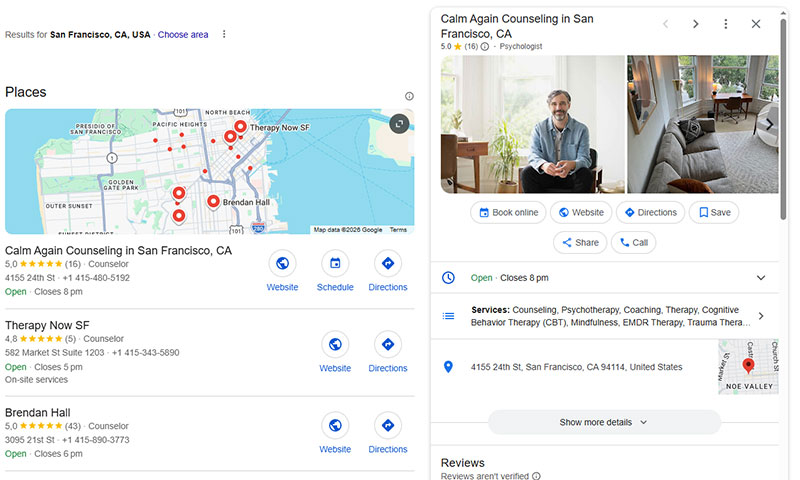
Google Business Profile (GBP) is the single most important free tool for therapist local search visibility. When someone types “therapist near me,” the local map pack (those three business listings above organic results) is what they see first.
BrightLocal data confirms that 99% of consumers use the internet to find local businesses. And over 60% of Google searches come from mobile devices. That “therapist near me” query at 11 PM on a Tuesday? Your GBP listing is either there, or it isn’t. There’s no partial credit.
Setting Up Your Google Business Profile
Category selection: Choose “Psychologist,” “Counselor,” “Marriage and Family Therapist,” or the most specific category that matches your license. Google uses this to decide which searches trigger your listing.
Service areas: If you offer telehealth across your state, list the cities or regions you serve. If you’re in-person only, keep it tight to your actual location radius.
Appointment links: Connect your scheduling tool (SimplePractice, Jane App, Calendly) directly to your GBP profile. Every extra click between finding you and booking you is a potential drop-off point.
Fill out every single field. Hours, services, insurance accepted, accessibility features, photos of your office. Incomplete profiles rank lower. It’s that straightforward.
Reviews Without Breaking Confidentiality
Here’s where therapy practices hit a wall that restaurants and dentists don’t. You can’t ask current clients for Google reviews the way a plumber can. The therapeutic relationship creates ethical complications around solicitation.
What you can do:
- Ask past clients (after termination) if they’d be willing to leave a review about their general experience
- Encourage reviews from workshop attendees, webinar participants, or people who used your free resources
- Respond to every review you receive, even the generic ones, because activity signals relevance to Google
Some therapists worry about reviews entirely. But having zero reviews in 2025 looks worse than having five solid ones. People trust what other people say, and form design on your website won’t matter if nobody trusts you enough to click through in the first place.
NAP Consistency Across Directories
NAP stands for Name, Address, Phone number. If your GBP says “Dr. Sarah Chen, 450 Oak Street, Suite 200” but your Psychology Today listing says “Sarah Chen, PhD, 450 Oak St, Ste 200,” Google sees inconsistency and may rank you lower.
This gets trickier with multiple office locations or shared office spaces. Audit your listings across every directory, your website, social profiles, and any insurance provider pages. Match them exactly.
Content That Attracts Therapy Clients
Not all content brings in leads. Took me a while to fully grasp this distinction, but here it is: traffic is not the same thing as client inquiries. You can rank a blog post for “what is cognitive behavioral therapy” and get 5,000 visits a month. Most of those people are students, curious readers, or other therapists. Almost none of them are booking a session.
The content that generates actual therapy leads targets specific symptoms, situations, and populations that match your clinical niche.
Blog Topics That Convert vs. Blog Topics That Just Get Traffic
Converts: “How to deal with burnout as a nurse in night shift” targets a specific person with a specific problem who might actually need a therapist.
Just traffic: “What is anxiety?” gets search volume but attracts people looking for a Wikipedia-style answer, not a therapy appointment.
The pattern is clear. Specificity converts. The more narrowly you write about a problem your ideal client actually faces, the more likely that person is to look at your about page and think “this therapist gets it.”
A BOSS Publishing study found that practices with the strongest revenue didn’t just specialize in treatment modality. They were specific about outcomes (“reduce panic attacks” vs. “manage anxiety”), client types (“executives in tech” vs. “working professionals”), and processes (“4-month intensive program” vs. “ongoing therapy”).
Using Video to Build Trust Before the First Session
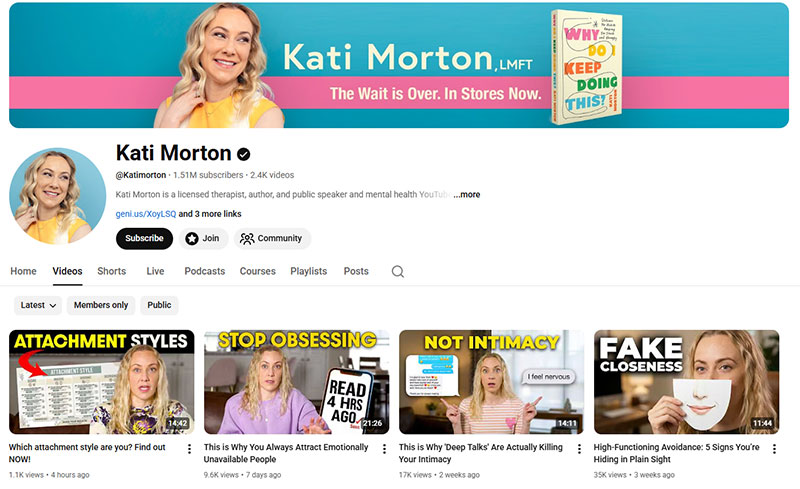
Video content on YouTube and TikTok does something that blog posts can’t. It lets potential clients hear your voice, see your face, and get a sense of your personality before they ever pick up the phone.
But here’s the honest part. Social media is great for brand awareness. It’s terrible for direct client acquisition. Therapy clients search with intent. They type queries into Google, not scroll Instagram hoping a therapist appears in their feed.
Your time is better spent on content that ranks in search engines. A 90-second YouTube video answering “what does EMDR therapy feel like” will generate more relevant views over 12 months than a dozen Instagram reels. And YouTube videos show up in Google search results, which means you’re building mental health SEO and trust simultaneously.
If you want to collect inquiries directly from your content, consider placing a lead generation form on the blog posts that get the most traffic from your ideal client demographic. A short form asking for name, email, and preferred service type is enough.
Paid Advertising Channels for Therapy Practices
Paid ads can fill a caseload faster than any other channel. They can also drain a monthly budget in three days if set up wrong. The tricky part with therapy advertising isn’t whether it works. It does. The tricky part is knowing which platform, which keywords, and what budget makes sense for your practice type.
Google Ads vs. Meta Ads for Therapists
Google Ads puts your practice at the top of search results when someone is actively looking for help. That’s the strength. You’re reaching people who already want a therapist and are choosing between options.
LocaliQ’s 2025 healthcare benchmarks report found that mental health had the highest average cost per lead of any healthcare subcategory at $141.17, a staggering 146% increase year over year. The average click-through rate for mental health search ads came in at just 4.46%, one of the lowest in healthcare.
Meta Ads (Facebook and Instagram) work differently. You’re interrupting someone’s scroll, so they need to already be problem-aware for the ad to land. Meta works best for:
- Group therapy programs and workshops with a specific start date
- Online therapy services targeting a broad geographic area
- Lead magnets like free anxiety self-assessments or relationship quizzes
Meta also introduced new advertising restrictions for health and wellness companies in January 2025, which limits targeting options for therapy practices specifically. Your mileage may vary, literally.
Budget Expectations and Cost Per Lead Benchmarks
Therapy practice ad campaigns from 2024 suggest a starting budget of roughly $600 per month ($20/day) for Google Ads, with a testing period of 2 to 3 months before you can really evaluate performance.
The average therapy client generates $3,000 to $8,000 in annual revenue, based on $150 to $200 per session seen weekly for 20 to 40 sessions. Even at $141 per lead, if your website converts inquiries at a reasonable rate, the math works out. But only if your site is actually set up to convert.
Paying for clicks to a one-page site with no clear call to action is burning money. Fix the website first, then turn on the ads. A well-structured contact form with proper validation can make the difference between a lead that books and a lead that bounces.
Google Local Services Ads
Google Local Services Ads (LSAs) show up above regular Google Ads. They display your name, photo, rating, and a “Google Screened” badge after you pass a background check and license verification.
LSAs use a pay-per-lead model instead of pay-per-click, which means you only pay when someone actually contacts you through the ad. For therapists who want to avoid the complexity of managing keyword bids, this is a simpler entry point into paid search.
The catch? LSAs are not available in every market yet, and the verification process takes time. But where they’re available, they tend to produce higher-quality leads because the Google Screened badge builds instant trust, something therapy clients value more than most other service buyers.
Website Conversion for Therapy Practices
Your therapy website might be getting visitors. The question is whether those visitors are becoming clients.
A BOSS Publishing analysis of 500 therapist websites found that roughly 80% were actively working against their owners’ business goals, often in ways the practice owners never realized. The most common issue? No clear path from landing on the site to actually reaching out.
The Pages That Actually Convert

The homepage and specialization pages do the heavy lifting. Not the blog. Not the “Our Team” group photo page.
Someone who lands on your “Anxiety Therapy” page from a Google search is a high-intent visitor. That page needs three things above the fold: what you treat, who you help, and how to book. Everything else is secondary.
That same BOSS Publishing study found practices with 8% website conversion rates (vs. the typical 2%) were specific about outcomes, client types, and treatment processes. The Unbounce benchmark for medical practitioners puts the median conversion rate at 3.6%, so there’s a lot of room to improve.
Scheduling Tools vs. Contact Forms

Online scheduling wins. Trafft, SimplePractice, Jane App, and Calendly let visitors book a consultation without waiting for a callback. That reduces friction, especially for someone reaching out at 11 PM when your office is closed.
But don’t ditch your intake form entirely. Some clients want to explain their situation before committing to a call. A short form asking for name, preferred contact method, and a brief description of what they’re looking for gives them that option.
The best setup? Both. A prominent “Book a Free Consultation” button and a simple website form for people who prefer writing over calling. Make sure both are optimized for mobile since 64% of therapy website visitors now come from phones, according to the BOSS Publishing data.
What Goes Above the Fold
- A headline that names the problem your ideal client is experiencing
- One sentence about your approach (not your credentials)
- A visible phone number with click-to-call for mobile
- A booking button or form link that doesn’t require scrolling
Toronto Psychotherapy Space keeps their homepage text static on the left while rotating photos on the right, showing client diversity without creating decision fatigue. Their free consultation offer sits at the very top, reducing the barrier for first-time visitors.
Email and Nurture Sequences for Therapists
Most therapists skip email entirely. And it costs them. Someone downloads your anxiety self-assessment, doesn’t book right away, and you never follow up. That’s revenue walking out the door.
Healthcare email campaigns carry an average open rate between 34% and 46% depending on the source (Mailchimp reports 34.6%, MailerLite reports 44.6%). That’s well above the all-industry average. People actually read healthcare emails when they’re relevant.
Lead Magnets That Work in Therapy
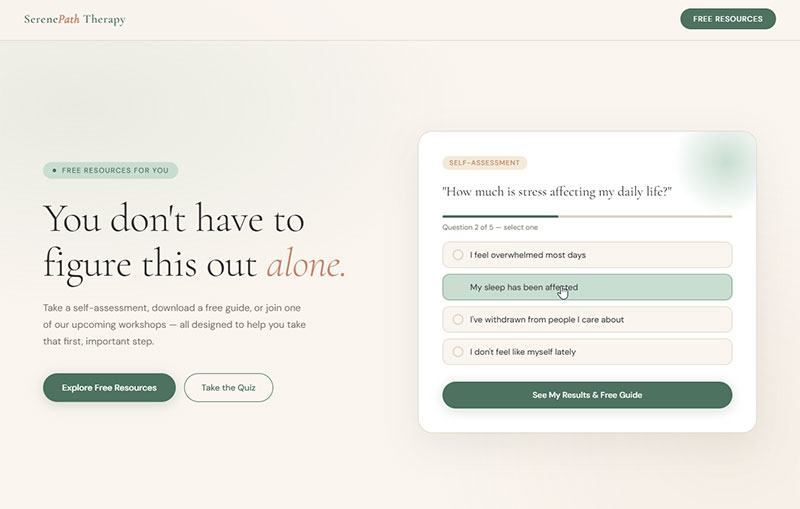
Self-assessments: A “Do I need couples therapy?” quiz or an anxiety symptom checklist. These give the potential client something useful immediately while capturing their email for follow-up.
Guides: A downloadable PDF like “5 Questions to Ask Before Choosing a Therapist” positions you as the expert and gives visitors a reason to share their contact information through a simple lead capture form.
Workshop invitations: Free or low-cost webinars on specific topics (managing holiday stress, parenting a teen with ADHD) attract people who are already problem-aware and considering professional help. You can collect registrations through a webinar registration form that feeds directly into your email list.
HIPAA Compliance and Email Platforms
Here’s the part most therapists get wrong. Standard Mailchimp doesn’t sign a Business Associate Agreement (BAA). Neither does HubSpot. Without a BAA, using an email platform to send anything that includes protected health information is a HIPAA violation.
The Office for Civil Rights has imposed penalties totaling over $144 million for HIPAA violations as of 2024, according to Evolve Healthcare Marketing. Fines range from $141 to $70,000 per violation depending on severity.
Alternatives that support BAAs include Hushmail, Paubox, and some configurations of Google Workspace. If you’re only collecting names and emails (no health details), you’re generally outside HIPAA’s strict zone. But the moment your forms collect health-related data, compliance matters.
A Simple 3-to-5 Email Nurture Sequence
Keep each email short. Three to five paragraphs at most. Healthcare email campaigns see an unsubscribe rate of just 0.07% according to Paubox, which means people stay subscribed when the content is relevant. Don’t ruin that by sending long newsletters nobody asked for.
Tracking and Measuring Therapy Leads
You can’t improve what you don’t measure. And most therapy practices don’t measure much.
Therapy Flow’s 2024 analysis of practice performance found that practices lacking tracking systems were consistently unsure which marketing efforts actually worked. They spent money on ads, directories, and content without knowing which channel produced a single booked session.
Call Tracking for Therapy Practices
CallRail and similar tools assign unique phone numbers to different lead sources. One number for your Psychology Today profile, another for Google Ads, another for your website.
When a prospective client calls, the system logs which source triggered the call. This is how you find out that your $30/month Psychology Today listing generates two calls a month while your Google Business Profile generates twelve.
For a field where many clients still prefer calling over filling out web forms, phone tracking is one of the highest-ROI investments you can make in measurement.
Google Analytics 4 Event Tracking
Key events to track:
- Contact form submissions
- Click-to-call button taps
- Scheduling widget completions
GA4 renamed “conversions” to “key events” in 2024. You can set these up through Enhanced Measurement or Google Tag Manager. Once configured, you can see which pages drive the most consultation requests and whether visitors from Psychology Today convert at a higher rate than organic search traffic.
The Low-Tech Method That Still Works
Ask every new client during intake: “How did you hear about us?”
Then actually log the answer. A simple spreadsheet with columns for date, client name, and referral source gives you more insight than most solo practitioners currently have. TherapyNotes, Jane App, and SimplePractice all support custom fields where you can tag this data directly in your practice management software.
The combination of call tracking, GA4 events, and intake question data gives you a complete picture of your therapy client funnel. From there, you double down on what’s working and cut what isn’t.
Lead Generation Mistakes Therapists Make
Some of these are going to sound obvious. But I’ve seen the same patterns show up over and over, and the therapists making these mistakes are usually smart, credentialed professionals who just never learned the business side.
The Psychology Today “Set and Forget”
Paying $29.95/month for a directory profile and never updating it is probably the most common mistake in therapist marketing. Your photo is from five years ago. Your bio lists every modality you’ve ever trained in. Your specialties section has 12 items checked.
Reframe Practice data shows many therapists reporting 77% to 94% declines in Psychology Today inquiries since 2023. An outdated, generic profile in an increasingly crowded directory is practically invisible.
Websites With No Clear Call to Action
BOSS Publishing’s study found that 43% of therapist websites had significant mobile usability issues and 31% had design elements that were objectively outdated. That’s before even looking at whether there’s a clear way to actually book a session.
If your call to action requires scrolling past four paragraphs of credentials, it’s not a call to action. It’s a treasure hunt.
Writing Content Nobody Searches For
A blog post titled “The Importance of Self-Care” might feel useful to write. But your ideal client (a burnt-out ER nurse in Denver) isn’t searching for that. They’re searching for “therapist for healthcare worker burnout Denver.”
Write for the person you want to treat. Not for a general audience that will never book.
Ignoring Google Business Profile
An unverified or empty GBP is like having a storefront with the lights off. Local searches for therapy consistently trigger the map pack, and if you’re not there, potential clients won’t find you no matter how good your website is.
Targeting “Everyone Who Needs Therapy”
Patricia Kozlowski Ptak, LPC, put it bluntly in Heard’s 2025 predictions report: many therapists don’t niche and don’t have specialized skills. That’s a marketing problem as much as a clinical one.
Trying to market to every person who might need therapy is the same as marketing to no one. The practices with the fullest caseloads picked a lane. Trauma therapy for veterans. CBT for teens with OCD. EMDR for first responders. Specificity wins.
How Group Practices Scale Lead Generation Differently
Everything changes when you go from solo practitioner to group practice. The lead generation math shifts. The systems need to handle more volume. And the mistakes get more expensive.
Centralized Intake Systems
Group practices that trained intake staff on clear metrics (response times, follow-up rates, call conversion) outperformed those that didn’t, according to Therapy Flow’s 2024 analysis. The intake process is often the first real touchpoint, and practices without regular training for this team struggled with missed calls and slow responses.
A centralized intake coordinator (or team) handles all incoming leads and distributes them across clinicians based on specialty, availability, and insurance. This prevents the common problem where a new lead calls, reaches the wrong therapist’s voicemail, and never calls back.
Individual Therapist Profile Pages
One generic “Our Team” page with headshots and two-line bios doesn’t convert. Each clinician needs a dedicated profile page with their photo, specialization, approach, and a direct booking link that goes to their specific calendar.
Toronto Psychotherapy Space routes their “Book Online” clicks directly to each therapist’s Jane App calendar. No dropdown menus. No extra steps. Every additional click is a chance for someone to bounce.
Marketing Multiple Specializations
A group practice offering couples therapy, trauma work, and adolescent counseling needs separate landing pages for each. The form fields on each page should match the service (asking about relationship length on the couples page, asking about the child’s age on the adolescent page). This improves both lead quality and conversion rates.
When to Hire a Marketing Coordinator
Most group practice owners start considering a dedicated marketing hire once they pass the $500,000 annual revenue mark or employ 5+ clinicians. Below that, outsourcing to a therapy-specific agency or consultant typically makes more financial sense.
The key metric: if your practice generates enough new client revenue to cover the cost of a marketing coordinator (usually $40,000 to $60,000 salary) and still turn a profit on the leads they produce, it’s time. Use your intake tracking data to model this before hiring.
Whatever you do, avoid hiring a generalist marketing agency that also serves restaurants, dentists, and law firms. Therapy marketing has specific language constraints, HIPAA requirements, and ethical considerations. A specialist who understands form accessibility and privacy compliance from day one will save you months of costly trial and error.
FAQ on Lead Generation For Therapists
What is lead generation for therapists?
It’s the process of attracting potential therapy clients and converting their interest into booked consultations or intake calls. This includes directory listings, Google Ads, content marketing, and website optimization tailored to mental health practices.
What is the best directory for therapist leads?
Psychology Today remains the largest therapist directory with roughly 80,000 listings. But its effectiveness has dropped in many metro areas. GoodTherapy and TherapyDen are solid alternatives, especially for niche specializations.
How much do Google Ads cost for therapists?
Expect to pay $5 to $30+ per click for therapy keywords. LocaliQ’s 2025 data shows mental health has the highest cost per lead in healthcare at $141.17. Start with a minimum budget of $600/month.
How do therapists get clients without social media?
Google Business Profile, directory optimization, local SEO, and paid search ads all work without social media. These channels reach people actively searching for a therapist, which converts better than passive social media scrolling.
What should a therapist website include to convert visitors?
A clear headline addressing the client’s problem, a visible booking button or contact form, click-to-call phone number, and specialization pages. Keep the most important elements above the fold on mobile.
Is email marketing effective for therapy practices?
Yes. Healthcare emails average a 34% to 46% open rate, well above most industries. A simple 3-to-5 email nurture sequence following a lead magnet download can turn passive interest into booked sessions.
What are the best lead magnets for therapists?
Self-assessments, symptom checklists, and short guides like “Questions to Ask Before Choosing a Therapist” perform well. They give visitors immediate value and a reason to share their email through a subscription form.
How do I track where my therapy clients come from?
Use call tracking tools like CallRail, set up Google Analytics 4 event tracking for form submissions, and ask every new client “how did you hear about us” during intake. Log all answers consistently.
Should therapists niche down for better lead generation?
Absolutely. Practices that specialize in specific populations or treatment areas (trauma therapy for veterans, CBT for teens with OCD) consistently fill caseloads faster than generalists listing 12 different specialties.
When should a group practice hire a marketing coordinator?
Most group practices consider this around $500,000 in annual revenue or when employing 5+ clinicians. Below that threshold, outsourcing to a therapy-specific marketing consultant usually makes more financial sense.
Conclusion
Lead generation for therapists isn’t a single tactic. It’s a system built from multiple channels working together, from your Google Business Profile and directory listings to paid search campaigns, email nurture sequences, and a website that actually converts visitors into booked sessions.
The therapists filling their caseloads right now aren’t doing one thing well. They’re tracking their lead sources with tools like CallRail and GA4, writing content for specific client populations, and treating their Psychology Today profile as one channel among many.
Start with what you can control today. Update your directory profiles. Add a clear booking path to your site. Set up basic tracking so you know what’s working.
The practices that grow from here are the ones that stop guessing and start measuring. Pick two or three strategies from this guide, commit to them for 90 days, and let the data tell you where to go next.