









A new client doesn’t sign with an accounting firm because a landing page convinced them. They sign because someone they trust vouched for the firm, or because the firm showed…
Table of contents
Most people who end up in a chiropractor’s chair aren’t there for wellness culture or a tune-up. They’re in pain and they want it to stop. A 2024 JAMA analysis of National Health Interview Survey data, run by the National Center for Complementary and Integrative Health, found that 85.7 percent of adults who saw a chiropractor in 2022 did so specifically for pain management.
Lead generation, in this context, is the machinery that turns those pain-motivated searches (and referrals from other providers) into an actual appointment on the calendar. Independent clinics and multi-location groups both run it alongside organic search, paid ads, and word of mouth, and they judge it less by traffic and more by cost per lead and how many first visits actually get scheduled.
What Is Lead Generation for Chiropractors?
Turning a pain-motivated searcher, or a call from a doctor’s office down the street, into someone sitting in a treatment room. That’s the job, stripped down to its basics.
It’s not brand awareness. It’s not a nice-looking website that nobody actually calls.
The underlying mechanics are the same ones you’d find in any industry: capture interest, get contact information out of it, follow up. A practice just layers a health filter on top of the usual process. Anyone unfamiliar with the base version of this can look at how lead generation actually works before applying it to a practice.
- Local search and Google Business Profile
- Paid ads on Google and Meta
- Referrals from patients and other providers
Chiropractic also sits inside the wider healthcare vertical, which means it inherits the same intake friction and trust barriers found across healthcare lead generation as a category.
A lead is contact information. A patient is a person actually sitting in the treatment room. Practices that blur those two together tend to celebrate numbers that don’t pay the rent.
How Does the Chiropractic Patient Conversion Funnel Work?
A stranger doesn’t become a patient in one jump. There’s a sequence to it, and most practices bleed people out at the same two points along the way.
- Impression: a map pack listing, an ad, or a friend’s mention
- Contact: a phone call, a booked slot, or a submitted form
- Booked visit: the appointment actually lands on the calendar
- Show: the patient walks through the door
Contact is where most website traffic quietly disappears. A visitor who never fills out a form or picks up the phone never really entered the funnel in the first place, whatever the analytics dashboard says about pageviews.
Practices that build a proper lead capture form on their own site close part of that gap before the front desk ever gets involved.
Anyone unfamiliar with the general mechanics of a lead generation funnel can review the concept on its own before mapping it onto a chiropractic schedule.
And a missed call at the front desk kills a paid lead just as fast as a broken contact form does. Doesn’t matter how good the ad was.
What Determines Local Search Visibility for a Chiropractic Practice?
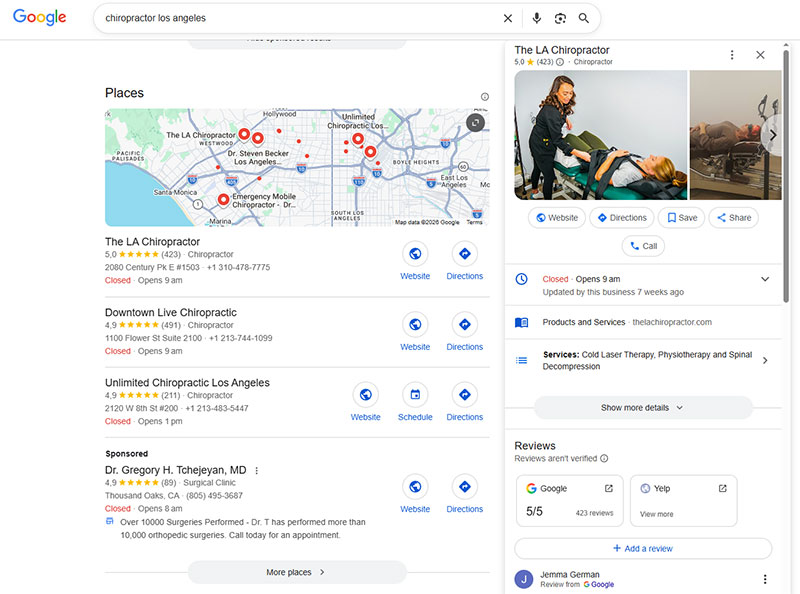
Google is mostly weighing how complete a profile looks and how consistently it shows up across every other directory online. Proximity to the person searching matters too, though that’s the one variable a practice has zero control over.
- Google Business Profile: category, hours, photos, and services filled in completely
- NAP consistency: the same name, address, and phone number across every directory
- Review volume and recency: a steady flow of new reviews, not a pile from three years ago
None of this is unique to a chiropractic office, by the way. It follows the same pattern seen across lead generation for local businesses generally, just with a health category layered on top.
How Patient Reviews Affect Visibility and Trust
BrightLocal’s 2025 Local Consumer Review Survey found 83% of consumers read reviews on Google specifically, ahead of Yelp, Facebook, and every other platform tested. That’s a wide enough gap that chasing Yelp reviews first, while neglecting Google, is probably backwards for most practices.
A profile with a healthy review count tends to outrank a technically cleaner listing when the search itself is trust sensitive, and chiropractic care definitely qualifies.
Healthgrades and Yelp still feed into that trust picture even when a patient ultimately books straight from Google. People check around before they call.
The rules around what a practice can say in a testimonial tightened in August 2024, when the FTC finalized a rule banning fake and incentivized reviews outright.
A glowing but engineered review carries real regulatory risk now, not just a credibility problem.
Which Lead Generation Channels Work Best for Chiropractors?
No single channel wins for every practice. The right mix depends on how new the practice is and how much competition sits in the same zip code.
| Channel | Average cost per lead | Time to first result | Best fit |
|---|---|---|---|
| Google Business Profile / local search | Low, mostly time investment | Weeks to months | Established practices |
| Google Local Services Ads | Pay per booked lead | Days | New practices needing volume fast |
| Meta Ads Manager (Facebook/Instagram) | Moderate, audience dependent | Days to weeks | Offer-driven campaigns |
| Patient referral programs | Lowest, incentive cost only | Months | Practices with an existing base |
Durable growth usually blends two or three of these rather than betting the whole budget on one channel. That combination is the backbone of most effective lead generation strategies outside chiropractic too, just scaled down to a local market.
The Joint Chiropractic runs this exact blend at scale, pairing centralized paid search management with location-specific landing pages for each clinic.
The category is also getting more crowded to compete in. The U.S. Bureau of Labor Statistics counted 57,200 chiropractor jobs in 2024 and projects 10% employment growth through 2034, well above the average for all occupations.
Practices running their own site typically lean on WordPress lead generation plugins to build the landing pages and forms that catch traffic before it leaves the site.
What Does Chiropractic Lead Generation Cost, and What Does a New Patient Return?
Cost per lead only matters next to what a patient is worth once they actually show up. Spending $150 to acquire a patient who visits twice is a loss. Spending $150 to acquire one who stays a year is not.
- Average cost per lead, all industries: $66.69 across Google and Microsoft Ads (WordStream by LocaliQ, 2026 benchmark report)
- Average cost per lead, Health & Fitness: $86.49 (WordStream, 2024 benchmark data)
- Average visit frequency: 2.3 visits per month for patients with chronic low back or neck pain (BMC Musculoskeletal Disorders, 2020)
Health-related categories tend to run above the all-industry average, largely because the decision to book carries more hesitation than a retail purchase does.
Comparing a practice’s own numbers against broader conversion rate benchmarks by industry shows whether a low show rate is a funnel problem or just a normal pattern for healthcare.
None of this means much without tracking which channel actually produced the patient, not just the click.
Tools like CallRail attribute phone calls back to a specific campaign, and a short list of lead generation KPIs to track keeps the cost-per-lead number honest month over month.
Should Chiropractors Use a Marketing Agency or Handle Lead Generation In-House?
Neither option is universally right. It really comes down to time, budget, and how much the owner wants to sit down and learn ad platforms.
Going the Agency Route
Someone else handles ad management, tracking setup, and reporting daily, which is worth a lot if none of that interests you. There’s also access to tools like HubSpot or a proper CRM without building it from scratch.
The catch is a monthly retainer that applies whether lead volume was strong that month or not, plus less control over messaging tone and how fast new offers get tested.
Keeping It In-House
Full control over budget, offer, and how the front desk follows up. No markup sitting on top of ad spend either, which adds up over a year.
- Someone on staff has to actually learn Google Ads and Meta Ads Manager
- A broken campaign takes longer to fix without daily attention
A hybrid model shows up often in practice: an agency runs the paid channels while the front desk owns referrals, reviews, and the actual patient conversation.
What New Patient Offer Converts Best for Chiropractic Leads?
The offer decides whether a curious click turns into a booked visit. A vague “call for pricing” converts worse than a specific, low-risk first step.
| Offer type | Patient draw | Compliance note |
|---|---|---|
| Free consultation | Lowest barrier to book | Widely accepted, low regulatory risk |
| Paid spinal screening | Filters for serious inquiries | Price must be stated clearly upfront |
| Decompression trial session | Strong draw for chronic pain searches | Discount structure has to follow state fee rules |
Functionally, this behaves like a lead magnet in any other industry: a low-commitment first step that earns the right to a second conversation.
ChiroHealthUSA built its entire compliance network around this exact problem, giving cash-paying patients a structured price break that still holds up under state fee-splitting rules.
Practices testing new offers can pull format inspiration from broader lead magnet ideas before narrowing back down to something a chiropractor can actually deliver in one visit.
How Do Referral Programs Generate Chiropractic Leads?
A referral program turns existing patients and nearby providers into a standing lead source that never touches an ad account. It runs on trust that was already earned, which is why it tends to convert better than a cold click ever will.
- Patient referrals: a structured incentive for current patients who bring in a friend or family member
- Provider referrals: relationships with primary care doctors, physical therapists, and orthopedists
- Community touchpoints: screenings, workshops, and local sponsorships that put the practice in front of new faces
Provider referrals work best when the practice makes it easy for another office to send someone over.
Foot Levelers built its entire distribution model around this exact relationship, supplying chiropractors with doctor-locator tools and referral materials that other providers can hand to patients directly.
None of this replaces paid or organic channels. It just costs less per patient once it is actually running.
Which Tools Track and Convert Chiropractic Leads?
Healthcare has the highest missed call rate of any small business category, at 32%, and up to 85% of those callers never call back (CallRail, January 2025). That’s a brutal number for something so fixable.
A chiropractic practice can spend real money attracting a lead and still lose it at the front desk if nothing is tracking where it came from, or catching it when the phone rings unanswered.
- Call tracking: platforms like CallRail assign a unique number per campaign so a phone lead traces back to the ad or listing that produced it
- CRM tagging: tools like HubSpot record source, funnel stage, and follow-up status for every contact
- Online scheduling: booking software through platforms like Trafft or Amelia cuts the back-and-forth that kills a lead’s momentum
- Automated reminders: SMS and email nudges through tools like Weave reduce no-shows after the appointment is already booked
None of this needs to be expensive or complicated. A practice can track form submissions inside Google Analytics for free before ever paying for a dedicated platform.
Spam submissions are the other half of the tracking problem, since a form full of bot entries makes every conversion number look worse than it actually is. A few basic steps to stop spam on a WordPress contact form keep that data clean from the start.
What Compliance Rules Apply to Chiropractic Lead Generation?
Marketing a healthcare practice comes with rules that a retail business never has to think about.
Patient privacy causes the most damage when it’s ignored, and state advertising rules aren’t far behind it. Review honesty rounds things out, and it was covered above already, but it belongs on this list too.
| Rule | What it covers | Practical requirement |
|---|---|---|
| HIPAA Privacy Rule | Patient testimonials, success stories, photos | Written authorization before posting anything identifiable |
| State chiropractic board rules | Advertising claims, fee-splitting, referral incentives | Varies by state, usually filed through the board |
| National Provider Identifier | Directory listings and insurance billing | Required for Healthgrades, Zocdoc, and payer directories |
The Cadia Healthcare Facilities case shows what happens when the first row of that table gets ignored. HHS’s Office for Civil Rights settled with the Delaware provider for $182,000 in September 2025 after it posted patient success stories, including names and photos, for 150 patients without written authorization.
Combined with the review-authenticity rules covered earlier, a chiropractic practice is really answering to two separate regulators at once, not one.
How Do You Build a Chiropractic Lead Generation System?

None of this is new at this point. It’s the pieces already covered above, just arranged in an order that actually works and checked at each step along the way.
- Lock down the Google Business Profile first, since every other channel eventually points traffic back to it.
- Build one landing page built around a single offer, rather than sending every ad to the general homepage.
- Turn on call tracking and CRM tagging before the first ad goes live, not after.
- Launch one paid channel at a time, Google Local Services Ads or Meta Ads Manager, and give it three to four weeks before judging it.
- Add the referral ask and review request to the patient’s actual visit, not a follow-up email nobody opens.
Following that order matters more than it sounds like it should. Medical practitioner landing pages convert at a median of just 2.4%, though the top 25% of pages in that category reach 20.4% (Unbounce, 2024 Conversion Benchmark Report).
That gap is almost never a traffic problem. A short list of ways to increase form conversions closes more of it than adding another ad channel does.
When Does Chiropractic Lead Generation Fail to Work?
Lead generation for chiropractors fails for a handful of predictable reasons, and almost none of them are the channel itself.
- No one answers the phone: a paid lead that hits voicemail behaves the same as a lead that was never generated
- The offer is vague: “call for pricing” gives a pain-motivated searcher nothing to act on right now
- The practice sits in a low-search area: a rural location with almost no local search volume won’t get bailed out by a better website
- Volume with no tracking: leads pile up with no record of source, so nobody can tell which channel to cut or scale
Form abandonment is a quieter version of the same failure. A visitor who starts filling out a form and quits counts as a cost with zero return, and nobody notices unless someone’s actually watching for it.
A handful of concrete tips for improving form abandonment rate usually fix more of this than a redesign does.
When lead volume looks fine but the schedule stays empty, the failure sits between the contact and the booked visit, not in the marketing itself.
FAQ on Lead Generation For Chiropractors
What Is the Difference Between a Lead and a Booked New Patient?
A lead is just a name, phone number, or form submission, someone raising a hand. Getting an actual appointment on the calendar and having that person show up is a different thing entirely, and that gap is where a lot of tracked “success” quietly falls apart.
Many practices track cost per lead closely but ignore the gap between lead volume and real patient acquisition.
What Does Not Count as Chiropractic Lead Generation?
A Facebook post with no offer or call to action doesn’t qualify, no matter how much brand awareness it builds. Neither does a website visit that never converts to a phone call or form.
True lead generation always ends in a name, number, or email captured, not just an impression.
What Mistakes Commonly Reduce Chiropractic Lead Generation Results?
Loose geo-targeting shows up constantly, pulling in clicks from searchers who live too far away to ever book. Slow follow-up on web form submissions loses leads just as fast as an unanswered call.
Treating every inquiry the same, regardless of urgency, wastes budget that could go toward the leads actually ready to book.
How Long Does It Take to See Results From Chiropractic Lead Generation?
Paid channels like Google Local Services Ads can produce a first call within days. Local search improvements through Google Business Profile typically take weeks to months to climb.
Referral programs build slowest of all, often taking a full patient cycle before referrals start arriving.
Can a Solo Chiropractic Practice Compete With Multi-Location Chiropractic Franchises on Lead Generation?
Yes, on a local level. A solo practice can’t outspend a franchise’s ad budget, but it can out-rank it in the map pack through faster review replies and a more complete profile.
Local trust beats brand scale on searches this specific.
What Should You Fix First in Lead Generation for Chiropractors?
Lead generation for chiropractors gets fixed first at the contact point, not the channel, since a missed call or a slow form reply erases the value of every dollar spent upstream on ads or local search visibility.
A couple of fixes carry more weight than any new campaign, and this is where the effort should go first:
- Same-day answer rate on every phone lead
- A complete, current Google Business Profile
- One dedicated landing page per paid channel
Prioritizing the contact point first means new ad testing waits a cycle, trading faster channel data for a higher share of already-paid leads that actually convert.
Once contact handling is fixed, the next decision is which fields actually belong on that form, covered in a closer look at the best form fields for capturing high-quality leads.