








A new client doesn’t sign with an accounting firm because a landing page convinced them. They sign because someone they trust vouched for the firm, or because the firm showed…
Table of contents
Most independent coaches never sit through a single sales training. They figure out client acquisition the hard way, usually right after a slow month makes it obvious that referrals and word of mouth won’t fill a calendar forever.
The formal name for that work is lead generation, the process of finding, attracting, and qualifying people before they ever land on a call with you. For a coach running their own show, nobody else owns this job. You’re the one checking discovery calls booked and cost per lead, not sitting in a marketing meeting staring at a traffic dashboard that means nothing for your calendar.
A life coach filling a $150-a-month program doesn’t fill their calendar the same way an executive coach selling five-figure engagements does. Different channels, different timelines, and sometimes a completely different idea of what even counts as a “lead.”
The International Coaching Federation’s 2025 Global Coaching Study found that 78% of coaches worldwide work as independent professionals rather than employees. That’s a lot of people responsible for their own pipeline, with no marketing department three floors down to hand it off to.
What Is Lead Generation for Coaches?
It works the same way general lead generation does, just bent around a relationship-based sale instead of a one-time purchase, since nobody buys six months of coaching the way they’d buy a pair of shoes.
Plenty of coaches blur this with marketing in general. Building an audience and filling a discovery call calendar are related goals, but the line between the two gets clearer once money starts going into ads, and the split between lead generation and demand generation is worth knowing before that happens.
Nearly every coaching funnel runs on cold leads and warm leads. Cold leads come in through paid ads or outbound outreach, from people who’ve never heard of the coach before. Warm leads arrive through referrals, content, or an existing network, already carrying some trust before the first message even goes out.
The 2025 ICF Global Coaching Study counted 122,974 professional coach practitioners worldwide, a 15% jump since 2023 (International Coaching Federation, 2025).
More coaches chasing the same pool of clients is exactly why a repeatable system for filling the calendar stopped being optional a while back.
The process spans life coaching, business coaching, executive coaching, and health coaching alike. The channels shift by niche, but the underlying funnel stage logic does not.
How Does a Coaching Lead Generation Funnel Work?
A stranger moves through stages here, from noticing something exists to eventually paying for it. Awareness comes first, when a cold or warm audience sees a piece of content, an ad, or a referral mention. Nurture comes next, where the lead gets value through email, DMs, or retargeting until enough trust builds that booking a call feels low-risk instead of pushy. Booking is one specific action, scheduling that discovery call, and then close: the call either turns into a paying client, or it doesn’t.
The full mechanics behind that sequence are covered in a dedicated look at what a lead generation funnel actually does, and coaching adds one quirk worth flagging on top of it.
A $200 mini-program and a $10,000 high-ticket package do not move through that funnel at the same speed.
Awareness to Booking
Most leads stall here, not at the close.
What closes that gap is usually content that shows real expertise without giving away the whole method, paired with one clear next step instead of five competing calls to action fighting for the same click. Retargeting picks up the stragglers, the visitors who almost booked and then got pulled away by something else in their browser.
Booking to Close
Once someone lands on the calendar, the funnel’s job is mostly finished. The discovery call takes it from there.
Show rate matters here, the share of booked calls that actually happen, and a nurture sequence that cuts off too early tends to tank that number. Close rate is a separate thing entirely: the share of calls that convert into paying clients, and that depends more on qualification than on anything the funnel itself controls.
Marie Forleo’s B-School funnel is a well-known version of this: free training content feeds an email sequence, which feeds a single, time-boxed enrollment window.
What Are the Best Lead Magnets for Coaches?
The best lead magnet for a coach is the one that filters for buyers, not just curiosity.
A lead magnet is a free resource offered in exchange for contact details, and coaching has its own quirks about which formats actually turn into paying clients.
| Magnet Type | Pro | Con |
|---|---|---|
| Quiz | Qualifies while it collects | Takes longer to build, needs a quiz tool |
| Checklist | Fast to produce, low commitment | Attracts curiosity over buyers |
| Free discovery call | Fastest path to a real conversation | Fills the calendar with unqualified calls |
| Mini-training | Builds trust before the ask | Bigger production lift |
Which format wins depends more on niche and price point than on any universal rule, a nuance covered in more depth in lead magnets built specifically for coaches.
Health and life coaches tend to do well with quizzes, probably because people like to self-diagnose before they buy anything in that space. Business and executive coaches usually respond better to a short, sharp mini-training, something that proves depth of expertise instead of being fun to click through.
How Do You Qualify Coaching Leads Before a Discovery Call?
Qualification happens before the call, not during it.
Skip this step and a coach ends up running free consulting sessions for people who were never going to buy anything.
Most coaching funnels lean on some mix of an application form that asks about budget, timeline, and current situation before anyone gets a slot on the calendar, a quiz with a score threshold so only leads above a certain number ever see the booking page, or just an open calendar with a screening question attached, which filters less but brings in more raw volume.
The form itself carries more weight than most coaches give it credit for.
Fields asking about budget and timeline up front do the filtering job the earlier magnet couldn’t, and there’s a real gap between which form fields for capturing higher-quality leads actually work versus fields that just add friction for no reason.
A single long form and a broken-up sequence produce different completion rates too, which comes down to multi-step versus single-step form design.
Removing qualification entirely doesn’t save time. It just moves the wasted time from the form to the call.
Which Traffic Channel Works Best for Coaches?
The right channel depends on the niche, the price point, and how much cash a coach has before the first client actually closes. No single platform wins across the board.
| Channel | Cost | Best For | Time To First Lead |
|---|---|---|---|
| Low organic, high paid | Business and executive coaching | Weeks | |
| Instagram / TikTok | Low organic | Life and health coaching | Weeks to months |
| Facebook Ads | Moderate | Proven, mid-ticket offers | Days |
| Google Ads | High | High-intent, search-driven niches | Days |
| Referrals | Very low | Coaches with an existing client base | Ongoing |
Whichever channel sends the visitor, the site still needs somewhere to catch them. That’s really the whole point behind using website forms for lead generation in the first place.
Lewis Howes built a large chunk of his coaching audience through a podcast and LinkedIn content long before he ran a single paid ad.
Coaches who try to run all five channels at once usually run none of them well, an idea broken down further in general lead generation strategy comparisons.
Pick one organic channel and one paid channel. Prove both work, then add a third.
Organic vs Paid Lead Generation for Coaches
Organic and paid lead generation solve different problems, and most coaches end up needing both eventually. The real question is which one comes first.
Organic work, content, LinkedIn posts, referrals, whatever counts as search visibility for a solo coaching business, compounds. A blog post or a LinkedIn thread from eight months ago can still be bringing in a booked call today, without anyone touching it again. It costs time instead of cash, which is exactly why it appeals to a coach who doesn’t have an ad budget yet. The catch is patience. A first lead from organic work can take months to show up, and there’s no guarantee it arrives at any predictable rate.
Paid changes the math entirely. Turn on a Facebook or Google campaign and leads start landing within days, sometimes within hours of the ad going live. But stop paying and the pipeline stops too, nothing carries over, nothing compounds. Running paid ads before an offer has proven itself organically is close to the riskiest thing a coach can do with a marketing budget, because now you’re paying to find out if people want something instead of paying to scale something they already know works.
Owned channels tend to punch above their weight on return. Litmus’ 2024 State of Email report puts average email marketing ROI at $36 for every $1 spent, well above what most paid channels return.
None of that is an argument against paid ads. It’s an argument for sequencing them right, proving an offer works for free before paying to push more people toward it.
The split lines up closely with the classic difference between inbound and outbound lead generation, where organic pulls people in and paid or cold outreach pushes out to find them.
How Much Does Lead Generation Cost for Coaches?
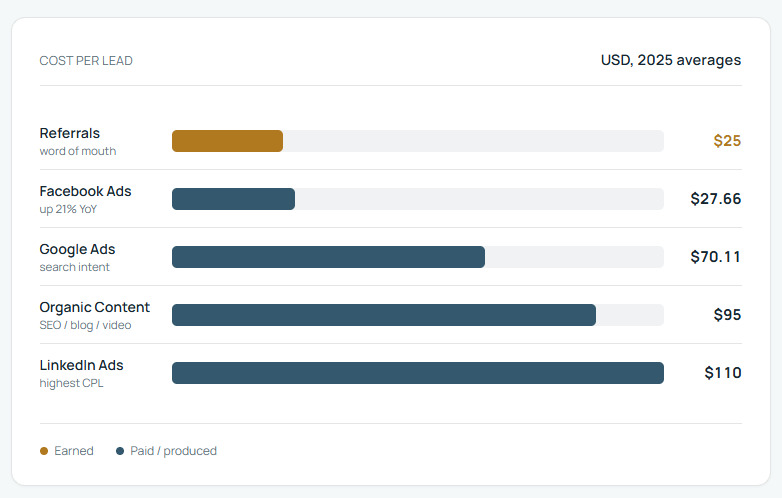
Cost per lead swings hard depending on the channel, and coaches usually underestimate the paid side of that swing.
Facebook Ads averaged $27.66 per lead in 2025, up 21% year over year (WordStream, 2025). Google Ads ran more than double that, averaging $70.11 per lead in the same year (WordStream, 2025). Referrals, unsurprisingly, cost the least of the three, landing under $25 per lead on average (Sopro, 2025).
Cost per lead is not the same number as cost per booked call, and it’s definitely not the same as cost per client. A $30 lead that never books a call is more expensive, in practical terms, than a $70 lead who shows up ready to buy.
Tracking that gap matters more than obsessing over the sticker price of any single channel, which is exactly where a short list of lead generation KPIs worth tracking earns its keep.
A coach with no ad budget can still get leads. Just slower, through referrals and content instead of Facebook or Google.
What Tools Do Coaches Need for Lead Generation?
A coaching funnel usually runs on a handful of separate tools, not one all-in-one miracle app that does everything.
Each tool maps to a specific funnel stage, and mixing them up wastes both money and setup time.
| Tool | Function | Funnel Stage |
|---|---|---|
| Calendly / Zoom | Discovery call booking and delivery | Booking |
| ActiveCampaign / ConvertKit | Email nurture automation | Nurture |
| Kajabi / ClickFunnels | Full funnel build in one platform | Awareness through close |
| HubSpot / Pipedrive / Close CRM | Lead and pipeline tracking | Tracking across every stage |
Coaches running WordPress sites usually stop at the booking and nurture layer, since the site itself just needs to capture the lead first.
The form on that site does more work than people give it credit for, and the right pick among WordPress lead generation plugins depends on whether the funnel needs simple contact capture or a full application flow.
Application-style intake, the kind that branches based on a prospect’s answers, needs a step up from a basic contact form.
That’s where a form builder with conditional logic earns its cost, since it can hide or show fields based on budget range or coaching niche before the lead ever hits a CRM.
How to Build a Coaching Lead Nurture Sequence
A nurture sequence starts at the moment of opt-in, not at the first email sent a day later.
Delivery has to be instant, and everything after that runs on a fixed cadence rather than guesswork.
- Day 0: deliver the lead magnet immediately, before any selling happens
- Day 1-2: send a welcome message that builds credibility, not a pitch
- Day 3-5: one or two value emails plus a supporting DM touch, addressing the exact problem the magnet promised to solve
- Day 6-7: a soft ask to book, tied to one specific, named outcome
- Day 8+: a resend to non-openers with a different subject line, not the same email twice
Klaviyo’s 2025 benchmark analysis of automated flows found they average a 48.57% open rate, well above what one-off broadcast campaigns pull in.
Timing beats volume here. A five-email sequence sent on the right cadence outperforms fifteen emails dumped on a list with no structure behind them.
Russell Brunson’s “Soap Opera Sequence” framework popularized this exact shape: a short story arc across the first few emails, building toward a specific offer rather than opening with one.
Leads who opened the magnet page but never finished the form need a separate track entirely, a gap covered under improving form abandonment rate rather than the main nurture sequence.
Coaches who want a starting structure instead of building one from scratch can adapt existing lead nurturing templates to their own niche and cadence.
How Personal Brand and Authority Positioning Generate Coaching Leads
Trust signals convert leads without a funnel doing any of the work.
A coach with strong positioning gets booked calls from people who already believe the outcome is real before the first email ever goes out.
Testimonials and named case studies do a lot of the qualification work a funnel would otherwise have to do later. Referral programs live or die on how happy existing clients already are, nothing fancier than that. Certifications and credentials matter more in cold outreach than they ever do in a warm, already-vouched-for conversation. And speaking gigs or podcast guesting move slower than almost anything else here, but the leads that come out the other end tend to be unusually warm.
This tracks with something Nielsen found years ago that still holds up: 84% of consumers trust word-of-mouth recommendations from friends and family above every other form of advertising (Nielsen, 2013).
That gap between paid trust and earned trust is exactly why a referral costs less and closes faster than almost any paid lead.
Credentials still carry weight on the cold side of the funnel. The 2025 ICF Global Coaching Study found 73% of coaches say clients expect them to hold a coaching certification or credential (International Coaching Federation, 2025).
Chris Do built The Futur’s audience almost entirely on free educational content before ever selling a coaching or mentorship product, letting authority do the qualifying work upfront.
Tracking where a referral actually came from matters as much as generating it, which is the whole reason a how did you hear about us field belongs on every intake form, not just the paid ones.
What Mistakes Cause Coaching Lead Generation to Fail
Most failures trace back to a handful of specific, fixable mistakes, and they tend to show up in the same order every time.
| Mistake | Consequence |
|---|---|
| No qualification step before booking | Discovery calls fill up with people who were never going to buy |
| Pitching too early in the sequence | Trust breaks before it forms, unsubscribes climb |
| Running paid ads before organic proof | Budget burns on an offer that hasn’t shown it converts yet |
| Tracking nothing | No channel can be judged, cut, or scaled with any confidence |
The tracking mistake is the quiet one. A coach who never checks numbers against conversion rate benchmarks has no way to know if a 2% booking rate is normal or a warning sign.
Fixing the first three mistakes without fixing the fourth just means repeating them with better intentions next quarter.
When Lead Generation Does Not Work for Coaches
Lead generation cannot fix an offer that hasn’t been proven yet.
No funnel, magnet, or ad budget compensates for a program nobody has actually paid for at the current price point.
Sometimes there’s no proven offer or price point yet, and without that there’s nothing consistent for a funnel to actually convert people into. Sometimes the audience is just too small, a few hundred followers isn’t enough to reliably produce weekly discovery calls no matter how good the content is. A niche with zero real differentiation is its own problem too, since competing purely on price against a field of similar coaches rarely ends well. And a budget that sits below the minimum viable spend for whatever paid channel got picked just burns cash before it ever reaches anything close to statistical significance.
The 2025 ICF Global Coaching Study found 59% of coaches expect revenue growth next year, driven mainly by more clients and more sessions rather than higher fees (International Coaching Federation, 2025).
That expectation only holds if new clients are actually arriving. Without a working lead generation system behind it, it’s just a hope, not a plan.
A coach still building their first offer, still testing pricing, or still under a few hundred people in their total audience is better off spending that time on the offer itself. The lead generation system comes after, not before.
FAQ on Lead Generation For Coaches
What Is the Difference Between Lead Generation and Marketing for a Coach?
Marketing builds awareness across a whole market. Lead generation does a narrower job, capturing contact details from people already showing interest, through a lead magnet, an opt-in page, or a discovery call request, and turning that awareness into a trackable pipeline.
Should a Coach Hire a Lead Generation Agency or Handle It Themselves?
Agencies help once an offer and price point are proven, mainly to scale paid ads. Coaches without a tested offer get more value from handling outreach and content themselves first, since paying to scale a system that doesn’t exist yet wastes budget.
Does Lead Generation Work Differently for Life Coaches Versus Business or Health Coaches?
Niche changes the channel and the price point a lot more than it changes the underlying mechanics. Life and health coaches tend to do better on Instagram and TikTok, usually at lower price points. Business and executive coaches are a different animal, leaning on LinkedIn and referral networks to sell higher-ticket engagements.
How Long Does It Take to See Results From Coaching Lead Generation?
Referral and content-driven leads often take 8 to 12 weeks to produce a steady flow of booked calls. Paid channels move faster, sometimes days, but only once the offer, landing page, and follow-up sequence have already been tested.
Can a Coach Generate Leads With No Budget?
Zero-budget lead generation leans on referrals, LinkedIn outreach, and content published consistently on one platform. It moves slower than paid ads, but referral swaps with other coaches and manual follow-up can still fill a calendar without spending a dollar on advertising.
What Should You Fix First in Lead Generation for Coaches?
Qualification. That’s the first fix, since every channel and every dollar spent upstream of it just feeds a leak that hasn’t been closed yet, regardless of budget or platform.
Google Ads at $70.11 a lead and referrals under $25 lead to the same conclusion once qualification is weak: both leads go to waste on the same unqualified call, so the pricier channel simply loses more money per mistake.
Once that leak is closed, the order to build in looks something like this:
- Tighten the qualification form first
- Match channel spend to proven close rate, not raw lead volume
- Extend the nurture cadence only after both of those hold steady
Once qualification is solid, the next document to work from is one on designing a lead capture form that filters for budget and timeline before a single call gets scheduled.