






A new client doesn’t sign with an accounting firm because a landing page convinced them. They sign because someone they trust vouched for the firm, or because the firm showed…
Table of contents
A patient searching for a doctor and a hospital marketing team chasing referrals are doing the same job at different scales: turning an inquiry into a scheduled appointment. The catch is that neither one gets to treat that inquiry like a normal marketing lead. Every form field touches something HIPAA or the TCPA cares about, which most industries never have to think about.
Solo practices track this differently than hospital systems do, and telehealth platforms run their own version again. Patient acquisition cost gets watched closely. So does conversion rate. How many inquiries actually survive intake matters too, maybe more than the other two combined.
Healthcare organizations reported 663 large breaches to the HHS Office for Civil Rights in 2024, exposing protected health information belonging to 242,908,056 individuals (HHS OCR, 2025). That number is a big part of why a basic contact form on a clinic’s homepage gets built with more caution than the same form would get anywhere else.
What Is Lead Generation for Healthcare?
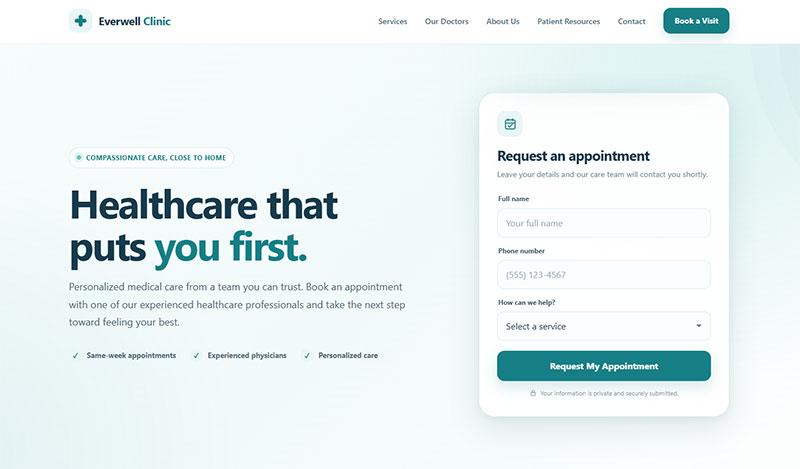
Turning an inquiry into a booked visit looks like every other funnel until you look at what’s actually sitting inside that inquiry. The logic underneath is the same everywhere: get attention, get contact details, get that contact to convert. Healthcare just changes what happens in the middle.
The moment a name gets attached to a symptom, an insurance plan, or a diagnosis, that data becomes protected health information. Doesn’t matter if it happened on a slick landing page or a rushed phone call at the front desk. That single fact reshapes how forms, call scripts, and follow-up emails get written in this industry.
Marketers in the field mostly say patient acquisition instead of lead generation, honestly. It’s the broader term, and it covers a Google search for a symptom just as easily as a referral passed hand to hand between providers.
Who actually runs it depends on the size of the operation. Solo practices handle it themselves. Hospital systems have dedicated marketing teams built for exactly this. Telehealth platforms tend to hand pieces of it off to agencies that specialize in the space.
What comes out the other end isn’t only an appointment, either.
- A scheduled visit
- A referral into a specialist network
- A provider-to-provider partnership
- A returning patient relationship
Zocdoc built a whole company around this, turning real-time appointment booking into the actual product instead of treating it as a side feature.
Whatever the industry, converting an anonymous visitor into a named, contactable prospect is the whole point of generating a lead in the first place. Healthcare just adds a compliance layer that decides which tools and channels are even allowed near that person’s information once it’s collected.
Why Does Healthcare Lead Generation Follow Different Compliance Rules?
Fill out a contact form on a clinic’s website with a name and a symptom, and what just got typed counts as protected health information the second it’s submitted. That single fact pulls in federal privacy law, telemarketing law, and breach notification law, all at once, for what looks like an ordinary marketing form anywhere else.
A handful of statutes carry most of the weight here.
- HIPAA: governs how patient data gets stored, shared, and secured
- TCPA: governs calls and texts sent to a lead’s phone number
- HITECH Act: extends HIPAA’s enforcement reach to vendors and business associates, marketing platforms included
HIPAA and Patient Data in Lead Forms
A compliant lead form has to protect anything tying a name to a health condition or an insurance number. Same goes for a treatment request, even a vague one.
That includes the plain contact form on a clinic’s homepage, not just the intake paperwork handed out at check-in.
Tier 4 violations, the category reserved for willful neglect that goes uncorrected, can run up to $2,190,294 per year for repeat violations of the same provision (HHS Office for Civil Rights, 2025).
HHS OCR imposed a $240,000 civil monetary penalty on Providence Medical Institute in October 2024 following a ransomware investigation, a case that started with a data security gap rather than a marketing form.
The lesson carries over anyway. A form, a chatbot, a call script, whatever collects patient data sits inside the same regulatory net.
TCPA and Outreach Rules for Calls and Texts
Statutory damages under TCPA run $500 to $1,500 per violation, with no cap on how many violations a single bad campaign can rack up.
Once a lead submits a phone number, every call or text that follows is covered.
Consent has to be documented before outreach starts, not assumed because someone filled out a form once.
A clinic running automated text reminders to a purchased list, rather than to leads who opted in directly, is exactly the scenario TCPA was built to punish.
CMS adds another layer for telehealth specifically, since its reimbursement rules affect which outreach channels make financial sense for a practice to run at all.
What Makes a Healthcare Lead Qualified?
A qualified healthcare lead has to match the practice’s insurance network. It also needs to describe a condition the provider actually treats. And realistically, it has to come from someone who lives close enough to show up in person, since most care still happens that way, telehealth aside.
Unqualified leads look identical on a spreadsheet until someone tries to schedule them.
The filters below are what most practices end up checking, whether they’d call it that or not.
| Qualification Filter | What It Checks | Why It Matters |
|---|---|---|
| Insurance match | Plan type against provider network | Unmatched leads rarely convert to paid visits |
| Condition specificity | Symptom or diagnosis detail | General inquiries convert far below specific ones |
| Geographic radius | Distance from the practice location | Most patients won’t travel past a set radius |
| Intake completion | How much of the form gets finished | Partial intake predicts no-shows |
The fields on that first form (insurance carrier, plan type, chief complaint, how long the condition has gone on) are what actually separate a real patient from noise.
A dental practice chasing every visitor who mentions a toothache burns through budget fast if half of them live outside the service area or carry no accepted insurance at all.
Marketing qualified lead and sales qualified lead are borrowed terms from B2B, but they map onto healthcare well enough. A marketing qualified lead has shown interest. A sales qualified lead has passed the insurance and condition filters and is sitting there waiting for intake staff to take over.
How Does the Healthcare Lead Generation Funnel Work?
Five stages make up the healthcare funnel: awareness, inquiry, intake, scheduling, retention. Intake is the hinge. It’s where a raw inquiry either turns into a confirmed visit or stalls out for good.
- Awareness: a symptom search, an ad, or a referral introduces the practice
- Inquiry: the person submits a form, calls, or books online
- Intake: insurance gets verified and forms get completed
- Scheduling: a specific appointment slot gets confirmed
- Retention: the patient returns for follow-up care or referrals
That’s the same shape as any general lead generation funnel, moving someone from stranger to customer in stages, just with insurance verification wedged into the middle of it.
Scheduling is where most healthcare funnels leak hardest.
A patient who finished intake but can’t find an open slot in the next two weeks often books somewhere else instead.
athenahealth’s patient portal handles this by pushing insurance verification and intake forms into the pre-appointment step, so scheduling isn’t blocked by paperwork that could have happened earlier.
Retention gets ignored more than it should.
A patient conversion rate that stops counting at the first visit misses most of the value, since a retained patient sends referrals a one-time visitor never will.
Which Channels Generate the Most Healthcare Leads?
Paid search, organic search, physician referral networks, and telehealth partnerships each produce healthcare leads at a different cost and speed. Most practices need more than one running at once to actually fill a schedule.
Some people call this healthcare PPC and healthcare SEO instead of paid and organic. Same channels, different label.
Picking the right combination isn’t unique to healthcare, the same channel-mix thinking behind any strategy for finding new customers applies here too.
Paid Channels
Paid channels buy visibility instead of earning it over time.
- Google Ads for symptom and service keywords
- Meta Ads for awareness and retargeting
- LinkedIn Ads for provider-to-provider outreach
- Google Business Profile for local visibility
They’re fast to launch and just as fast to turn off, which makes them a reasonable first move for a new service line with no organic footprint yet.
The tradeoff shows up in cost per lead. Paid channels almost always cost more per healthcare lead than organic or referral traffic does, even when they convert faster.
Organic and Referral Channels
Organic and referral channels take longer to build and cost less once they’re running.
Healthgrades turned patient searches for a physician’s name into a referral lead source, building a directory business on top of behavior patients were already doing anyway.
A Press Ganey survey found that 65.4% of consumers use search engines like Google to find a new doctor, and 51.1% go online first before picking a primary care physician at all.
Physician referral networks still carry real weight. A recommendation from a current doctor remains one of the strongest signals a prospective patient responds to.
Telehealth adds a channel that barely existed a decade ago.
95% of HRSA-funded health centers used telehealth to deliver primary care in 2024, according to the Health Resources and Services Administration, which says more about how normal the channel has become than any ad campaign could.
Which Content Formats Convert Healthcare Leads Best?
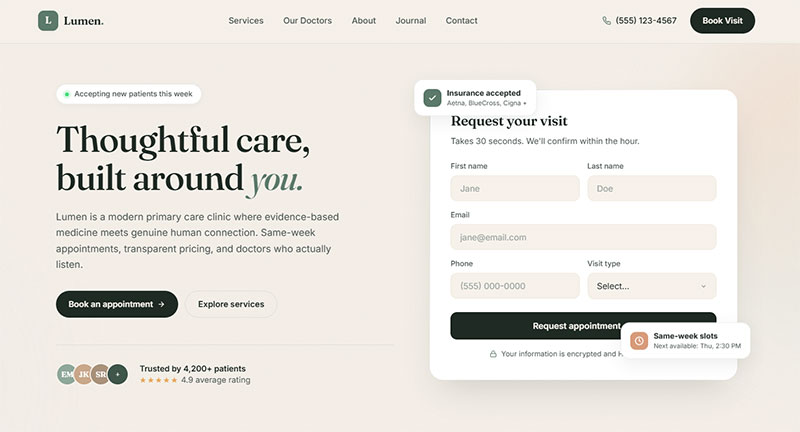
Symptom checkers, gated guides, service-specific landing pages, live chat, testimonials, and appointment reminder emails convert healthcare leads at different points in the decision. Mixing formats usually beats relying on just one.
Here’s roughly what each one is doing, though the lines blur once they’re actually running on a live site.
- Symptom checkers capture high-intent visitors already worried about something specific
- Gated guides capture research-stage visitors who aren’t ready to book yet
- Landing pages capture visitors who already know what service they want
- Live chat catches visitors before they bounce off a page entirely
- Testimonials and reviews reduce hesitation right before submission
- Appointment reminder emails convert an already-booked lead into a kept visit
Mayo Clinic’s symptom checker tool is a familiar example of turning a self-diagnosis habit patients already had into a structured intake point.
A downloadable guide that only unlocks after a name and email is the same mechanic marketers everywhere use to trade information for contact details.
Whether it’s a symptom checker or a service-specific landing page, the form sitting behind it needs to be built the same way any high-converting capture form gets built.
Testimonials do quieter work than people give them credit for.
A rater8 report found that 84% of patients read online reviews before choosing a provider, and nearly half say they’re more likely to pick a doctor who responds to feedback publicly.
Which CRM and Tracking Tools Manage Healthcare Leads?
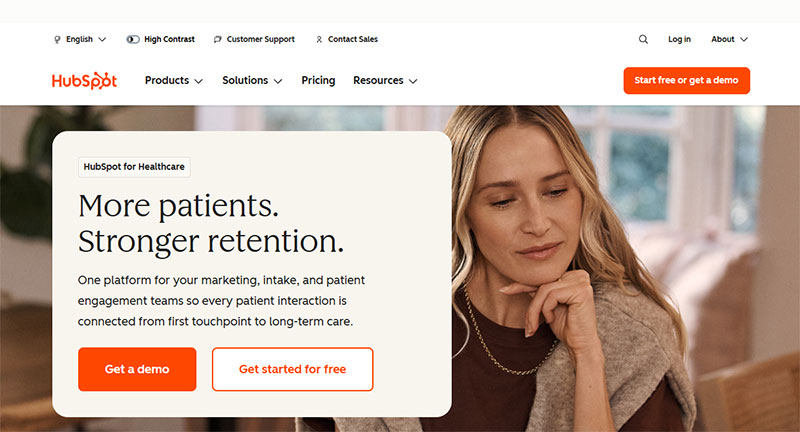
A healthcare CRM logs every inquiry that comes in and routes it to whichever staff member should actually see it. The tracking half does something different: it attaches a source to each lead, so a practice can eventually tell which channel paid for itself and which one just burned budget.
Some are general CRMs adapted for healthcare. Others are built for it from the ground up.
| Platform | Primary Use | Compliance Handling | Typical Practice Size |
|---|---|---|---|
| HubSpot | Marketing automation, lead routing | Configurable, simpler setup | Small to mid-size practices |
| Salesforce Health Cloud | Patient relationship management | Built-in, healthcare-specific | Health systems, hospitals |
| athenahealth | Practice management, patient portal | Native EHR integration | Independent and group practices |
| CallRail | Healthcare call tracking, attribution | Add-on call recording controls | Any size running phone-based leads |
Salesforce marketing materials cite a 125% return on investment for Health Cloud users, pointing to reduced administrative costs and improved patient outcomes, and attributing the figure to a Forrester Total Economic Impact study. Chasing that citation down, though, it doesn’t actually trace back to any Forrester-published Health Cloud report. Treat it as a vendor talking point, not something worth citing as a benchmark.
Worth flagging more generally that any ROI study commissioned by the vendor being studied isn’t the same thing as an independent benchmark.
Smaller practices tend to start with something lighter, HubSpot’s free tier or a scheduling tool like Klara, before graduating into a full patient relationship management platform once lead volume justifies it.
Whatever platform gets picked, the tracking half matters as much as the CRM half.
A lead that isn’t tagged with its source is a lead nobody can optimize toward, which turns healthcare lead scoring into guesswork instead of a repeatable process.
How Much Does Healthcare Lead Generation Cost?
Cost here depends on specialty and channel, mostly, but also on how tightly a practice qualifies its leads before it counts them as real ones instead of just line items on an invoice.
A few numbers are worth holding onto.
- Average cost per lead for the Physicians & Surgeons category on Google Ads sits at $59.74, converting at 11.08% (WordStream, 2024)
- The cross-industry average cost per lead in the same report is $66.69, meaning healthcare search campaigns typically undercut the general benchmark
- Healthcare marketing budgets fell from 9.6% of revenue in 2023 to 7.2% in 2024 (Gartner CMO Spend Survey, 2024)
Cost per lead isn’t the same thing as cost per patient.
A lead that fails the insurance or geography filter still shows up on the ad platform’s invoice, even though it never becomes revenue.
Knowing whether a number is good or bad means checking it against a wider set of conversion rate benchmarks by industry, not just against last month’s spend.
Shrinking marketing budgets make this math less forgiving.
When a health system’s marketing spend drops as a share of revenue, the same cost per lead eats a bigger piece of whatever is left to spend.
In-House Team or Agency: Which Handles Healthcare Lead Generation Better?
Neither option wins outright, honestly. It comes down to lead volume and budget, mostly, and whatever channel expertise the practice already has sitting on staff.
In-house teams usually win on the stuff that’s hard to fake.
- Understands the brand, the physicians, and local market politics better than any outsider
- Keeps patient data inside fewer hands, which simplifies HIPAA oversight
- Struggles to scale quickly when lead volume spikes
- Rarely has deep expertise across every channel at once
Agencies flip most of that around. They show up already knowing paid media, organic, and CRM setup, so there’s no slow hiring process to get through first, and they can scale a campaign up or down as fast as the budget allows. What they add instead is a vendor relationship that now has to be managed under HITECH Act rules, plus a monthly cost that’s higher than a single in-house hire, though usually still cheaper than building out a whole internal team.
Cleveland Clinic runs its content marketing entirely in-house, producing its own health content through an internal team rather than outsourcing it to an agency.
Most organizations land somewhere in between. An internal lead who owns strategy and compliance, paired with an agency or freelance specialists for paid media and design.
How Does Lead Generation Differ Across Healthcare Verticals?
A dental practice, a telehealth platform, and a hospital referral department are chasing leads under the same laws but completely different economics.
Specialty alone swings cost per patient by more than 2x.
| Specialty | Organic Cost Per Patient | Paid Cost Per Patient |
|---|---|---|
| Dermatology | $147 | $239 |
| Dentistry | $216 | $350 |
| General Practice | $294 | $477 |
| Psychiatry | $392 | $636 |
Figures come from Focus Digital’s 2024 clinic-type benchmark, calculated as marketing spend divided by new patients acquired.
Patient-Facing Verticals
Dental, med spa, urgent care, and senior care all sell directly to the person receiving treatment.
Urgency and price sensitivity separate them more than anything else.
- Urgent care leads convert fast, often same-day, and tolerate higher paid spend
- Med spa leads shop around on price before committing
- Senior and home health leads involve a family member in the decision, stretching the timeline
A dental practice generating leads usually competes on convenience and insurance acceptance rather than urgency, since most dental needs aren’t emergencies.
Teladoc Health built its national patient acquisition model on direct-to-consumer advertising, a structure that works at Teladoc’s scale but rarely translates to a single-location practice with a fraction of the budget.
Provider-Facing and Referral-Based Verticals
Provider-facing lead generation sells to other clinicians, not directly to patients.
Doximity built its entire model around physician-to-physician networking and referral rather than direct-to-patient acquisition, a different funnel from anything covered so far in this piece.
Referral-dependent specialties, oncology, neurosurgery, and other highly specialized fields, lean on physician referral networks over paid channels because patients rarely self-diagnose their way into these specialties from a symptom search.
Decision cycles run longer here too.
A referral from one physician to a specialist can take weeks to convert into a scheduled visit, compared to same-day booking for an urgent care lead.
How to Build a Compliant Healthcare Lead Generation Process
Get the order wrong here and it doesn’t matter how good the rest of the process is. Consent capture has to come first, data collection second, and everything else falls in line after that.
Skipping that order is how HIPAA and TCPA violations happen even when nobody intended to break a rule.
- Confirm consent before any phone number or health detail gets collected
- Build the intake form with only the fields staff will actually use
- Route the submission into a HIPAA-compliant CRM, not a general inbox
- Verify insurance before offering an appointment slot
- Send confirmation and reminder messages through a channel the lead opted into
Step two is where most practices overbuild.
Every extra field on an intake form is a chance for someone to abandon it, so the consent checkbox and required fields need to be designed with the same care as any lead capture form, not bolted on as an afterthought.
Field-level validation matters more than people think. A malformed phone number or an empty insurance field should never reach intake staff in the first place.
That kind of checking happens at the point of submission, not fixed later during a support call.
Step five pays off in ways that show up on a scoreboard.
Patients with an active portal account had a 6.2% no-show rate, compared to 7.9% for patients without one, according to Epic Research’s 2025 analysis of over 1.6 billion outpatient visits.
That gap exists because portal reminders reach a channel the patient already checks, not because the reminder itself is clever.
When Does Healthcare Lead Generation Fail or Not Apply?
Healthcare lead generation fails when a practice generates demand it has no capacity to serve, or when outreach ignores the consent rules covered earlier in this piece.
A handful of situations come up again and again.
- Fixed capacity: a solo practitioner already booked three weeks out gains nothing from more inbound leads
- Non-compliant outreach: cold calls or texts sent without documented consent expose a practice to TCPA liability regardless of intent
- Understaffed intake: lead volume without enough staff to process it just creates a backlog of unanswered inquiries
- Referral-dependent specialties: paid lead generation underperforms physician referral networks for fields patients don’t self-diagnose into
The non-compliant outreach scenario isn’t hypothetical.
A federal jury found that ViSalus, a multi-level marketer of health supplements, made 1,850,440 unsolicited robocalls in violation of TCPA, a verdict in Wakefield v. ViSalus that initially put the company on the hook for more than $925 million in statutory damages. The Ninth Circuit later found that an award of that size could violate due process and sent the case back to the district court to determine how much it should be reduced.
That case involved a health-adjacent company, not a clinic, but the mechanism transfers directly. Volume plus missing consent equals liability that scales per call, not per campaign.
Fixed capacity is the quieter failure mode.
A practice running an aggressive paid campaign while already overbooked just spends money manufacturing a waitlist nobody asked for.
FAQ on Lead Generation For Healthcare
What’s the Difference Between Healthcare Lead Generation and General Lead Generation?
Healthcare lead generation collects protected health information the moment a name links to a symptom or an insurance plan, pulling in HIPAA, TCPA, and the HITECH Act.
General lead generation answers to none of that.
Can You Buy or Use Third-Party Healthcare Lead Lists?
Purchased lead lists rarely carry documented consent, which puts a practice at immediate TCPA risk the moment a call or text goes out.
Most compliant healthcare marketers skip third-party lists entirely and stick to leads captured directly through owned forms and channels.
What’s a Good Conversion Rate Benchmark for a Healthcare Funnel?
A funnel-wide benchmark runs higher than any single channel’s number, since it counts every qualified inquiry against every completed intake, not just ad clicks.
Most healthy healthcare funnels convert between 5 percent and 10 percent of inquiries into scheduled visits.
Does Lead Generation Work for Referring Providers, Not Just Patients?
Provider-to-provider lead generation runs on different levers. CME sponsorships, EHR-integrated referral pathways, direct outreach to office managers instead of symptom-based search ads.
The relationship matters more than the click.
How Long Does It Take to See Results From Healthcare Lead Generation?
Paid channels produce inquiries within days, but qualified, converting leads typically take 4 to 8 weeks to stabilize as targeting improves.
Organic and referral channels take longer, often 3 to 6 months before volume becomes predictable.
Is Cold Calling Still Effective in Healthcare Lead Generation?
Cold calling patients converts poorly and carries real TCPA exposure without documented consent on file.
Warm outreach, following up on a form submission or a referral, converts at a far higher rate and keeps the practice inside the law.
What Should You Fix First in Lead Generation For Healthcare?
Lead generation for healthcare succeeds or fails on the compliance layer first, since a fast funnel built on undocumented consent or a poorly secured collection form creates legal exposure before it creates a single scheduled visit.
A few things need to happen before any channel spend goes up.
- Documented consent captured on every form
- Insurance and condition filters applied before scheduling
- One channel proven before a second gets added
That order costs something. Fixing compliance before scaling slows the first weeks of lead volume, since legal review and consent language take longer to finalize than a rushed campaign launch.
The trade-off holds until a practice already has a documented consent workflow in place, at which point channel expansion can move immediately.
The next practical step is tightening how the underlying forms handle security before adding volume to any channel.
All stats, citations, links (with their exact URLs and anchor text), tables, and lists are preserved from the corrected version. Let me know if you want another pass on any specific section.
Ensure scratchpad directory exists