







A new client doesn’t sign with an accounting firm because a landing page convinced them. They sign because someone they trust vouched for the firm, or because the firm showed…
Table of contents
A patient searching “dentist near me” on a Tuesday afternoon is not thinking about marketing funnels. They want an appointment, ideally today, and they will call whichever practice looks trustworthy enough in about eight seconds of scrolling. That eight seconds is what lead generation for dentists actually competes over.
Solo practices, dental service organizations, and single-location offices are all running that same race, against the same local search results, the same online reviews, and the same insurance questions that shape where a patient ends up. What separates a good campaign from a wasted one isn’t clicks. It’s cost per lead and, further down the line, cost per booked patient.
More than 202,000 professionally active dentists compete for that same local patient pool in the United States, according to the American Dental Association’s Health Policy Institute (2024). At that scale, how fast a practice responds and how many reviews it has collected end up deciding who actually gets the call.
What Is Lead Generation for Dentists?
Turning a stranger who needs dental work into someone who has actually handed over a name and phone number, with real intent to book, is the whole job here. It sits between marketing and the scheduling calendar: a billboard gets someone to notice the practice exists, but noticing isn’t the same as booking, and the lead is what closes that distance.
Not every visitor or phone call counts as one, either. Someone reading a blog post about flossing technique is not a lead. Someone who fills out a form asking about Invisalign pricing, and leaves a phone number, is.
This distinction gets ignored more often than it should. There’s a real gap between a simple contact form and a form built to qualify a lead, and plenty of dental sites treat the two as interchangeable, which is how a practice ends up with a database full of names that never turn into patients.
Most of the volume comes from a handful of places. Local search brings in patients typing “dentist near me” or searching a specific procedure. Paid ads, meaning Google Ads, Local Services Ads, and social campaigns, target people who are already searching or scrolling with intent. Referrals come from existing patients, other providers, or community partners sending someone your way, and directories like Healthgrades or ZocDoc let patients compare providers before a website ever enters the picture.
Generic B2B advice mostly does not transfer here. Nobody is running a 90-day sales cycle to sell someone a filling.
Most dental leads decide within days, sometimes hours, and pain, trust, and insurance coverage move that decision more than any nurture email sequence would. It’s part of why lead generation across the broader healthcare field behaves so differently from lead generation for a SaaS product or an online store.
How the Dental Patient Lead Funnel Works
Somebody searches, scrolls, or gets a recommendation from a friend, and that’s the first time they learn a given practice exists. From there they poke around: reading reviews, checking the website, maybe cross-referencing two or three other options. At some point they either pick up the phone, send a message, or fill out a form, and that’s the moment a visitor legally and practically becomes a lead.
What happens next determines everything. The practice has to respond and actually lock in a time on the calendar before the appointment can happen and the lead can become a patient.
The gap between that first contact and getting something on the calendar is where most dental practices bleed leads, and it’s usually not dramatic. Someone fills out a form at 9pm, nobody calls back until the following afternoon, and by then they’ve already booked with the practice down the street.
Understanding how a lead generation funnel moves people from stranger to customer in any industry explains why dental practices lose so many leads at exactly this seam.
What the form asks for at that contact moment decides how usable the lead is later. A form that only collects an email address is nearly useless to a front desk trying to call someone back quickly. It needs a full name and a phone number, some sense of the specific concern (pain, a cosmetic question, an insurance issue), and ideally a preferred contact time or how urgent things feel.
Getting this right is closer to a science than most practices assume. There’s a real difference between form fields that filter for genuinely high-quality leads and fields that just pad a database with names nobody follows up on.
How Local Search Visibility Drives Dental Lead Generation
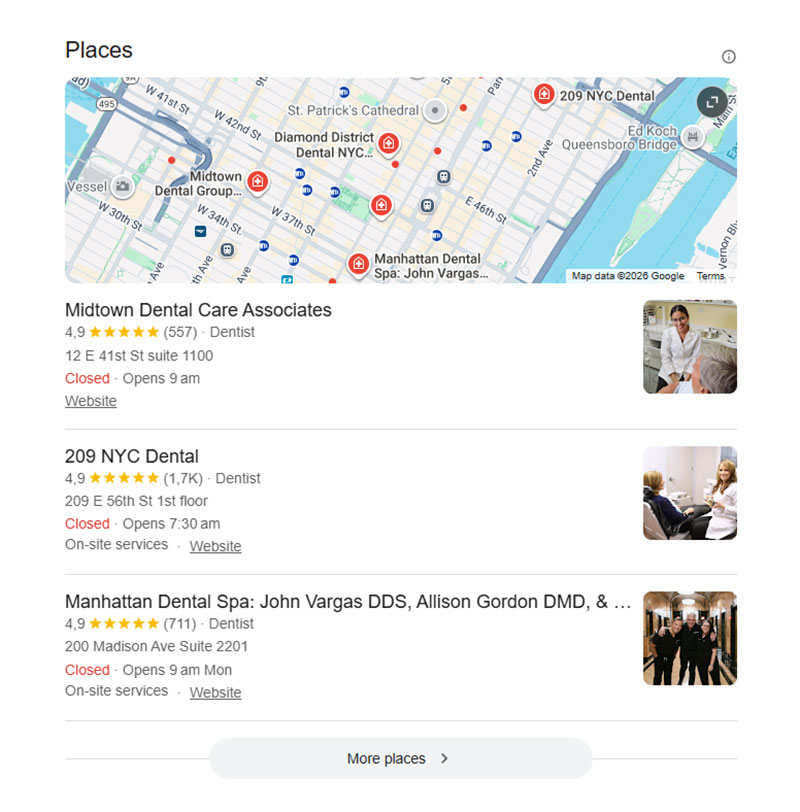
42% of people searching for a local business click a result inside the local pack, the map-based block Google shows above regular search results (Backlinko, 2024). For a dentist, that block is often the entire game. Most people searching for a nearby dentist never scroll past it.
Distance from the searcher matters more than anything a marketing budget can influence, and no amount of ad spend moves a practice closer to someone’s house. Beyond that, whether a practice shows up depends heavily on how complete its Google Business Profile is (hours, categories, photos, services, an address that’s actually correct) and how many reviews it has collected relative to whoever else is nearby, weighted by how recent those reviews are and what they average out to.
Structured data helps too, in a quieter way. Marking up a practice with dentist-specific schema gives search engines a cleaner read on what kind of business it is, where it serves, and when it’s open.
None of this is unique to dentistry. Any local business chasing nearby customers through search depends on the same handful of factors. Dentists just happen to compete inside a more crowded, higher-intent category than most.
An incomplete or unclaimed profile doesn’t just rank lower, either. It disappears from the block entirely, and a patient can’t choose a business they never see.
How Reviews and Referrals Drive Dental Patient Acquisition
Trust decides more of the outcome here than in almost any other local business category. A bad Wi-Fi review just costs a coffee shop a customer. With a dentist it reads differently: patients see a bad review as a signal about pain, safety, and what it’s going to cost them, and they treat it that way instead of shrugging it off.
Patient Reviews as a Lead Source
83% of consumers now use Google specifically to read reviews before choosing a local business, ahead of Yelp, Facebook, and every other platform (BrightLocal, 2025). For a dental practice, that means the Google Business Profile carries almost the full weight of first impressions.
- Google reviews
- Healthgrades ratings
- Yelp listings
- ZocDoc provider pages
A practice with four reviews and a practice with four hundred are not competing on the same terms, even if both offer identical care.
Referral Networks as a Lead Source
Word of mouth still fills chairs, it just travels through more channels than it used to.
The best source is usually patients who already like the practice enough to tell a friend or family member about it, and this tends to convert higher than anything else a practice runs. Physicians, pediatricians, and specialists send people over for specific treatments too, though that pipeline depends on relationships the practice actually has to maintain. And then there’s the more passive kind, program listings like the Invisalign Provider Locator, which route brand-driven searches straight to certified providers without the practice lifting a finger.
None of these referral paths run on autopilot. A practice that never asks a happy patient for a referral gets fewer of them, no matter how good the dentistry actually is.
Which Lead Generation Channels Work Best for Dental Practices
No single channel wins across every practice. The right one depends on how established the practice already is.
| Channel | Typical cost per lead | Time to first result | Best fit |
|---|---|---|---|
| Local search (organic) | Low, mostly time investment | Months | Established practices with reviews |
| Google Local Services Ads | Pay per lead, higher | Days | New practices needing fast volume |
| Paid social ads | Moderate | Weeks | Cosmetic and elective services |
| Referral program | Very low | Ongoing | Practices with a loyal patient base |
A new practice with zero reviews and no history cannot lean on organic local search yet. It has nothing to rank on.
That is usually where paid channels earn their cost, buying visibility while the review base and search history build in the background.
An established practice with strong reviews sees the opposite problem: paid ads often just pay for clicks the practice would have gotten anyway.
One North Texas practice with almost no online presence ran a tightly targeted local ad campaign and generated 91 new patient inquiries in fourteen days, at a cost of roughly five dollars per lead (BusySeed).
That result is not typical. Most markets are more competitive and most practices pay considerably more per lead, but it shows what a narrow, well targeted campaign can do for a practice starting from nothing.
Paid channels split further into inbound approaches that wait for the patient to search and outbound approaches that interrupt their scroll, and dental practices generally see more qualified volume from the inbound side, since dental care is rarely something people buy on impulse.
Every paid channel eventually runs into the same bottleneck, which is the landing page the ad actually points to. A generic homepage converts worse than a page built around one offer, one form, and one clear next step, and that’s why landing page form design ends up mattering just as much as the ad spend itself.
How Much Does Dental Lead Generation Cost
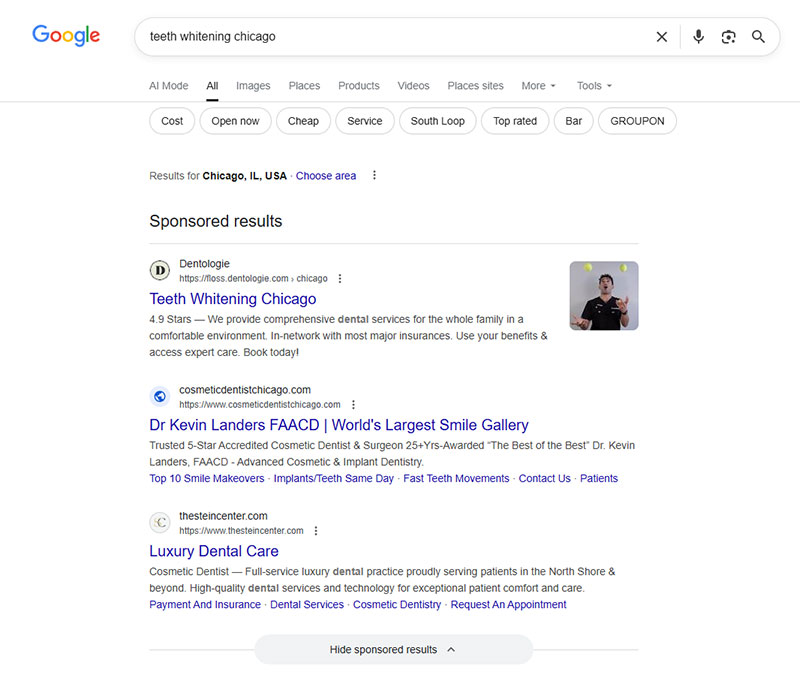
Cost per lead and cost per patient are not the same number, and mixing them up leads practices to judge channels on the wrong measure. A cheap lead that never books is more expensive, in the ways that actually matter, than a costly lead that turns into a ten-year patient.
A few figures are worth having on hand:
- Cost per lead in medical and health fields generally runs $26 to $50 (Zocdoc)
- Google Ads campaigns for health related searches average closer to $125 per lead (Zocdoc)
- Local Services Ads for dentistry commonly run higher still, since Google prices them per booked lead rather than per click
These ranges swing hard by market. A dental practice in a small town pays far less per click than one competing in a dense metro area for the same keywords.
What decides whether a number is good or bad isn’t the number itself. It’s what that lead is worth once booked, and dental patients tend to stick around for years, not just one visit.
Improving the site’s actual conversion rate often does more for cost per patient than switching channels ever does. A practice that turns 30% of leads into booked visits instead of 15% has cut its cost per patient in half without spending another dollar on ads.
Comparing a practice’s numbers against broader conversion rate benchmarks across industries is a useful gut check before assuming a channel is underperforming.
Most of the gains actually sit on the website side. Small, unglamorous changes to form length, page speed, and call to action placement tend to move the needle more than a bigger ad budget, and there’s a fairly well documented set of tactics for lifting form conversion rates that apply directly to a dental site’s booking forms.
Which Tools Capture and Manage Dental Patient Leads
Software cannot fix a broken funnel, but the right tool closes a lot of the gaps a busy front desk cannot cover alone.
The tools worth knowing about split roughly into scheduling and intake, communication and reviews, and marketing automation built into the practice platform itself.
Smaller practices sometimes patch together their own system using standard WordPress plugins built for capturing leads rather than paying for a dental specific platform, and for a single location office that can work fine.
Scheduling and Intake Tools
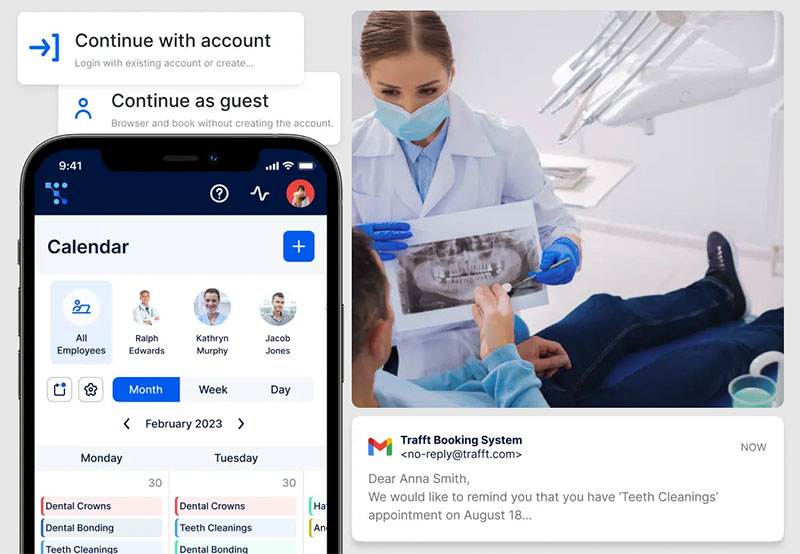
Trafft and Curve Dental both let a patient book directly online, without a phone call, at 11pm on a Sunday if that’s when they happen to be searching. That alone captures leads outside office hours and cuts down on the phone tag that eats up a front desk’s morning, and the digital intake forms save time on the actual first visit too.
The catch is integration: these need to talk to the practice management system properly or you end up with double bookings, and some patients, especially anyone in real pain, still just want to call.
Communication and Review Tools
According to call tracking data from Convirza, three out of four missed dental calls happen after business hours, right when a scheduler can’t do anything about it anyway.
Weave, Podium, and OhMD cover the gap with automatic text replies, review requests sent right after a visit, and two way messaging that keeps the conversation in one thread.
A missed call answered by an automatic text asking how the office can help recovers leads that would otherwise just call the next practice on Google.
Texting has largely replaced the web form for this kind of quick back and forth, though the two solve slightly different problems. The tradeoff between a chat based reply and a structured form comes down to speed versus detail, since a chat feels faster to the patient while a form gathers more information upfront.
Marketing Automation Platforms
RevenueWell, Tebra, Solutionreach, and Modento sit a layer above individual tools and try to run the whole patient communication cycle in one dashboard: recall reminders, review campaigns, new patient intake, the works.
| Platform | Strength | Watch out for |
|---|---|---|
| RevenueWell | Customizable reminders and recall | Best suited to single location practices |
| Tebra | Combines growth tools with EHR and billing | Bigger system, longer setup |
| Solutionreach | Strong patient engagement and recall | Pricing scales with patient volume |
| Modento | Digital forms and consent built in | Newer platform, smaller footprint |
None of these tools generate a lead by themselves. They only convert the leads a practice already has faster and with fewer gaps.
A practice that installs one of these platforms without first fixing weak local search visibility or a thin review profile is fixing the back half of a funnel that never fills up in the first place.
What Compliance Rules Govern Dental Lead Generation
Two different rulebooks apply here, and mixing them up is a common mistake.
HIPAA governs what a practice can do with a patient’s health information. The ADA’s Code of Professional Conduct is a separate document that governs what a dentist can actually claim in an advertisement, and the two rarely overlap, until a single marketing campaign manages to touch both at once.
A lead capture form asking for a name and phone number sits outside HIPAA’s usual concerns. A form asking someone to describe their dental pain, and storing that answer, is now handling protected health information whether the practice thinks of it that way or not.
Section 5 of the ADA Code covers advertising, and it boils down to one line: a dental ad can’t say anything false or misleading about the practice or the care it offers (American Dental Association).
The HIPAA side has sharper teeth. The Department of Health and Human Services’ Office for Civil Rights fined U. Phillip Igbinadolor, D.M.D. & Associates, a North Carolina dental practice, $50,000 after it responded to a negative Google review by naming the patient and describing his treatment.
The practice thought it was defending its reputation. Instead it disclosed protected health information in public, which is exactly the kind of well-intentioned marketing move that turns into a regulatory problem.
Review responses, chat widgets, and web forms are where this tends to go wrong most, since each one tempts whoever’s typing to get specific about a real patient somewhere the public can see it.
The fix runs earlier than most practices assume. A securely configured intake or contact form keeps that information off public pages in the first place, rather than relying on staff judgment after the fact.
Neither rulebook prohibits marketing. Both just narrow how specific a practice can get about a real patient’s condition or a promised outcome.
How to Track and Attribute Dental Patient Leads
A lead without a recorded source is a lead a practice cannot learn from.
Most of what a dental practice needs comes down to call tracking numbers, UTM tagged links, and a source field inside whatever system holds the patient record.
- Call tracking: a unique phone number per channel (Google Ads, the website, a print ad) shows which one the caller actually used
- UTM tagging: a tagged link on a Facebook ad or email campaign shows up as its own row in analytics instead of blending into “direct” traffic
- Source field at intake: a required field on the new patient form, filled in the moment the lead arrives, not reconstructed later from memory
That last point matters more than it sounds. A front desk member asked “how did you hear about us” three days after the call rarely gives an accurate answer.
On the web side, tracking form submissions inside Google Analytics turns a form fill into a measurable event instead of an invisible action buried in a page view count.
A phone call or a form fill is rarely the final action a practice cares about, it is a step on the way there.
Treating each one as a small, trackable event, the kind of thing marketers call a micro conversion, makes it possible to see exactly where in the process leads stall before ever reaching a booked appointment.
Google Search Console adds one more layer, showing which specific search terms brought someone to the site before that person ever clicked, called, or filled out anything.
Without any of this in place, a practice is left guessing which channel to fund next based on impression rather than evidence.
How to Nurture Dental Leads Into Booked Appointments
Speed decides more of this than the message itself does.
A lead management study covering thousands of medical practice leads found that calling back within 12 minutes converted about 65% of leads into booked consultations, compared to 31% at one hour and just 8% after nine hours (MyMedLeads).
That gap is not really about persuasion. It is about whether the person is still available and still undecided by the time the practice reaches them.
The first move should happen within minutes: a call, a text, or even an automated reply the second the form or call comes in. Anyone who doesn’t answer or book on that first attempt needs a second touch within 24 hours. After that, a message timed to whatever point the lead seemed close to deciding does more good than a generic weekly newsletter ever will.
Texting tends to outperform email for this kind of sequence in healthcare generally. A 2026 survey found 93% of patients had opted in to receive texts from a healthcare provider, and 84% said a text reminder made them more likely to attend an appointment (Sinch).
None of this replaces a clear confirmation message the moment someone submits a form, which sets the expectation for when and how the practice will follow up.
Most practices improvise this sequence call by call. A small set of lead nurturing templates covering the first text, the 24 hour follow up, and the pre-decision reminder removes that guesswork for whoever is on the front desk that day.
How to Build a Dental Lead Generation Strategy Step by Step
Order matters more than most practices assume. Running ads before the basics are in place wastes the spend on leads the practice cannot convert or even track.
- Claim and completely fill out the Google Business Profile, including hours, categories, services, and photos.
- Set up call tracking and a source field on every web form before spending a dollar on ads.
- Launch one paid channel, not three at once, so results stay easy to attribute.
- Put a review request system in place so the review count keeps growing alongside the new lead volume.
- Connect an online scheduler so leads can book outside office hours.
- Set a nurture sequence covering the first response, the 24 hour follow up, and a pre-decision reminder.
Skipping step two is the most common mistake. A practice that runs ads for a month with no tracking in place cannot tell which keywords or audiences produced an actual patient.
Each step in this sequence pulls from a broader set of lead generation strategies that apply well beyond dentistry, adapted here to the pace and trust requirements of dental patients specifically.
Step one and step five both come down to the same underlying task, giving a patient a way to act on interest without waiting for a callback. Whether that action happens through a scheduler widget or a plain web form, the practice needs a way to create a lead capture form that collects enough detail to make the follow up worth making.
Most practices see the local search and referral steps compound over three to six months, while the paid channel in step three shows results within days.
Running steps out of order does not always fail outright. It just means paying for volume a stronger foundation would have produced for less.
When Dental Lead Generation Does Not Work
More leads is not always the answer, and sometimes it is the wrong problem to solve entirely.
A saturated local market is the clearest case. When five practices within two miles are all bidding on the same “dentist near me” keywords, paid lead generation mostly bids up everyone’s cost per lead without changing who wins the patient.
A weak review profile causes a quieter version of the same failure. Sending paid traffic to a page with twelve reviews next to three competitors with hundreds does not convert, it just funds an expensive bounce.
Sometimes the funnel is not the problem at all. Industry survey data puts case acceptance for roughly two-thirds of U.S. dental practices between 20% and 50%, well short of the commonly cited 90% target (Levin Group Practice Survey).
A practice sitting at the low end of that range does not have a lead generation problem. It has a case presentation problem, and no amount of additional ad spend fixes what happens once the patient is already in the chair.
Forms themselves can quietly sink a campaign before any of this happens. A multi step form that asks too much too soon loses patients who would have booked through a shorter version of the same request.
- A practice already at full capacity, where new leads just create a longer wait rather than more revenue
- A practice with no system for calling leads back quickly, where the marketing spend funds calls that never get returned
- A practice mid rebrand or relocation, where visibility efforts point patients toward information that is about to change
In each of these cases, the fix sits upstream or downstream of marketing, not inside it.
Even a well built campaign cannot outrun a form people quit halfway through, and understanding why patients abandon a form before finishing it often does more for booked appointments than any new ad ever could.
FAQ on Lead Generation For Dentists
What Is the Difference Between a Dental Lead and a Dental Patient?
A lead has shown interest and handed over contact details, but nobody’s seen them yet. A patient has actually sat in the chair at least once. Closing that gap comes down to a fast booking mechanism and follow up that doesn’t drag.
What Is the Difference Between Dental Marketing and Dental Lead Generation?
Dental marketing is the wider umbrella, covering brand, reputation, and awareness work like a rebrand or sponsoring the local little league team. Lead generation is narrower and more transactional: it’s aimed specifically at producing a contact who’s ready to book. One builds the reputation the other one spends.
Do Paid Ads Convert at a Different Rate Than Organic Search Leads?
Generally, yes. Organic and referral leads convert higher because trust is already in place before anyone even makes contact. Paid leads convert at a lower rate on average, though they show up faster and in bigger volume. Neither one really replaces the other since they’re doing different jobs at different stages of growth.
Is Paid Lead Generation Worth It for a Solo Practice or a DSO?
For a solo practice with strong reviews already, organic and referral growth usually delivers more value per dollar. A multi-location DSO is a different animal. It can spread paid lead generation costs across more chairs and billing codes, absorbing risk that a single office just can’t.
How Long Does a Dental Lead Generation Campaign Take to Show Results?
Paid channels like Google Ads or Local Services Ads can put booked patients on the calendar within days. Organic local search and referral programs take longer, usually three to six months before they really compound. Compliance and tracking setup should happen before either clock starts running.
Can Dental Lead Generation Work Without a Website?
A Google Business Profile alone can generate calls and direction requests with no website behind it at all. That said, a website still earns its keep for intake forms, case studies, and service pages that a profile just can’t hold. Most practices end up needing both eventually.
What Should a Practice Fix First in Lead Generation for Dentists?
Call tracking and review count come before any increase in paid ad spend, in basically every case worth considering. An untracked, under-reviewed funnel just wastes budget on clicks a front desk was never going to convert into booked appointments anyway.
Committing to a fast callback standard trades front desk flexibility for a higher conversion rate, since prioritizing every ringing phone or fresh form submission pulls staff away from check-ins and insurance calls.
This priority order holds as long as HIPAA and the ADA Code of Professional Conduct keep their current advertising and privacy limits, a position verified as of September 2026.
Turning that priority order into an actual page usually starts with the intake step itself, and a set of ready-made appointment form templates gives a practice a faster starting point than building a booking form from a blank page.