







A new client doesn’t sign with an accounting firm because a landing page convinced them. They sign because someone they trust vouched for the firm, or because the firm showed…
Table of contents
30% of marketers still name lead generation as one of their biggest challenges heading into 2026, according to HubSpot’s State of Marketing Report. That share has barely moved over the past few years. Most people who search “what is lead generation” already have a rough answer sitting in their head. Just not one they could actually put into practice yet.
At the simplest level, it means turning anonymous website traffic into named, reachable contacts a sales team can follow up with. A downloaded guide counts, and so does a gated webinar signup. A demo request works too, though it usually shows up further down the funnel than the other two.
Nearly every marketing channel runs on top of this same mechanic, whether that’s SEO, paid ads, email, or cold outreach. Get it wrong at this layer and everything built on top of it underperforms, no matter how much budget goes into it.
What Is Lead Generation
Not every form on a website produces a lead in the marketing sense. A support question routed through a general inbox is a different animal than an inquiry captured specifically to start a sales conversation, and that’s the line most teams draw between contact forms and lead generation forms.
What actually counts as a lead comes down to whether someone crossed from anonymous into reachable. A filled-out form does it. So does a phone number left on a callback request, or an email typed into a newsletter box on the way out of a blog post. The moment a visitor hands over some way to be contacted, they stop being a bounce-rate number and become a lead, a name someone on a sales team can actually call or email.
Zoom out and lead generation sits at the top and middle of what most marketers call a lead generation funnel. Traffic shows up first. A portion of it converts into leads, and those leads inch toward an actual purchase decision from there.
Marketing usually owns this part of the process. Once a lead clears a set threshold of interest or fit, the handoff moves to sales, and that handoff point is exactly where lead quality problems tend to show up first in the pipeline.
Lead vs Prospect vs Customer
A lead has shared contact information, nothing more. Nobody has checked yet whether they’re a real fit for the product or have any actual intent to buy.
Once someone clears basic qualification criteria (budget, need, that kind of thing) and a rep has actually talked to them directly, they move up to prospect. A customer, meanwhile, is just a prospect who paid and landed in onboarding.
None of this is fixed, by the way. These are stages a person moves through, not permanent labels stapled onto a contact record. Someone can be a lead on Monday and a prospect by Friday, assuming a rep manages to confirm real buyer intent somewhere in between.
What Is the Difference Between Lead Generation and Demand Generation
Content Marketing Institute’s 2025 B2B benchmarks found that 74% of B2B marketers say content helped generate demand and leads over the past year, and 87% say it built brand awareness (CMI, 2025). Both numbers come out of roughly the same content efforts, which is part of why people mix the two terms up so often. They’re not the same job, though.
Demand generation is the one that doesn’t ask for anything back. It’s built to get a brand or an idea in front of as many of the right people as possible, without a form standing in the way. Lead generation flips that. It trades something, usually a name and an email and sometimes a phone number, for access to a resource or an actual conversation with a rep.
- Demand gen: an open webinar promoted for reach, no signup required
- Lead gen: the same webinar placed behind a signup form
- Demand gen: brand campaigns, podcast sponsorships, open-access guides
- Lead gen: contact forms, discovery call bookings, resources locked behind an email
The two feed each other in practice. Demand generation fills the top of the funnel, and lead generation is what actually converts a chunk of that traffic into someone sales can follow up with. Skip the demand side entirely and lead gen ends up working a smaller, colder pool.
Drift pushed this distinction hard in 2016 with its “No Forms” campaign, pulling the gates off its own content to argue that trust has to come before the ask. It’s still a live argument, honestly, over when gating actually helps and when it just adds friction for no reason, and that argument plays out today under the label lead generation vs demand generation.
How Does the Lead Generation Process Work
Sopro’s 2025 State of Prospecting research found that 84% of marketers rely on on-site form submissions to convert leads, more than any other single mechanism (Sopro, 2025). Behind that number sits a sequence that looks roughly the same no matter what industry you’re in.
- Traffic arrives through organic search, paid ads, social, or a referral link
- A call to action points the visitor toward a landing page
- The landing page makes an offer and asks for contact details through a form
- The submission gets logged into a CRM or marketing automation platform for follow-up
Every step in that chain leaks visitors. A landing page only ever converts a fraction of whoever lands on it, and each extra field tacked onto a form chips away at that number a little more.
HubSpot runs its own funnel this way, in public, for anyone paying attention. A blog post links out to a gated template, the landing page grabs an email through a lead capture form, and the contact lands straight in HubSpot’s own CRM. It’s about as textbook as this gets, which is probably why so many B2B teams copy it more or less exactly.
From Form Submission to CRM Entry
The instant someone hits submit, the system needs to run validation almost immediately, checking that the email format is real and catching the obvious spam before a bad record ever gets saved. Right behind that comes routing, where the new contact gets assigned to a list, a workflow, or a specific rep depending on which form they used and what data came through with it.
A slow or broken handoff at this exact step is usually where leads go cold, often before anyone on the sales side has even looked at them.
What Are the Types of Lead Generation
Who makes first contact, the business or the buyer, is really what separates one type of lead generation from another. Everything else is a variation on that one distinction.
Sopro’s research also found that 45% of businesses struggled to generate enough leads in the past year (Sopro, 2025), and which type a team leans on tends to explain a good chunk of that number.
| Type | Who Initiates | Typical Cost Pattern |
|---|---|---|
| Inbound | Buyer discovers content or a search result | Lower per lead over time, slower start |
| Outbound | Business initiates contact directly | Higher per lead, faster initial volume |
| Hybrid | Paid traffic pointed at a gated inbound asset | Blended cost, faster than pure inbound |
Whichever one a team picks, or however they blend the two, that choice shapes everything downstream, from the content that gets built to the tools bought and the general shape of the funnel. There’s more on that split under inbound vs outbound lead generation.
Inbound Lead Generation
Inbound pulls people in through content, SEO, and organic discovery instead of a rep picking up the phone first. HubSpot gets credit for popularizing the term back in 2006, building a whole company around the bet that buyers would rather find something useful on their own than get cold-called about it.
Blog posts, gated guides, search rankings, these things compound in a way outbound never really does. A blog post that lands on page one of Google keeps pulling in leads for years after it was published, and it doesn’t cost anything extra per visitor who shows up.
The catch is time. It can take months to build any real momentum this way, sometimes a lot longer than that in a crowded industry.
Outbound Lead Generation
Outbound works the opposite way around. Instead of waiting for someone to find a blog post or a search result, a sales or SDR team picks target accounts and reaches out directly, usually through cold email, cold calling, or direct mail.
What outbound has going for it is speed, mostly. A cold outreach campaign can turn into booked meetings within a matter of days, which is hard to match when inbound content might need months just to start ranking. Apollo.io and Salesloft have made a lot of the list-building and sequencing work automatic now too, which is part of why outbound is cheaper to run than it was ten years ago, even though the cost per lead usually still lands higher than what organic inbound produces.
There’s a real tradeoff buried in all of that, though. Outbound leads start out cold. Nobody’s read three blog posts about the company before that first email lands in their inbox, so the message itself has to carry a lot more weight than it would with someone who came in through search.
How Does B2B Lead Generation Differ From B2C
Databox’s benchmark data, pulled from June 2023 client accounts, puts B2C companies at an average of 196.5 new leads in a month, more than seven times what B2B companies averaged in the same period (27), with the median across all companies at 36 (Databox, 2025).
Volume isn’t the only place the two pull apart.
| Factor | B2B | B2C |
|---|---|---|
| Decision makers | Multiple stakeholders, often five to sixteen people (Gartner, 2025) | Usually one |
| Sales cycle | Weeks to many months | Minutes to days |
| Qualification data | Firmographic: company size, industry, budget | Demographic and behavioral: age, location, browsing history |
Gartner’s 2025 survey of B2B buyers found buying groups now span five to sixteen people across as many as four departments, which goes a long way toward explaining why B2B lead forms tend to ask for job title and company size while B2C forms are happy with just an email.
Salesforce sells into committees like that every day, with legal, IT, and finance all weighing in before a deal closes. A brand like Sephora, on the other hand, captures a lead the instant someone types an email in for a discount code, no committee required.
What Channels Drive Lead Generation
Paid, organic, and owned pretty much cover every channel that drives leads, and most teams end up running several of them at once instead of betting everything on just one.
WordStream’s 2026 Google Ads Benchmarks report, built from more than 13,000 search campaigns running between April 2025 and March 2026, put the average cost per lead across 23 industries at $66.69, down from $70.11 the year before, the first decline in five years (WordStream by LocaliQ, 2026).
HubSpot’s 2026 State of Marketing survey of over 1,500 marketers found 93.8% said lead quality improved over the past year, while 74.5% reported lead volume increased at least somewhat (HubSpot, 2026). Set next to WordStream’s falling cost per lead, that pattern points to something sharper than plain luck. Better targeting and richer intent data are likely pulling more relevant traffic into the same channels, not just producing cheaper clicks.
| Channel | Example Tool | Best For |
|---|---|---|
| SEO and content | Ahrefs, organic blog traffic | Long-term, compounding lead volume |
| Paid search and social | Google Ads, LinkedIn Ads | Fast volume, higher cost per lead |
| Mailchimp, ActiveCampaign | Nurturing existing contacts into leads | |
| Events and webinars | Webinar platforms and webinar registration forms | High-intent, lower volume leads |
Referral and affiliate programs round out the list, along with on-site tools like WordPress lead generation plugins that turn an existing website into a capture point without needing a full rebuild.
Content Marketing Institute’s 2025 research found 87% of B2B marketers say content helped build brand awareness in the past year (CMI, 2025). That’s the quiet groundwork sitting underneath every other channel on this list, making each one convert a little better once it’s actually in place.
Paid Channels vs Organic Channels
Ahrefs is a decent example of the organic model working as intended. The company built a lot of its customer base without spending on ads at all, mostly by publishing SEO research and free tools that happen to rank for the exact terms its buyers are already searching. It’s slower to build than paid, but once content ranks, it keeps producing leads without costing anything extra per visitor.
Paid channels run on a different clock entirely. Traffic shows up as soon as the budget turns on, and it disappears just as fast once that budget gets pulled.
Past a certain size, most companies just run both. Paid fills the gap while organic content is still working its way up the rankings.
What Is a Lead Magnet
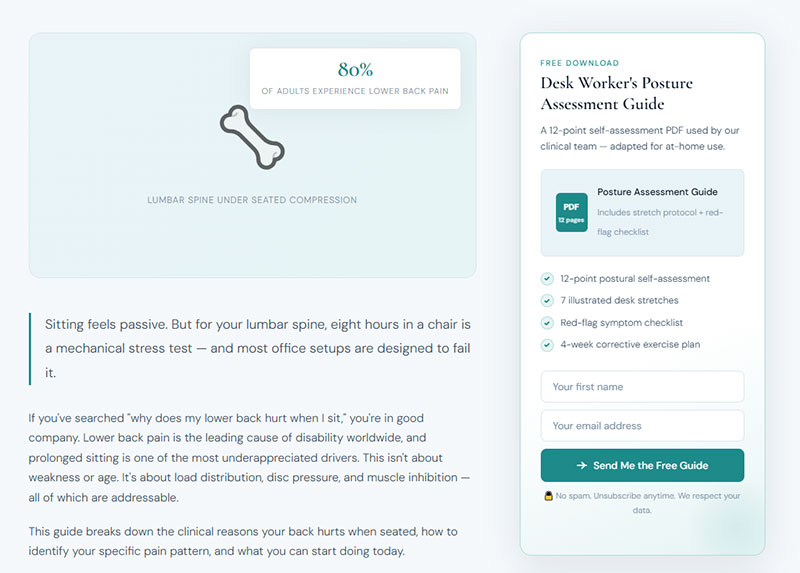
Every gated resource on a marketing site runs on the same basic trade: give something away for free, get a way to reach that person afterward. That’s what a gated content offer really is underneath the branding, and a lead magnet is just the name for the thing being given away, usually in exchange for an email address.
Formats vary a lot, and the types of lead magnets that actually convert tend to depend heavily on where someone sits in the funnel.
- Ebooks and guides
- Checklists and templates
- Free trials or free tool access
- Webinars and live training
- Discount codes, mostly in B2C
The ones that actually work tend to solve one specific problem right away, instead of promising something broad and vague. A ten-point pricing page checklist will usually outperform a full guide to marketing, mostly because the person downloading it already knows exactly what they’re getting before they hand over an email.
HubSpot’s Website Grader is a genuinely good example of this done right. Type in a URL, get a free scored report on how the site performs, hand over an email to unlock the full breakdown. It’s been running as a lead magnet since 2007, and it still pulls in signups the same way almost twenty years later.
Placement matters almost as much as the offer itself. Most lead magnets live behind a dedicated landing page. Exit-intent popups and in-content offers (sometimes called content upgrades) work fine too, usually as a secondary capture point rather than the main one.
How Are Leads Qualified
Qualification is really just sorting. Raw leads get ranked by how likely they actually are to buy, so sales time goes toward the contacts worth calling instead of everyone who filled out a form.
In a typical B2B pipeline, most of that sorting comes down to two labels.
Marketing Qualified Lead vs Sales Qualified Lead
| Stage | Trigger | Next Step |
|---|---|---|
| MQL | Engagement signal: download, webinar, repeat visit | Reviewed against sales criteria |
| SQL | Fit and budget confirmed by a rep | Direct sales conversation |
The argument between the two labels is a familiar one in most B2B teams. Marketing tends to treat engagement itself as a sign of intent. Sales usually wants something closer to proof, actual evidence that someone can sign a contract, before they’ll call it qualified.
How Lead Scoring Assigns Value
Lead scoring works by tacking points onto a contact based on two kinds of signal, one behavioral and one firmographic.
- Behavioral: page visits, email opens, content downloads, demo requests
- Firmographic: company size, industry, job title, budget signals
Every action adds or subtracts points, and the moment a contact crosses a set point threshold, it moves from lead to MQL on its own, no human needed to make that call.
HubSpot and Marketo built a lot of their reputation on this kind of automated scoring. It runs the math quietly in the background so reps aren’t left guessing which contact to call first.
What Tools and Software Power Lead Generation
Salesforce held 20.0% of global CRM revenue in 2025, its 13th consecutive year at the top of IDC’s Worldwide Semiannual Software Tracker (IDC, cited by Salesforce, 2026). No other single CRM vendor comes close to that share.
A CRM is really just the record-keeping layer underneath everything else. Most lead generation stacks run several other tool categories alongside it.
| Category | Example Tools | Role |
|---|---|---|
| CRM | Salesforce, HubSpot CRM, Pipedrive | Store and track every lead record |
| Landing pages | Unbounce, Instapage | Build and test capture pages |
| Data enrichment | Clearbit, ZoomInfo | Fill in missing contact and firmographic data |
| Conversational capture | Drift, Intercom | Qualify visitors through live chat |
On-site capture tools round out most stacks too, including exit intent popup plugins that catch a visitor right as they’re about to leave.
Conversational tools have picked up real ground here as well. The shift toward chat-based capture, sometimes framed as chatbots vs forms, comes down to a fairly simple tradeoff. Chat feels faster to the visitor, at least in the moment. Forms take a bit more effort up front, but they’re easier to structure, filter, and actually report on afterward.
What Does Lead Generation Cost
Cost per lead swings more by industry than almost any other lead generation metric out there.
WordStream’s 2026 Google Ads Benchmarks report put Attorneys and Legal Services at $131.63 per lead, the highest of any industry tracked, while Arts and Entertainment sat lowest at $26.84 (WordStream by LocaliQ, 2026).
That’s a five-fold spread inside a single report, pulled from the same 13,000-plus campaigns referenced earlier in this piece.
What Affects Cost Per Lead
The single biggest driver is usually customer lifetime value. A law firm paying well over a hundred dollars per lead can still come out ahead if one case is worth thousands of dollars down the line.
Competition matters almost as much, and it’s simple math: more advertisers bidding on the same keywords pushes the price of every click up, which drags cost per lead up right along with it.
Then there’s targeting precision, which ties back to conversion rate benchmarks more than people usually assume. Cost per lead is just cost per click divided by conversion rate. A cheap click that never actually converts into a lead was never cheap to begin with, it just looked that way on the ad platform’s dashboard.
Channel choice plays a role too, though it’s easy to miss. Paid channels show a visible number right there in the dashboard. Organic and referral traffic carry a real cost as well, it’s just spread out as time and content investment instead of showing up as ad spend.
How Is Lead Generation Performance Measured
Unbounce’s Q4 2024 Conversion Benchmark Report, built from more than 57 million conversions across 41,000 landing pages, found a median landing page conversion rate of 6.6% across all industries (Unbounce, 2024).
That single number, checked against solid landing page form best practices, is usually the first benchmark teams reach for before anything else.
- Visitor-to-lead conversion rate: share of traffic that becomes a lead
- Cost per lead and cost per acquisition: what each lead and each closed deal actually cost
- MQL-to-SQL rate: how many marketing-qualified leads survive sales review
- Lead velocity rate: month-over-month growth in qualified leads, a number SaaS investors watch closely
Tracking tools matter almost as much as the metrics themselves. Google Analytics 4 and CRM-native reporting dashboards handle most of this work automatically now, pulling conversion data straight from the same forms that feed the CRM.
None of these numbers mean much sitting on their own. A rising lead volume paired with a falling MQL-to-SQL rate usually signals a targeting problem, not a growth story, and that’s exactly the kind of pattern worth checking against a published set of lead generation KPIs before anyone gets to report a win.
What Common Mistakes Undermine Lead Generation
A handful of repeat offenders cause most lead generation problems, over and over, across pretty much every industry.
| Mistake | Effect |
|---|---|
| Generic lead magnets | Attracts low-intent contacts who never convert |
| Long or intrusive forms | Suppresses landing page conversion rate |
| No nurture sequence | Interested leads go cold within days |
| Purchased or scraped lists | Damages sender reputation fast |
| Marketing and sales misalignment | Wastes rep time on unqualified contacts |
Cutting form fields fixes the easiest problem on this list, and it’s also the most commonly ignored one. Teams working on improving form abandonment rate usually start there, trimming fields, rather than redesigning the whole page from scratch.
Purchased lists carry a much harder line now than they used to. Gmail and Yahoo’s 2024 bulk sender guidelines flag any account with a spam complaint rate above 0.3% for filtering or outright blocking, and a purchased list is about the fastest way there is to cross that line (Google, 2024).
Then there’s the nurture gap, which is quieter than the other two but costs just as much over time. A lead who downloads a guide and hears nothing for three weeks has usually moved on to a competitor before anyone circles back, and that’s exactly the gap lead nurturing templates exist to close.
FAQ on Lead Generation
Is Lead Generation the Same as Sales
No, and mixing the two up is a common mistake. Lead generation identifies and captures interested contacts. Sales takes it from there and converts those contacts into paying customers. Marketing usually owns the lead generation side, while an actual rep drives the sales conversation itself, and even though the two functions work closely together, they get measured on completely different metrics.
What Is the Difference Between a Lead and a Subscriber
A subscriber just opted into content, usually a newsletter, without necessarily showing any buying interest at all. A lead has done something more specific, taken an action actually tied to a product or service, like requesting a demo. Every lead starts out looking a lot like a subscriber. Most subscribers never make that jump, though.
What Is the Difference Between Lead Generation and Lead Nurturing
Lead generation is the capture step, nothing more. Lead nurturing is everything that happens after that, the sequence of emails, content, and touchpoints that slowly moves a cold contact toward an actual sales conversation. One fills the top of the funnel. The other keeps leads warm long enough that they’re actually ready to buy when a rep finally calls.
Can AI Help With Lead Generation
Yes, quite a bit actually. AI tools now handle lead scoring, chatbot qualification, and personalized outreach at a scale no human team could keep up with manually. Predictive models can flag a high-intent visitor before they’ve even filled out a form. The judgment calls, though, the actual messaging and offer strategy, those still need a person behind them.
Do You Need a Website to Do Lead Generation
Not strictly, no. Lead generation runs just fine through social media, in-person events, and cold outreach without a website anywhere in the mix. That said, having one helps a lot in practice, mostly because it gives paid ads and organic search somewhere to actually send traffic, and gives a lead magnet a place to live.
How Is Lead Generation Different From Affiliate Marketing
Affiliate marketing pays a third party a commission once a sale closes, and the affiliate usually never even sees the contact information. Lead generation is different. It captures that contact information directly, inside a business’s own CRM, well before any purchase ever happens.
Is Lead Generation Regulated by Privacy Laws Like GDPR
Yes, in most regions that have any kind of data protection law on the books. Consent has to be explicit. Contacts need a clear, working way to opt out, and whatever data gets stored has to be handled securely. Building GDPR compliant forms from day one saves a painful rebuild later, once a regulator starts asking questions nobody prepared for.
How Many Leads Should a Small Business Aim for Each Month
There’s no universal number here, and anyone who gives you one is guessing. It depends almost entirely on conversion rate and deal size, not raw lead volume. A business closing 20% of its leads at a high price point needs a lot fewer of them than one running a low-cost, high-volume funnel.
Do Lead Magnets Have to Be Free
Almost always, yes. The entire trade depends on low friction for the visitor, and asking for money kind of defeats the point. A few brands do run pay-what-you-want versions to filter out anyone who isn’t serious, but honestly, those sit closer to a first sale than an actual lead magnet.
How Long Does It Take to See Results From Lead Generation
Outbound can produce meetings within days, sometimes faster than that. Inbound content usually needs three to six months before it ranks and starts pulling in leads on its own, and it can take a lot longer than that in a crowded industry. Paid channels land somewhere in the middle. Leads show up immediately, but only for as long as the budget keeps running.
Conclusion
Most teams building lead generation from scratch try to run five channels at once, and that’s usually backwards. Pick one lead magnet, one landing page, one channel, and prove that specific combination actually converts before touching a second one.
The first month’s numbers will probably look worse than any benchmark mentioned in this piece. That’s normal. Cost per lead comes down as targeting gets sharper, not before it does, and there’s no shortcut around that part.
The CRM and the lead scoring model can wait a while longer than most people think. A single funnel that actually works, tracked honestly, will teach more in thirty days than a full martech stack assembled before anyone’s closed a single deal.
Set a real budget ceiling for that first funnel, and a real deadline, written down somewhere before launch. Skip either number and the whole effort tends to drift, spending a bit more each month just to justify what already got spent.