





A new client doesn’t sign with an accounting firm because a landing page convinced them. They sign because someone they trust vouched for the firm, or because the firm showed…
Table of contents
Over 97% of visitors leave an online store without buying anything. Most never come back. Lead magnets for ecommerce exist to fix that gap, turning anonymous browsers into email subscribers you can actually reach again.
But the generic “10% off” popup isn’t cutting it anymore. Shoppers have seen it a thousand times, and discount fatigue is real.
This guide breaks down what actually works for ecommerce lead generation right now. You’ll learn which lead magnet types drive the highest opt-in rates, how to match offers to different stages of the buying journey, and which real brands (like Jones Road Beauty and Beardbrand) are using quizzes, gated access, and content-based offers to build email lists that convert into revenue.
Every strategy here is backed by current data from Omnisend, Wisepops, Klaviyo, and other platforms tracking real ecommerce performance.
What Is a Lead Magnet in Ecommerce?
A lead magnet is a free resource or incentive that an online store offers visitors in exchange for their email address, phone number, or other contact information.
That’s the short version. But in ecommerce specifically, lead magnets look and behave differently than they do in B2B or SaaS. A B2B company might gate a 40-page whitepaper. An ecommerce store? It needs something faster, more visual, and closer to the actual purchase decision.
The reason is simple. Online shoppers have high purchase intent but short attention spans. They’re browsing products, comparing prices, maybe killing time on their phone. They’re not downloading PDFs to read later. They want something that helps them right now or saves them money right now.
That’s why the best ecommerce lead magnets tend to fall into a few categories: discount codes, free shipping offers, product recommendation quizzes, buying guides, and early access to sales. All of these share one thing. They create an immediate value exchange that feels worth giving up an email address for.
Statista found that 48% of consumers willingly hand over their email address in exchange for a discount. When you consider that the average ecommerce conversion rate sits under 2% (HubSpot, 2025), capturing emails from the other 98% of visitors becomes the entire game.
A lead magnet turns a one-time anonymous visitor into a contactable subscriber you can reach through email marketing, retargeting, and personalized product recommendations. Without one, you’re relying on paid ads to bring that person back. With one, you own the relationship.
How Ecommerce Lead Magnets Differ from B2B Lead Magnets
Speed matters more. B2B buyers expect long sales cycles. Ecommerce shoppers expect instant gratification. Your lead magnet has to deliver value in seconds, not days.
The offer is closer to the transaction. A SaaS lead magnet educates. An ecommerce lead magnet often IS the incentive to buy. A 10% off code doesn’t just capture an email. It pushes the visitor toward checkout in the same session.
Visual presentation carries more weight. An ugly popup on a fashion store kills credibility. Form design and brand consistency matter far more when you’re selling physical products to consumers who judge by aesthetics.
According to DemandSage, retail, ecommerce, and consumer goods businesses earn the highest email marketing ROI at $45 for every $1 spent. That beats the cross-industry average of $36. The gap exists because ecommerce subscribers are already primed to buy. They just needed a reason to hand over their email first.
Ecommerce Lead Magnets to Try
Why Ecommerce Stores Need Lead Magnets Beyond Discount Codes
Here’s what most store owners do. They slap a “Get 10% Off” popup on their homepage, connect it to Klaviyo, and call it a day.
It works. Sort of. But it also trains your customers to never pay full price. And after a while, the people signing up are just coupon hunters who will unsubscribe the moment they’ve used the code.
The Real Cost of Relying on Paid Ads Alone
Wisepops data shows that ecommerce businesses achieve the highest popup conversion rate at 6.88% across all industries. That means nearly 7 out of every 100 visitors who see a well-targeted popup will hand over their contact info.
Compare that to paid advertising. You’re paying to acquire that visitor once. If they leave without buying (and 97-98% do), you pay again to bring them back through retargeting.
An email list changes the math completely. Omnisend reports that automated emails drove 37% of all email-generated sales in 2024. That’s revenue generated from subscribers you captured once and can reach for free, repeatedly.
Discount Fatigue Is Real
When every popup on every store offers 10% or 15% off, the offer stops feeling special. It becomes expected.
Shoppers start waiting for the code before buying. Worse, some will abandon their cart specifically because they know an abandoned cart email with a discount is coming. You’ve accidentally built a system that punishes full-price buyers.
This is where content-based and interactive lead magnets become interesting. A product recommendation quiz, a style guide, a buying comparison sheet. These capture emails without cutting into your margins. And the subscribers they produce tend to be more engaged because they signed up for value, not just a coupon.
Customer Lifetime Value Tells the Real Story
Shopify research shows consumers spend 128% more when shopping from emails compared to other methods. But not all email subscribers are created equal.
Someone who signed up because your quiz told them which moisturizer matches their skin type has a relationship with your brand. Someone who signed up for 10% off? They have a relationship with the discount.
The difference shows up in repeat purchase rates, average order values, and how long they stay subscribed. Measuring email-to-first-purchase conversion rate (not just opt-in rate) is what separates stores that grow from stores that just collect addresses.
Discount and Monetary Lead Magnets

Look, discounts still work. They’re the most common ecommerce lead magnet for a reason. The trick is using them strategically instead of lazily.
Statista data shows 63% of people who open a marketing email are looking for discounts. That demand is real. The question is how you structure the offer so it captures emails without destroying your margins.
Percentage-Off vs. Fixed-Amount Discounts
Percentage-off feels bigger on cheap items. Saving 15% on a $30 purchase ($4.50) sounds better as “15% off” than “$4.50 off.” The psychology flips on expensive items. “$25 off” sounds more impressive than “5% off” on a $500 order.
Free shipping consistently outperforms both. I’ve seen this across dozens of Shopify stores. People have an irrational hatred of shipping fees. A “$7 off” coupon and “free shipping” might cost you the same amount, but the free shipping offer will almost always win on conversion.
Exit-Intent Discount Offers
The visitor has already decided to leave. Their mouse is heading toward the browser tab. This is your last shot.
Exit intent popups exist for exactly this moment. And the data backs them up. Conversion Sciences research shows well-crafted exit messages recover 10-15% of abandoning visitors.
OptiMonk’s data is even more specific. Cart abandonment exit-intent popups (shown to people who already added items) convert at 17.12% on average. That’s because these visitors had purchase intent. Something just stopped them, usually price or shipping cost.
Tools like Klaviyo, Justuno, Privy, and OptiMonk all handle this well. The setup is straightforward. But the offer matters more than the tool. “Wait, here’s 10% off” works. “Your cart is waiting, plus free shipping if you complete your order now” works better because it removes a specific friction point.
One thing to watch out for: don’t show exit intent popups to visitors who just arrived. If someone bounces in 3 seconds, they weren’t your customer. Target visitors who’ve spent at least 30 seconds on site or viewed multiple pages. Popupsmart’s analysis of 10,000+ campaigns confirms that triggering after 30-60 seconds of engagement produces the best results.
Content-Based Lead Magnets That Work for Product Sales
Not every lead magnet needs to cost you margin. Content-based offers capture emails by solving a problem or answering a question the shopper already has.
The key difference? Discounts attract price-sensitive buyers. Content attracts curious buyers who haven’t decided yet. These are often higher-value customers because they’re doing research before committing.
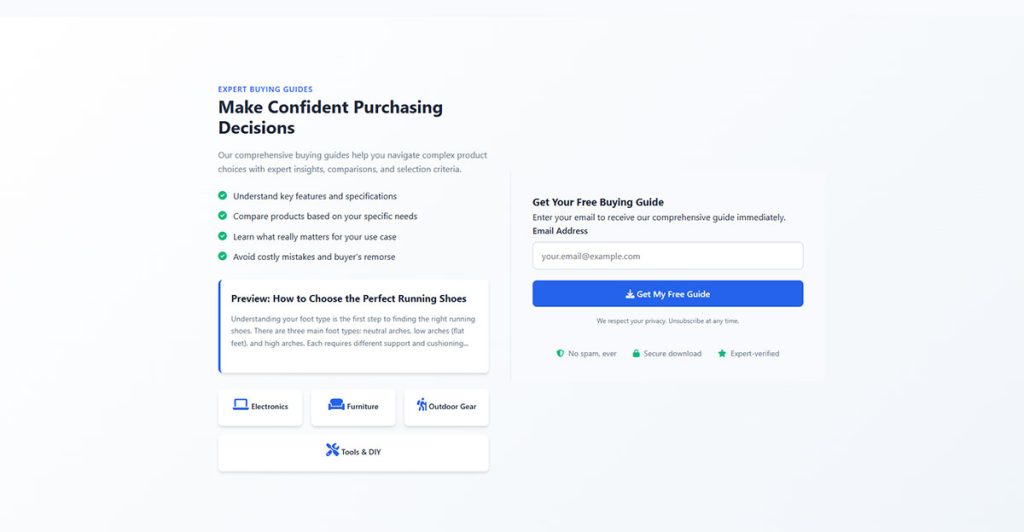
Buying Guides and Product Comparisons
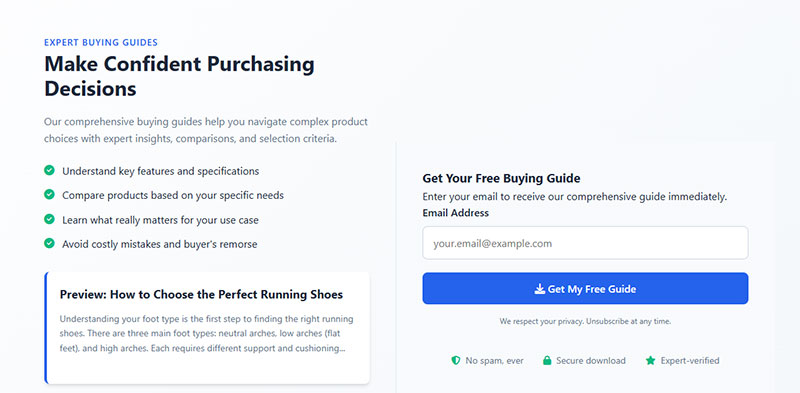
This works best for stores selling complex or high-ticket products. Mattresses, electronics, skincare routines, supplements. Anything where the buyer thinks “I don’t know which one is right for me.”
A downloadable buying guide positions your store as the expert. It also pre-sells your products by framing the comparison around features where your products win.
Think about it from the shopper’s perspective. They’re comparing five different protein powders. Your store offers a free “Complete Protein Buyer’s Guide” that breaks down whey vs. plant-based vs. casein, explains what to look for on labels, and happens to recommend three of your products as top picks. That’s not a hard sell. That’s genuine help.
These guides work especially well as gated content delivered through a simple lead capture form. Two fields max: name and email. Anything more and you’ll see drop-off.
Style Guides and Lookbooks
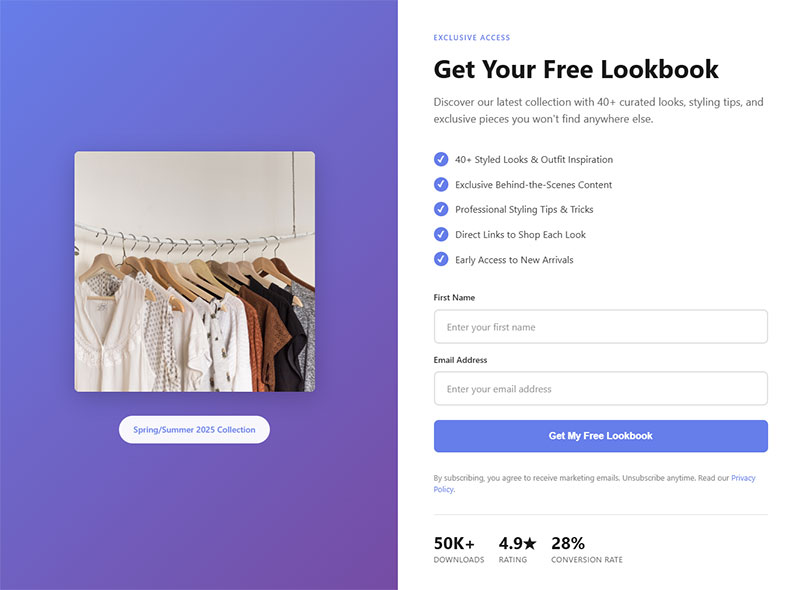
Fashion, home decor, and lifestyle brands have a natural advantage here. A seasonal lookbook or style guide does double duty. It inspires the shopper AND showcases your products in context.
The format matters. A PDF lookbook should feel like a mini-magazine, not a product catalog. Include styling tips, color palette suggestions, or room layout ideas alongside the product shots. The more editorial it feels, the more subscribers will actually open and engage with it.
Brooklinen does something clever with this approach. Instead of just gating a lookbook, they gate early access to seasonal sales and new collections. The content IS the exclusivity, which creates both email capture and urgency.
Quizzes as Lead Magnets
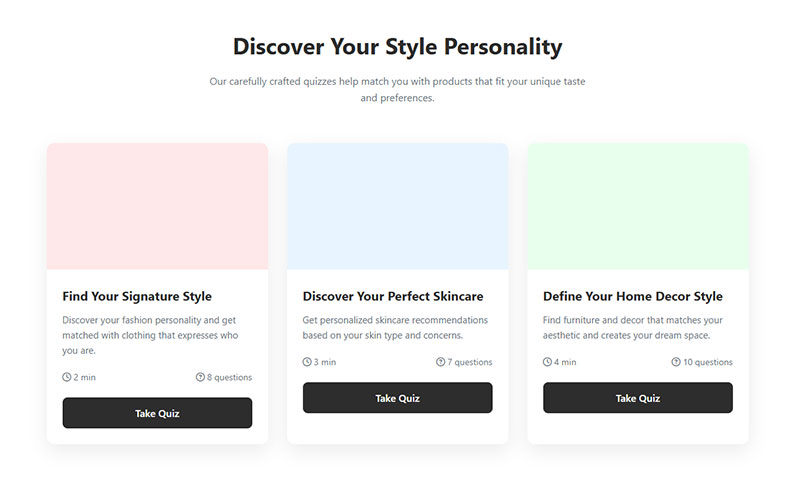
Quizzes are probably the most underused lead magnet type in ecommerce. And the data suggests they shouldn’t be.
Interact’s 2026 quiz conversion report shows an overall 40.1% conversion rate when people start a lead generation quiz. That’s roughly 4 out of 10 quiz takers becoming subscribers. Compare that to a standard email popup converting at 3-5%.
Why so high? Because a quiz is inherently personal. “What’s your skin type?” or “Find your perfect coffee blend” or “Which running shoe matches your stride?” These questions make shoppers feel like the store cares about getting them the right product, not just any product.
Octane AI reports conversion rates between 7-25% for brands using their Shopify quiz platform, with some standout results. Jones Road Beauty captured 800,000 email leads through their quiz alone. That represents 80% of their entire email list. Zenni Optical’s eyewear quiz generated $1 million in revenue and 29,500 lead conversions.
Quiz platforms for ecommerce include Octane AI, RevenueHunt, and Typeform. Octane AI integrates directly with Shopify and Klaviyo, which makes the data flow from quiz answer to personalized email sequence pretty smooth. RevenueHunt is another solid option for product recommendation quizzes specifically.
The zero-party data angle is what makes quizzes really valuable long-term. When someone tells you their skin concerns, budget range, and preferred ingredients through quiz questions, you now have segmentation data that would take months of purchase history to figure out otherwise.
Lead Magnets for Different Stages of the Buying Journey
Not every visitor landing on your store is in the same headspace. Someone browsing your blog post about “best running shoes for flat feet” is in a completely different place than someone staring at a product page with an item in their cart.
Showing the same lead magnet to both of them is a missed opportunity. The wrong offer at the wrong stage doesn’t just fail to convert. It can actually push people away.
Awareness Stage
Who they are: First-time visitors, blog readers, social media click-throughs. They might not even know your brand yet.
What works: Educational content, trend reports, style inspiration, and content upgrades tied to whatever page they’re reading. A skincare blog post about retinol pairs naturally with a downloadable “Retinol Starter Guide.” A running shoe category page can offer a “Find Your Fit” quiz.
The goal here isn’t a sale. It’s permission to keep the conversation going.
Consideration Stage
These visitors are actively comparing products. They’ve been on your site more than once, or they’re deep into product pages.
Comparison guides, sample packs, and sizing tools work well here. If you sell clothing, a fit guide delivered through a multi-step form that asks about height, weight, and preferred fit style gives you both the email and useful data for personalized recommendations.
Marigold’s 2024 Consumer Trends Index found that 52% of consumers made a purchase directly from an email in the last year. That number goes up significantly when the email contains product recommendations based on data the subscriber already provided.
Decision Stage
They’re almost ready to buy. Maybe they’ve added something to the cart. Maybe they’re just hesitating on the product page.
This is where monetary lead magnets make the most sense. A limited-time discount, free shipping offer, or bonus item with purchase. The friction is small, and the incentive tips them over the edge.
OptiMonk data shows that popups with countdown timers convert at 14.41%, compared to 9.86% without them. Urgency works at this stage because the buyer’s intent is already there.
Post-Purchase Stage
Most stores forget this one entirely. But the moment after a purchase is when customer engagement is at its peak.
Loyalty program enrollment, referral rewards, and replenishment reminders are all lead magnets in disguise. They capture additional data, deepen the relationship, and increase customer lifetime value without needing another paid ad click.
Sephora’s Beauty Insider program is the classic example. The signup happens right after (or during) checkout, and the tiered rewards structure keeps customers coming back. It’s a lead magnet that keeps generating value for years.
You can collect post-purchase feedback at this stage too, which doubles as customer research and engagement.
How to Deliver Lead Magnets on an Ecommerce Site
Having a great offer means nothing if nobody sees it. Or worse, if everyone sees it at the wrong time and it just annoys them.
Delivery is about three things: the right format, the right trigger, and the right placement. Get all three right and your opt-in rate jumps. Get even one wrong and you’re just creating friction.
Popup Types and When to Use Each
Wisepops’ 2026 data shows that center-positioned popups achieve the highest conversion rate at 6.84%. Fullscreen formats go even higher at 14.40% when used at the right moment, like exit intent on checkout pages. But use fullscreen on a first-time visitor’s landing page and you’ll just drive them away.
The format should match the intent. Slide-ins feel less intrusive on blog pages. Modals work for clear value exchanges on product pages. Fullscreen is your nuclear option, save it for high-intent moments.
Timing and Trigger Rules
Showing a popup the instant someone lands on your site is a bad idea. DiviFlash research shows popups displayed in the first 5 seconds convert at 4.25%, but conversion drops off significantly after 60 seconds.
The sweet spot? Scroll-depth triggers between 35-50% show the highest conversion rates (2.5-3.35%) according to Drip data. For time-based triggers, 30-60 seconds works best for most stores.
But the real winner is behavioral targeting. Click-triggered popups (where the visitor actively clicks something to open the offer) achieve a 54.42% conversion rate per Wisepops data. That’s because the visitor self-selected. They wanted to see the offer.
Consider using conditional logic to show different lead magnets based on which page the visitor is on, whether they’re a new or returning visitor, and what’s in their cart.
Mobile-Specific Considerations
Mobile devices drive 59.6% of ecommerce traffic, but desktop still converts at 4.8% versus mobile’s 2.9%. That gap represents a massive opportunity for mobile form optimization.
Google penalizes intrusive interstitials on mobile. That means fullscreen popups that block content immediately on page load can hurt your search rankings. The workaround: use bottom-of-screen slide-ups, timed delays of at least 30 seconds, or tab-style teasers that expand when tapped.
Keep your signup form to one field on mobile. DiviFlash data shows single-field popups convert at 4.4%, while two-field popups drop to 2.85%. On a small screen, every extra field feels like work.
Tools and Platforms for Ecommerce Lead Magnet Delivery
Shopify stores: Klaviyo (email + popup + automation in one), Privy (good for smaller stores), Justuno (advanced targeting rules), OptiMonk (strong A/B testing).
WooCommerce stores: OptinMonster is probably the most popular option. WordPress lead generation plugins like Sumo and Thrive Leads also work, though they’re not ecommerce-specific.
Platform-agnostic: Wisepops works across any platform and has solid analytics. For quiz-based lead magnets, Octane AI (Shopify-only) and RevenueHunt (works anywhere) are the main players.
Whatever tool you pick, make sure it connects to your email marketing platform. The lead magnet capture is only step one. The follow-up email sequence is where the actual revenue happens.
Measuring Lead Magnet Performance
Most ecommerce stores track the wrong number. They look at how many emails they collected last month, celebrate, and move on.
That number means almost nothing on its own. A list of 10,000 subscribers who never buy is worth less than a list of 500 who purchase regularly. The metrics that actually matter connect your opt-in to your bottom line.
Opt-In Rate as the Baseline
Wisepops’ 2026 data puts the average ecommerce popup conversion rate at 6.88%. That’s your starting benchmark. If your opt-in rate sits below 3%, something is off with your offer, timing, or targeting.
But here’s what that average hides. The top 10% of popup campaigns hit a 57.7% conversion rate per Wisepops. Five times the average. The gap between good and great is massive, and it almost always comes down to how well the offer matches the visitor’s intent.
Email-to-First-Purchase Conversion Rate
This is the metric that separates vanity from value.
Omnisend reports that automated emails drove 37% of all email-generated sales in 2024, despite making up just 2% of email volume. Automated sequences also showed 2,361% better conversion rates compared to regular campaigns.
Track how many subscribers from each lead magnet type (discount popup vs. quiz vs. buying guide) make their first purchase within 30, 60, and 90 days. You’ll quickly see which magnets attract buyers and which attract freebie seekers.
A/B Testing What Actually Matters
Litmus data shows marketers who A/B test their emails regularly see 86% higher ROI (42:1) compared to those who never test (23:1). The same principle applies to lead magnet testing. Small changes compound fast.
Tracking Setup in Google Analytics 4
Event tracking is the key. Set up custom events in GA4 for each lead magnet interaction: popup displayed, form submitted, email confirmed. Most popup tools like Klaviyo, Justuno, and OptinMonster push these events automatically.
Then connect the dots. Use GA4’s funnel exploration to see how conversion rates differ by traffic source, device, and lead magnet type. A quiz might convert at 25% from Instagram traffic but only 8% from Google organic. That context changes how you allocate ad spend.
Lead Magnet Mistakes That Hurt Ecommerce Revenue
Most of these feel obvious when you read them. But I keep seeing the same ones repeated on store after store, even on sites doing seven figures a year.
Offering a Lead Magnet with Zero Product Relevance
A pet supplies store offering a “Win an iPad” giveaway will collect plenty of emails. But those subscribers don’t care about dog food. They wanted a free tablet.
Formstack’s analysis of 650,000 forms found that contest lead magnets hit a 35% conversion rate, compared to 11% for standard lead generation forms. Impressive numbers, terrible lead quality if the prize has nothing to do with your products.
The fix is straightforward. Make the offer directly related to what you sell. A pet store running a giveaway for a premium dog bed? That attracts actual pet owners who will buy from you later.
Asking for Too Much Information
One field outperforms everything else. DiviFlash data shows single-field popups convert at 4.4%, while two-field forms drop to 2.85%. That’s a 35% loss just from adding one extra field.
Name plus email is the maximum for a first interaction. Phone number, birthday, preferences? Collect those later through a welcome email sequence or a follow-up survey. But don’t add those form fields at the point of capture.
No Follow-Up After Delivery
This one is painful because it wastes the hardest part (getting the email) and drops the ball on the easy part (sending a sequence).
VerticalResponse data shows that new leads are most engaged within 48 hours of subscribing. If your first email arrives three days later, you’ve already lost momentum. Klaviyo reports abandoned cart email campaigns have a 50.50% open rate. Welcome sequences should aim for similar engagement since the subscriber just told you they’re interested.
Build a 3-5 email welcome sequence that delivers the lead magnet, introduces your brand story, showcases bestsellers, and makes a soft first-purchase push. All within the first week.
Using the Same Lead Magnet Site-Wide
Someone reading your blog about skincare ingredients is in a different headspace than someone browsing your clearance section. Showing both of them the same “10% Off Your First Order” popup ignores context entirely.
The better approach: match the lead magnet to the page category. Educational content on blog pages. Product-specific recommendations on collection pages. Discount offers on product pages and cart pages. Your form conversion rates will jump when the offer matches what the visitor is already looking at.
Ignoring Mobile Experience
Mobile drives nearly 60% of ecommerce traffic but converts at roughly half the rate of desktop. A popup that looks great on a laptop might be unreadable or impossible to close on a phone.
Always preview your lead magnets on actual mobile devices. Check that the close button is easy to tap, that text is large enough to read, and that the form experience doesn’t block the entire screen immediately. Google’s interstitial penalty is real, and so is the frustration of a shopper who can’t dismiss your popup.
FAQ on Lead Magnets For Ecommerce
What is a lead magnet in ecommerce?
A lead magnet is a free incentive, like a discount code, quiz, or buying guide, offered to online shoppers in exchange for their email address. It turns anonymous visitors into contactable subscribers for future email marketing campaigns.
What is the best lead magnet for an online store?
Product recommendation quizzes consistently outperform other formats. Interact’s data shows quizzes convert at 40.1% on average. Discount codes and free shipping offers also work well, especially for stores with lower average order values.
Do lead magnets actually increase ecommerce sales?
Yes. Omnisend reports automated emails (triggered by lead magnet signups) drove 37% of all email-generated sales in 2024. The key is following up with a well-built email nurture sequence after capturing the address.
How do I create a lead magnet for my Shopify store?
Use tools like Klaviyo, Privy, or Justuno to build popups and email capture forms. For quizzes, Octane AI integrates directly with Shopify. Start with a simple welcome offer, then test content-based options.
What opt-in rate should I expect from my lead magnet?
Wisepops’ 2026 report puts the average ecommerce popup conversion rate at 6.88%. Top-performing campaigns reach nearly 58%. If you’re below 3%, revisit your offer, timing, or targeting rules.
Are discount-based lead magnets bad for my brand?
Not inherently. But relying only on discounts trains customers to wait for codes. Mix monetary offers with value-based alternatives like quizzes, gated content like buying guides, or early sale access to protect your margins long-term.
When should I show a lead magnet popup?
Avoid showing it immediately. Data from Drip suggests scroll depths between 35-50% produce the best conversion rates. Exit-intent triggers also work well, especially on cart and product pages where purchase intent is high.
How many form fields should my lead magnet have?
One. Email only. DiviFlash data shows single-field popups convert at 4.4%, while two fields drop to 2.85%. Collect additional details like name or preferences through your follow-up welcome emails instead.
Can I use the same lead magnet on every page?
You can, but you shouldn’t. Matching the offer to page context performs better. Show educational content on blog pages, product quizzes on collection pages, and discount offers on product or checkout pages for the best results.
What tools do I need for ecommerce lead magnets?
At minimum, a popup builder and an email marketing platform. Klaviyo handles both for Shopify stores. WooCommerce users often pair OptinMonster with Mailchimp or ActiveCampaign. For quiz funnels, Octane AI or RevenueHunt are the go-to options.
Conclusion
Lead magnets for ecommerce aren’t optional anymore. With customer acquisition costs climbing and paid ad returns shrinking, your email list is the one asset that keeps compounding without a recurring ad bill.
The stores seeing real results aren’t just throwing up a coupon popup and hoping for the best. They’re using product recommendation quizzes, gated sale access, and buyer-stage-specific offers that capture zero-party data alongside the email address.
Start with one lead magnet that directly relates to what you sell. Test it. Measure the full funnel, from opt-in rate to first purchase, not just how many emails you collected.
Then build from there. Add an exit-intent offer for cart abandoners. Create a welcome email sequence powered by different lead magnet types and subscriber segments. Connect everything through Klaviyo, Omnisend, or ActiveCampaign so no subscriber falls through the cracks.
The gap between average stores and top performers isn’t budget. It’s how well they turn visitor attention into subscriber data, and subscriber data into repeat revenue.