





Google Analytics files plenty of visits under direct that were never direct. In a 2023 experiment by SparkToro and Really Good Data, covering 1,113 test visits across 11 networks, 100%…
Table of contents
Say your ad dashboard credits Meta with most of last month’s orders. Then you read the survey answers and a pile of buyers typed “podcast” into the box marked other.
Post-purchase survey questions exist for that gap. They appear on the order confirmation page seconds after payment and ask buyers how they found the brand and why they bought. Ad-platform reports and UTM-tagged traffic can then be checked against what customers actually say, which matters most for discovery that never produces a click.
Whatever tracking cannot place tends to land in the “Other” field, where buyers type in things like podcasts or a friend’s recommendation.
Which post-purchase survey questions should most stores start with?
One attribution question to begin with. A second only when a named person will act on the answer.
These questions run on the confirmation page seconds after payment, while the buyer still remembers how they found the store. That timing works for discovery and motivation, and for how checkout went. It works badly for anything about the product itself.
| Goal | Example question | Answer format | Decision it informs |
|---|---|---|---|
| Attribution | How did you first hear about us? | Multiple choice plus “other” | Ad budget, channel mix |
| Motivation | What convinced you to buy today? | Open text | Messaging, landing pages |
| Hesitation | What, if anything, almost stopped you from buying? | Open text | Checkout and product page fixes |
| Checkout effort | How easy was it to complete your purchase? | Rating scale | Checkout changes |
| Product feedback | What would you improve about this product? | Open text, after delivery | Product roadmap |
Yotpo advises building each survey around a single primary goal. SurveyMonkey adds that jumping between checkout and product questions, or into attribution halfway through, makes even a short survey feel long.
Attribution goes first. Ad budget decisions sit right behind it.
Leave demographic questions for later. They add typing and rarely move an ad budget, so ask them once the core goal is covered, using wording from a tested bank of age, income and household questions.
How should the “how did you hear about us” question be worded?
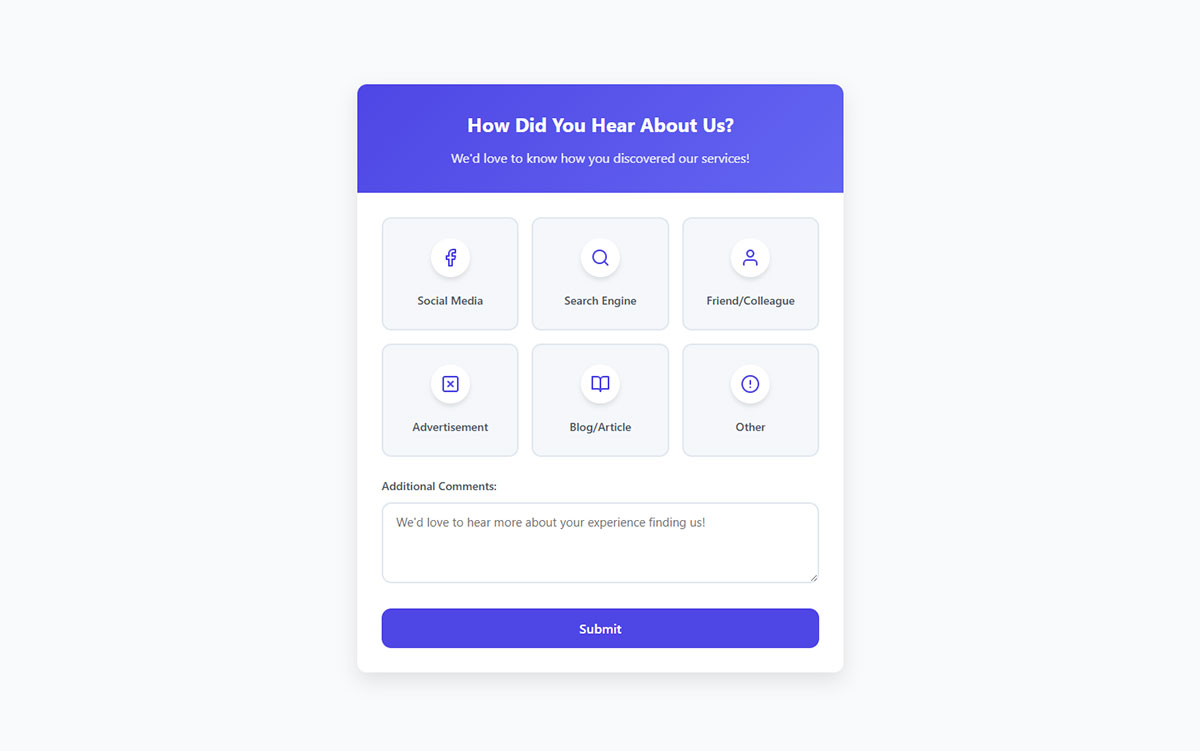
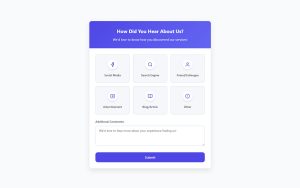
Ask it as one multiple-choice question with an open “other” field, and word it around first discovery, not the last click.
The wording matters more than people expect. Get it wrong and you only learn where the sale was collected, not where demand started.
Answer options and the “other” field
Refine Labs ran software-based and self-reported attribution side by side for 12 months across 620 declared-intent conversions (analysis published April 2023). Customers credited podcasts with 53% of closed-won revenue, while software attributed none of it to podcasts.
That data comes from B2B SaaS demand forms, not stores. Read it as proof that tracking misses channels it cannot see, not as a benchmark for your own mix.
A workable answer list covers the channels you pay for and the ones you can’t track.
- Instagram or Facebook
- TikTok
- YouTube
- Google search
- Podcast
- Friend or family
- Influencer or creator
- Other (type in)
According to ConvertFlow’s roundup of brand examples, Native’s post-purchase survey lists channels for shoppers to pick from. Mysa goes at it a bit differently, asking where customers first heard about the company and offering several options on the first step.
Podcasts and creator mentions tend to surface in the “other” box, along with plain word of mouth. Keep that box as open text and read it monthly. A pre-built template for this question gives you a starting answer list.
In a WordPress form, a Radio button field holds the answer list, and the option order can be shuffled so the first choices do not collect extra votes. When the buyer picks Other, conditional logic can reveal a text field for the typed answer.
First touch or last touch wording
Asking “When did you first hear about us?” shows how long consideration ran and which channel started it. A question about what pushed the buyer over the line does the opposite and favors recent exposure. A Fairing blog post on question variations includes an attribution variant worded to prioritize recency.
Default to first-touch wording. Switch only when the open question is which ad closed the sale.
Follow-up questions by channel
Conditional logic shows a second question only to buyers who named a channel worth digging into. Yotpo’s question bank pairs podcast answers with “which one was it?” and friend referrals with “what did they say?”
Creator answers work the same way, so ask which creator. Skip follow-ups on channels you already report at campaign level.
Which questions explain why customers bought and what almost stopped them?
What convinced the buyer and what nearly stopped them do most of the work here. Both are best as open text.
Motivation questions
Pick from these for the motivation slot.
- What convinced you to buy today?
- What problem does this purchase solve?
- Who is this purchase for?
- What occasion is it for?
- Which other brands did you consider?
Pair the alternatives question with a discount check. “Would you have made the purchase without the discount?” tells you whether the code changed the decision.
A Paragraph field is the natural home for these typed answers, and each one is saved in the entry next to the channel the buyer chose.
Hesitation and friction questions
“What, if anything, almost stopped you from completing your purchase?” surfaces objections that analytics records only as drop-off.
Baymard Institute’s checkout research names unexpected shipping, tax and fees as the leading cause of abandonment, with forced account creation also a major barrier. Your open-text answers show which of those, if any, applies to your store.
Group the answers into a short fix list, then work through it with tested ways to tighten the checkout.
There’s a limit, though. Only people who finished the purchase can answer, so the question shows what nearly stopped buyers who still bought, not why others left.
First-time and repeat buyers
First-time buyers are still forming a view of the brand, so discovery and motivation questions fit them. “Is this your first purchase in this product category?” separates category newcomers from switchers.
Repeat buyers already answered the discovery question, so skip it. Ask what brought them back, or whether the purchase was planned before the visit or decided while browsing. Tortuga has a separate returning-customer survey, per the examples in Triple Whale’s guide.
Which satisfaction and product questions belong on the confirmation page, and which wait for delivery?
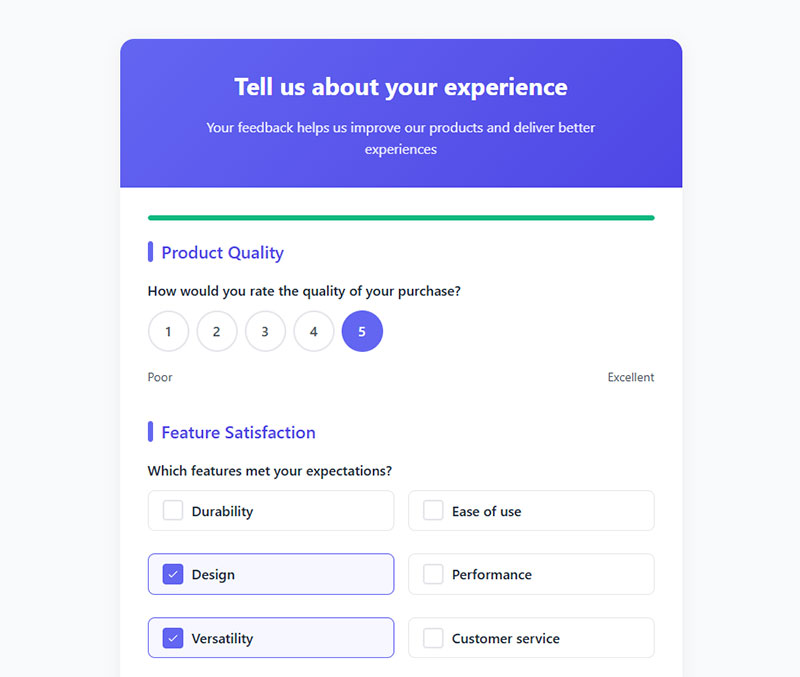
Checkout ease belongs on the confirmation page. Questions about the product, or whether the buyer would recommend the brand, wait until the order arrives.
SurveyMonkey puts checkout and attribution questions on the confirmation page, immediately after purchase. Yotpo files product feedback in a separate post-delivery group, because a buyer who has paid but not unboxed cannot rate the item.
Questions that work right after payment
Customer Effort Score (CES) was introduced by Matthew Dixon, Karen Freeman and Nicholas Toman in a 2010 Harvard Business Review article, built on Corporate Executive Board research that Gartner now owns. It was designed for support interactions, so a checkout version is an adaptation. The usual form is a statement rated from strongly disagree to strongly agree, such as “The store made it easy for me to place my order.”
Customer Satisfaction Score (CSAT) works on this page too, though here it rates the buying experience, not the product.
Pick one rating question. A second one costs completion and rarely adds a separate decision.
The Rating field covers the one-question version, with labeled levels and stored values for scoring, and the Likert field covers the agreement-statement version. The Post-purchase feedback form template is built to collect feedback on checkout, delivery and fulfillment.
Questions that need the product in hand
Net Promoter Score asks how likely the buyer is to recommend the brand on a 0 to 10 scale. Bain & Company’s Net Promoter System subtracts the percentage of detractors (0 to 6) from the percentage of promoters (9 to 10), which gives a score from -100 to 100.
Ask it after delivery. A recommendation score taken before the box arrives rates the checkout and the brand’s reputation, not the product.
Follow the score with one open question, and borrow wording from a worked set of NPS questions.
The NPS field shows 0 to 10 buttons with a label at each end, and the stored scores read directly as detractors, passives and promoters. The Customer loyalty and recommendation form template measures loyalty and likelihood to recommend.
Product-specific questions fit the same post-delivery message, and they’re short.
- What would you improve?
- Did it match the listing?
- How does it compare with what you expected?
For attribute-level phrasing, see these product quality question examples. The Product feedback form template collects feedback about a specific product, covering quality, features and usability.
Where and when should the survey appear?
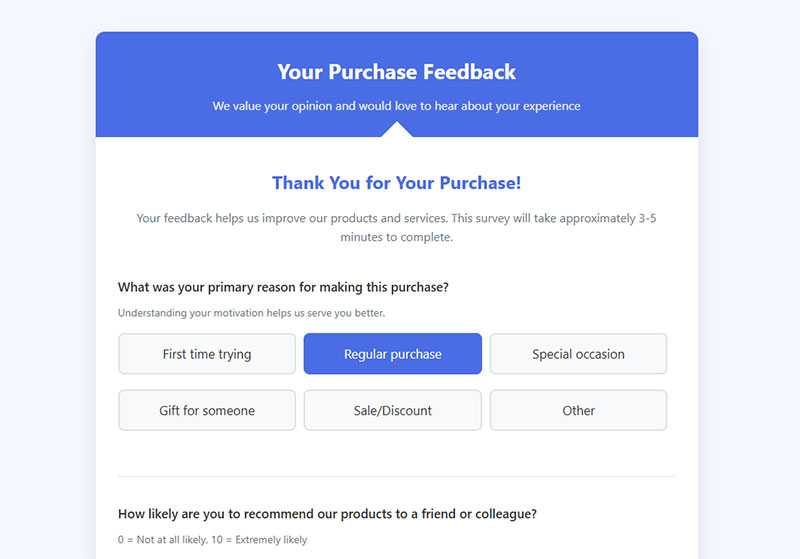
Run the attribution and checkout questions on the confirmation page the moment payment clears. Send everything about the product by email or SMS after delivery.
Confirmation page
On Shopify, the thank-you and order status pages take survey blocks through checkout UI extensions, part of Checkout Extensibility. Shopify’s changelog puts the rollout for Plus merchants on those pages at November 7, 2023.
As of October 2026 the old route is closed for every store. Shopify removed checkout.liquid, script tags and additional scripts from the thank-you and order status pages for Plus merchants on August 28, 2025, and for all other stores on August 26, 2026, when pages that had not been upgraded were upgraded automatically.
A survey app that relied on a script tag has no place to render there, so place a test order and confirm the survey still appears.
Fairing’s documentation shows the current method. The app block is added to the Thank You page and the Order Status page separately, each with its own success message, and Fairing recommends placing it above the order status block to lift response rate.
Adding it to both pages gives a shopper who skipped the survey at checkout a second chance when they return to check the order.
On a WordPress store, the same idea works with a form embedded on the order thank-you page through a shortcode or the Gutenberg block. The form’s confirmation then shows a thank-you message, or hides the form after submission so the buyer sees one clear next step.
Email and SMS follow-up
The confirmation email catches attribution and checkout answers from buyers who left before the thank-you page loaded. Product feedback and Net Promoter Score go in a post-delivery email, triggered on the delivered status and not a fixed day count. SMS suits a single rating question with a link for anything longer.
Ask each question once, in one place, so the answers stay in a single dataset.
For the link inside an email or text, a conversational form has its own permalink and shows one question at a time, which suits a phone screen.
How many questions can a post-purchase survey hold before response drops?
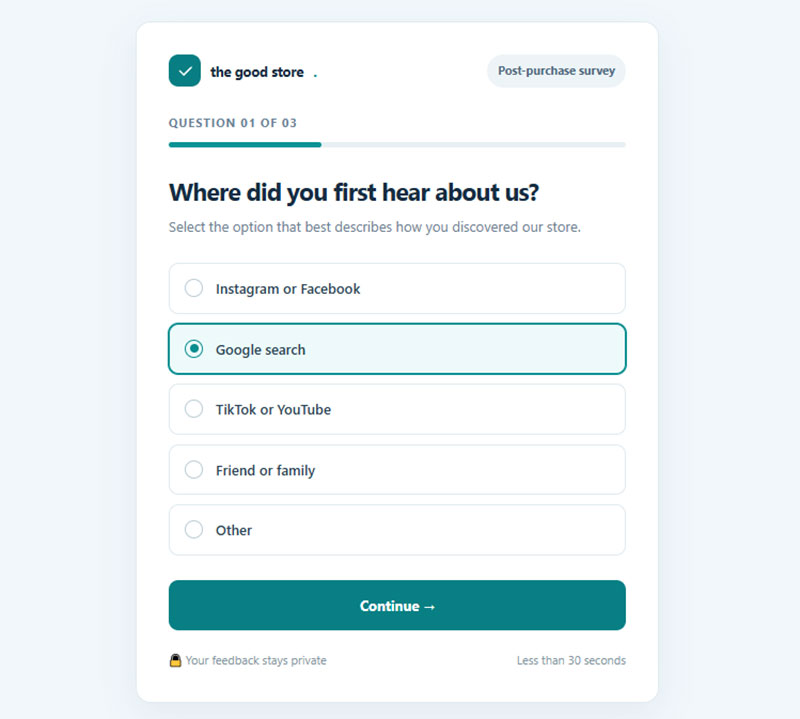
Start with one to three visible questions. Published guidance puts the ceiling in different places, partly because sources count a response differently and partly because some long surveys use logic to show each person only a few questions.
Why the length guidance varies
Yotpo says to choose 1 to 3 questions per survey to respect the customer’s time. SurveyMonkey lands higher, at four to six questions for a confirmation-page survey and one to five for quick-decision formats.
Survicate’s benchmark found that surveys with 7 or more questions had the lowest median response rate, at 6.87%, though the report notes that many of them show each person only part of the survey through logic. KnoCommerce pushes back on the whole idea, saying shorter is not automatically better for meaningful data. Its Oats Overnight case study ran 20 questions.
The sources are not measuring the same thing. SurveyMonkey divides people who started by everyone invited, while Triple Whale’s reports divide responses by all orders in the period.
A dashboard that surveys only new customers shows a higher rate than a report that divides by every order, which is why the same survey can show different rates in different dashboards.
Benchmarks and the exception
The figures, for reference.
- 45% average response rate across KnoCommerce customers (KnoCommerce)
- 58% response and 77% completion for Oats Overnight on a 20-question KnoCommerce survey
- 18.54% for SMS surveys (SurveyMonkey, 2025 platform data)
- 3.65% for popup surveys (SurveyMonkey, 2025 platform data)
The 45% and the Oats Overnight result are vendor-reported, from KnoCommerce’s own customers. SurveyMonkey’s popup and SMS figures come from general platform data, not store surveys.
Oats Overnight placed “where did you first hear about us” among its first questions, according to KnoCommerce. Length alone did not sink the survey.
Keeping the visible count low
Branching keeps the visible count low without cutting what you can ask. Show a follow-up only to buyers who gave an answer worth probing.
Returning buyers meet the survey on every order unless you limit it. Fairing and KnoCommerce both support audience targeting such as new customers only, and there are more ways to keep repeat respondents from tiring of surveys.
When a longer form is unavoidable, multi-page forms put the easy tick-box question on page one, add a progress bar, and leave the typed answers for the last page.
Multiple choice, open text or rating scale: which answer format fits which question?
Put a tick-box question first, and save typed answers for the end.
KnoCommerce lists open-ended questions up front as a common cause of low response. It suggests opening with a simple tick-box question, something attribution-based or preference-driven, and asking for a typed answer only once the buyer is engaged. SurveyMonkey says much the same, with questions ordered from easy to effortful and open-ended ones held until the shopper is invested.
A broader breakdown of the formats a builder offers sits in this guide to survey question types.
Multiple choice for attribution and consideration
Randomizing the order is worth doing. Fairing documents order bias, where options near the top pull answers toward them, and lets you shuffle display on single-response and multi-response questions.
Leave randomization off for numerical choices such as price points, where shuffling confuses people.
Open text for motivation and hesitation
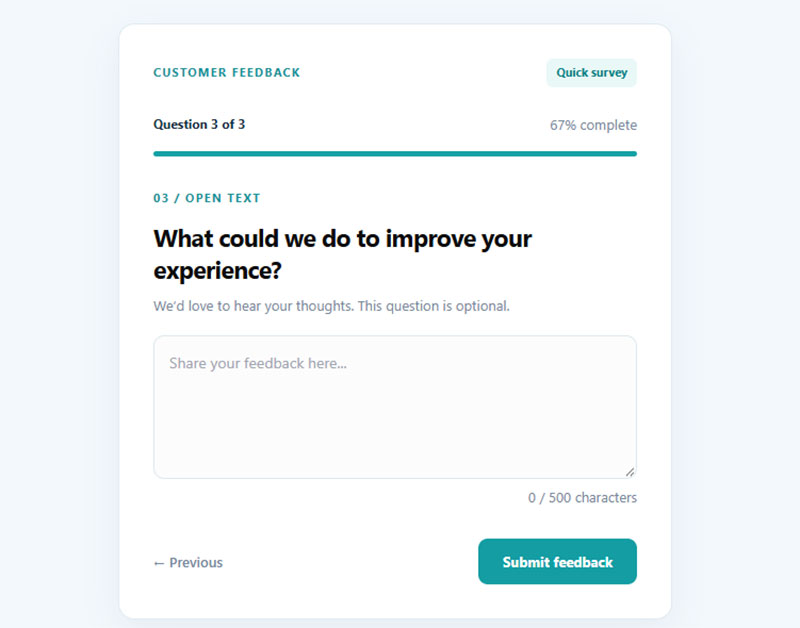
Typed answers carry what a list cannot, like a creator’s name or the exact objection. They also need reading.
Plan the coding work before launch, since someone has to sort the answers into themes unless the app does it. Zigpoll lists AI summaries of responses as a feature, so check what your tool already offers.
Rating scales for effort and satisfaction
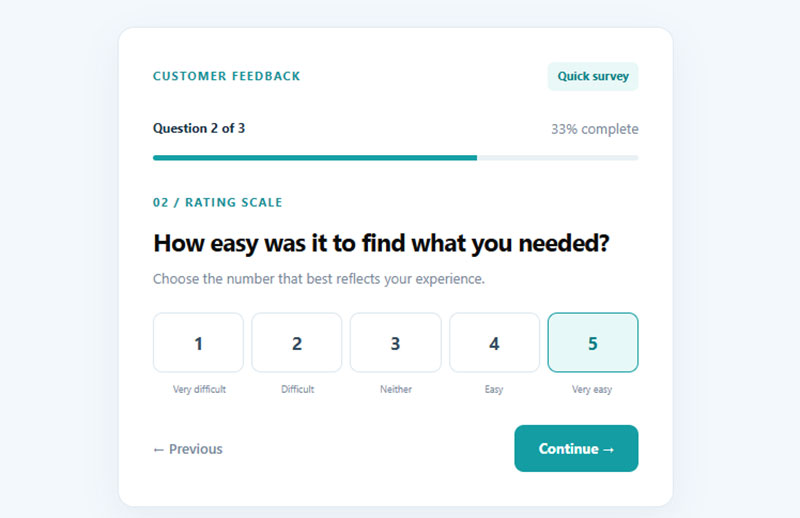
Stick to one scale style across the whole survey and label every point, not only the two ends. Neutral statements beat agreement wording, which is the format behind Customer Effort Score and invites some yes-saying.
Sample statements for each point of an agreement scale appear in these Likert scale question examples.
How to set up a post-purchase survey step by step
Pick the tool first. It decides where the survey can appear and where the answers end up.
Choosing between an app, a survey builder and email
| Option | Examples | Best for | Limit |
|---|---|---|---|
| Dedicated Shopify app | Fairing, KnoCommerce, Zigpoll | Attribution on the thank-you and order status pages | App block needed on each page |
| General survey builder | Typeform, SurveyMonkey | Post-delivery email links | Needs an embed or bridge app at checkout |
| Email platform follow-up | Klaviyo with a survey app | Post-delivery questions and reminders | Sync settings differ by app |
A dedicated app ties the answer to the Shopify order. Zigpoll says every answer is tied to a real Shopify order, and Fairing can write responses to order or customer tags through Shopify Flow. Zigpoll’s Shopify listing says it runs surveys on the thank-you and order status pages.
General builders suit the follow-up email. Older community answers tell merchants to paste a Typeform embed code into the checkout settings for the Order status page, the settings-box route Shopify retired for those pages (August 28, 2025 for Plus stores, August 26, 2026 for all others).
Klaviyo handles the email stage once responses sync. Fairing logs each answer as a “Fairing: Responded to Question” event and also writes it to the customer profile, while KnoCommerce pushes only the questions you switch on.
Stores on WordPress or WooCommerce have a plugin route. A form plugin such as IvyForms builds the survey with drag and drop, stores every answer as an entry in your dashboard, and embeds it with a shortcode, the Gutenberg block or Elementor. Its Zapier integration and webhooks can pass each answer to an email or attribution platform, and the Mailchimp integration maps answers to audience fields.
Setup steps
- Choose one goal and write the attribution question first, with an open “other” field.
- Install the survey app from the Shopify App Store and authorize it. The person installing KnoCommerce needs app installation privileges on the store.
- Open the checkout editor (Settings, Checkout, then Edit on your checkout configuration), select the Thank You or Order Status page, and add the app block from the Apps menu. KnoCommerce offers no block on the Checkout page itself.
- Place a test order. Shopify’s editor shows only a generic preview, so use an email address that has never answered, and a brand-new one if the question targets new customers only.
- Set the audience, then switch the question live.
- Turn on the Klaviyo or attribution-platform sync question by question. Klaviyo’s flow builder shows the property only after one answer has synced, so answer the survey yourself first.
Setups most often fail at one point. KnoCommerce’s troubleshooting guide names an unfinished Checkout Extensibility migration as the biggest reason stores collect no responses.
How do you compare survey answers with tracked attribution?
Convert both reports to channel shares and put them side by side. Each gap is a question to test, not a correction to apply.
Matching survey channels to tracked sources
Tracked data has holes by design. Since iOS 14.5 shipped on April 26, 2021, apps must request permission through Apple’s App Tracking Transparency prompt, and without it the advertising identifier returns zeros (Apple developer documentation).
Build the survey buckets to mirror your tracking. Google Analytics 4 does not let you edit its default channel group, but the primary channel group is editable, so a custom grouping can carry survey labels such as podcast or creator.
UTM parameters only label what you tag. A podcast mention or a creator’s story arrives without campaign parameters, so it lands wherever GA4’s rules put an untagged visit.
These patterns are worth checking, though none of them is a rule.
| Channel | Tracking tends to show | Survey tends to show | Next step |
|---|---|---|---|
| Retargeting, branded search | Strong (last click) | Weak | Check for over-credit |
| Podcast, creator | Weak (no click) | Strong | Test with a fixed budget |
| Word of mouth | Hidden in direct | Strong | Read it from the survey alone |
Recast notes that most other attribution methods lean toward lower-funnel channels such as paid search, while self-reported answers lean toward memorable ones.
How attribution platforms merge the two
In Triple Whale, matching answers get added to the customer journey with no change in credit, so the order is not counted twice. If the two differ, a tracked Meta Ads click with a “TikTok” survey answer keeps its credit with Meta. Orders with no tracked click are assigned by the survey answer and show in their own survey row.
Triple Whale’s Triple Attribution and Total Impact models read only the first attribution question in a survey, per its knowledge base. Its Fairing integration also looks for specific phrases in the question text, so reword that question with care.
Compatibility has gaps too. Fairing’s documentation says its Rockerbox integration sends no event data on stores using Shopify Checkout Extensibility, while KnoCommerce documents a Rockerbox integration that pushes events for the question you select.
Whose number wins
Triple Whale lets tracked data win when the two disagree. Recast argues for layered reporting that keeps both views, and Hyros (August 2026) calls the gap between them the dark social estimate.
The positions fit the same data. TrueROAS puts the split plainly. The survey sets channel weight, while tracking supplies campaign and creative, since customers say “Instagram” and not an ad set.
Group the “other” answers into channels before you compare any shares, using a routine for analyzing survey data.
When the answers live in a form plugin, the entries table searches and filters by date range, and the wpDataTables integration turns entries into tables and charts, which makes channel shares easy to read at a glance. Choose only non-personal fields for any table shown on the front end.
Suppose podcast keeps showing up in “other” while tracking files those orders under direct. The survey cannot say which show, so add the follow-up question and fund a fixed test.
When do post-purchase survey answers mislead?
They mislead when buyers name the platform they remember instead of the touch that mattered, and when only a self-selected slice answers.
Where the answers distort
RevenueCat argues that self-reported discovery overrepresents familiar channels and fails to capture true causality as the media mix expands (app install data). The answer also cannot rank creative, because customers name the app and not the ad (TrueROAS).
Then there’s self-selection. KnoCommerce warns that if only a certain type of buyer answers, the metric will mislead.
Peer-reviewed work attacks the problem from the other side. Juergens, Stark and Magin (Social Science Computer Review, 2020) found that mobile tracking data is itself linked to systematic distortions, after earlier studies used tracking to show self-reports of media exposure are unreliable.
That study covers media exposure, not checkout surveys, but the logic transfers. Read alongside Recast’s lower-funnel point and Triple Whale’s pixel-first tiebreak, it points one way. Neither source is ground truth, so the disagreement between them is the useful signal.
When the survey adds little
Some stores get little out of it.
- Low order volume, since Triple Whale’s Total Impact model needs a statistically significant number of survey responses relative to total orders
- Gift-heavy catalogs, where the buyer is not the person who discovered the brand
- Stores advertising on a single channel, which leaves little to reconcile
- Repeat-heavy customer bases. When the same question runs on a later order, the answer saved to the Klaviyo profile can be overwritten (Fairing recommends building on the response event for this reason), and the first-purchase source is gone
A survey that disagrees with tracking is a prompt to test. It is not a verdict.
Post-Purchase Survey Questions FAQ
What is a post-purchase survey?
Shoppers see it on the confirmation page right after checkout, a short questionnaire asking how they found the store and why they bought.
Apps such as Fairing and Zigpoll tie each answer to the order, so the responses can be compared with tracked data.
Is a post-purchase survey the same as a review request?
No. The survey is a private questionnaire for the brand, while a review request asks for a public rating that future shoppers read.
Yotpo notes that asking through a reviews tool can turn feedback into user-generated content.
Should you offer a reward for completing the survey?
The sources split. Yotpo says loyalty points can lift completion, while SurveyMonkey warns that incentives can skew who responds, advises against them for a short survey at purchase, and says to avoid rewards when you run a series of similar surveys over time, where they can harm the quality of feedback.
A permanent confirmation-page survey is that kind of repeating series, so skip the reward there.
Do survey responses need consent under GDPR?
Not automatically. GDPR requires an Article 6 lawful basis before collecting any personal data, and consent is only one option beside legitimate interests.
Answers tied to an order or customer profile count as personal data, so name the basis in your privacy notice and confirm it with a privacy lawyer. Where you do rely on consent, the GDPR field adds a required, unticked consent checkbox with a link to your privacy policy.
Can you run one on a store that is not on Shopify?
Yes. KnoCommerce supports custom survey locations for stores outside Shopify, and Triple Whale documents a survey setup for BigCommerce stores.
Fairing also lists a web SDK install next to its Shopify app. On a WordPress or WooCommerce store, a form plugin such as IvyForms can run the same survey from the feedback form templates, each fully editable.
When to Retire a Question From the Confirmation Page
Post-purchase survey questions stay on the confirmation page until their answers stop changing a decision. Response rate gives the earlier warning.
SurveyMonkey reads a rate that falls between survey cycles as a sign that something about the audience, the delivery or the design has shifted. KnoCommerce treats anything below 10% as a fault in timing or delivery, or in the wording.
Retire in this order, so the attribution trend line is the last thing to change.
- Questions whose answers repeat after the fix has shipped
- Questions whose response rate keeps falling between cycles
- The attribution question, with its replacement run in parallel for one cycle
Every swap buys new information at the price of comparability, because shares measured before and after a wording change form two different series. Running the replacement as its own form for one cycle keeps the two entry histories apart.
Candidates for the open slot sit in a wider bank of feedback survey questions.