






Google Analytics files plenty of visits under direct that were never direct. In a 2023 experiment by SparkToro and Really Good Data, covering 1,113 test visits across 11 networks, 100%…
Table of contents
A single confusing survey question can undo months of careful data collection. Feedback survey questions determine whether a team collects a real signal or just filler text, and that matters more than which platform sends the survey or when it lands in someone’s inbox.
Gartner’s research on customer effort found it predicts loyalty about 40% more accurately than satisfaction scores alone. That’s a big gap for something as simple as how a question gets worded.
Wording is the line between real opinion and outright confusion, and format decides whether you get a checkbox back or a full paragraph. Timing is its own problem entirely, since none of that matters if nobody finishes the survey in the first place.
Nail these and feedback stops being noise. It starts shaping decisions instead.
What Is a Feedback Survey Question
Ask someone their age and you get a fact. Ask them how satisfied they were with checkout and you get feedback. That’s the real line a feedback survey question sits on, a structured prompt built to pull out opinion, experience, or a rating, rather than a demographic detail.
These prompts show up in plenty of places: emails triggered right after a purchase or a support ticket, quick in-app popups that interrupt a session for one answer, exit-intent overlays that catch someone before they close the tab, and follow-ups tied to a resolved support case.
Median response rates across every channel sit at just 9.98% (Survicate, 2025). That’s already a thin pool of respondents, so wasting even a slice of it on a confusing question is a bigger deal than most teams treat it as.
Most teams don’t build these from scratch every time either. A dedicated survey form builder handles the scale logic, branching, and mobile layout that raw questions need to actually work.
What Are the Main Types of Feedback Survey Questions
Closed formats hand you numbers you can drop straight into a chart. Open formats hand you sentences someone actually has to read. Most surveys end up mixing the two, since neither one covers everything on its own.
| Format | Data Type | Best For |
|---|---|---|
| Closed-ended | Categorical, quantifiable | Tracking trends over time |
| Open-ended | Qualitative, free text | Uncovering unexpected issues |
| Rating scale | Numeric score | Benchmarking satisfaction or loyalty |
| Ranking or matrix | Ordered or grid comparison | Comparing several items at once |
Closed-Ended and Open-Ended Questions
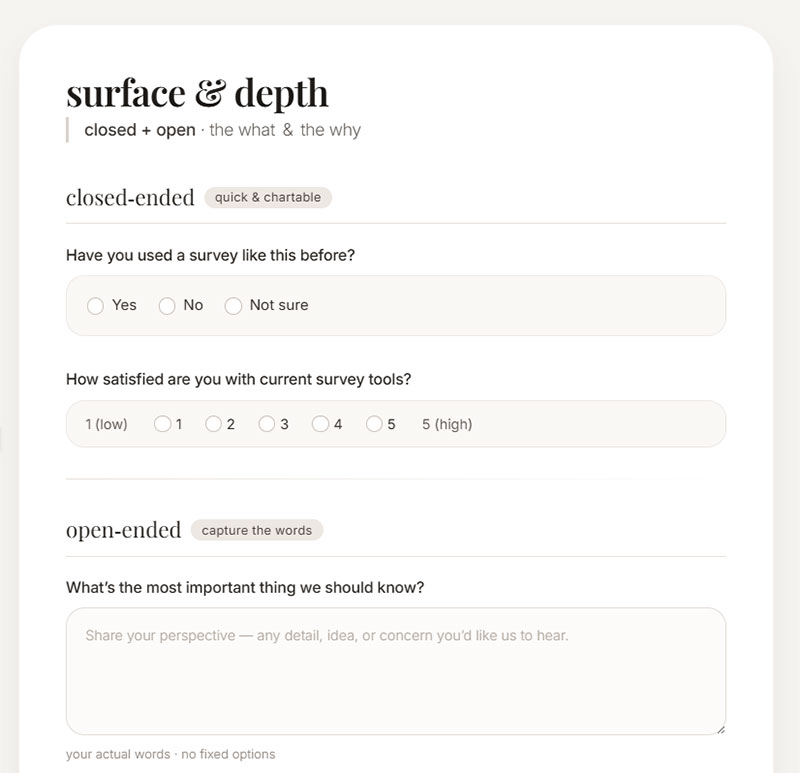
Closed-ended questions lock the response down to fixed options, a yes or no, a multiple choice list, or a scale. Open-ended questions leave the box blank and let the respondent write whatever they want.
Closed formats are quick to answer and just as quick to chart. Open formats surface the kind of language a checkbox could never capture, the actual words someone used to describe a problem. Put both in the same survey and you get the what and the why without sending two separate emails.
Sticking one open-ended question at the end of an otherwise closed survey lines up with most types of survey questions researchers actually recommend.
Rating Scale Questions
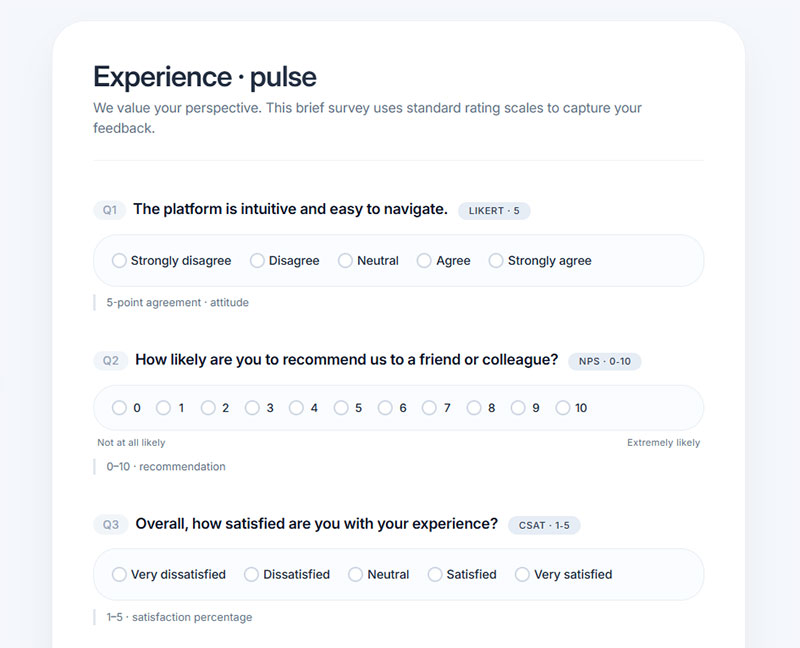
Likert, Net Promoter Score, Customer Satisfaction Score, and Customer Effort Score cover most of the rating scales you’ll run into in a feedback survey.
A Likert scale runs on a 5 or 7-point agreement range, built for attitude questions rather than hard facts. These examples of Likert scale questions give a decent sense of how the phrasing usually goes.
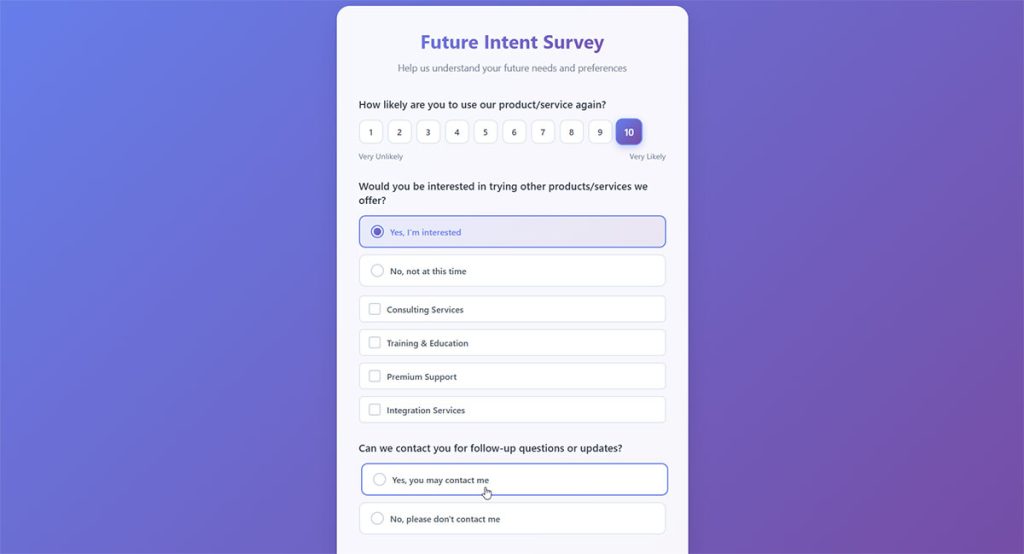
Net Promoter Score narrows everything down to one 0-10 recommendation question. Fred Reichheld and Bain and Company created it back in 2003, and it’s held up remarkably well for something that simple.
CSAT and CES measure different things despite sounding almost identical. CSAT rates satisfaction on a 1-5 or 1-10 scale and reports the result as a percentage. CES uses a 1-7 statement scale instead, measuring how easy an interaction felt rather than how happy someone was with it. It was originally built by CEB, which Gartner now owns.
Ranking and Matrix Questions
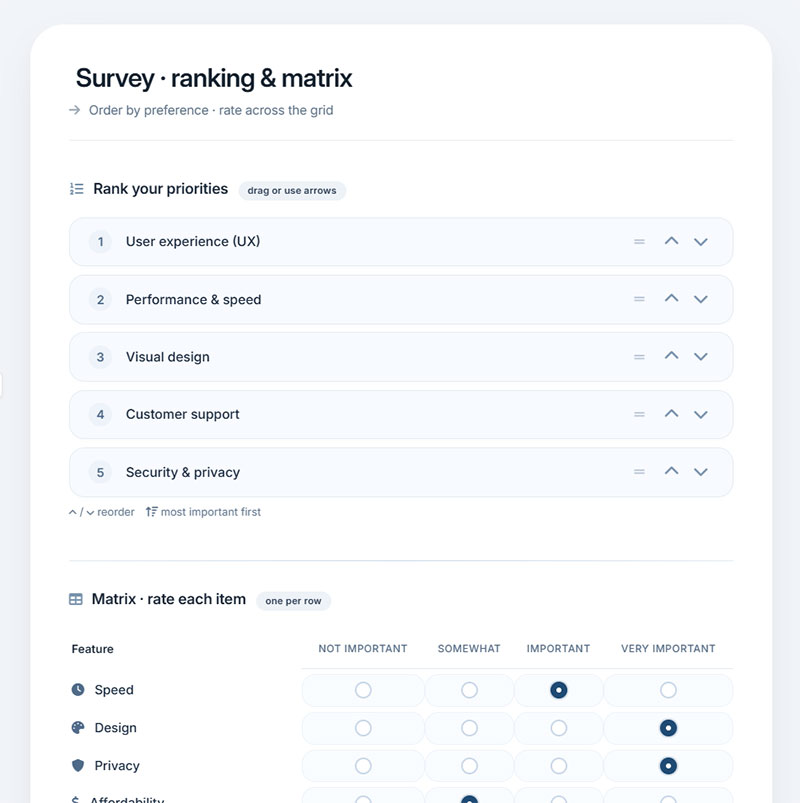
Ranking questions ask respondents to order a set of options by preference, from most important down to least. Matrix questions do something similar but different, they put several related items into one grid and rate them all against the same scale.
Both formats pack a lot of comparison into a single screen. The tradeoff is length. A ten-row matrix takes real effort to finish, and drop-off climbs the further down the grid a respondent has to scroll.
How Do You Write Effective Feedback Survey Questions
Bundle two ideas into one question and the answer you get won’t mean much, just an average of two different opinions squeezed into a single response. Good questions stick to one idea, use neutral language, skip vague terms, and keep the scale pointing the same direction every time. General satisfaction questions come before specific ones, always. Skip any of these rules and bias or plain confusion creeps into the results.
Wording and Neutrality Rules
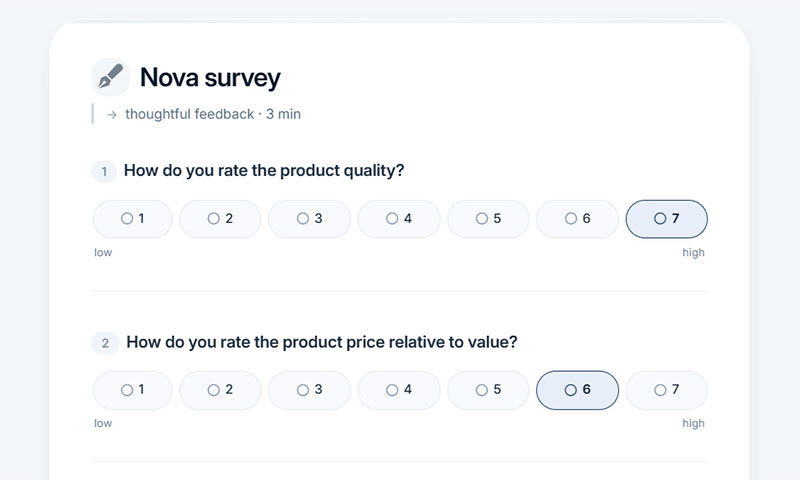
Bundling “quality and price” into one line forces respondents to average two different opinions into a single answer. That’s the trap worth avoiding first.
Keep the wording neutral, no adjectives that hint at the answer you’re hoping for. Go specific instead of vague (“How long did checkout take” beats “Was checkout fast” every time). And hold the scale direction steady across the whole survey, always low to high, never flipping halfway through and confusing everyone.
These rules sit at the core of most best practices for creating feedback forms, whether the question sits in an email, a popup, or a native app screen.
Question Order and Flow
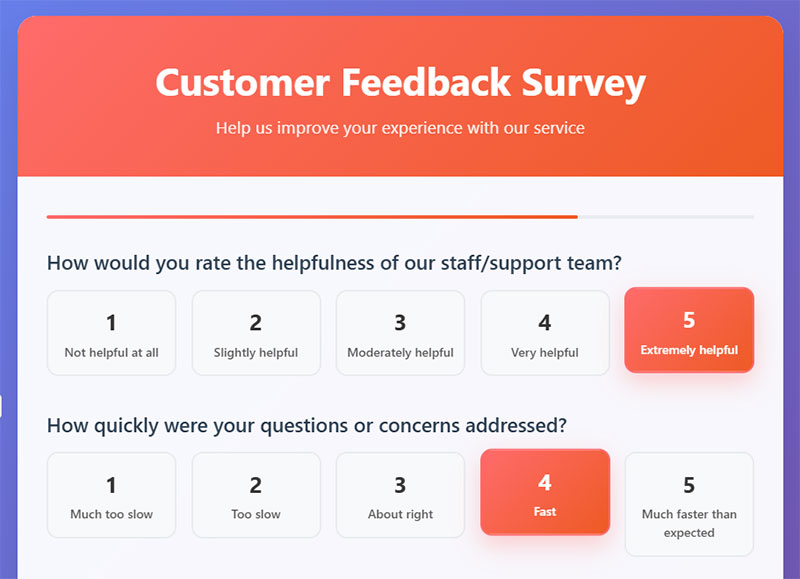
Order shapes how honestly people answer. General satisfaction questions belong first, before anything narrows attention down to a specific detail.
Survicate’s 2025 data on completion rates shows just how sharp that drop can be. Microsurveys running 2-3 questions hit an 86.8% completion rate, and that number falls to 77.4% once a survey stretches to 4-6 questions.
Two things follow from that. Put open-text boxes near the end of a survey, never at the start. And cut any question that wouldn’t actually change a decision you’re planning to make anyway.
What Mistakes Weaken Feedback Survey Questions
The most common mistakes are leading questions, double-barreled phrasing, missing neutral options, unexplained jargon, and open-text prompts that drag on too long. Each one does the same basic damage. It either confuses the respondent or nudges them toward an answer that doesn’t reflect what they actually think.
| Mistake | Example | Effect |
|---|---|---|
| Leading question | “How helpful was our amazing team” | Pushes toward a positive answer |
| Double-barreled | “Was it fast and easy to use” | Forces one answer onto two questions |
| Missing neutral option | Scale with no midpoint | Forces a fake opinion |
Kantar’s research on question design treats leading and double-barreled phrasing as equally damaging, since both distort the data before a single response comes in.
Jargon and long open-text prompts cause a quieter version of the same problem, the kind covered in how to avoid survey fatigue. People just disengage before they get around to answering honestly.
Customer Feedback Survey Questions
Customer feedback survey questions show up at specific points in the journey, right after a purchase, once a support call wraps up, or following a cancellation. What they’re really doing is checking whether the experience landed where it should have, fell short, or beat expectations outright.
| Metric | Question Focus | Best Timing |
|---|---|---|
| CSAT | Satisfaction with one interaction | Right after purchase or ticket close |
| NPS | Overall loyalty and referral likelihood | Quarterly or after a milestone |
| CES | Ease of resolving a specific issue | Immediately after support contact |
Satisfaction and Service Quality Questions
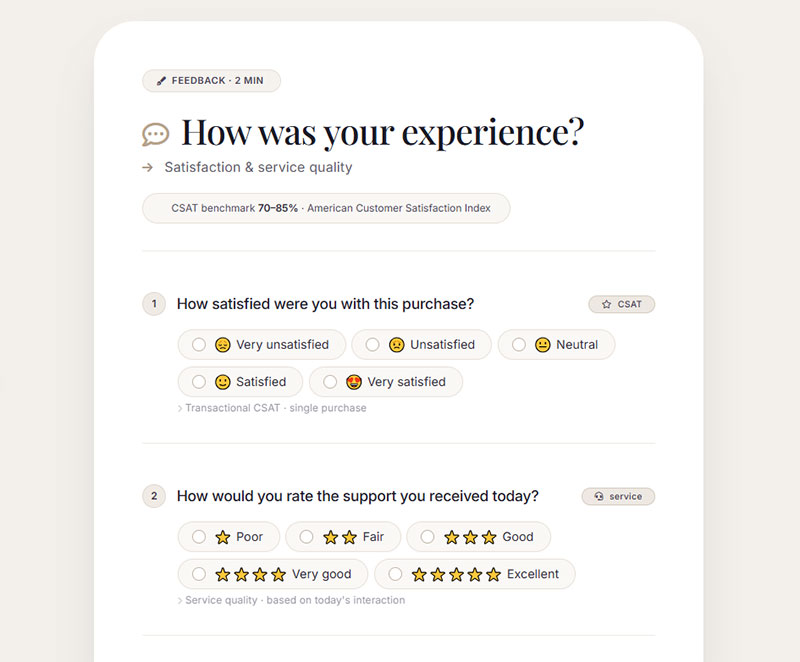
These questions target a single transaction or support case while the experience is still fresh.
Customer Satisfaction Score benchmarks run between 70% and 85% across most industries, according to the American Customer Satisfaction Index.
- “How satisfied were you with this purchase” for transactional CSAT
- “How would you rate the support you received today” for service quality
- “Was your issue resolved on the first contact” for effort-adjacent tracking
Many teams pull directly from a bank of customer service survey questions rather than writing new ones for every touchpoint.
Loyalty and Net Promoter Score Questions
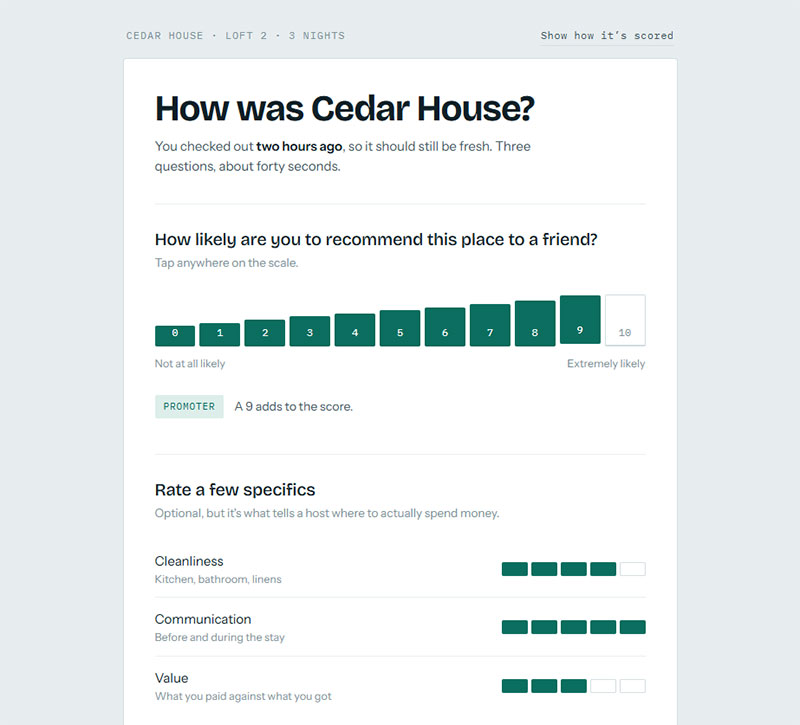
Net Promoter Score is calculated from one question: “On a scale of 0 to 10, how likely are you to recommend us to a friend or colleague.”
Respondents scoring 9 or 10 are promoters, 7 or 8 are passives, and 0 through 6 are detractors. NPS itself is the percentage of promoters minus the percentage of detractors.
Two-thirds of Fortune 1000 companies now track NPS as a leading indicator of revenue growth and retention (CustomerGauge).
Airbnb pairs a post-stay NPS question with six-category star ratings covering cleanliness, communication, and value, feeding both scores back into host performance reviews.
Timing matters here too, maybe more than people give it credit for. Sending the question while everything’s still fresh (the same logic behind most post-purchase survey questions) tends to pull more honest answers than waiting around and hoping someone remembers.
Employee Feedback Survey Questions
Ask an employee about their manager and the honesty of the answer depends entirely on whether their name is attached to it. That’s the real difference between employee feedback survey questions and customer ones, the tone and the stakes shift completely. These questions end up measuring engagement, how effective a manager actually is, and the real reasons people eventually walk out the door.
Engagement and Manager Feedback Questions
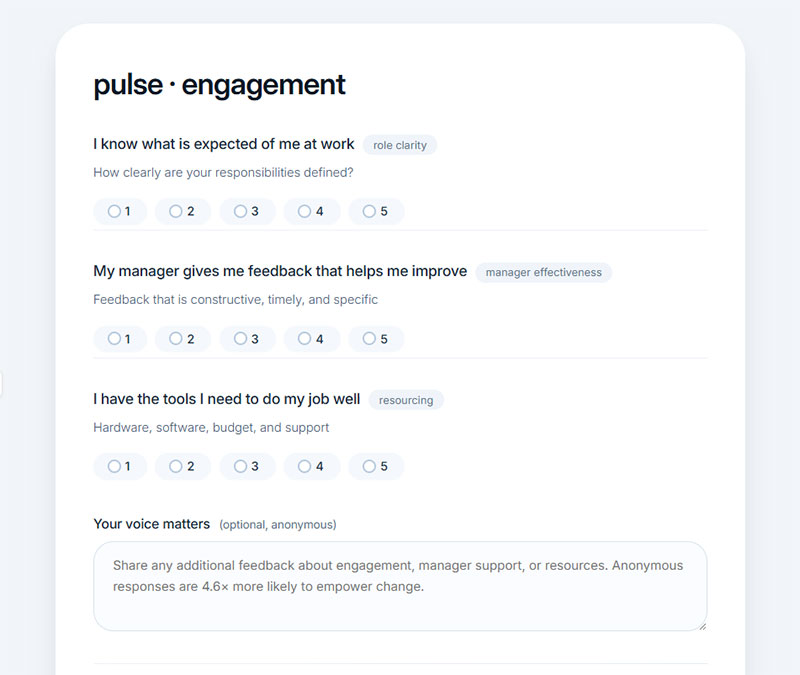
Global engagement sits at just 20%, its lowest level since 2020 and down from a 2022 peak of 23%, while US engagement remains stuck at 31%, matching its decade low, according to Gallup’s workplace research.
- “I know what is expected of me at work” for role clarity
- “My manager gives me feedback that helps me improve” for manager effectiveness
- “I have the tools I need to do my job well” for resourcing
Employees who feel their voice is heard at work are 4.6 times more likely to feel empowered to do their best work, per Salesforce research. That’s part of why anonymous formats tend to outperform attributed ones for this category.
Marks and Spencer runs quarterly pulse surveys alongside one larger annual employee satisfaction survey, tying manager engagement scores directly to a performance KPI.
Exit Interview Questions
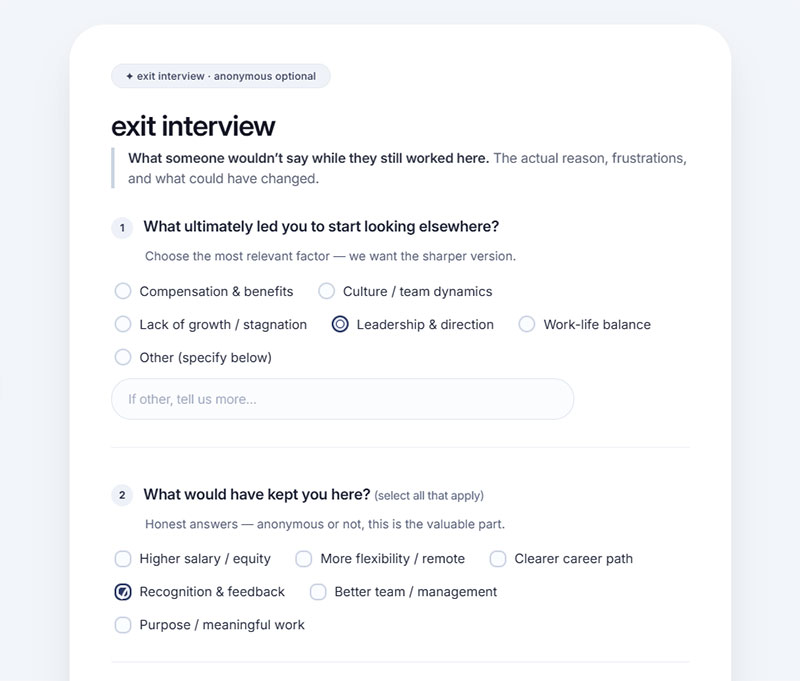
Exit interview questions get at what someone wouldn’t say while they still worked there: the actual reason they’re leaving, frustrations they never raised, whatever might have changed their mind if someone had asked sooner.
Voluntary turnover costs US businesses close to 900 billion dollars a year in replacement and lost productivity, according to Work Institute’s 2024 Retention Report.
- “What ultimately led you to start looking elsewhere”
- “What would have kept you here”
Attributed exit surveys tend to produce softer answers, the diplomatic version. Anonymous ones get you the sharper, more useful version instead.
Product Feedback Survey Questions
These questions aren’t really about satisfaction, they’re about steering the roadmap. Feature requests, friction in the interface, how someone perceives the price, and the first few days of onboarding, when a user’s opinion of the product is still forming rather than fixed. That’s the territory product feedback survey questions cover.
Feature and Usability Questions
A 2016 survey of product managers by Mind the Product found 49% did not know how to prioritize features without direct customer feedback, a finding still cited across product research today (Productboard).
- “What is the one feature that would make this easier to use”
- “Were you able to complete this task without help”
- “What almost stopped you from finishing this task”
Usability questions tied to a specific task produce sharper answers than general ones. That’s why most survey questions about product quality get asked right after the task, not at the end of a session.
Starbucks ran its My Starbucks Idea platform for years, turning close to 300 of the more than 150,000 submitted ideas into real menu and store changes.
Pricing and Onboarding Questions
Pricing questions test perceived value, not willingness to pay in the abstract. “How would you feel if this feature was no longer available” reveals more than a direct price question ever does.
Onboarding questions belong in the first few days of use, before habits form and early friction gets forgotten.
- “What almost stopped you from completing setup”
- “What were you expecting that you have not found yet”
Teams running structured onboarding survey questions at day one, day seven, and day thirty catch friction while it’s still fixable.
Website and User Experience Feedback Survey Questions
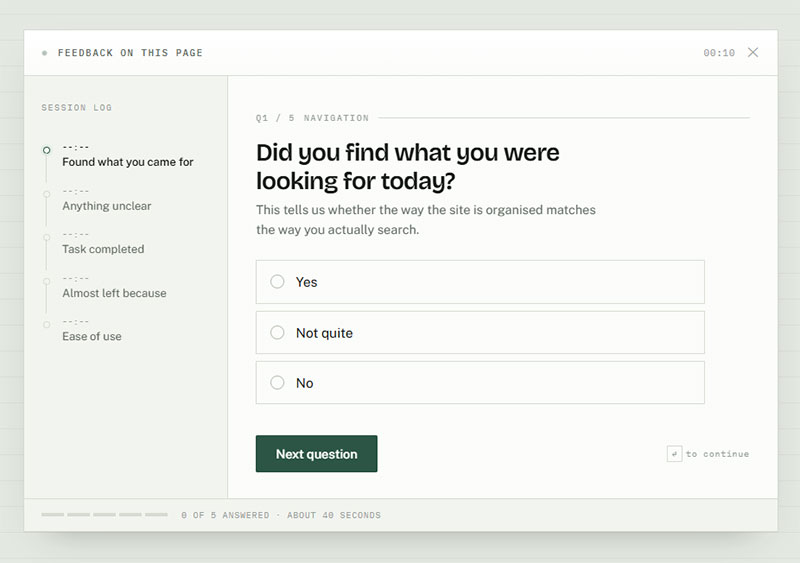
Can a visitor find what they came for? Do they understand the page in front of them, or does something trip them up along the way? Website and user experience survey questions chase both answers, along with whether someone can finish a task without getting stuck, and they live inside on-page widgets and popups rather than showing up in someone’s inbox.
Something like “Did you find what you were looking for today” checks whether the site’s navigation actually matches how people search, whether the structure someone built makes sense to a visitor who didn’t build it.
A question like “Was anything on this page confusing or unclear” surfaces wording problems before they turn into support tickets, which is honestly the whole point of asking early.
- “Were you able to complete what you came here to do” for task completion
- “What almost made you leave this page” for friction diagnosis
- “On a scale of 1 to 5, how easy was this page to use” for a quick usability score
Nielsen’s usability research found that testing with just 5 participants uncovers roughly 85% of a page’s usability problems in a single round, with a second small-sample round catching most of what remains. That’s why on-site question widgets rarely need large sample sizes to actually be useful.
GOV.UK runs a two-button “Is this page useful” component across more than 700,000 pages, routing every “No” answer into a short follow-up about what went wrong.
Task-specific prompts tied to a flow tend to outperform generic ones, since a question asked right after checkout produces sharper answers than the same question asked on a random page visit. This logic sits behind most website feedback survey questions and most website usability survey questions placed directly inside a task flow.
Event Feedback Survey Questions
Before an event even starts, these questions set expectations. Afterward, they measure how the sessions landed, whether speakers delivered, and how the logistics held up. Most standardized post event survey questions follow this same two-window structure, one round before, one round after.
| Window | Focus | Example Question |
|---|---|---|
| Pre-event | Expectations and topic interest | “What do you most want to learn at this event” |
| Post-event | Content and logistics quality | “How would you rate the relevance of the sessions” |
Pre-Event Questions
Pre-event questions set the agenda before a single session starts.
- “What topics are you most interested in seeing covered”
- “What would make this event worth your time”
Registration data paired with a short pre-event question often shapes session selection more accurately than registration numbers alone.
Post-Event Questions
Feedback collected within 2 hours of an event ending scores 40% higher on actionability than delayed surveys, according to the Event Marketing Institute’s 2024 study.
Conference and corporate events typically pull a 10-20% response rate, narrowing to 12-15% for trade shows (Explori).
- “How would you rate the overall quality of the sessions”
- “How likely are you to recommend this event to a colleague”
- “What should we do differently next time”
How Many Questions Should a Feedback Survey Include
Somewhere between 1 and 10 questions is the sweet spot for most feedback surveys, and completion rates fall off steadily past that. In-app micro-surveys do best staying at 1 to 3 questions. Standalone surveys can stretch to 5 or 10 before people start bailing.
SurveyMonkey’s analysis of 100,000 surveys found the sharpest completion drop-off happens within the first 15 questions, with each added question in that stretch costing more respondents than any question added afterward.
Length compounds with time on task. Kantar’s research found surveys running past 25 minutes lose more than three times as many respondents as those finished in under 5 minutes.
- Nearly 20% of respondents abandon a survey once it reaches around 60 questions (Zoho)
- Abandonment can climb as high as 75% by 100 questions
Open-text questions belong at the end of a longer survey, not the beginning. They demand more effort than a scale or multiple-choice item and get skipped more often when placed early.
Which Tools Are Used to Build Feedback Surveys
Depending on where the audience already lives, teams reach for a general-purpose platform, a micro-survey tool built specifically for NPS and CSAT, or a WordPress-native plugin.
| Tool | Purpose | Best For |
|---|---|---|
| Typeform, Google Forms | General-purpose survey building | One-off surveys, simple logic |
| Qualtrics | Enterprise research platform | Complex branching, large research teams |
| Retently, Hotjar | In-app and on-site micro-surveys | NPS, CSAT, and CES at scale |
Delighted, long a popular pick for NPS, CSAT, and CES with more than 50 integrations including Slack and Zapier, was sunset by its parent company Qualtrics on June 30, 2026. Teams that relied on it are migrating either into the Qualtrics XM suite or to comparable standalone tools such as Retently, which covers the same three metrics.
Hotjar places surveys as a side popover, a full-screen overlay, or an external link, and lets teams start from a template or build one from scratch, per Hotjar’s help documentation.
Logic branching, integration depth, and monthly response limits usually separate a free tier from a paid one, more than the core question types on offer.
Sites already running on WordPress often skip a separate subscription entirely and handle this with a dedicated WordPress survey plugin instead.
When Do Feedback Survey Questions Fail to Produce Useful Data
Response bias tops the list. Undersized samples come in close behind it, and so does bad timing, when a survey lands well after the experience it’s asking about actually happened. Each failure mode distorts the data in its own direction, not just in general.
| Failure Mode | Cause | Effect |
|---|---|---|
| Self-selection bias | Only strong opinions respond | Skews toward extremes |
| Undersized sample | Too few completed responses | Wide margin of error |
| Timing mismatch | Survey sent long after the event | Distorted or forgotten detail |
Self-selection bias pulls in respondents who feel strongly, positive or negative, while the quiet middle stays silent. Scribbr’s research on this pattern notes that volunteers and non-volunteers differ systematically enough to skew a sample on their own.
Undersized samples carry the same risk from a different angle. Roughly 400 completed responses are needed for a 5% margin of error at 95% confidence in a large population, while populations under 5,000 typically need 10-15% participation to hit that same band (Clootrack, 2025).
Timing failures are quieter but just as damaging. A question sent weeks after a support case closes asks someone to reconstruct a memory rather than report an experience, and the answer reflects that gap.
FAQ on Feedback Survey Questions
How Do You Analyze Feedback Survey Results
Group closed-ended answers into trend charts by question and time period. Read open-ended responses for repeated themes, not individual complaints. A dedicated guide to how to analyze survey data covers scoring methods in more depth.
What Is a Good Response Rate for a Feedback Survey
There’s no universal benchmark here. In-app micro-surveys often clear 30 to 50%, while cold email feedback requests typically land in the single digits. Compare your rate to your own channel’s history, not to a different survey type entirely.
Do Feedback Surveys Need to Be Anonymous to Get Honest Answers
Not always, but stakes matter. Employee and exit interview questions get more honest answers when anonymous, since job security worries shape responses. Customer feedback tied to a name is usually fine, since there’s less to lose by being candid.
How Often Should You Send Feedback Surveys
Transactional questions go out after every relevant interaction. Relationship surveys like NPS work best quarterly, since asking more often produces repeat fatigue without new information. Pulse surveys sit in between, typically monthly, built for tracking change rather than one-time scores.
Do Feedback Surveys Need an Incentive to Work
No, but incentives lift response rates for longer or lower-stakes surveys. A short in-app question rarely needs one. A 10-minute survey asking for detailed opinions usually performs better with a small discount, entry, or donation attached.
What Is the Best Time to Send a Feedback Survey
There’s no fixed calendar rule for this. In-app and on-site questions trigger from user behavior, not a send time, which is why they tend to outperform email-based requests. Match an email survey’s send time to when that audience actually checks its inbox.
Are Single-Question Feedback Surveys Effective
Yes, for a narrow goal. A single well-placed question, like a post-chat rating, captures a clean signal without the drop-off longer surveys create. The tradeoff is depth, since one question can’t explain why a score moved, only that it did.
What Is the Difference Between a Feedback Survey and a Poll
A poll is just one quick question, usually grabbing a snapshot opinion that isn’t tied to any specific experience. A feedback survey works differently. It targets a defined interaction, a purchase or a support call, and usually mixes rating scales with open text to get more than just a number.
Can Feedback Survey Questions Be Translated for Global Audiences
Yes, and literal translation isn’t enough on its own. Rating scale labels, agreement phrases, even color cues carry different weight across cultures, which can shift how people answer the exact same question. Most survey tools support localized versions instead of one template.
How Long Should You Keep a Feedback Survey Open Before Closing It
Most transactional surveys collect enough signal within 7 to 14 days. Relationship surveys like quarterly NPS often stay open 2 to 3 weeks to catch slower responders. Closing too early shrinks the sample. Too long invites stale answers.
Conclusion
Most teams buy a new platform before fixing a single bad question, and for feedback survey questions specifically, that order is backwards.
Phrasing compounds. It carries across every channel, every audience segment, every question type, long before which tool you pick ever enters the picture.
Fix the phrasing in your top three questions first. Everything else can wait.
Platform migration, incentive structure, and send time and cadence can all wait until the wording itself is solid.
A clean CSAT question on a mediocre tool still beats a confusing one on Qualtrics.
Expect this to take longer than an afternoon. Rewriting one Net Promoter Score prompt, testing it, and confirming the response rate actually held steady usually eats a full survey cycle, not a single send.