






Google Analytics files plenty of visits under direct that were never direct. In a 2023 experiment by SparkToro and Really Good Data, covering 1,113 test visits across 11 networks, 100%…
Table of contents
Only 23% of employees worldwide say they are actually engaged at work, according to Gallup’s 2024 State of the Global Workplace Report. The right employee satisfaction survey questions are usually the fastest way to find out why that number is so low.
Most companies already run some kind of survey. Few of them ask anything specific enough to actually point at a problem. A vague pulse check tells you morale sits at a 3.2 out of 5 and stops there. A sharper set of questions tells you it’s one manager people have stopped trusting, or one policy that’s quietly draining goodwill on a specific team, and gives HR something to actually go fix.
Part of it is just design. Surveys get buried in soft language, padded with extra items nobody reads all the way through, or built off a template that was never really written with this company’s employees in mind. What separates a survey people finish from one they click through on autopilot usually comes down to the questions themselves, not which platform is running it.
What Is an Employee Satisfaction Survey?
HR teams reach for this kind of survey when a general sense that morale is “fine” isn’t good enough anymore. It usually combines a handful of rating scale items, a couple of open text fields, and demographic tags like department or tenure, all packaged into one instrument that takes ten or fifteen minutes to fill out.
Gallup’s 2024 State of the Global Workplace Report found only 23% of employees worldwide are engaged at work. That gap is a big reason HR teams run satisfaction surveys alongside engagement tracking rather than instead of it.
Structurally, most instruments include:
- rating scale items, usually running 1 to 5 or 1 to 7
- open-ended text fields for the story behind the numbers
- demographic tags covering department, tenure, and location
- one overall satisfaction question, kept separate so it doesn’t get averaged into the rest of the score
Nobody has to build a question bank completely from scratch either. Most platforms, Culture Amp, Officevibe, Qualtrics, SurveyMonkey, Gallup Access, ship with pre-built survey form templates that HR can adjust instead of writing from zero.
The demographic layer is what makes results useful later. Tagging each response with demographic questions about department, tenure, or location means someone can slice the data by team once it comes in, instead of staring at one company-wide average that hides where the actual problem lives.
A few validated instruments keep showing up in this space.
| Instrument | Focus | Best For |
|---|---|---|
| Gallup Q12 | Engagement conditions | Manager-level conversations |
| Job Descriptive Index | Facet-level satisfaction | Academic and HR research |
| Minnesota Satisfaction Questionnaire | Intrinsic and extrinsic satisfaction | Long-form diagnostic studies |
A lot of this traces back to Frederick Herzberg’s Two-Factor Theory. His hygiene factors, things like pay and job security, don’t really make anyone happy when they’re present. They just stop people from getting angry. The stuff that actually pushes satisfaction up (recognition, growth, feeling like the work matters) is a separate bucket entirely.
Employee Satisfaction Survey vs Employee Engagement Survey
Satisfaction is about whether the current job meets expectations (pay, hours, the way a manager treats people). Engagement asks something different. It’s whether someone actually cares about where the company is headed, whether the goals feel worth extra effort on a random Tuesday. A person can answer yes to the first question and shrug at the second.
| Dimension | Satisfaction Survey | Engagement Survey |
|---|---|---|
| Core question | Am I happy here | Am I invested here |
| Typical cadence | Annual or semi-annual | Quarterly pulse checks |
| Primary owner | HR and compensation teams | Direct managers |
A worker can like the paycheck and the schedule and still do the bare minimum. That’s the gap engagement surveys exist to catch. Satisfaction alone doesn’t predict effort, and plenty of HR teams learn that the hard way after a satisfaction score comes back high while turnover keeps climbing anyway.
What Types of Questions Do Employee Satisfaction Surveys Use?
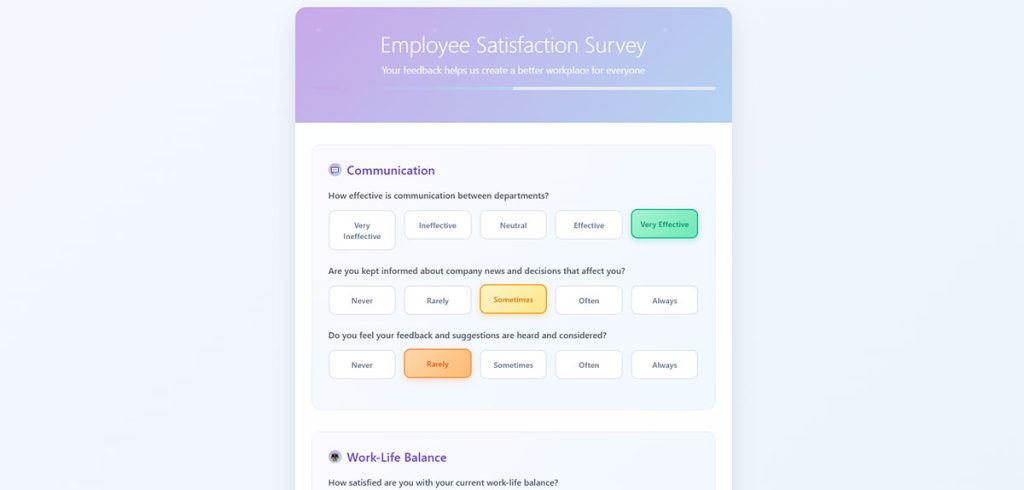
Most instruments lean on the same handful of formats. Likert ratings carry the weight for anything that needs tracking over time. Open-ended prompts fill in context a number never captures on its own. Then there’s the occasional ranking exercise, a single-select item here and there, and usually one 0-10 recommendation question borrowed straight from customer research.
Each format is doing a different analytical job. A survey that leans on just one of them tends to end up either too shallow to be useful or too slow for anyone to finish.
None of this is specific to HR, by the way. It’s the same pool covered in general guidance on the different types of survey questions, just adapted for workplace topics instead of customer research or product feedback.
| Format | Structure | Best Use |
|---|---|---|
| Likert scale | 1-5 or 1-7 agreement | Trend tracking over time |
| Open-ended | Free text response | Root-cause context |
| Ranking | Forced-choice priority order | Resource allocation decisions |
Closed formats win on speed. You can run the numbers across a thousand responses in an afternoon. Open text is slower, somebody actually has to read it, but it catches the stuff a rating scale just can’t see.
Closed-Ended Question Formats
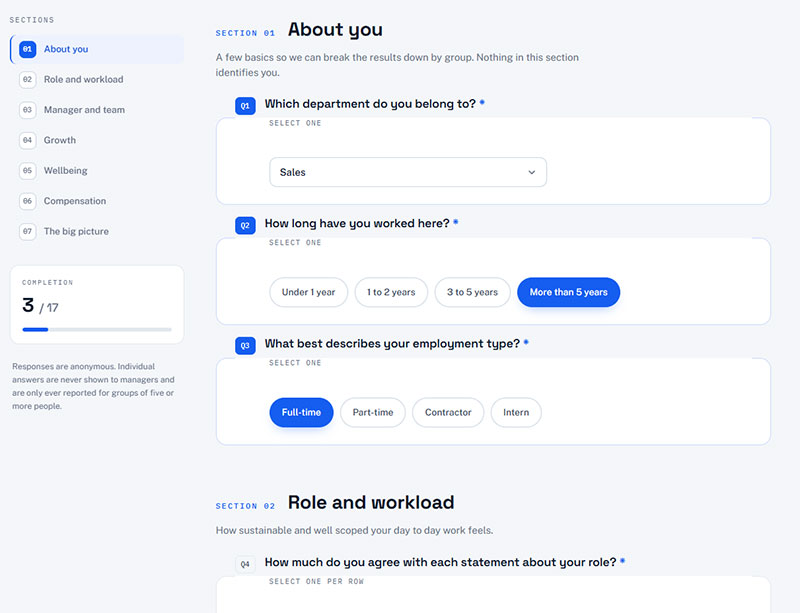
These are the formats that make analysis easy. Likert items rate agreement with a statement. Single-select multiple choice questions handle quick categorical answers. And the 0-10 recommendation scale is the basis for eNPS, which gets its own section further down.
Agreement statements that hold up across cycles:
- I know what is expected of me at work.
- I have the tools and resources I need to do my job well.
- My work makes a difference to the company.
- I am fairly paid for the work I do.
- My manager cares about me as a person.
- I can be myself at work.
- I see a future for myself here.
- I would defend this company if someone criticised it.
Ranking items work well when the answer feeds a budget decision:
- Rank these by what would improve your work life most: pay, flexibility, career growth, better tools, workload, recognition.
- Which two benefits matter most to you? (select two)
- Rank your top three reasons for staying here.
Most items land on a 1-to-5 or 1-to-7 agreement scale. That’s covered in more depth in the piece on Likert scale question design, including the tradeoffs between the two.
The upside of closed formats is comparability. Scores line up across departments, across quarters, against outside benchmarks, without anyone manually coding a single response.
Open-Ended Question Formats
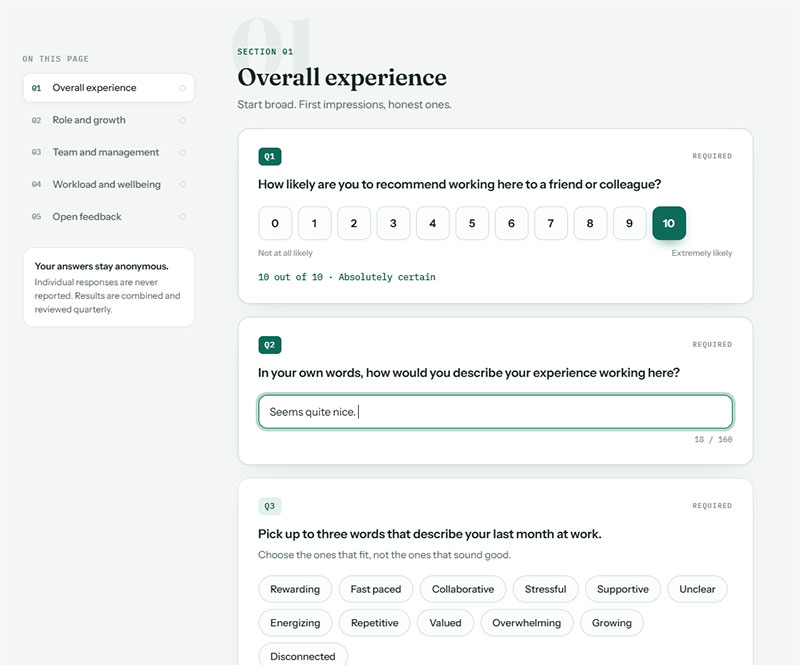
Open-ended prompts ask people to explain a rating in their own words, rather than just picking a number and moving on. One question, something as simple as “What would make your job better?”, often surfaces issues a rating scale misses completely.
Prompts that actually get answered:
- What’s one thing we should start doing?
- What’s one thing we should stop doing?
- What’s the most frustrating part of your week?
- What would make you consider leaving?
- What’s keeping you here?
- If you ran this company for a day, what would you change first?
- Is there anything you’ve wanted to raise but haven’t?
- What do we do well that we should protect?
Start, stop, and keep is an old format and it still outperforms most clever alternatives. People know exactly what to write.
They work best right after a low rating, when you actually want to know why the number came in low. Suggestions without a fixed answer set fit here too. And every survey needs at least one open field where people can put a concern that doesn’t have an obvious category anywhere else.
Text analysis tools cluster open responses into themes automatically now, which is a big part of why open-ended questions got cheap to run at scale. Ten years ago, someone was reading every single one of those by hand.
Job Satisfaction and Role Clarity Questions
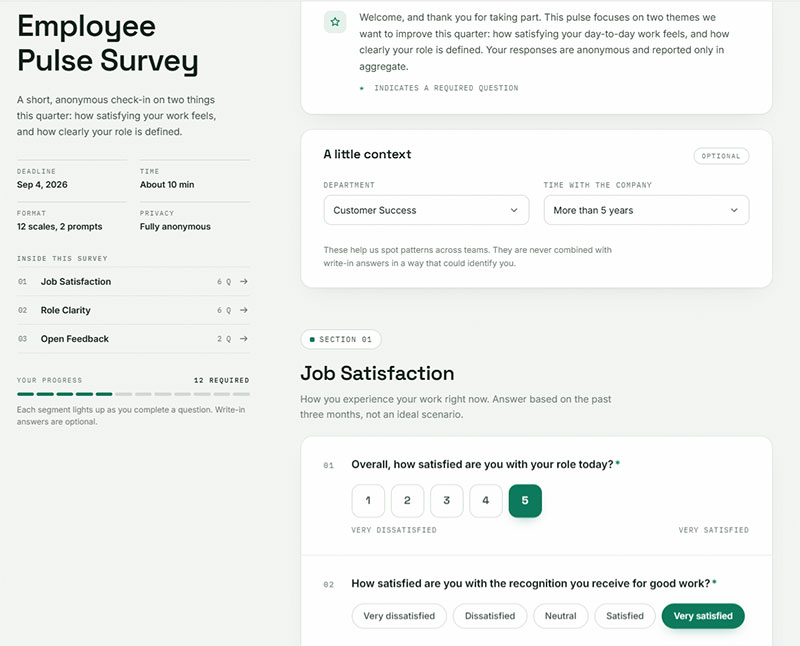
This category comes down to whether people actually understand their role and have what they need to do it well. It sits at the base of most validated engagement models, Gallup’s Q12 included.
Gallup’s twelve items stack into a rough hierarchy, basic needs at the bottom, then individual contribution, then teamwork, then growth at the top. Role clarity lives at that bottom level, and for good reason. None of the stuff higher up the pyramid really holds if people don’t know what’s expected of them on a normal Tuesday.
Questions worth asking directly:
- I know what is expected of me at work. (1-5)
- I understand how my work contributes to the company’s goals. (1-5)
- I have enough authority to make decisions about how I do my work. (1-5)
- Over the past month, has your workload been too light, about right, or too heavy?
- How often do you work outside your normal hours? (never, occasionally, weekly, most days)
- How well does your current role use your skills? (1-5)
- Is there part of your job you feel underqualified for?
- Is there part of your job that isn’t a good use of your time?
- Do you find your work interesting on most days?
- What’s one thing that regularly gets in the way of doing your job well? (open text)
That “not a good use of your time” question surfaces process waste nobody escalates on their own. People assume the pointless report exists for a reason. Often it doesn’t.
Workload especially deserves its own line item instead of getting folded into one blanket satisfaction rating. Ask about a specific stretch of time (the last month, the last quarter) and you get something HR can actually track over time. Ask in general and you get a number that means almost nothing.
Management and Leadership Questions
This section is really about trust, both in the direct manager and in senior leadership further up. And trust in management happens to be one of the strongest predictors of whether someone stays or walks.
BambooHR’s 2025 Boss Effect study found that 88% of employees who quit cited at least one negative manager behavior (poor communication, favoritism, taking credit for someone else’s work) as a reason for leaving.
Direct Manager Questions
- My manager cares about me as a person. (1-5)
- My manager gives me feedback that helps me improve. (1-5)
- When did you last have a one-on-one with your manager? (this week, this month, this quarter, longer, never)
- How useful are those conversations? (1-5)
- My manager gives credit where it’s due.
- My manager treats everyone on the team fairly.
- I can raise a problem with my manager without worrying about the consequences.
- My manager removes obstacles rather than adding them.
- If I were struggling, my manager would notice.
- How quickly does your manager respond when you need something?
Senior Leadership Questions
- I trust the decisions senior leadership makes. (1-5)
- Leadership communicates a clear direction for the company.
- Leadership is honest about problems, not just successes.
- I understand why recent major decisions were made.
- Leadership acts on employee feedback.
- Do senior leaders feel accessible to you?
Splitting these two blocks matters more than most survey designers treat it. A team can love their manager and have zero faith in the executive team, and one combined “leadership” score erases that distinction entirely.
Plenty of organizations just reuse a generic bank of feedback survey questions for this instead of writing new ones, mostly to get a real read on how often people hear from their manager. An annual review doesn’t count as ongoing feedback, whatever the org chart implies.
Gallup found managers account for 70% of the variance in team engagement scores, yet only 27% of managers report being engaged at work themselves (Gallup, 2025). That gap alone is a decent argument for measuring manager trust directly instead of assuming it’s fine because nobody’s complained.
Compensation and Benefits Questions
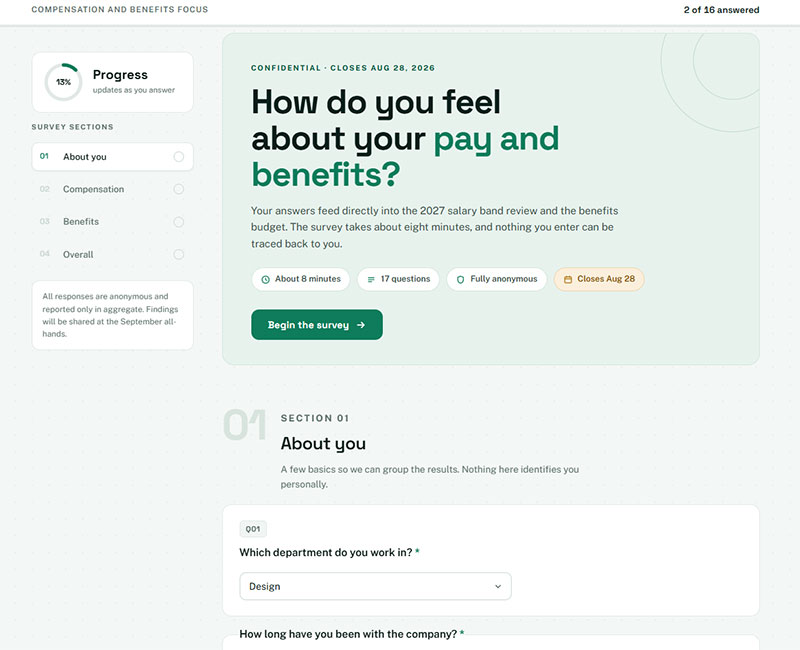
Compensation questions are touchy by nature. Wording and anonymity matter more here than in any other section of the survey, and people only answer honestly when they actually believe their response can’t be traced back to them.
- I am paid fairly for the work I do. (1-5)
- My pay is competitive with what I could earn elsewhere. (1-5)
- I understand how pay decisions are made here.
- I understand how to earn a raise or promotion.
- How satisfied are you with your health coverage? (1-5)
- How satisfied are you with retirement or pension contributions? (1-5)
- How satisfied are you with paid time off? (1-5)
- Which benefit do you value most? Which do you never use?
- Is there a benefit we don’t offer that you’d want?
- Do you know the full value of your total compensation, beyond base salary?
The “which benefit do you never use” question saves real money. Most benefits packages carry at least one line item nobody has touched in two years.
Lattice’s 2024 State of People Strategy survey found companies committed to increasing pay transparency saw engagement scores of 72%, versus 39% at companies that stayed opaque about compensation. That’s not a small gap.
A Payscale analysis found pay transparency lowers the odds an employee is actively job hunting by roughly 30%. Meanwhile Aon’s 2024 North America study found 75% of US employers are still not ready for pay transparency laws already taking effect across the country. Most of the policy is ahead of the practice right now.
Superside, a creative-services company, shows up in Lattice’s 2025 report making the same point from the inside. Opening up its compensation structure built trust, and it shifted performance conversations away from pay and toward what people were actually producing.
Work-Life Balance and Wellbeing Questions
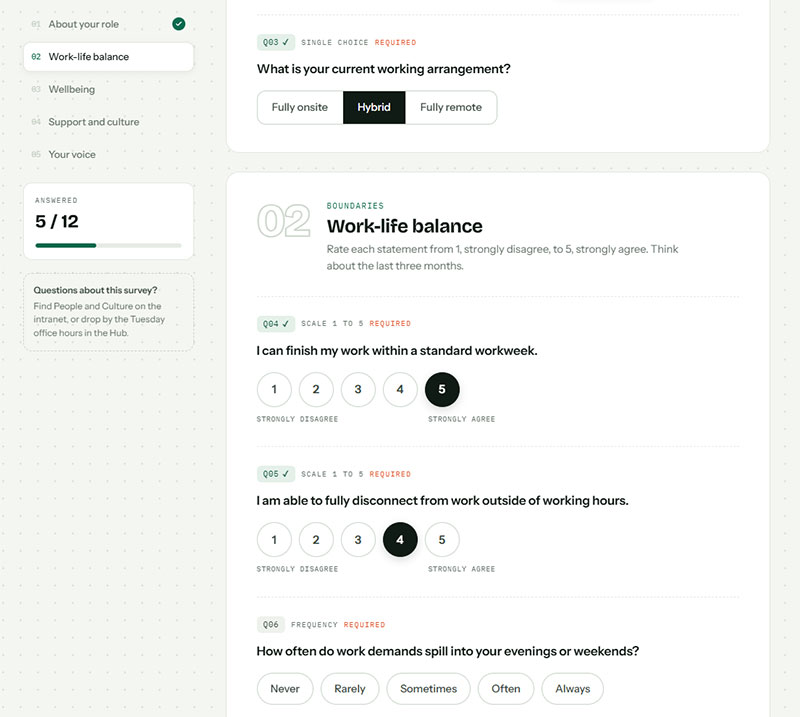
Burnout stopped being just a wellness issue a while ago. It’s a retention problem now, and employees who report burnout are far more likely to be job hunting within the year.
Gallup’s most recent State of the Global Workplace data puts daily stress among US and Canadian workers at 50%, the highest of any region the study tracks.
- I can maintain a reasonable balance between work and my personal life. (1-5)
- Over the past month, how often have you felt drained at the end of the workday? (never, rarely, sometimes, often, always)
- How often do you check work messages outside working hours?
- Are you able to fully disconnect when you take time off?
- Did you take all the time off you were entitled to last year? If not, why?
- Do you feel comfortable requesting time off?
- How satisfied are you with your current working arrangement? (on site, hybrid, remote)
- Do you know what mental health support the company offers?
- Have you ever used it? If not, what stopped you?
- Is there anything about your schedule you’d change if you could?
Frequency wording beats agreement wording on burnout items. “How often” gives you something trackable. “I feel burned out” gets under-reported, because nobody wants to be the person who admitted it.
Awareness gaps are common even where the benefit already exists. NAMI’s 2025 research found only 53% of employees know how they’d actually access mental health care through their employer. Often the benefit itself isn’t the problem. Finding it is.
Gallup also puts the global cost of reduced wellbeing at $438 billion in lost productivity for 2024 (Gallup, 2025). Whatever else this category is about, it’s a financial question too, not just a compassionate one.
Career Growth and Development Questions
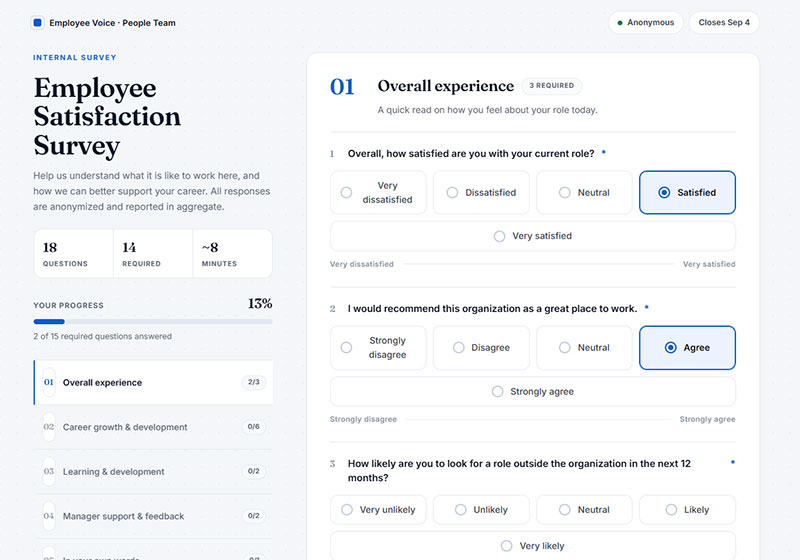
Career stagnation is one of the more common reasons people start quietly looking elsewhere. This section is asking something simple underneath all the wording: can they see an actual future here, or just a paycheck.
- I can see a clear path to advance my career here. (1-5)
- I know what I’d need to do to reach the next level.
- I have had a conversation about my career with my manager in the past six months.
- I have learned something new in my role in the past three months.
- I have access to the training I need to grow. (1-5)
- Does the company promote from within often enough?
- Do you have a mentor or someone here who invests in your development?
- What skill would you most like to build this year?
- Would you apply for an internal role if one opened up?
- Where do you see yourself in two years, here or elsewhere?
That last question is uncomfortable and worth asking anyway. Anonymous answers to it predict turnover better than a satisfaction score does.
LinkedIn’s 2024 Workplace Learning Report found 90% of organizations are concerned about retention, and learning opportunities ranked as their top retention strategy for addressing it. Companies with strong learning cultures saw 57% higher retention and 23% more internal mobility than the companies without one.
Pairing this category with dedicated training survey questions is worth doing too. It shows whether a specific program actually built new skills, instead of just confirming people clicked through to the end of a course.
AllianceBernstein is a decent real-world example here. They built a structured toolkit pairing manager coaching conversations with individual career plans, and trained both first-line leaders and staff on how to actually run those conversations well, not just schedule them.
Company Culture and Belonging Questions
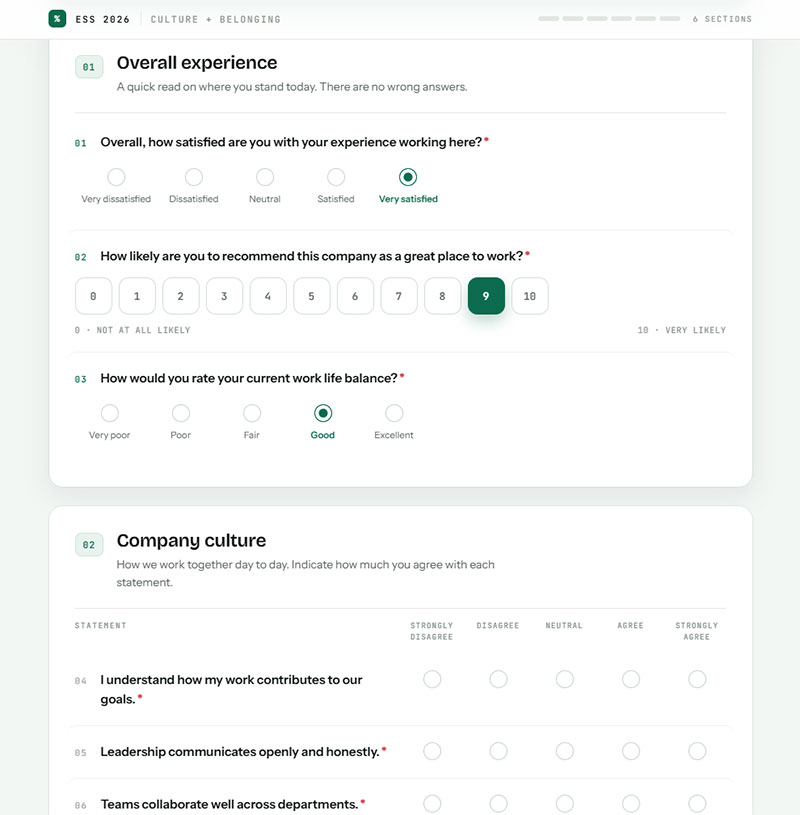
This one is about fit, whether people feel like they belong here, separate from whether they’re paid fairly or managing a reasonable workload. Values alignment shows up here too.
- My personal values line up with what this company stands for. (1-5)
- Can you name a company value and point to a time you saw it in practice?
- I feel like I belong on my team. (1-5)
- I feel respected by the people I work with.
- I feel safe admitting a mistake here.
- I can disagree with a decision in a meeting without it hurting me later.
- Everyone on my team gets a fair chance to be heard.
- I received meaningful recognition for good work in the past month.
- Does recognition here feel genuine or routine?
- Have you seen or experienced anything here that didn’t sit right with you?
Recognition questions need the frequency and the quality asked separately. Plenty of companies hand out weekly praise that lands as noise, and the score looks fine until someone asks the second question.
A joint Workhuman and Gallup study tracking more than 3,400 employees from 2022 to 2024 found that workers who received high-quality recognition in 2022 were 45% less likely to have left their job by 2024.
Psychological safety comes from Harvard Business School professor Amy Edmondson’s research. In practice it just means whether people feel safe admitting a mistake or raising a concern without getting punished for it. Google’s internal Project Aristotle study went looking for the strongest predictor of team effectiveness among a long list of variables. Psychological safety won.
McKinsey research finds 89% of employees say psychological safety is essential to how they work. A separate McKinsey study finds only 26% of leaders consistently show the behaviors that actually create it. That’s the gap this section exists to surface.
Communication and Feedback Questions
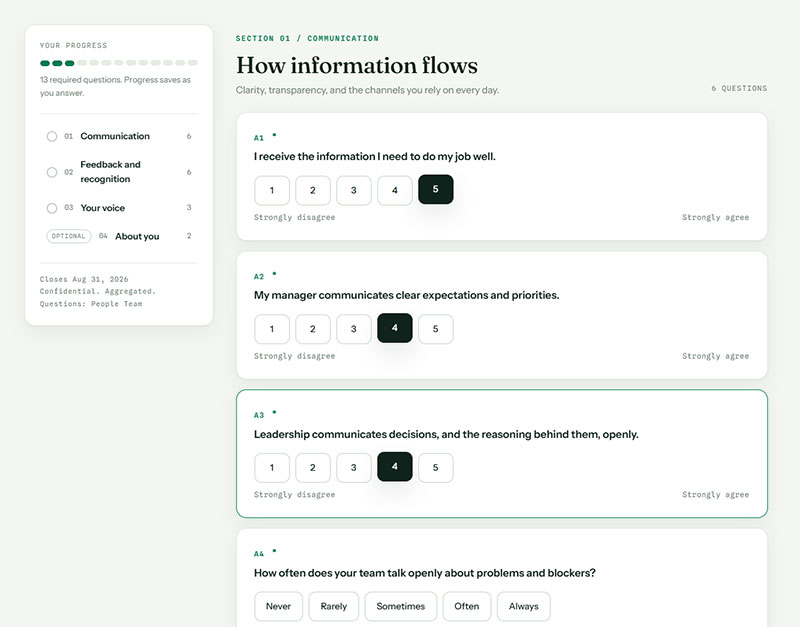
Communication quality ends up shaping whether people trust anything else the survey is measuring. Vague or inconsistent messaging from leadership has a way of undermining every other category on this list.
- I get the information I need to do my job well. (1-5)
- Company news reaches me before I hear it through rumour.
- Communication within my team works well. (1-5)
- Communication between my team and other teams works well. (1-5)
- I have received useful feedback on my work in the past six months.
- I know where to go if I have a concern.
- I believe raising a concern here would be taken seriously.
- I believe raising a concern here wouldn’t be held against me.
- Are there meetings you attend that could be an email?
- What’s one thing leadership could explain better? (open text)
Employee voice only works if people actually believe raising a concern won’t cost them something down the line. Splitting “taken seriously” from “held against me” is deliberate. Those are two different failures and they need different fixes.
Cross-team gaps rarely surface in department-level results by themselves, they get averaged out. A dedicated item comparing communication quality within a team against communication quality between teams isolates the actual problem instead of burying it.
Employee Net Promoter Score Questions
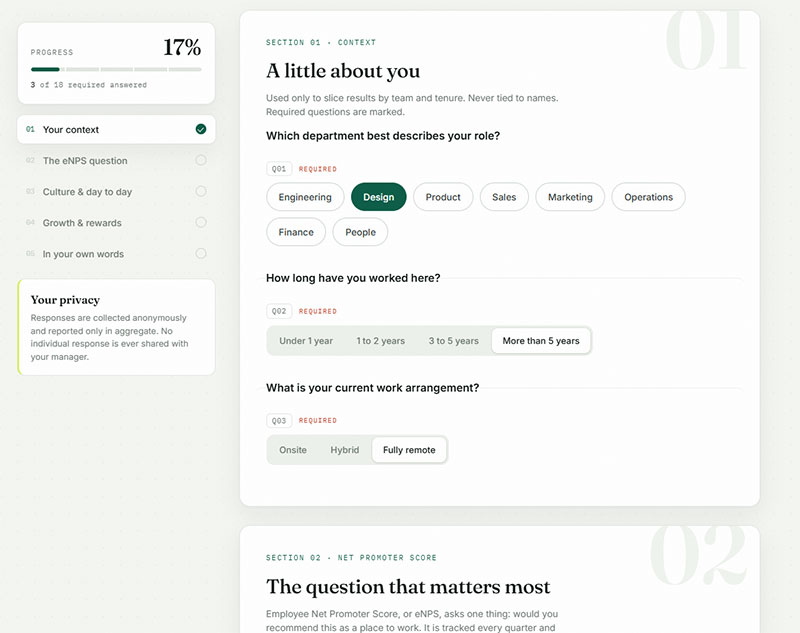
eNPS borrows its format wholesale from Bain and Company’s Net Promoter System, which was originally built to track customer loyalty, not how people feel about their employer. It boils down to one question.
How likely are you to recommend this company as a place to work, on a scale of 0 to 10. That’s it. The scale is lifted straight from broader guidance on NPS survey questions, just moved over from customer research into the workplace.
| Score Range | Category | Typical Behavior |
|---|---|---|
| 0-6 | Detractors | Unlikely to recommend, higher flight risk |
| 7-8 | Passives | Neutral, easiest group to shift |
| 9-10 | Promoters | Active advocates for the company |
Route the follow-up by score instead of showing everyone the same box:
| Score | Follow-up |
|---|---|
| 9-10 | What makes this a good place to work? |
| 7-8 | What would move your score to a 9 or 10? |
| 0-6 | What’s the main thing that needs to change? |
Unlike a full satisfaction survey, eNPS trades depth for speed. One question means it can run monthly, or even more often, without wearing people down the way a 40-item survey eventually does.
How eNPS Scoring Works
The formula itself is nothing fancy. Take the percentage of Promoters, subtract the percentage of Detractors, and leave Passives out of the calculation entirely.
Perceptyx’s benchmark database puts the global eNPS average at 12 as of 2024, a figure that has shifted year to year but stayed in positive territory since the pandemic.
Industry analysis built on Bain and Company’s original NPS framework estimates that converting a Passive into a Promoter costs roughly one-third the effort of converting a Detractor, which is why most improvement plans target the middle group first.
Questions for Remote and Hybrid Teams
Distributed teams break in places a standard question bank never checks. Someone can rate their manager highly and still be quietly cut out of every decision that happens in the office.
- Do you have what you need to work effectively from where you sit?
- How easy is it to get a quick answer when you’re stuck? (1-5)
- Have you ever found out about a decision after it was already made?
- Do remote and in-office staff get the same opportunities here?
- Do you feel connected to your colleagues? (1-5)
- How many people outside your immediate team have you spoken with this month?
- Are meeting norms clear (cameras, notes, who gets invited)?
- Would a different mix of office and remote days work better for you?
The “found out after the decision was made” question is the cleanest proximity-bias detector I know of. If remote staff answer yes at a much higher rate than office staff, that’s the finding.
How Many Questions Should an Employee Satisfaction Survey Include?
Shorter surveys get finished. Longer surveys collect more detail but lose respondents with every additional screen.
Survicate’s analysis of 267,564 survey responses found a direct relationship between length and completion:
| Question Count | Average Completion Rate |
|---|---|
| 1-3 questions | 83.3% |
| 4-8 questions | 65.2% |
| 9-14 questions | 56.3% |
| 15+ questions | 41.9% |
Annual surveys can reasonably run 40 to 60 items across every category on this list. People expect more depth once a year, and they’ll usually tolerate it.
Pulse surveys need to stay a lot shorter. HR platform Deel recommends 3 to 5 questions for a weekly pulse, up to 7 for bi-weekly, and up to 10 for monthly. The more often you’re asking, the less you get to ask each time.
A Ten-Question Pulse You Can Copy
When there’s no time to design something custom, this covers the main categories without running long:
- How likely are you to recommend this company as a place to work? (0-10)
- What’s the main reason for your score? (optional text)
- I know what is expected of me at work. (1-5)
- Over the past month, my workload has been manageable. (1-5)
- My manager gives me feedback that helps me improve. (1-5)
- I am paid fairly for the work I do. (1-5)
- I can see a path to grow my career here. (1-5)
- I feel safe raising a concern here. (1-5)
- I received meaningful recognition in the past month. (1-5)
- What’s one thing we should change? (optional text)
Mandatory items should cover the categories leadership actually plans to act on. Everything else belongs in an optional section respondents can skip without abandoning the whole survey.
How Often Should Employee Satisfaction Surveys Be Sent?
Cadence depends on what the data actually needs to do. A once-a-year benchmark and a monthly temperature check are serving two different purposes, and mixing them up doesn’t help anyone.
| Cadence | Typical Length | Best For |
|---|---|---|
| Annual | 40-60 questions | Full category benchmarking |
| Quarterly pulse | 10-15 questions | Trend tracking between annual cycles |
| Monthly pulse | 5-10 questions | Fast-moving teams, high-change periods |
Most organizations pull from a shared bank of pulse survey question examples instead of writing fresh items every cycle. It’s not laziness, it’s what keeps trend data comparable from one quarter to the next.
Run pulses too often without paying attention to how to avoid survey fatigue and response rates tank fast. Platform data from Peoplexact recommends most organizations start with just 2 to 4 surveys a year, and only expand once the action loop is actually proven to work.
Trigger-based surveys sit outside all of this. New-hire check-ins usually pull from a separate set of onboarding survey questions rather than the standard satisfaction bank. Exit interviews and post-reorganization pulses fire on their own schedule too, tied to the event itself, not the calendar.
Stay Interview and Exit Questions
Two event-triggered sets worth keeping ready. Stay interviews ask the questions an exit interview asks, except while there’s still time to act on the answers.
Stay interview:
- What keeps you here?
- What might tempt you to leave?
- What part of your job would you drop if you could?
- What would make this the best job you’ve had?
- Do you feel your contribution is noticed?
Exit:
- What’s the main reason you’re leaving?
- When did you first start thinking about it?
- Was there a point where we could have changed your mind?
- How would you describe your manager’s role in your decision?
- Would you consider coming back?
- Would you recommend this company to someone looking for work?
“When did you first start thinking about it” is the most useful line in an exit interview. It tells you how long the warning signs were sitting there unread.
What Questions Should Be Avoided in Employee Satisfaction Surveys?
Bad wording produces bad data, and no amount of clever analysis fixes that after the fact. Most of the damage comes from two specific mistakes people make over and over.
Leading and Loaded Questions
Take this one: “How much do our great benefits improve your day-to-day happiness?” That is a leading question, plain and simple. The word “great” already tells the person answering what they’re supposed to say, before they’ve even thought about it.
Strip the adjective and it fixes itself. “How satisfied are you with your current benefits package?” leaves someone free to answer in either direction, because nothing in the wording is nudging them one way already.
Loaded questions cause the same problem a different way, through assumption instead of adjective. “How often does your manager’s poor communication affect your work?” assumes the communication is already poor before the respondent gets a say in it.
Double-Barreled Questions
A double-barreled question crams two separate issues into one item and forces a single answer to cover both, which never actually works.
- Bad: “Are you satisfied with your manager’s communication and your compensation?”
- Better: two separate items, one for each topic
Pew Research Center’s guidance on questionnaire design flags this exact pattern as one of the most common ways survey data becomes impossible to interpret cleanly, since nobody can tell which half of the question drove the answer.
Weak Questions and Better Versions
| Weak version | What breaks | Better version |
|---|---|---|
| Are you happy here? | Too broad, and nobody answers it honestly | What’s one thing that would improve your next three months? |
| How do you feel about our great new policy? | Adjective plants the answer | How has the new policy affected your work? (better / no change / worse) |
| Do you get enough feedback and support? | Two topics, one score | Split into feedback and support |
| Do you ever feel burned out? | Under-reported, no timeframe | Over the past month, how often have you felt drained after work? |
| Rate leadership | Merges manager and executives | Separate items for direct manager and senior leadership |
| Why haven’t you used the wellness program? | Sounds like a reprimand | Do you know what wellness support is available? Have you used it? |
| Any comments? | Mostly skipped | What’s one thing we should start doing, and one we should stop? |
How Do You Act on Employee Satisfaction Survey Results?
A survey nobody acts on quietly trains people to stop answering honestly. This is the part where the data either turns into an actual decision, or just becomes a wasted quarter of everyone’s time.
Before any of it gets communicated, results need an actual process behind them, something like the steps in how to analyze survey data, not just a five-minute glance at the topline average.
In practice that usually means:
- benchmarking current results against the previous cycle and against outside industry data
- breaking results down at the manager level, not just company-wide
- building action plans that target the lowest-scoring categories first
- communicating findings, and whatever actually changes as a result, directly back to employees
Company-wide averages hide team-level problems that a single number smooths over. A team scoring far below the company average needs its own conversation, not a footnote in a slide deck.
One rule that protects the whole program: suppress reporting for any group under a threshold, usually five or ten responses. Slice tenure by department by gender in a small company and you can name individuals, which is exactly what anonymity promised not to allow.
Closing the Loop with Employees
A Perceptyx study found organizations that communicated results and took visible action within 30 days kept response rates above 80% on the next survey cycle.
Organizations that skipped that step saw response rates decline 10 to 15 percentage points with every cycle that followed.
Silence tends to be the one response people actually remember. Even a short update, here’s what changed, here’s what didn’t, keeps the next survey worth answering at all.
FAQ on Employee Satisfaction Survey Questions
Are employee satisfaction survey questions answered anonymously?
Most are, yes. Anonymity increases honesty, especially around pay and management topics. Culture Amp and Qualtrics anonymize individual responses by default, though very small teams (under five to seven people) can still end up with identifiable patterns even without names attached.
What counts as a good response rate for an employee satisfaction survey?
Most HR benchmarks treat 65 to 70 percent as healthy for a well-run internal survey. Fall below 50 percent and results start skewing toward whoever felt strongly enough to bother responding, which weakens the data leadership is supposed to be making decisions from.
Should employee satisfaction surveys be mandatory?
Mandatory participation inflates the response rate number without actually improving honesty. It’s usually better to make completion easy and visibly tied to real action, so people respond because they trust something will change, not because HR is making them.
Is a 5-point or 7-point Likert scale better for satisfaction questions?
A 5-point scale is quicker to answer and easier to benchmark over time. A 7-point scale picks up finer shades of sentiment, if that level of detail actually matters for what you’re measuring. Most employee satisfaction surveys default to 5-point anyway, mostly for speed and consistency across cycles.
What is the difference between employee satisfaction and employee happiness?
These two get used interchangeably a lot, but they’re not quite the same thing. Satisfaction is about whether specific job conditions (pay, workload, the way a manager treats people) meet expectations. Happiness is broader and messier, shaped by plenty of stuff that has nothing to do with work at all. A satisfied employee isn’t always happy, and a happy one isn’t always satisfied.
Can AI help write employee satisfaction survey questions?
Yes, within limits. It speeds up drafting and is genuinely good at catching double-barreled or leading phrasing. It can’t replace real employee input though. The best question banks still start with what HR actually needs to decide, not with a generated list someone copy-pasted in.
Who should design the survey, HR or an outside vendor?
HR usually owns question design, since nobody understands the internal context better. Outside vendors earn their keep through validated instruments, benchmarking data, and analysis tools HR probably isn’t going to build in-house. Plenty of organizations end up combining both, writing the content internally and running delivery and reporting through an external platform.
Do remote employees need different survey questions than in-office staff?
Core categories stay the same, but the wording shifts. Remote-specific items end up asking about isolation, communication friction across time zones, and access to equipment at home, none of which really surfaces in a survey built only with an in-office workforce in mind.
When is the best time of year to run an annual employee satisfaction survey?
Steer clear of periods around layoffs, bonus announcements, or major reorganizations. Results get skewed hard during those windows. Many organizations settle on a fixed quarter instead, away from the December holiday stretch and separate from performance review season, so what comes back actually reflects typical conditions.
Do managers need to answer the same questions as their direct reports?
Not exactly, no. Managers often get a parallel version that asks them to predict their team’s answers, and then the two get compared side by side. A big gap between a manager’s guess and what the team actually said usually points to a blind spot worth digging into.
Conclusion
Building this kind of survey from scratch tempts most teams to try covering every category at once. Worth resisting that if you can.
If budget or time forces a choice, start with role clarity and manager trust. Those two categories tend to predict trouble everywhere else on the list, from workload complaints all the way to culture scores months later.
A five-question pulse before the full annual version isn’t a bad way to start either. It proves the action loop actually works before anyone commits to forty items and weeks of analysis.
The first response rate will probably undershoot whatever benchmark you’re comparing it to. That’s fine. Treat it as a baseline, not a verdict on the whole program.
None of this matters much if nothing happens after the last response comes in.
Get that part right and employee retention tends to follow. Skip it, and people just stop answering the next one.