





Google Analytics files plenty of visits under direct that were never direct. In a 2023 experiment by SparkToro and Really Good Data, covering 1,113 test visits across 11 networks, 100%…
Table of contents
Only 12 percent of employees think their company handles onboarding well. That’s Gallup’s number, and it hasn’t shifted much despite how much attention HR teams claim to put into someone’s first few weeks.
Most new hires decide whether a job fits within weeks, not the 90 days most onboarding programs are built around measuring. And once someone’s mentally checked out, there’s not much a survey in month three does to bring them back.
A good onboarding survey question isn’t complicated. It catches one problem, at one stage, while there’s still time to fix it. Ask too late and all you’re doing is documenting why someone quit.
The wording matters more than most HR teams give it credit for. Get it wrong and the survey gets ignored like every other form sitting in the new hire folder. Get it right and it becomes the earliest warning system you have.
What Is an Onboarding Survey Question
HR teams use these to pull feedback on one specific slice of a new hire’s transition, not the whole experience at once. Orientation covers a day or two of paperwork and facility tours. A general employee engagement survey tracks ongoing sentiment across the whole workforce, month after month. An onboarding survey question sits in a narrower window than either one.
That window has an official shape to it. SHRM frames the transition period at 90 days, and Talya Bauer at Portland State University, writing for a SHRM Foundation research report, put it directly: new hires get roughly 90 days to prove themselves in a role. Most onboarding survey programs are built around that same clock for a reason.
None of this is optional extra credit for HR departments with time to spare. Brandon Hall Group research, published through Glassdoor, tied structured onboarding programs to an 82 percent lift in new hire retention and a productivity increase of more than 70 percent. Numbers like that only mean something if someone’s actually collecting the feedback that shows where the process is breaking down.
What Makes an Onboarding Survey Question Effective
A handful of traits separate a working question from a weak one, and none of them are complicated.
- Single topic, not two ideas stacked into one sentence
- Neutral wording that does not lead the respondent toward a “right” answer
- Tied to one onboarding stage, whether pre-boarding, week one, 30 day, 60 day, or 90 day
- Produces an answer you can score, count, or code into a theme
BambooHR pulled data in 2023 that found 70 percent of new hires already know whether a job’s the right fit within their first month, and 29 percent decide in the first week. Ask your questions after that window’s closed and the answers don’t help much. You’re documenting a decision that’s already been made.
What Are the Main Types of Onboarding Survey Questions
Most onboarding programs end up using some mix of rating scales, open-ended prompts, multiple choice or ranking questions, and the eNPS style question. Each does something different, and leaning on just one format tends to leave gaps the others would’ve caught.
Timing matters too. A day-one survey works better with quick multiple choice items, since nobody wants to write essays on their first morning. By the 90 day mark, people have more to say, so open-ended and scale-based questions carry more weight. There’s a whole rundown of types of survey questions if you want to go deeper on how each one behaves.
| Format | Best For | Example |
|---|---|---|
| Rating scale | Confidence, clarity, satisfaction | 1 to 5 agreement scale |
| Open-ended | Unscripted blockers and context | “What’s slowing you down?” |
| Multiple choice | Prioritizing resources or gaps | Pick top training need |
| eNPS style | Single trackable retention signal | 0 to 10 recommend scale |
Rating Scale Questions
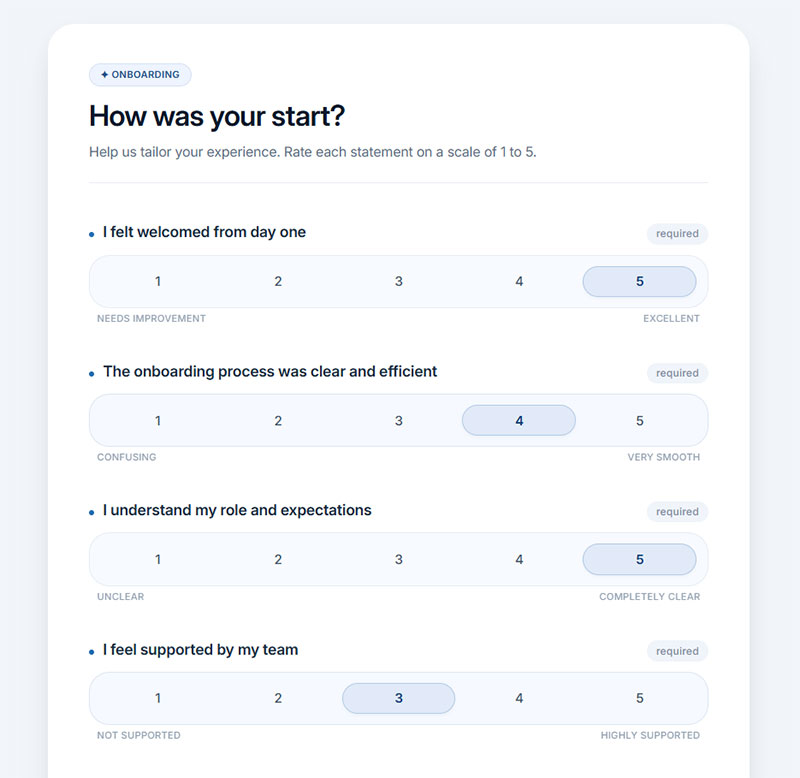
These usually get built as Likert scales, where a new hire rates agreement, frequency, or confidence somewhere on a fixed range, typically 1 to 5 or 1 to 7. Qualtrics includes Likert and matrix table formats in their list of standard question types, mostly because they turn a vague feeling into a number that’s actually trackable over time.
For onboarding specifically, Likert scale questions do their best work on confidence and clarity checks. Something like “I understand what’s expected of me in this role” gives you a number you can watch move, or not move, across an entire hiring cohort.
Statements that hold up well on a 1 to 5 agreement scale:
- I understand what’s expected of me in this role.
- I know how my work connects to what my team is measured on.
- I had everything I needed to start working on my first day.
- My manager has made time for me since I started.
- I feel comfortable admitting when I don’t know something here.
- The job so far matches how it was described during interviews.
- I know who to ask when I get stuck.
One habit worth keeping: use the exact same statement at 30, 60, and 90 days. Reword it and you lose the comparison, which was the whole point of using a scale.
Open-Ended Questions
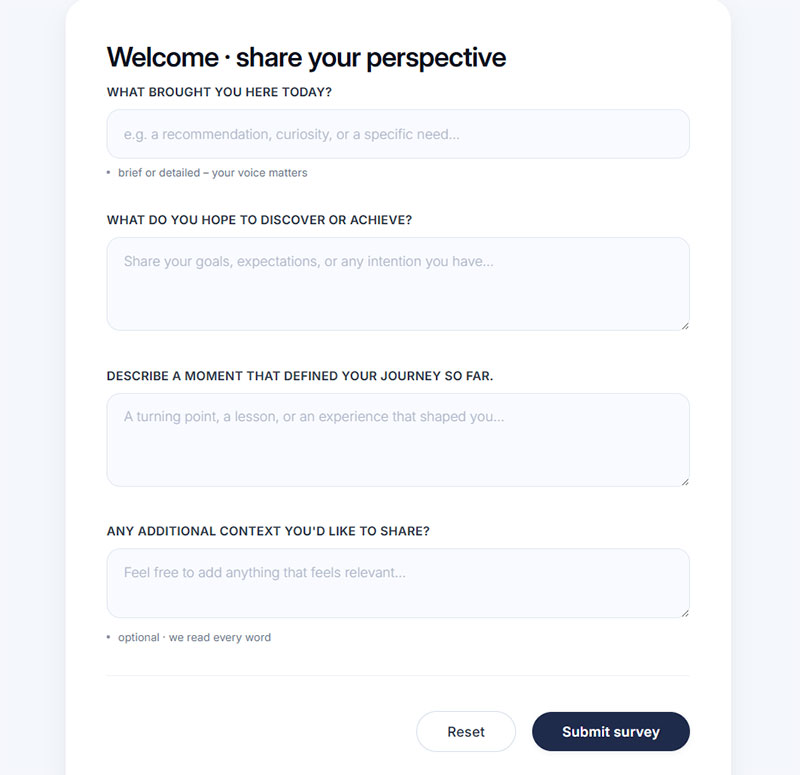
A scale only tells you so much. Someone can rate their onboarding a 4 out of 5 and still leave a comment explaining the one thing that nearly made them quit in week two. That gap between the number and the note is usually where the useful stuff lives.
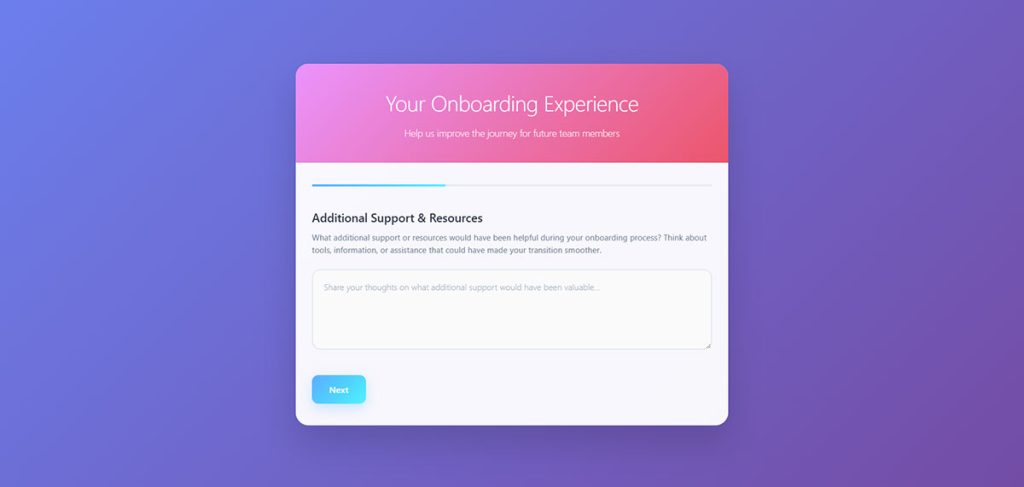
Vague prompts don’t work well here. “Any feedback?” gets skipped constantly, or answered with one word that tells you nothing. “What’s one thing that would have made your first week easier?” gets an actual answer, because it gives someone something specific to react to.
Open-ended prompts that reliably pull real answers:
- What’s one thing that would have made your first week easier?
- What surprised you most about this job so far, good or bad?
- Which part of onboarding felt like a waste of your time?
- What did you have to figure out on your own that someone should have told you?
- If you had to explain your role to a friend right now, what would you say?
- What’s the one question you’ve been hesitant to ask anyone here?
- Who has been the most helpful to you so far, and what did they do?
- What would you change about your first two weeks if you could?
That last-but-one question, about who helped most, does double duty. You find out where informal support is actually coming from, and you get a name worth thanking.
Multiple Choice and Ranking Questions
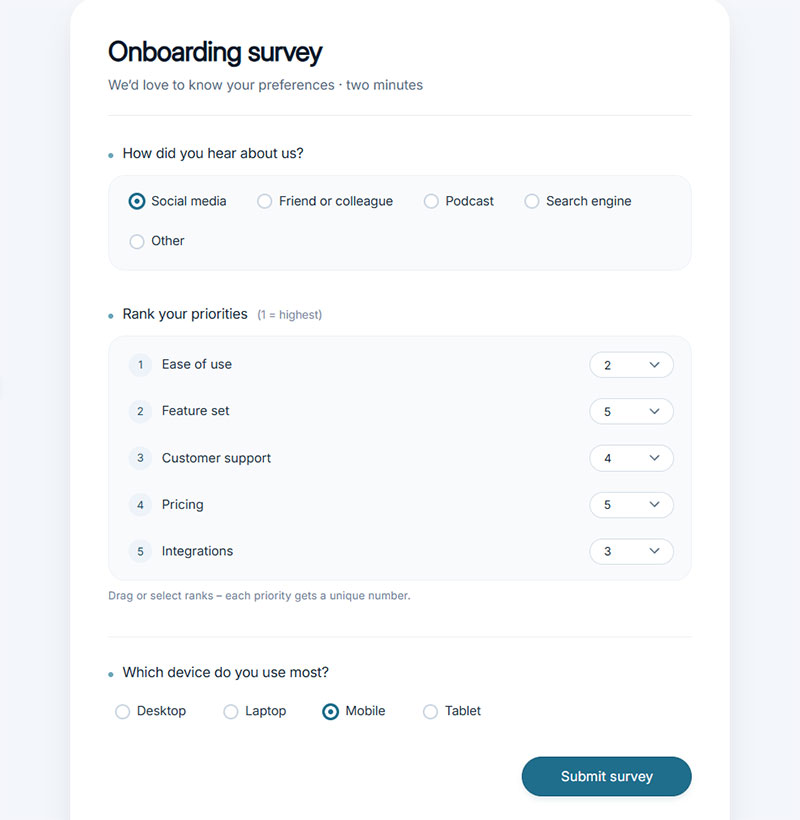
These formats make sense when you already know the range of possible answers and just need someone to rank or pick among them, rather than write anything out.
Ranking which training topics felt weakest is a common one. So is asking which resource, documentation, a buddy, their manager, or the team wiki, they actually leaned on most during week one. You’d be surprised how often the answer isn’t the resource HR spent the most time building.
Ready-made versions:
- Which of these slowed you down most in week one? (IT access, unclear instructions, no one to ask, too many meetings, nothing)
- Where did you find answers most often? (team wiki, manager, buddy, teammates, Slack search, outside Google)
- Rank these by how prepared you feel: core tools, internal processes, product knowledge, team norms, customer context.
- How much of your first week was spent waiting on something or someone? (none, under a day, one to two days, most of the week)
- Which would help you most in the next 30 days? (shadowing, written documentation, more one-on-ones, structured training, more independent time)
eNPS Style Questions
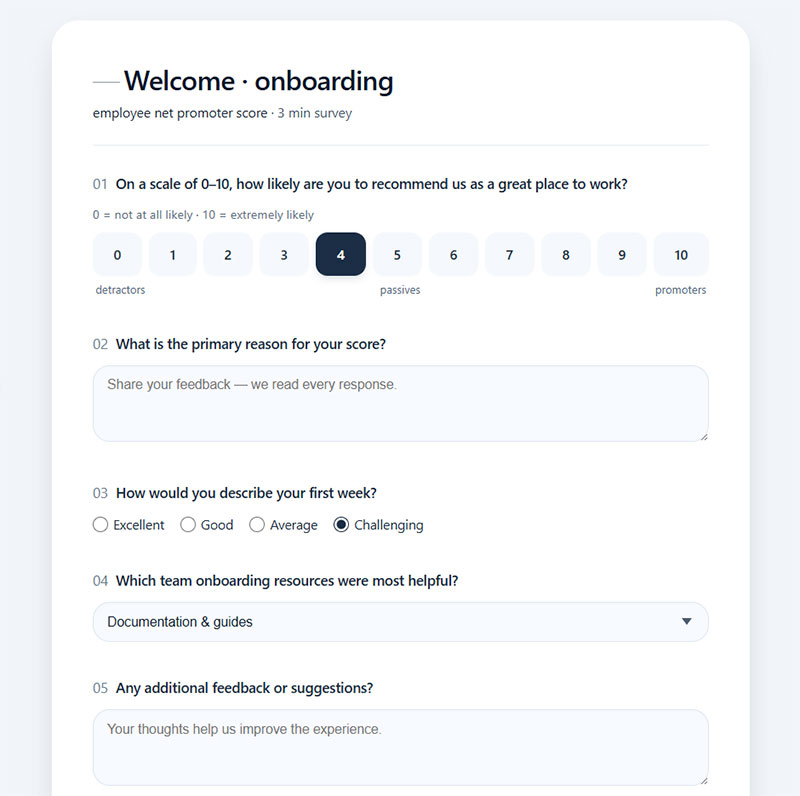
This one’s simple on the surface. On a scale of 0 to 10, how likely is a new hire to recommend the company as a place to work. Qualtrics treats this as a standardized question type since the 11-point scale automatically sorts people into detractors, passives, and promoters without any extra math on your end.
The benchmarks people cite for this number are all over the place, for what it’s worth. Perceptyx, which pulls data from more than 20 million employees, puts the average eNPS around 14. QuestionPro’s 2025 survey of 5,000 employees landed on 32, up from 25 the year before. Neither number is wrong exactly, they’re just measuring different populations at different times.
Either way, an NPS survey question hands you one number you can track across every new hire cohort, which is what makes it worth pairing with the more detailed formats above instead of using it alone.
Always pair the score with one follow-up. “What’s the main reason for your score?” turns a number into something you can act on, and it takes maybe eight seconds to answer.
When Should Onboarding Surveys Be Sent
Roughly 20 percent of new hire turnover happens within the first 45 days on the job, according to workforce data that gets cited constantly across the industry. That number alone should tell you timing matters just as much as how a question’s worded.
Most onboarding surveys land around pre-boarding, the first day, the first week, and then the familiar 30-60-90 day cycle. Some companies compress that into fewer touchpoints. Most don’t.
| Checkpoint | Timing | Typical Length |
|---|---|---|
| Pre-boarding | Before start date | 5 to 8 questions |
| First day / week | Days 1 to 7 | 5 to 8 questions |
| 30, 60, 90 day | Days 30, 60, 90 | 10 to 15 questions |
New hires apparently form a lasting impression within about 44 days, per BambooHR’s onboarding research, and 44 percent say they regretted taking the job within their first week alone. If you’re waiting until day 90 to ask your first question, you’ve already missed the window where it mattered.
About one in three new hires leave within the first 90 days. That figure shows up constantly in workforce research, and it’s the whole argument for shorter, more frequent pulse survey questions instead of one long survey saved for the end.
There’s a ceiling on how often you can ask, though. Cram too many touchpoints too close together and response rates start dropping fast. Keeping early surveys short and learning to avoid survey fatigue matters more than most people assume going in.
Pre-boarding and First Day Survey Questions
Two touchpoints happen before a new hire’s done any actual work: pre-boarding and the first day itself. Questions here stick to logistics, first impressions, and whether the offer they accepted matches what they’re now walking into.
There’s a real gap worth knowing about. Enboarder’s 2018 workforce research found world-class organizations are 53 percent more likely to run a formal pre-boarding program. Talentech’s 2021 study found the flip side: 64 percent of new hires get no pre-boarding experience at all. Most companies fall somewhere in that gap, closer to the second number than the first.
Pre-boarding Questions
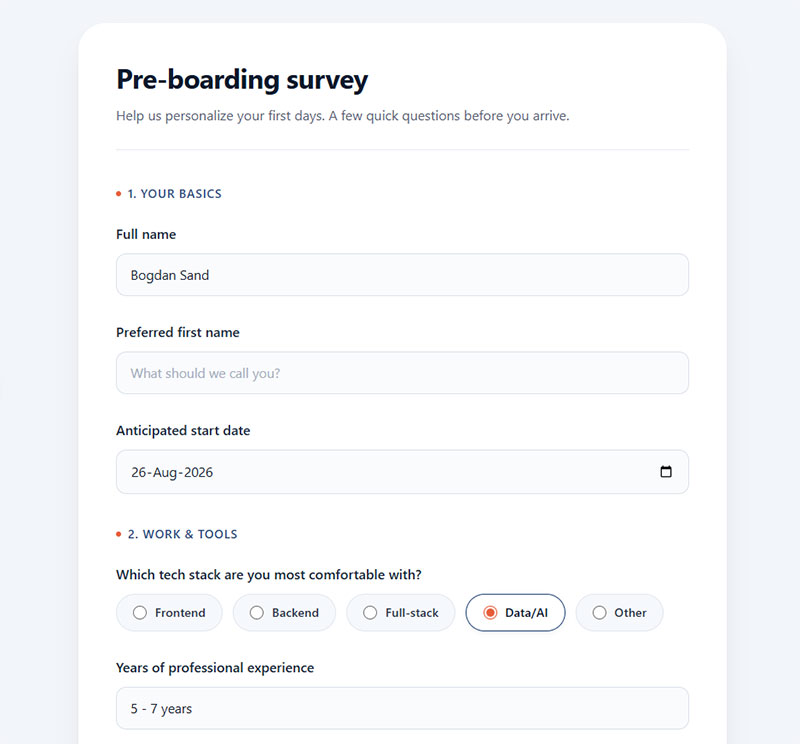
Five to eight questions is plenty here. Any longer and it starts feeling like homework assigned before day one’s even happened.
- Was the offer letter and the paperwork that followed clear to you?
- Has your equipment or workspace setup been confirmed?
- Do you know who to contact with questions before you start?
- Do you know exactly where to go, or which link to click, on your first morning?
- Do you know what your first day will look like hour to hour?
- How confident do you feel about starting, from 1 to 5?
- Is there anything you still need from us before day one?
- Has anyone from your future team reached out to you yet?
That last question is the sleeper. A single message from a teammate before the start date changes how the first morning feels, and it costs nothing. When the answer comes back “no” across a whole cohort, you’ve found a fixable problem.
Enboarder and Sapling are two platforms that automate this whole stage, firing off the survey the moment a signed offer lands in the system. Nobody has to remember to send it manually.
First Day Questions
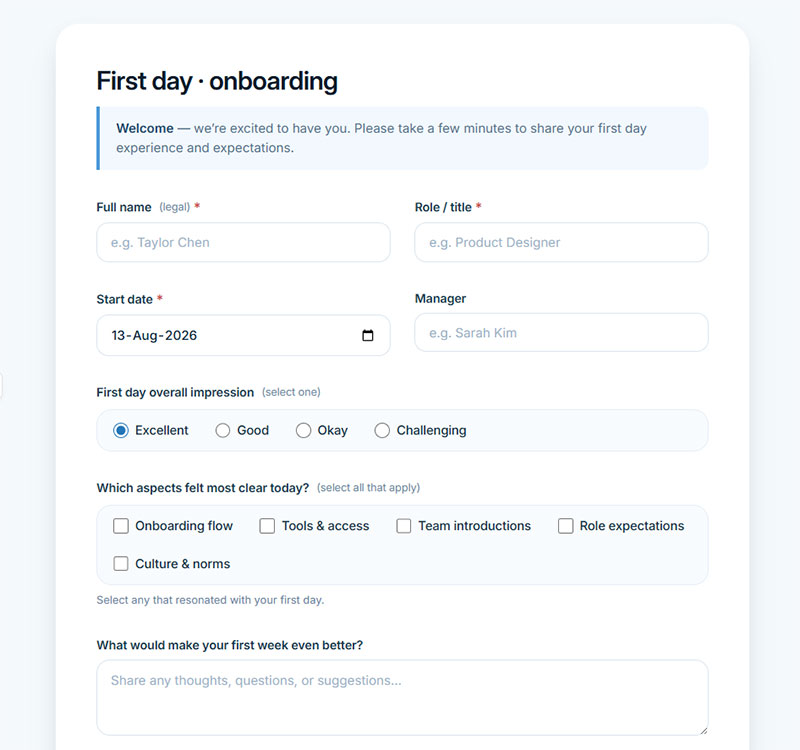
A CareerBuilder survey found 43 percent of new hires wait more than a week just to get basic workstation logistics and tools sorted out, and 18 percent wait more than two months. That’s not a typo. Two months. First day questions exist specifically to catch that gap before it drags on.
Ask directly whether the welcome matched what they expected, whether the workspace was actually ready, and whether they met their immediate team.
- Was someone expecting you when you arrived or logged on?
- Was your workspace, laptop, and account access ready to go?
- Did you meet your manager today?
- Did you meet the people you’ll be working with day to day?
- Do you know what you’re supposed to do tomorrow?
- How would you rate your first day, from 1 to 5?
- Was anything about today confusing or awkward?
BambooHR’s pre-boarding workflows often route these answers straight to a manager’s dashboard, so the feedback doesn’t just sit unread in some HR inbox.
End of Week One Questions
Week one deserves its own short check, separate from day one. By Friday the welcome has worn off and reality has set in.
- Do you understand what your team is working toward this quarter?
- Have you completed a task on your own yet, however small?
- How much of this week felt productive, from 1 to 5?
- Is there anyone you were supposed to meet but haven’t?
- What’s still unclear to you heading into week two?
30 60 90 Day Onboarding Survey Questions
Somewhere around day 30, onboarding survey questions stop being about process and start being about performance. Same new hire, different question at each checkpoint.
| Day | Focus | Sample Question |
|---|---|---|
| 30 | Role clarity, early confidence | Do you understand what’s expected of you? |
| 60 | Workload, skill gaps | Is your workload manageable right now? |
| 90 | Retention, overall rating | How likely are you to recommend this company? |
30 Day Questions
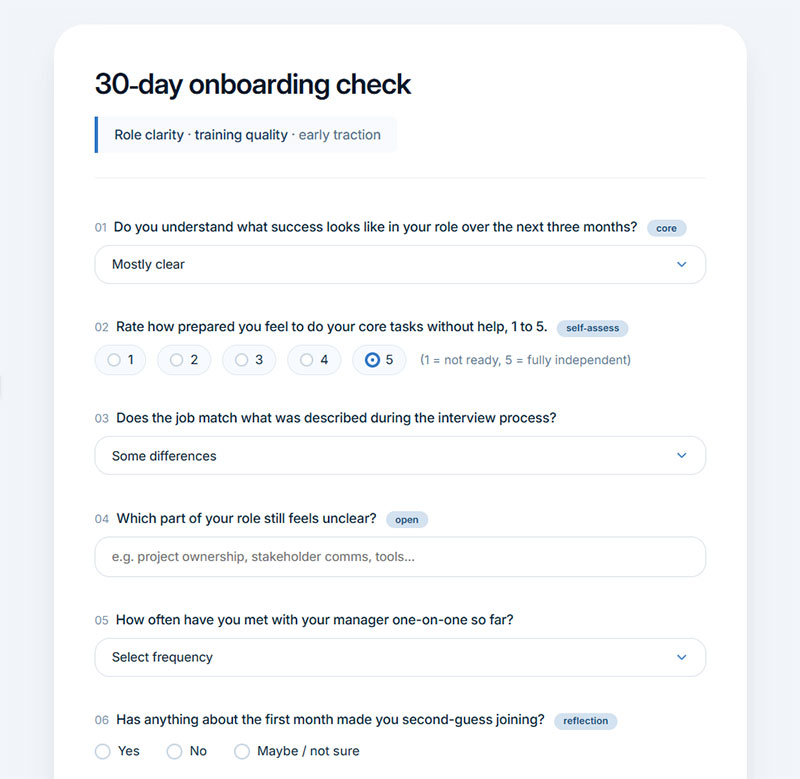
Role clarity and training quality are the two things worth digging into first at this checkpoint. Then there’s the harder question underneath both: can this person actually do the core parts of their job without someone hovering over them yet.
- Do you understand what success looks like in your role over the next three months?
- Rate how prepared you feel to do your core tasks without help, 1 to 5.
- Does the job match what was described during the interview process?
- Which part of your role still feels unclear?
- How often have you met with your manager one-on-one so far?
- Has anything about the first month made you second-guess joining?
- What’s the single biggest thing slowing you down right now?
- Do you know how your performance will be measured?
The second-guessing question makes some HR teams nervous. Ask it anyway. Someone who’s wavering at day 30 is still reachable, and the alternative is finding out during their exit interview.
BambooHR’s onboarding data already came up once, but it’s worth repeating here. 70 percent of new hires know whether a job’s the right fit within their first month. The 30 day survey is basically your one real shot to catch a bad fit before it turns into a resignation letter.
60 Day Questions
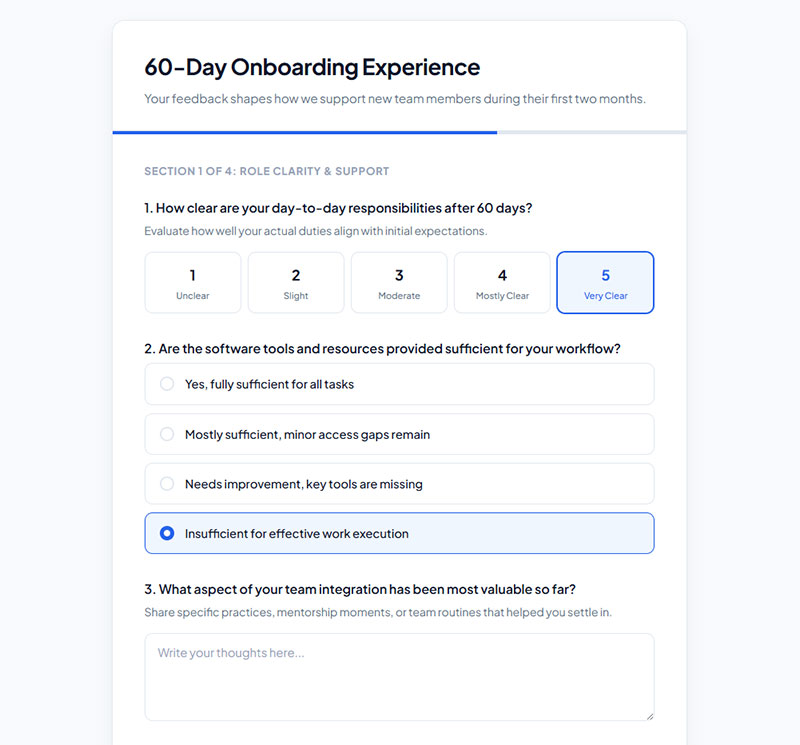
By day 60, the questions shift. Less “did you settle in,” more “how are you actually doing.” Progress against whatever goals got set in week one, workload balance, skill gaps that only show up once someone’s had time to hit a wall or two.
- Is your current workload manageable, too light, or too heavy?
- Are you making the progress you expected against your early goals?
- Which skill or system do you still feel behind on?
- Have you received feedback on your work from your manager yet?
- Do you feel like a contributing member of the team, or still a new person watching?
- Rate how confident you feel handling problems on your own, 1 to 5.
- What would help you most over the next 30 days?
- Is there anything you’re doing that doesn’t seem like a good use of your time?
BJC HealthCare runs this kind of staged check-in across 33,000 employees hired continuously, according to Cornerstone OnDemand. BJC is a nonprofit health system operating 15 hospitals across the St. Louis area, so the scale alone says something about how this holds up outside a single office building.
90 Day Questions
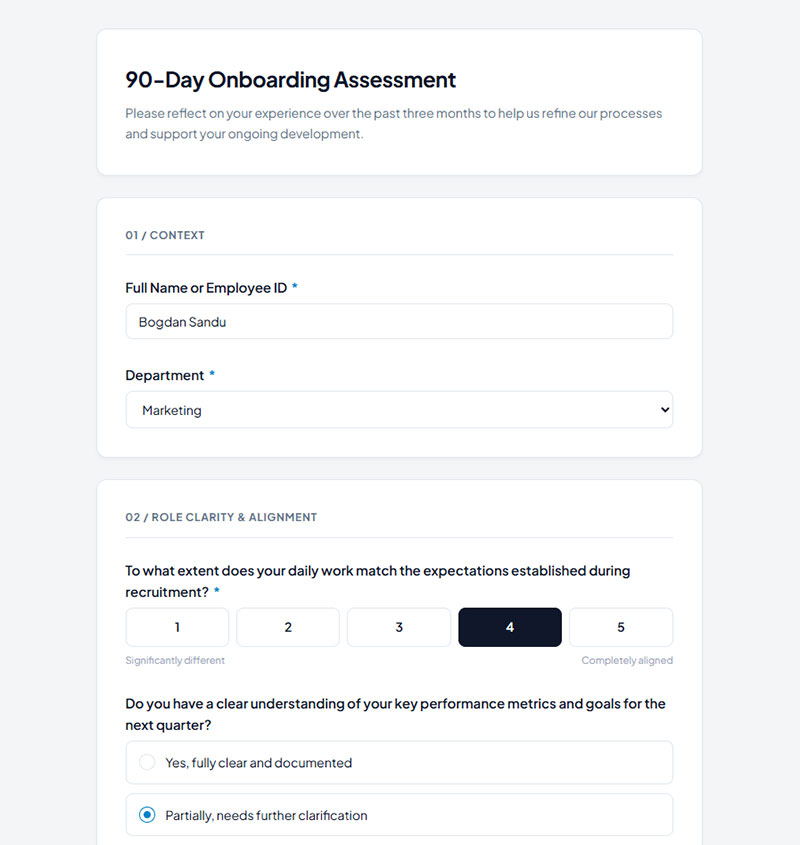
Only 18 percent of new hires have actually discussed performance goals with their manager by the 90 day mark, according to research cited by Gartner. Eighteen percent. After three months. That gap is exactly what a 90 day survey, usually paired with a formal review, is meant to catch.
- Overall, how would you rate your onboarding experience, 1 to 10?
- On a scale of 0 to 10, how likely are you to recommend this company as a place to work?
- What’s the main reason for that score?
- Have you and your manager agreed on written goals for the next six months?
- Do you see yourself here in a year?
- Looking back, which part of onboarding helped you most?
- Which part should we drop entirely?
- What do you know now that you wish someone had told you in week one?
That final question is the most useful one in the whole cycle. Answers to it become next quarter’s day-one checklist, straight from the people who just lived through the gaps.
Wrap the cycle with an overall rating plus something that signals retention risk. An employee satisfaction survey question asking for an overall onboarding score, next to a recommend-to-a-friend style question, gives you one number per hire you can actually compare across cohorts.
Role Clarity and Training Survey Questions
Role clarity questions check whether a new hire understands the job they’re actually doing day to day, not the version of it they read in a job posting three months ago.
A few areas are worth checking directly here.
- Whether daily responsibilities match what was described in hiring
- Whether training was completed and rated useful
- Whether documentation and internal knowledge bases are easy to find
- Whether the new hire can perform core tasks without supervision
Three-fourths of new hires say training in the first week matters more to them than any other part of onboarding, according to a BambooHR survey SHRM cited. That’s not a small preference, it’s close to a consensus.
LinkedIn’s 2025 Workplace Learning Report backs this up from the retention side. 88 percent of organizations are worried about retention, and offering learning opportunities ranked as their top strategy for addressing it. Which means early training feedback isn’t just an onboarding metric, it’s tied to something leadership already tracks and cares about.
Good training survey questions for this stage sound like these:
- Did you complete the training assigned to you in week one?
- Rate how prepared you feel to do your core tasks without help, from 1 to 5.
- Which specific tool or process do you still feel unsure about?
- Was the pace of training too fast, too slow, or about right?
- Did you get enough hands-on practice, or mostly watching and reading?
- How much of the training will you actually use in your day-to-day work?
- Where do you go first when you don’t know how to do something?
- Is there a task you’ve been assigned that you don’t yet feel trained to do?
“Was training good?” isn’t one of them. It produces nothing you can act on. Naming the tool or the process is what turns an answer into a fix.
Manager and Team Relationship Survey Questions
Relationships, not job knowledge, that’s what this layer of questions is checking. How connected does a new hire feel to their manager and immediate team, separate entirely from whether they understand what they’re supposed to be doing.
Active manager involvement makes new hires 3.4 times more likely to call their onboarding experience exceptional, according to Gallup research cited by Cornerstone OnDemand. Google’s internal Project Oxygen research landed on something similar from a completely different angle. Coaching and empowering behaviors topped their list of what makes a manager effective. Technical expertise came in last.
A few questions cut right to it.
- Have you had a one-on-one with your manager in the past two weeks?
- How useful were those conversations, from 1 to 5?
- Do you feel comfortable raising concerns or asking questions on your team?
- How connected do you feel to your team, rated 1 to 5?
- Has a buddy or mentor been assigned, and has that relationship been useful?
- Has your manager given you clear feedback on anything you’ve done so far?
- Do you know how your manager prefers to be contacted, and how quickly they usually respond?
- Is there anyone on your team you still haven’t spoken to directly?
- If you were struggling with something personal or work-related, would you tell your manager?
That question about feeling comfortable asking questions is really a psychological safety check wearing an onboarding costume. SHRM’s research on buddy programs found 56 percent of new hires say meeting their onboarding buddy just once in the first 90 days helped them get productive faster. Once. That’s a low bar to clear for a meaningful bump in outcomes.
Company Culture and Belonging Survey Questions
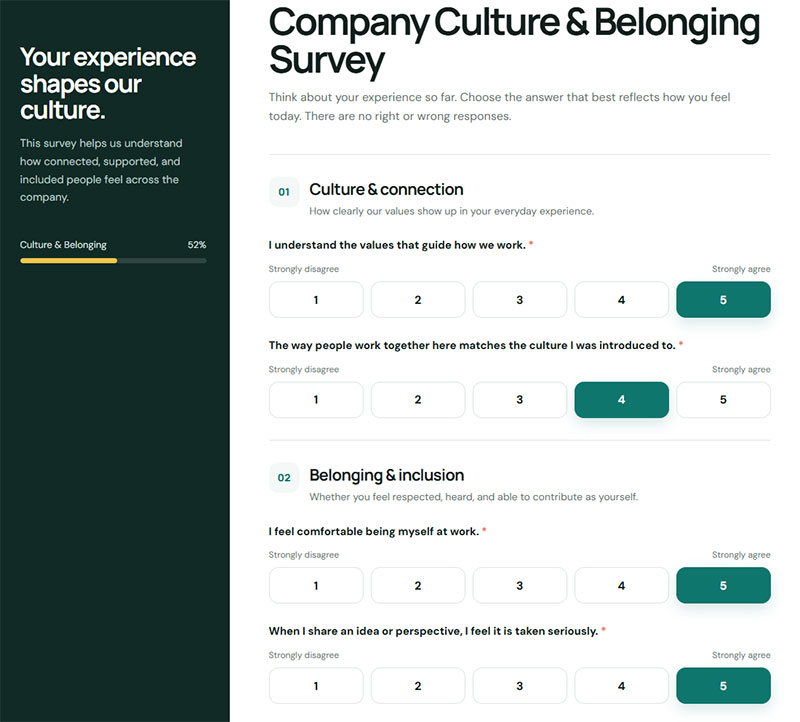
Culture and belonging questions check something different again: does day-to-day work actually match the values a company described while hiring someone, separate from whether that person gets their tasks done.
A few things matter most here. Do stated values line up with what someone’s actually experiencing day to day? Is there a real sense of inclusion on the team, or just a welcome message and silence after that? And underneath both of those sits something people tend to underestimate: whether someone would actually feel safe disagreeing with a decision in a group setting.
Perceptyx’s 2025 workforce panel research found 67.6 percent of employees feel safe speaking up when they disagree with a team decision. Roughly a third don’t. That remaining third is exactly the gap an onboarding culture question is meant to catch, ideally before someone’s silence gets mistaken for agreement.
Zapier’s one-month onboarding program is built around exactly this. A dedicated onboarding manager runs workshops on company values, and every new hire gets matched with a peer buddy who reaches out during their first week.
These work well as direct asks:
- Does day-to-day work match what you were told about our culture during hiring?
- Do you feel like you belong on your team so far?
- Would you feel comfortable disagreeing with a decision in a team meeting?
- Have you been included in the meetings and conversations relevant to your work?
- Have you seen anything here that didn’t sit right with you?
- Can you name one company value and point to a time you saw it in practice?
- Do you feel you can be yourself at work here, from 1 to 5?
- Has anyone made you feel like an outsider since you started?
The value question is sneaky-good. If nobody in a cohort can connect a stated value to a real moment, the values are decoration.
There’s a specific red flag worth watching for in the answers. Someone who rates culture fit high but leaves every open-ended question blank isn’t necessarily confirming a good experience. More often they’re avoiding an honest one.
Tools Resources and Technology Survey Questions
This section checks one narrow thing. Does a new hire actually have working access to what they need, which is a separate question entirely from whether they know how to use any of it yet.
There’s a handful of checkpoints that cover the gap between broken and working. Hardware and IT setup finished by day one. Access to core software and the HRIS. Knowing where documentation actually lives. And whatever friction points are still sitting there unresolved, the stuff nobody’s gotten around to fixing yet.
| Checkpoint | What to Verify | Typically Owned By |
|---|---|---|
| Hardware | Laptop, monitor, badge access | IT |
| Software | Core systems, HRIS, email | IT / HR |
| Documentation | Wikis, SOPs, team drives | Manager |
Identity platforms like Okta automate the provisioning side of this. They sync new hire records straight from the HRIS, usually Workday, BambooHR, or ADP, so application access gets granted the moment a hire is confirmed instead of getting assembled by hand on day one.
Most HR platforms ship survey form templates ready to go for exactly this checkpoint. Makes sense, since tool access questions repeat almost identically across every new hire no matter what department they’re in.
Ask about the specific systems, not the general category:
- Is your laptop or workstation fully set up and working?
- Do you have access to every software system your role requires?
- Which systems are you still waiting on access to? Name them.
- How long did it take from your start date to get full access?
- Do you know where to find internal documentation when you need it?
- Is the documentation you’ve found accurate and up to date?
- Have you had to ask a colleague for a workaround because a tool wasn’t working?
- Is there a tool your team uses that nobody has shown you yet?
A vague “any tech issues?” question gets a vague answer back, if it gets answered at all. Naming the actual systems, instead of asking about “tools” as some abstract category, is what turns this into something IT can actually act on.
Remote and Hybrid Onboarding Survey Questions
Remote onboarding breaks in different places. Nobody bumps into anyone in a hallway, so the informal learning that carries a lot of in-office onboarding just doesn’t happen. Standard question sets miss this entirely.
Worth asking separately:
- Did your equipment arrive before your start date?
- How easy is it to get a quick answer when you’re stuck, from 1 to 5?
- How long do you typically wait for a response when you ask a question?
- Do you understand your team’s norms for what goes in chat versus a meeting versus a document?
- How many people outside your immediate team have you spoken with one-on-one?
- Have you felt left out of a conversation because you weren’t in the room?
- Do you know what your team’s core working hours are?
- Do you have what you need to work comfortably from where you sit?
The response-time question surfaces a problem most managers never see. A new hire waiting four hours for a Slack reply loses a whole afternoon, and they almost never bring it up on their own.
Follow-Up Questions That Get Better Answers
One question rarely gets you the full picture. A short follow-up attached to the right answer does more than adding five more questions to the survey.
| If the answer is | Ask next |
|---|---|
| A low rating (1 or 2) | What would have moved this up by one point? |
| A high rating (5) | What specifically worked well, so we can repeat it? |
| “No” to manager one-on-one | Has one been scheduled? |
| “Still waiting on access” | Which system, and who did you report it to? |
| “Role doesn’t match the interview” | Which part is different? |
Conditional logic handles this automatically in most survey tools. Set it once and the follow-up only appears for the people whose answer triggered it, which keeps the survey short for everyone else.
How to Score and Analyze Onboarding Survey Results
Raw answers turn into something trackable once you actually score them, instead of reading each response as an isolated data point that means nothing next to the others.
The eNPS formula is simple enough. Subtract the percentage of detractors from the percentage of promoters. Passives don’t factor into it either way.
| Score Range | Category | Counts Toward Score |
|---|---|---|
| 0 to 6 | Detractor | Subtracted |
| 7 to 8 | Passive | Not counted |
| 9 to 10 | Promoter | Added |
Before trusting any score, check the response rate first. Perceptyx’s benchmark data puts large enterprises at 72 to 88 percent response rates on full census surveys, and 55 to 81 percent on the shorter pulse-style ones. Fall well below that range and the problem’s probably the survey design, not how employees actually feel.
Open-text answers take more work. Read through everything, sort responses into a handful of repeat themes (training gaps, tool access, manager support, whatever keeps coming up), and count how often each theme shows up instead of treating every comment like it stands alone.
Once you’ve got themes coded, analyzing survey data mostly means comparing across cohorts rather than staring at one in isolation. A 30 day score from this quarter’s hires tells you a lot more sitting next to last quarter’s 30 day score than it does by itself.
Common Mistakes in Onboarding Survey Design
Most bad onboarding data isn’t a sentiment problem. It’s a question-writing problem.
Double-barreled questions cause the most damage. Pew Research Center defines these as questions asking someone to evaluate more than one concept in a single sentence, and onboarding surveys are full of them. Ask a new hire “was your training clear and complete?” and you’ve built exactly the problem Pew’s talking about. Which half are they even supposed to answer?
Leading and loaded wording is the next one down the list. “Don’t you agree the onboarding process was helpful?” nudges someone toward a specific answer before they’ve had a real chance to think about it.
| Mistake | Problem | Fix |
|---|---|---|
| Double-barreled question | Two ideas, one answer slot | Split into two questions |
| Leading wording | Pulls toward one answer | Use neutral phrasing |
| No follow-up loop | Feedback goes nowhere | Close the loop within weeks |
Weak Questions and What to Ask Instead
| Weak question | Why it fails | Better version |
|---|---|---|
| How was your onboarding? | Too broad to answer or score | Which part of your first week felt least organized? |
| Was your training clear and complete? | Two questions in one | Was the training clear? / Did it cover everything you needed? |
| Don’t you agree your manager was supportive? | Leads the answer | How would you rate your manager’s support so far, 1 to 5? |
| Any tech issues? | Gets a shrug | Which systems are you still waiting on access to? |
| Are you happy here? | Nobody answers this honestly at day 30 | What’s one thing that would make your next 30 days easier? |
| Do you have any feedback? | Skipped by most respondents | What do you know now that you wish you’d known in week one? |
There’s a subtler mistake buried in anonymity too. Open-text responses give away far more identifying information than numeric ratings do. Writing style alone, plus enough specific detail, can unmask someone even without a name field attached.
Treating every feedback survey question as equally sensitive fixes most of this. Keep numeric ratings tied to a role or team for benchmarking purposes, and strip identifying detail out of open-text comments before anyone outside HR reads them.
Then there’s the mistake that undoes everything else: silence after the survey closes. Collect an answer and never act on it, and you’ve just taught that new hire the next survey isn’t worth their fifteen seconds either.
Best Onboarding Survey Software and Platforms
Which platform makes sense depends more on what’s already running in your HR stack than on any single feature you’re chasing.
Culture Amp and Lattice lead the structured pulse category. Both pair onboarding surveys with broader engagement benchmarking, and Lattice adds direct integration with performance reviews on top of that. Culture Amp tends to fit larger organizations, generally 200 or more employees, that want industry benchmarks sitting next to their own numbers. Lattice works better for mid-market teams that want engagement data tied directly to goals and performance in one place.
| Platform | Best Fit | Standout Feature |
|---|---|---|
| Culture Amp | Mid-market to enterprise | Industry benchmarking |
| Lattice | Mid-market, performance-linked | Reviews integration |
| Officevibe | Small teams, first-time users | Lightweight automated pulses |
| Qualtrics | Custom, complex builds | Full question type library |
Officevibe and 15Five sit at the lighter end of the category. Officevibe, now under Workleap, targets small to mid-sized teams that want automated pulses and anonymous feedback without needing a full HRIS running underneath. 15Five leans more toward manager coaching and weekly check-ins than deep benchmarking.
Qualtrics and SurveyMonkey handle the custom-build end. Qualtrics in particular carries the broadest question type library of anything in this space, which starts to matter once your onboarding program needs branching logic or question formats the lighter tools just don’t support.
BambooHR works differently from the rest of this list. Instead of standing alone as a survey tool, it ties onboarding surveys directly into the HRIS record itself, so pre-boarding and first day responses land in the same profile IT and payroll are already using.
Pricing varies a fair amount by source and tier, but entry pricing generally lands somewhere between $3 and $16 per user per month. Qualtrics and full enterprise suites skip published pricing entirely and go straight to a custom quote.
Whatever platform you end up on, knowing how to create a survey form that respects the spacing and question-type choices covered above matters more than whatever logo sits on the login screen.
FAQ on Onboarding Survey Questions
How many questions should an onboarding survey include?
Shorter works better early on. Stick to 5 to 8 questions for pre-boarding and first day surveys, then let the 30, 60, and 90 day checkpoints stretch to 10 or 15. Push past that range and completion rates start dropping.
Should onboarding survey responses be anonymous?
Numeric ratings are fine staying tied to a role or team, since that’s what makes benchmarking possible. Open-text comments are the riskier ones. Writing style alone can identify who wrote something, even with no name field, so strip identifying detail before anyone outside HR sees the responses.
What’s the difference between onboarding and orientation?
A day or two of paperwork and facility tours, that’s orientation. Onboarding runs much longer, usually the full 90 days, and covers role clarity, manager check-ins, and culture integration on top of the basics. One’s an event. The other’s a process.
Who should send onboarding survey questions, HR or the manager?
Both, just not at the same moments. HR typically owns pre-boarding, first day, and the 30-60-90 day pulse surveys, while managers handle the direct questions that come up naturally in one-on-ones. Splitting it this way keeps the process consistent and still catches whatever a formal survey misses.
What is a good eNPS score for a new hire survey?
It depends which benchmark you’re looking at. Perceptyx’s global average sits near 14, while QuestionPro’s 2025 survey found 32. Most sources agree anything in the 10 to 30 range is workable, and that dropping below zero signals a real onboarding problem.
Can an onboarding survey ask multiple choice questions only?
Technically, sure. You’ll lose the context that actually makes results useful, though. Pairing multiple choice with at least one open-ended question per checkpoint gives a new hire room to explain an answer instead of just picking one and moving on.
How long should a company keep sending onboarding surveys after hire?
Gallup’s own research points to running the process through a full year, not just the first 90 days. Makes sense once you think about it. Engagement tends to dip once the initial excitement wears off and the actual demands of the job start piling up.
What happens if a new hire doesn’t respond to the survey?
One missed response isn’t a crisis. A pattern of them is. Low response clustered around one team or role is often disengagement showing up in a different form. Follow up with a real message instead of firing off the same automated reminder for the third time.
Should managers see individual survey answers or only aggregated results?
For anonymous pulse checkpoints, managers should only see aggregated or thematic results, never individual responses. Named one-on-one check-ins are a different situation. Those answers already belong to that conversation, so anonymity protections don’t really apply.
Do onboarding survey questions need to be different for remote employees?
Mostly the same set works fine. Add one thing specifically about connection and communication tools, since remote hires don’t get the informal hallway signals that quietly flag problems for people sitting in an office.
Conclusion
Start with one checkpoint, not the whole program at once. A single owner testing questions at the 30 day mark beats rolling out a full onboarding survey program in one go.
Programs built all at once tend to collapse under their own question count eventually. Pick whichever checkpoint carries the most risk if you get it wrong, then build outward from there.
Retention risk decides the order here, not how complete the survey looks on paper. A short, well-timed question beats a thorough one that nobody finishes filling out.
Give that first cycle a full 90 days before adding anything else. Role clarity gaps and manager relationship problems tend to surface fast. Culture and tools questions can wait a quarter, they’re not going anywhere.
It’s the sequencing that separates programs which stick around from the ones that quietly fade out by month three. Not the wording. The order.