





Google Analytics files plenty of visits under direct that were never direct. In a 2023 experiment by SparkToro and Really Good Data, covering 1,113 test visits across 11 networks, 100%…
Table of contents
The wrong question format can sink a survey before anyone answers it. Ask for a rating when you needed a reason, and the data tells you nothing.
Getting the types of survey questions right is what separates clean, usable feedback from a spreadsheet full of noise.
Open-ended or closed-ended, Likert scale or ranking, every format shapes the answer you get back and how hard it is to analyze later.
This guide breaks down each type, from multiple choice and rating scales to matrix and demographic questions.
You will learn:
- What each question type collects and when to use it
- How Likert, NPS, and semantic differential scales differ
- Which wording flaws quietly introduce bias
By the end, you will know how to pick the right format for any research goal.
What Is a Survey Question Type
A survey question type is the structural format that controls how a respondent gives an answer and what kind of data that answer produces.
The type is separate from the topic. Topic is what you ask about (satisfaction, pricing, loyalty). Type is the shape of the response you allow.
Every question type falls under one of two parents: open-ended or closed-ended.
That single fork decides almost everything downstream. It sets whether you collect qualitative or quantitative data, how fast people finish, and how much work analysis takes later.
Data output by type:
- Open-ended: free text, qualitative, respondent’s own words
- Closed-ended: fixed options, quantitative, comparable across people
Type also ties to the measurement scale behind the answer. Nominal, ordinal, interval, and ratio scales each map to specific question formats, and the scale you pick limits which statistics you can run afterward.
MeasuringU breaks survey items into four working classes: open-ended, closed-ended static, closed-ended dynamic, and task-based. There is no official survey taxonomy, so most practitioners group by response format instead.
What Are Open-Ended Survey Questions
Open-ended survey questions let respondents write answers in their own words with no preset options. The output is qualitative text, richer than a rating but harder to quantify at scale.
These questions surface problems you never anticipated. When you do not know what issues exist, you cannot write predefined options, so the free-text box does the discovery for you.
Where they earn their place:
- Post-purchase feedback (“what almost stopped you buying?”)
- Exit surveys and cancellation flows
- Follow-ups that explain a low rating
The honest downside is nonresponse. A Pew Research Center analysis found open-ended questions carry an 18% nonresponse rate versus 1 to 2% for closed-ended items, and closed questions make up more than 95% of a typical survey wave.
Volume matters too. In that same Pew data, 48% of open-ended questions asked for multiple sentences, which raises the cognitive burden and the drop-off.
Balance is the fix, not avoidance. Formbricks recommends a 70 to 80% closed, 20 to 30% open split, with open-ended items capped at 2 to 4 per survey.
You will find the free-text field in every builder, from Google Forms to Typeform. The friction is not adding one. It is coding hundreds of unstructured replies afterward, which is why turning raw survey responses into usable insight is its own discipline.
What Are Closed-Ended Survey Questions
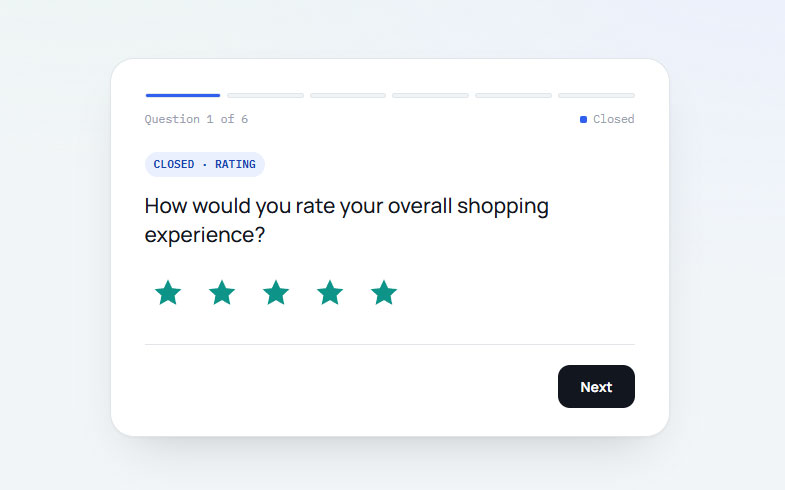
Closed-ended survey questions give respondents a fixed set of answers to choose from. They produce quantitative, comparable data and finish faster than any open format.
Pew’s American Trends Panel shows why researchers lean on them: closed items sit at a 1 to 2% nonresponse rate, and one Canadian study found complete-data rates of 67% for closed formats against 44.7% for open ones.
Every specific type you will meet branches from this parent: multiple choice, dichotomous, rating, ranking, and matrix. The two most common sub-types are worth pulling apart first.
Multiple Choice Questions
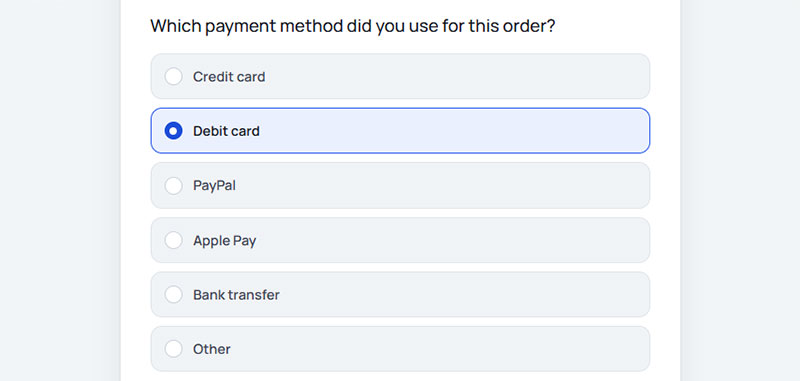
Multiple choice questions list several answer options and let the respondent pick one (single-select) or several (multi-select).
The “Other” write-in is the detail people skip. Without it, anyone whose answer is not listed either abandons the question or picks something false, and both corrupt your data.
The most common mistake: answer options that overlap or fail to cover every case. If someone can honestly fit two boxes, the question is broken. The choice between a single-answer control and a multi-answer one also hinges on whether radio buttons or checkboxes fit the response.
Dichotomous Questions
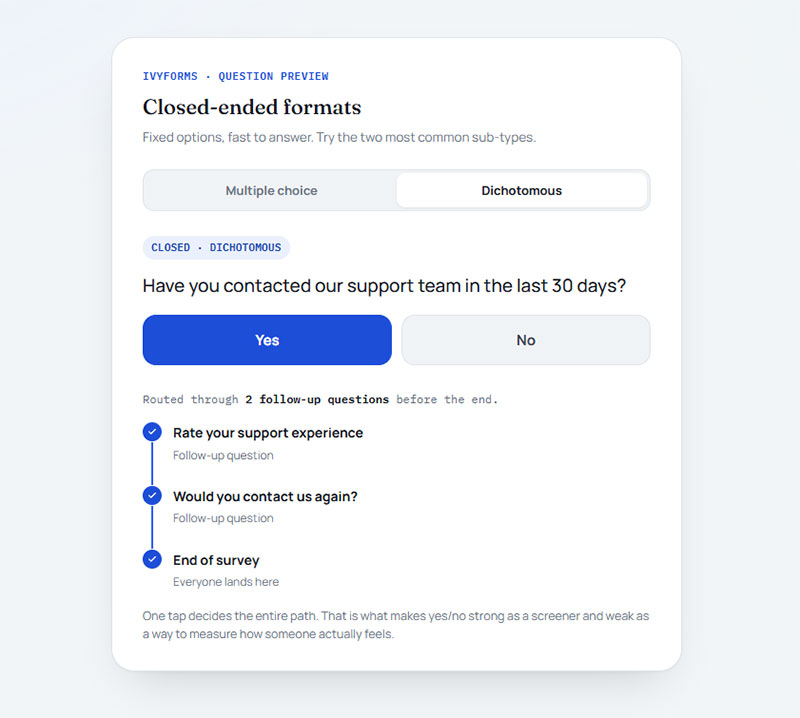
Two options only: yes/no, true/false, agree/disagree.
These shine as screeners and skip-logic triggers. A single yes/no can route someone into or past a whole block of follow-up questions.
Limitation: they force a binary where real opinion has shades. Use them to filter, not to measure nuance.
What Are Rating Scale Questions
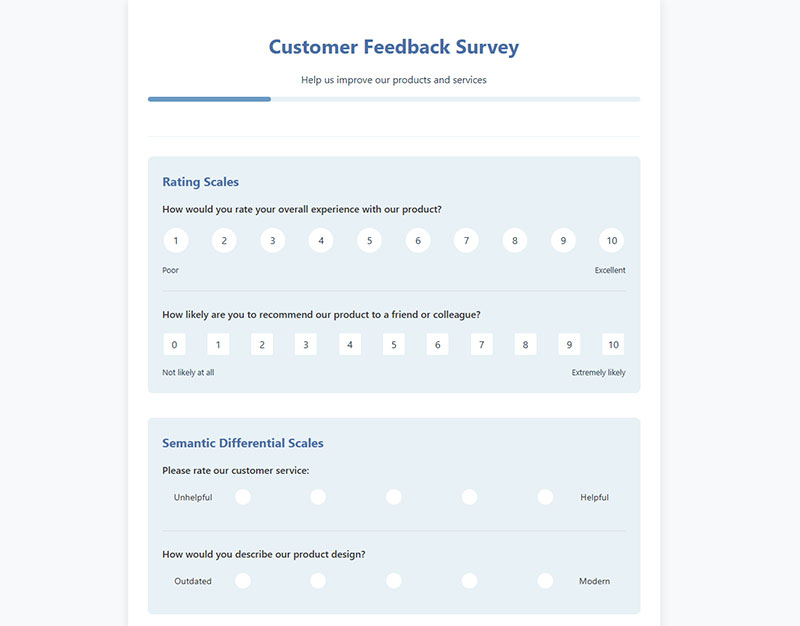
Rating scale questions ask respondents to rate something along a numbered or labeled scale. The data is ordinal, ranked but with unequal gaps between points, and it powers most quantitative survey work.
One structural choice drives everything: odd versus even scale points. An odd scale (3, 5, 7) includes a neutral midpoint. An even scale forces a lean one way, which is why even formats are called forced-choice.
Qualtrics and SurveyMonkey both ship scale libraries, so the build is trivial. The judgment sits in how many points you offer and whether you allow that middle option. Three scale variants dominate real surveys.
Likert Scale Questions
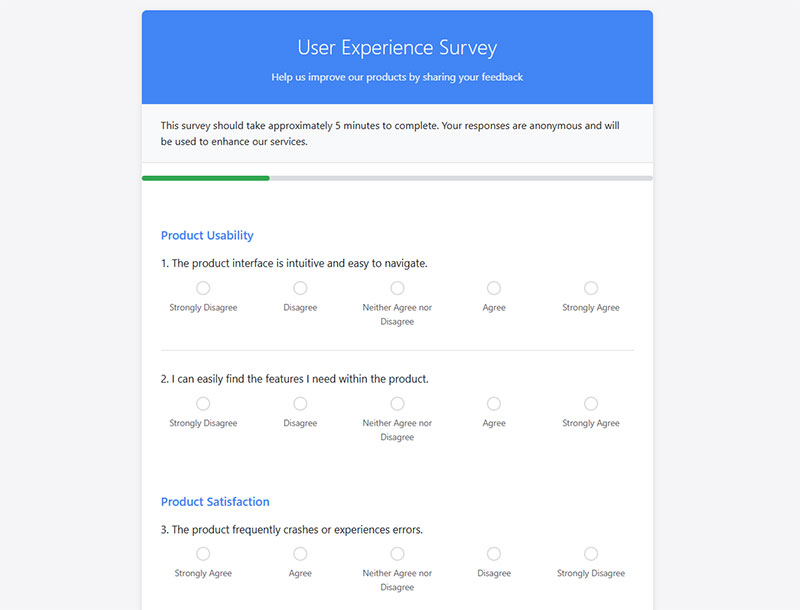
Rensis Likert built this scale in 1932 to measure attitude, not just direction but intensity of agreement.
The 5-point version is the most widely used because it balances speed with detail. Marketing research skews longer: one Wiley review found the 7-point scale dominant at 55%, with the 5-point at 30%.
Researcher.Life notes Likert data is treated as ordinal and summarized with the median or mode.
Semantic Differential Questions
Bipolar adjective pairs anchor each end of the scale: cheap to expensive, slow to fast, weak to strong.
Respondents place themselves somewhere between the two poles. Brand perception and product studies rely on this format to map how a name actually feels to people.
Net Promoter Score Questions
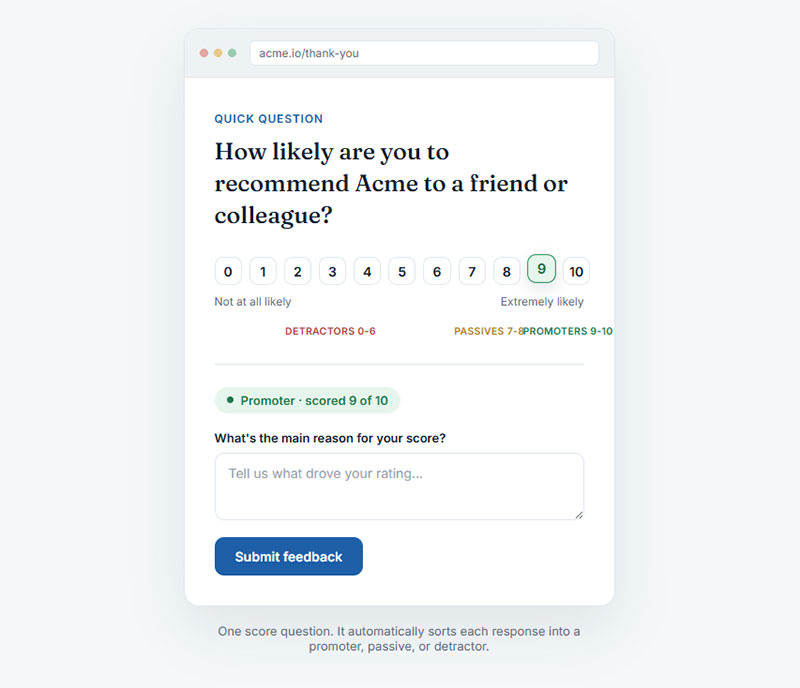
Fred Reichheld introduced NPS in 2003 with Bain and Company. One question, a 0 to 10 likelihood-to-recommend scale, splits respondents into promoters (9-10), passives (7-8), and detractors (0-6).
You subtract the detractor percentage from the promoter percentage. The result runs from -100 to +100.
SurveyMonkey benchmark data from over 150,000 organizations puts the average NPS at 32, with a median of 44 and the top quartile at 72 or higher. Building the question itself is simple once you know how to word the recommend-to-a-friend prompt.
What Are Ranking Questions
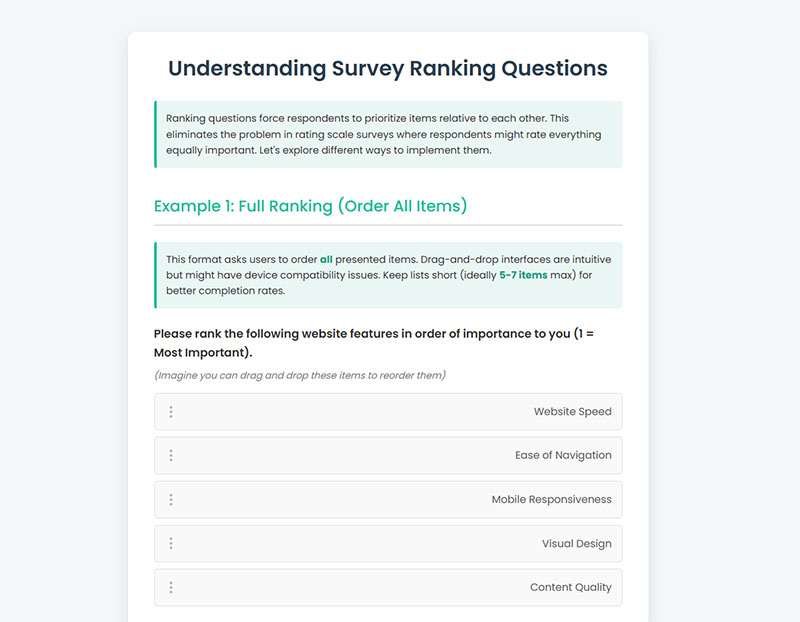
Ranking questions ask respondents to arrange a set of options in order of preference. The output shows relative priority, not absolute value.
That is the core difference from rating. A rating question can score five items all “very important” and tell you nothing about trade-offs. Ranking forces a choice between them.
The catch is cognitive load. Past 5 to 7 items, respondents struggle to hold the full list in their head, and answer quality falls.
Modern tools handle the interaction with drag-and-drop, which reads cleanly on desktop but gets fiddly on a phone. When people need genuine trade-offs rather than a wall of top scores, ranking is the tool. When you only need to know how strongly people feel about each item on its own, a rating scale does the job with less effort.
What Are Matrix Questions
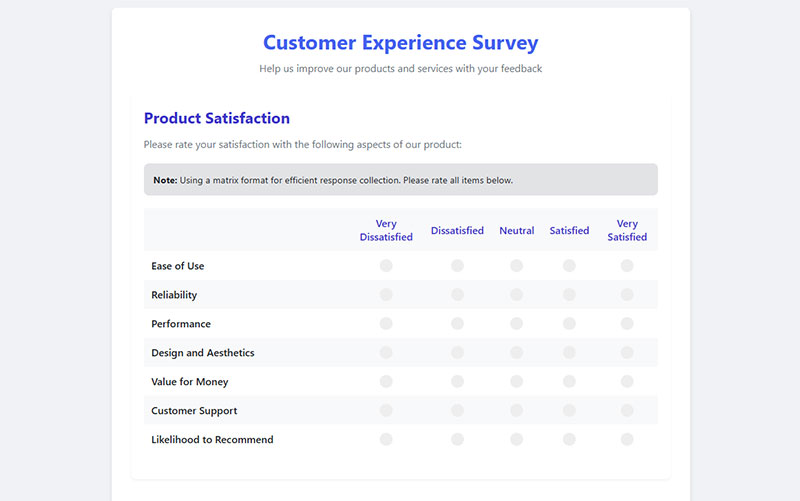
Matrix questions place several items in rows that all share one column scale. One grid, filled once, covers what would otherwise be four or five separate rating questions.
The appeal is density. Instead of scrolling through repeated “how do you feel about X” prompts, the respondent sees one organized block, which saves screen space and groups related items.
The problem is straightlining. Respondents run one answer straight down the grid without reading, and you end up with structured-looking data that means nothing.
Research backs the risk. A 2020 Survey Research Methods paper found genuine straightlined responses reached up to 22% of answers in some surveys, and Zhang and Conrad showed grids produce more nondifferentiation than item-by-item layouts.
Mobile makes it worse. A matrix wider than the screen forces horizontal scrolling, column headers vanish, and item nonresponse climbs. Liu and Cernat found nonresponse runs higher for matrix than item-by-item questions, especially among mobile respondents.
When to break the grid apart:
- More than 5 rows
- A mobile-heavy audience
- Any documented history of abandonment on that page
Keep grids to five items and five response options. Beyond that, split into single questions. This kind of layout decision is one piece of broader form design that respects how people actually answer.
What Are Demographic Questions
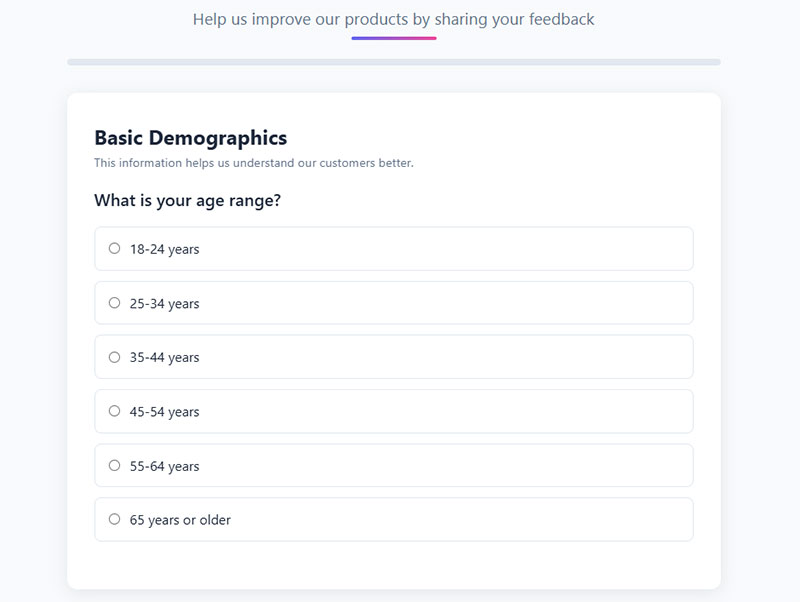
Demographic questions capture classification data about the respondent: age, gender, income, location, education. They produce nominal and ordinal data you use to cross-tabulate every other answer in the survey.
Placement is the running debate. Front-load them and you risk friction before the respondent is invested. Save them for the end and fatigue may thin your completion.
Format choice affects accuracy directly. That Canadian internist study found closed demographic formats hit 67% complete data versus 44.7% for open ones, though open formats produced fewer inaccurate answers on questions needing a calculation.
Handle sensitive fields with care:
- Make income and identity questions optional
- Offer inclusive, self-describe options for gender
- Explain why you are asking when it is not obvious
These fields carry more privacy weight than any other question type, which is why wording demographic questions without alienating respondents takes real thought.
What Are Contingency Questions
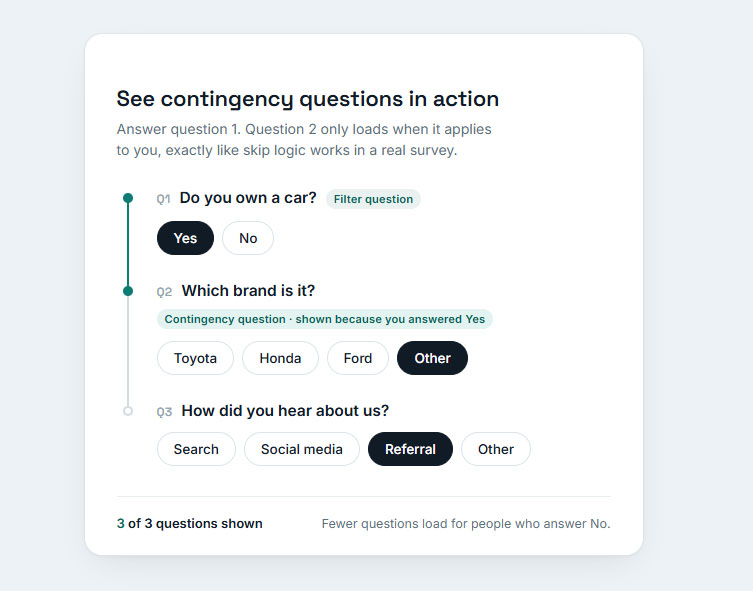
Contingency questions appear only when a previous answer triggers them. A filter question decides who sees the follow-up, so irrelevant items never load for the wrong respondent.
The mechanism runs under several names: branching, skip logic, jump logic, conditional logic. They all do the same job, routing each person down a path built from their own answers.
Filter feeds contingency. “Do you own a car?” is the filter. “Which brand?” only shows if they said yes.
The payoff is completion. BlockSurvey reports skip logic can lift completion rates by as much as 375% when applied well, mostly by cutting the irrelevant questions that trigger drop-off.
A 2024 NIH study on survey design found response quality falls measurably once respondents see questions that do not apply to them, which is the exact problem contingency questions remove.
The trade-off is analysis. Skipped questions and “N/A” answers both leave blanks, and if you mix the two approaches your dataset gets messy fast. Pick one and stay consistent.
Every major builder ships this. Qualtrics calls it display logic, Google Forms handles it through section jumps, and Typeform routes it inline. The wider principle behind these branching paths, how conditional rules reshape a form in real time, applies well beyond surveys.
Which Survey Question Types Introduce Bias
Four flawed constructions corrupt data no matter which question type carries them: leading, loaded, double-barreled, and absolute-language questions.
Bias is not a separate question type. It is a wording defect that infects the types already covered, from a Likert statement to a multiple-choice option.
| Flaw | What It Does | Example Tell |
|---|---|---|
| Leading | Steers toward a preferred answer | “our hardworking team” |
| Loaded | Assumes an unverified premise | “why don’t you get along?” |
| Double-barreled | Asks two things, allows one answer | “quality and service?” |
| Absolute | Forces a distorted yes/no | “always” or “never” |
Leading and Loaded Questions
Leading questions bias through non-neutral language. A single loaded adjective (“fantastic,” “hardworking”) nudges people toward the answer you were hoping for.
Loaded questions go further and bury an assumption inside the prompt. Kantar flags “what do you think about the negative impact of social media on teenagers?” as a classic, since it presumes harm before the respondent speaks.
Sawtooth Software notes that surveys run by political organizations are the textbook source of these, useful mainly as examples of how not to word a question.
Double-Barreled Questions
One question, two topics, a single answer box. “How satisfied are you with our product quality and customer service?” cannot be answered cleanly by anyone who feels differently about each half.
The fix: split it into two focused questions.
Qualtrics warns these can leave you with unusable data, since you never know which half the rating actually reflects. Spot them by scanning for “and” or “or” joining two distinct ideas.
How Question Order Skews Answers
Placement creates bias even when wording is clean. An earlier question can prime how someone answers a later one.
Sawtooth Software recommends randomizing question groups to counter order effects. Neutral, exhaustive answer options matter just as much as the question stem itself.
How to Choose the Right Survey Question Type
Match the question type to your data goal. Open-ended formats for discovery, closed formats for measurement, and a deliberate mix when you need both the number and the reason behind it.
Start from what you will do with the answer. If you need comparable data across a large sample, closed types win on speed and clean analysis. If you are exploring an unknown problem, open text earns its higher drop-off.
| Goal | Best Fit | Data Type |
|---|---|---|
| Explore unknowns | Open-ended | Qualitative |
| Measure attitude | Likert / rating | Ordinal |
| Track loyalty | NPS | Numeric |
| Screen respondents | Dichotomous | Nominal |
| Rank priorities | Ranking | Ordinal |
Weigh Sample Size and Analysis Capacity
Large samples favor closed types. Coding 5,000 free-text replies by hand is a project. Tallying 5,000 multiple-choice answers is a formula.
Check your capacity before you add open-ended questions. Two or three per survey is plenty, and each one you add is more qualitative work waiting on the other end.
Control Length to Protect Completion
Question count drives drop-off directly. Survicate analyzed 267,564 responses and found 1 to 3 question surveys complete at 83%, sliding to 56% at 9 to 14 questions and 42% once you pass 15.
SurveyMonkey data shows a similar curve, with abandonment spiking 5 to 20% once a survey runs past the 7 to 8 minute mark.
Cognitive load per question matters more than raw count. A 25-question survey of simple rating scales finishes better than a 12-question one loaded with open text.
Mix Types Within One Questionnaire
No single type carries a whole survey. A working questionnaire opens with easy closed items, places any open-ended prompts in the middle, and holds sensitive demographics until the end.
Skip logic keeps each respondent on a short, relevant path regardless of total length. The goal is steady, so learning how to keep respondents from burning out mid-survey shapes type selection as much as any data goal does.
Once the questions are set, a clean build matters. Choosing the right platform is its own decision, and comparing the survey plugins available for WordPress is a sensible next step before you launch.
FAQ on Types Of Survey Questions
What are the two main types of survey questions?
The two parent categories are open-ended and closed-ended questions. Open-ended questions collect free-text answers in the respondent’s own words. Closed-ended questions offer fixed options, producing quantitative data that is faster to answer and easier to compare.
What is the difference between open-ended and closed-ended questions?
Open-ended questions capture qualitative detail but carry higher nonresponse. Closed-ended questions limit answers to preset choices, which speeds completion and simplifies analysis. Pew data shows open items nonresponse near 18%, versus 1 to 2% for closed formats.
What is a Likert scale question?
A Likert scale question measures agreement or attitude along a rated scale, usually 5 or 7 points. Rensis Likert built it in 1932. The odd number gives a neutral midpoint, and responses are treated as ordinal data.
When should I use multiple choice questions?
Use multiple choice questions when answer options are known and finite. Single-select fits one clear choice; multi-select allows several. Always add an “Other” write-in so respondents whose answer is missing do not abandon or pick something false.
What is a matrix question?
A matrix question places several items in rows sharing one column scale. It saves space and groups related items. The risk is straightlining, where respondents run one answer down the grid without reading each row.
What is the difference between rating and ranking questions?
Rating scores each item on its own scale, so several items can all rank high. Ranking forces respondents to order items by preference, showing relative priority. Ranking gets harder past 5 to 7 items.
What is a Net Promoter Score question?
An NPS question asks how likely someone is to recommend you on a 0 to 10 scale. Promoters score 9 to 10, passives 7 to 8, detractors 0 to 6. SurveyMonkey benchmarks the average around 32.
How do I avoid bias in survey questions?
Drop leading language, unverified assumptions, and absolute words like “always.” Split double-barreled questions that ask two things at once. Keep answer options neutral and exhaustive, and randomize question order to blunt priming effects.
What are demographic questions?
Demographic questions classify respondents by age, gender, income, location, and education. The data powers cross-tabulation across every other answer. Make sensitive fields optional, offer inclusive gender options, and place these questions carefully to protect completion.
How many questions should a survey have?
Shorter surveys finish better. Survicate found 1 to 3 question surveys complete near 83%, dropping to 42% past 15 questions. Skip logic keeps each respondent on a short, relevant path regardless of total length.
Conclusion
Choosing among the different types of survey questions comes down to one decision made early: what will you do with the answer once it arrives?
Closed-ended formats give you clean, comparable numbers. Open-ended prompts hand you the reasons behind those numbers, at the cost of slower analysis.
Rating scales, dichotomous questions, ranking, and matrix grids each solve a different job. None of them works well outside the job it was built for.
The strongest questionnaires mix formats on purpose and cut the wording flaws that quietly skew results.
Keep the survey short. Lean on skip logic so every respondent sees only what applies to them.
Match the format to the goal, and your data starts answering the questions you actually asked.