








A new client doesn’t sign with an accounting firm because a landing page convinced them. They sign because someone they trust vouched for the firm, or because the firm showed…
Table of contents
Fence contractors compete for homeowners who are already comparing three or four quotes before anyone picks up the phone. Getting in front of that search, and then actually closing it, is what lead generation for this trade comes down to.
What makes fencing different from most home service categories is the sales cycle. A permit application or an HOA sign-off can sit on someone’s desk for two or three weeks before a job even gets scheduled, so contractors have to weigh cost per lead against a contract value that might not close for a month.
The market backs that up. The U.S. fencing market was valued at $9.33 billion in 2024 and is projected to reach $14.86 billion by 2033, growing at a 5.3% annual rate, according to Grand View Research’s 2025 industry report. Professional installation still accounts for most of that spend. Most homeowners would rather hand off the permit paperwork, the HOA back-and-forth, and the warranty questions than deal with it themselves.
What Is Lead Generation for Fence Contractors?
Every signed fence contract starts somewhere: a Google search after a storm knocks down half a backyard fence, a neighbor’s recommendation, a five-star review that tips the decision. Lead generation is just the work of showing up in enough of those moments and capturing the details before the homeowner calls someone else.
It covers everything from what lead generation actually means in a home services context to the specific steps a fencing company takes to fill its crew schedule.
Fence work carries its own wrinkles that general lead generation for contractors content tends to skip over. There’s usually a fence permit step required by the municipality before anyone can break ground, and in planned communities there’s HOA approval to get through too. A property line survey often has to happen first, just to confirm where the fence is even allowed to sit.
None of that applies to a plumber or an electrician, and it’s part of why the sales cycle runs longer here.
Core channels include Google Local Services Ads, paid marketplaces like Angi Leads, organic Google Business Profile visits, and referrals from past customers.
Lead generation for fence contractors isn’t brand advertising, and it’s not a single canvassing push before spring.
What Makes a Fence Lead Qualified?
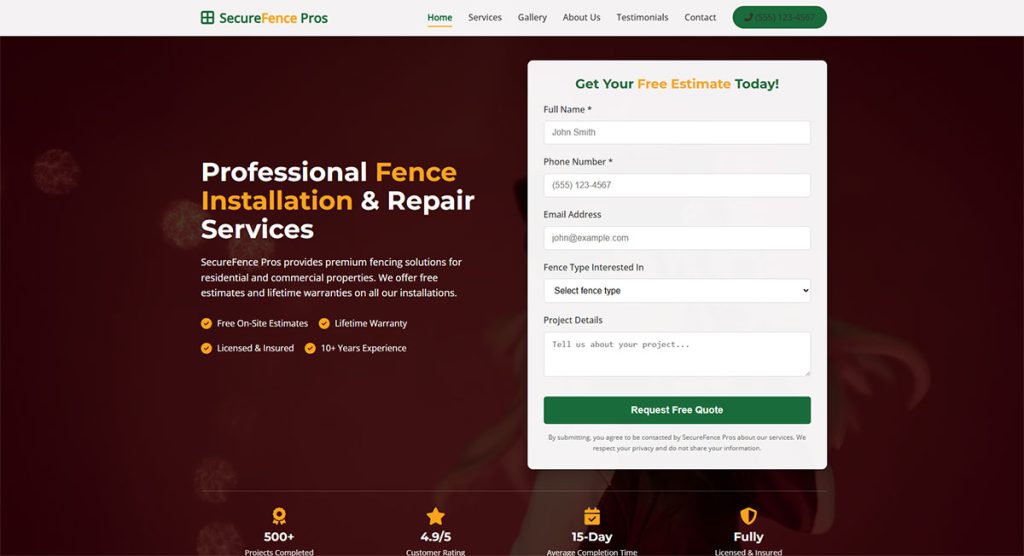
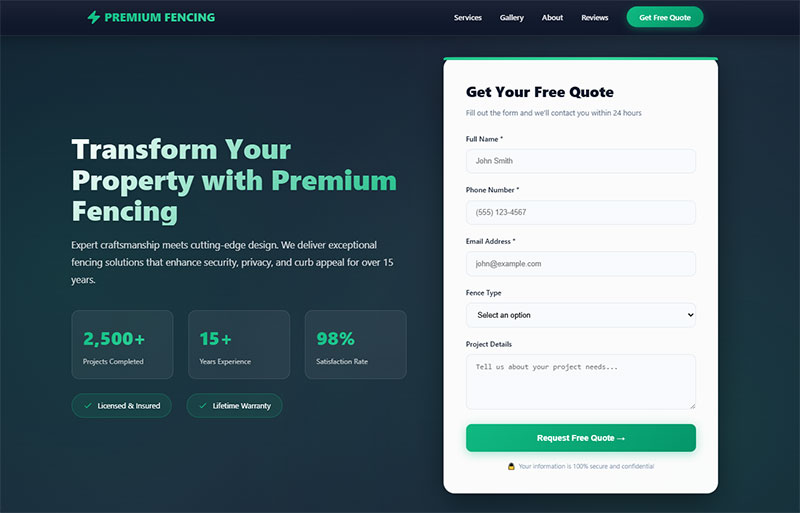
A vague web form or a one-line voicemail doesn’t tell you much. A qualified fence lead comes with a property type, a material preference, some sense of budget, and a timeframe, and when even one of those is missing, you’re often just talking to someone pricing curiosity rather than a job.
Property type matters because a residential backyard, a commercial perimeter, and an agricultural boundary all price out completely differently. Material preference (vinyl, wood, chain-link, aluminum) changes the cost per linear foot enough that quoting blind wastes everyone’s time. Even a rough budget range separates a serious buyer from someone just browsing, and timeline tells you whether you’re looking at a same-week install or a job that might not happen until next spring. “This weekend” and “sometime next year” are two completely different sales conversations.
Getting these four fields onto the intake form matters more than most contractors assume, and the guidance on which form fields actually capture high-quality leads applies directly here.
A basic contact box that only asks for name and phone number produces volume, not qualification. The difference between a contact form and a true lead generation form comes down to exactly these qualifying fields.
Wood fences account for 65% of residential demand nationally, with vinyl a distant second at 25% (ArcSite, 2025). A form that never asks about material is skipping the single most predictive field for estimating a job’s price and crew time.
How the Fence Lead Generation Funnel Works
Most of the drop-off in a fence sales process happens at one predictable point, not spread evenly across the funnel, which is exactly why it helps to name each stage separately.
Understanding what a lead generation funnel actually tracks makes it easier to spot where fence-specific steps slow things down.
- Homeowner submits an inquiry through a call, a website form, or a marketplace listing
- Contractor captures the property, material, budget, and timeline details
- Contractor schedules a site visit or sends a remote estimate
- Contractor confirms permit or HOA requirements before quoting a final price
- Homeowner signs the contract and a deposit is collected
Step two is where the intake form does the heavy lifting, and setting up proper lead capture forms on the website removes a lot of manual back-and-forth.
Speed matters more than most contractors realize once that inquiry lands. Velocify’s research on contact timing found that reaching a lead within 60 seconds lifts conversion by 391% compared to leads contacted 30 minutes later.
What Drives the Cost of a Fence Lead?
A vinyl privacy fence inquiry in a dense suburban market is going to cost more to land than a chain-link quote in a rural county with two competing installers, and the gap between those two scenarios comes down to a handful of overlapping factors.
Channel matters first: paid marketplaces and pay-per-lead ads cost more upfront than organic search or referral traffic ever will. Service area size plays into it too, since a wider radius pulls in more competition bidding on the same search terms. And material type pushes the number around on its own, because ornamental and aluminum fence inquiries carry a higher ticket size, which means contractors are willing to pay more per lead to win them.
The 2026 SearchLight Digital benchmark, drawn from 888 contractors and $6.72 million in ad spend, put the average Google Local Services Ads cost per lead at $53. That same dataset found a 43.9% book rate on those leads, which works out to a cost per paying customer of $233.
Blended Google Ads leads run closer to $90.92 for home-services search campaigns. That’s roughly 72% higher than the Local Services Ads figure, based on WordStream’s 2026 benchmark study of more than 13,000 campaigns.
Cost per lead only tells half the story, which is why it sits alongside other lead generation KPIs worth tracking, like cost per booked job and average ticket value.
Which Lead Sources Work Best for Fence Contractors?
Google Local Services Ads, Angi Leads, organic Google Business Profile visits, and Nextdoor referrals each produce fence leads with a different cost, a different level of exclusivity, and a different close rate. No single channel covers every stage of demand, from a same-week repair search to a planned spring installation booked months out.
| Source | Cost Model | Exclusivity | Best Fit |
|---|---|---|---|
| Google Local Services Ads | Pay per lead | Exclusive | Urgent repair and install searches |
| Angi Leads / HomeAdvisor | Pay per lead + membership | Shared | Building early volume, new companies |
| Google Business Profile (organic) | Free | Exclusive | Long-term, low cost per acquisition |
| Nextdoor referral | Free or ad-boosted | Exclusive | Established companies with reviews |
Reviewing a mix of lead generation strategies instead of betting on one channel keeps the pipeline steadier through slow months.
Referral and organic traffic sit on the inbound side of the equation, while paid marketplaces and ads sit on the outbound side. The split between inbound and outbound lead generation is worth mapping against your crew capacity.
Exclusive Leads vs Shared Leads for Fence Companies
An exclusive lead goes to one contractor only. A shared lead gets sold to several competitors at the same time, sometimes as many as eight of them chasing the same homeowner.
Angi and HomeAdvisor commonly sell the same fence inquiry to three to eight contractors simultaneously, at $15 to $85 per lead plus roughly $288 to $300 in annual membership fees (SmartService, 2026).
Exclusive leads cost more, but there’s no competing bid landing in the homeowner’s inbox five minutes after yours. That’s a better setup for an established crew with enough of a review base to win on trust instead of racing on price.
Shared leads work differently. The entry cost is lower, which helps a new fence company that hasn’t built up a review history yet, though the close rate tends to drop fast once speed and price both become deciding factors, and honestly, in a crowded shared pool, the fastest caller usually wins regardless of who does better work.
A company with an empty schedule and no reputation yet often does better starting on shared leads, then moving to exclusive once reviews build up.
How Seasonal Demand Shapes Fence Lead Generation
Fence lead volume climbs sharply from early spring through summer, as homeowners plan yard projects around warmer weather. That same demand spike pushes cost per lead higher too, since every fence company in the area ends up bidding on the same searches at once.
Spring and early summer bring the highest search volume and the highest lead prices. Fall is quieter but steadier, with lower cost and less competition for crew time. Winter installation demand drops off, though planning and estimate requests often hold up better than you’d expect.
Blackrock Fence & Construction in League City, Texas, added crews and expanded material inventory ahead of the 2026 spring season specifically to meet this seasonal jump in requests.
The off-season is the better window for review generation and referral outreach, since paid channels cost more without producing proportionally more booked jobs during the summer rush.
Local Search Visibility and Service Area Targeting for Fence Companies
Getting found locally comes down to a handful of things working together: a claimed Google Business Profile, a verified Google Local Services Ads account, and a service area radius that actually matches what the crew can handle. Skip one of these or size it wrong, and you either cap how many homeowners ever see the listing, or let in more competition than the schedule can absorb.
Setting Up Google Business Profile for Fence Categories
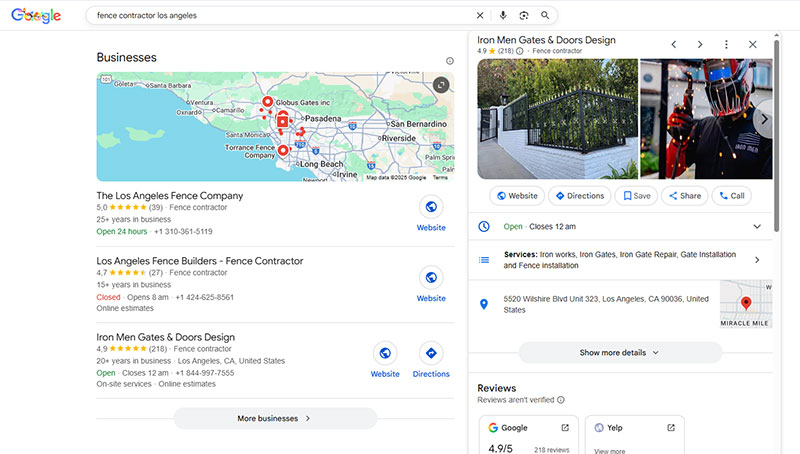
A lot of fence companies stop at “fence contractor” as their only category, when the profile actually supports selecting every fence-related category the business services. Photos matter more than owners tend to think too: completed vinyl, wood, chain-link, and aluminum fence projects, not just a logo and a stock photo. And turning on the request-a-quote button only helps if it’s actually connected to the intake form on the website, not left pointing nowhere.
A profile that routes homeowners straight into a website form built for lead generation collects the qualifying details a phone call alone often misses.
Reviews and photos posted directly to the profile carry more weight with local ranking than a bare listing with just an address and phone number.
Qualifying for Google Local Services Ads
Google’s own screening process requires proof of general liability insurance, typically a minimum of $1 million in coverage, plus a background check on the business owner and any fieldworkers. That background check runs through a third-party provider and generally clears in about 2 to 3 business days, according to Google’s Local Services Ads documentation.
Beyond that, Google checks business registration and license status against state databases, requires a linked and publicly visible Google Business Profile, and keeps monitoring insurance proof on an ongoing basis, since coverage that lapses can suspend the account without much warning.
Skipping the insurance step is the single most common reason fence companies sit in pending status for weeks.
Choosing a Service Area Radius or Zip Targeting
A wider service area pulls in more search volume, but it also means competing against more fence companies for the exact same homeowner.
| Targeting Style | Lead Volume | Competition | Best Fit |
|---|---|---|---|
| Narrow radius or zip list | Lower | Less | Small crews, limited capacity |
| Wide radius | Higher | More | Multi-crew companies with open schedules |
Matching the radius to actual crew capacity keeps cost per lead predictable instead of paying for inquiries the schedule can’t absorb.
Building Referrals and Reputation Into a Fence Lead Pipeline

None of this requires much of a budget. What it requires is doing it right after the job wraps, not weeks later when the homeowner’s already forgotten which crew showed up.
BrightLocal’s 2025 Local Consumer Review Survey, based on a panel of 1,026 US adults, found that just 4% of consumers say they never read online reviews before choosing a local business, and star rating remains one of the biggest factors in whether they’ll consider one at all.
Asking for a review within 24 to 48 hours of the crew leaving the property makes a real difference, and it’s worth pairing with a modest referral credit for homeowners who pass along a neighbor’s name. Before-and-after photos tied to the specific fence material installed help too, though a lot of contractors forget to actually post them anywhere people will see.
Viking Fence, an Austin, Texas fence and gate contractor, has built up more than 270 Google reviews at a 4.8-star average, a volume that keeps it visible well beyond its immediate service radius.
That kind of review count doesn’t happen by accident. It happens because someone on the team asks every time.
Tracking, Qualifying, and Converting Fence Leads With CRM Tools
Without a clear link between each inquiry and the channel that produced it, cost per lead numbers stay disconnected from which channel actually pays the crew’s wages.
Most contractors end up leaning on call tracking numbers through CallRail, so each ad and listing gets its own trackable line, along with missed call text-back automation so an inquiry that goes to voicemail still gets an immediate reply. Field service CRMs like Jobber or ServiceTitan log the job from first contact through invoice, which is where the whole picture comes together.
CallRail reports a 14% missed call rate across home service businesses, a gap that a text-back workflow closes automatically.
Pairing call data with form submission tracking in Google Analytics shows which pages and channels actually produce a completed intake form, not just a click.
Premier Oaks Landscape, a Dallas-Fort Worth home services company, connected CallRail’s call tracking to its Jobber account and doubled its booking rate once managers could see which lead source actually closed jobs.
When Fence Lead Generation Does Not Work
Recognizing these conditions early saves money that would otherwise go straight into inquiries nobody has time to work.
- Paying for more leads while the schedule is already booked out six weeks just raises cost per lead with no upside, since there’s no spare capacity to put them to use
- Companies that take longer than an hour to respond report losing that lead to a faster-moving competitor 81.2% of the time, and even businesses responding within 15 minutes still lose leads 46.6% of the time (Blazeo’s 2026 Speed-to-Lead Benchmark Report, 573 companies)
- A lead sold to several competing fence companies at once in an oversaturated shared marketplace tends to go to whoever calls back first, not whoever does the best work
- A brand new fence company leaning entirely on organic search and referrals often stalls out before enough reviews exist to build any real trust
A leaky intake form adds another failure point most contractors never diagnose. Reviewing the common reasons behind form abandonment often turns up a form asking for too much information before a homeowner has decided to trust the company at all.
When any of these conditions apply, fixing the operational gap comes before spending more on lead volume.
FAQ on Lead Generation For Fence Contractors
Is It Better to Buy Fence Leads or Build Organic Lead Generation?
Buying leads gets you volume faster, but the cost per job stays higher over time. Organic search and referrals cost less in the long run, though they take months to build up. Most fence companies end up running both: leaning on paid volume early, then shifting budget toward organic as reviews and rankings grow.
How Much Should a Fence Contractor Budget Monthly for Lead Generation?
There’s no fixed number that fits every fence company. Budgets vary by market size, competition, and crew capacity. Most start with a modest Local Services Ads budget and raise it once cost per booked job proves it’s actually profitable.
Which Lead Channel Fits a Small Fence Company Versus a Multi-Crew Company?
A single-crew company usually does better on exclusive channels like Google Local Services Ads or referrals, since it can’t compete on speed against three to eight other bidders chasing the same shared lead. A multi-crew company can absorb that same shared volume and keep crews booked anyway.
How Long Does It Take to See Results From a New Fence Lead Generation Effort?
Paid channels like Google Local Services Ads can start producing calls within days of verification. Organic visibility and referral volume are slower. Figure on three to six months, since reviews, rankings, and word of mouth build up gradually rather than showing up overnight.
Does a Fence Company Need Its Own Website if It Buys Leads From Marketplaces?
Marketplace listings limit a fence company to whatever contact format the platform allows. A dedicated website built around one of the available WordPress contact form plugins captures qualifying details marketplaces skip, and keeps leads out of a shared bidding pool.
What Should You Fix First in Lead Generation For Fence Contractors?
Lead generation for fence contractors breaks down most often at the response step, not at the channel or budget level. A qualified inquiry left unanswered past the first minute rarely converts, regardless of what it cost to acquire.
Fixing that failure point comes before adding channels or increasing spend, in this order:
- Cut response time first, since an unanswered call costs more than a slow landing page ever will
- Add a second exclusive channel once intake and follow-up both convert consistently
- Raise budget last, once cost per booked job actually confirms the math works
The missed-call rate and response-time research cited earlier point to one fix: closing that gap recovers more conversion than a new channel does.
Rebuilding that form is the next step, and the guidance on how to design lead capture forms covers the field order and messaging that keep a fixed response process from leaking inquiries.