





A form is usually the last thing standing between a visitor and whatever you actually want them to do: buy something, sign up, ask a question. Optimizing that form means…
Table of contents
A pulse survey question earns its place when somebody has already decided what happens if the score comes back low. Maybe that’s a conversation with the manager or a stay interview. Sometimes it’s a change to someone’s workload.
Each round sticks to one topic, such as engagement, wellbeing, manager support or onboarding, and uses a handful of statements. Most are rated on a 5-point agreement scale, and they go out between annual surveys.
Useful items still get left out. Microsoft Viva Glint reported in January 2025 that only 24% of its customers include an intent-to-stay item in their surveys, although the platform’s own data ties unfavorable ratings on that item to employees leaving within 90 days.
Which engagement and eNPS questions belong in a pulse survey?
Engagement fits in a pulse with a single eNPS question and a few driver statements behind it. The eNPS question gives you the outcome. The drivers hint at what moved it.
A lone outcome score tells a manager that engagement dropped, not why. Driver statements point at the cause, and each one needs an owner who acts when the score falls.
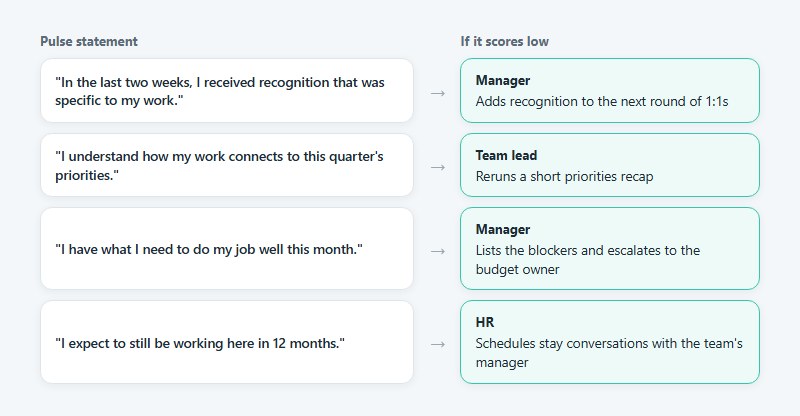
The statements below each come with the action a low score sets off.
- “In the last two weeks, I received recognition that was specific to my work.” If this scores low, the manager adds recognition to the next round of 1:1s.
- “I understand how my work connects to this quarter’s priorities.” A low score means the team lead reruns a short priorities recap.
- “I have what I need to do my job well this month.” Low scores get the blockers listed by the manager, then escalated to whoever owns the budget.
- “I expect to still be working here in 12 months.” HR schedules stay conversations with that team’s manager.
The last item earns its place, and if I could keep only one statement from this list, it would be that one. Microsoft Viva Glint’s research team reported in January 2025 that employees who rate its intent-to-stay item (worded around two years out) unfavorably were 10 times as likely to leave within 90 days.
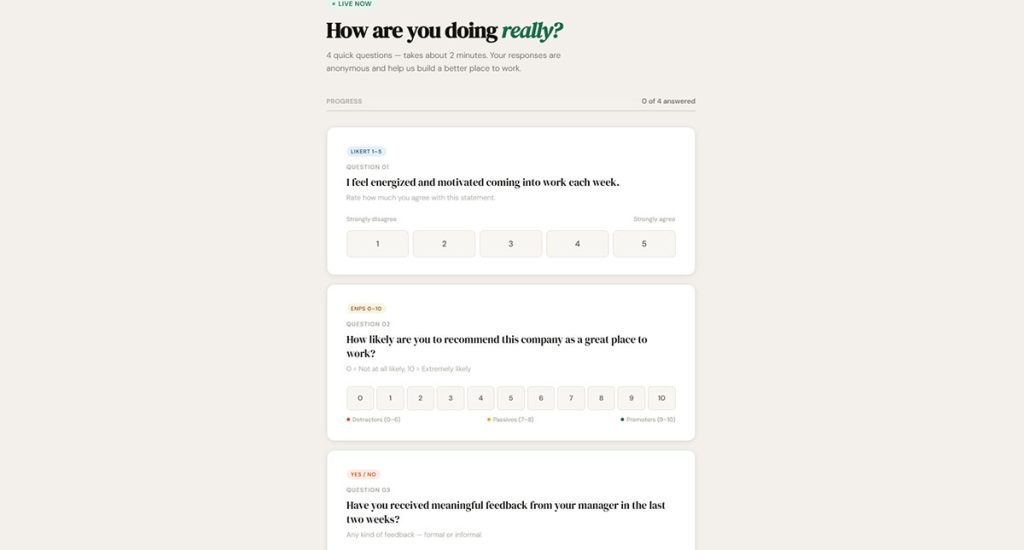
The eNPS question takes the 0-10 recommendation format from customer NPS survey questions (Fred Reichheld’s measure, first widely publicized in 2003) and aims it at the employer. How likely are you to recommend this company as a place to work? Culture Amp backs the question but advises against making it the only one asked. A form’s NPS field asks that one question on a fixed 0 to 10 scale.
Gallup’s Q12 is the usual engagement benchmark, but the wording is protected. Gallup’s Q12 materials state that the items cannot be administered or reproduced without Gallup’s consent.
So a pulse borrows themes such as recognition and development, or having a manager who cares, and writes its own statements, like the ones above.
Examples of Pulse Survey Questions
Employee Engagement Pulse Survey Questions
Engagement questions measure the emotional connection between employees and their work. They’re the foundation of any pulse survey program, and they should show up in almost every survey cycle you run.
Gallup’s Q12 framework is the most cited benchmark for measuring employee engagement. It covers twelve elements ranging from role clarity to having a best friend at work. You don’t need to use all twelve in a pulse survey. But pulling from that framework gives your questions research-backed credibility.
Here are engagement-focused pulse survey questions you can use directly:
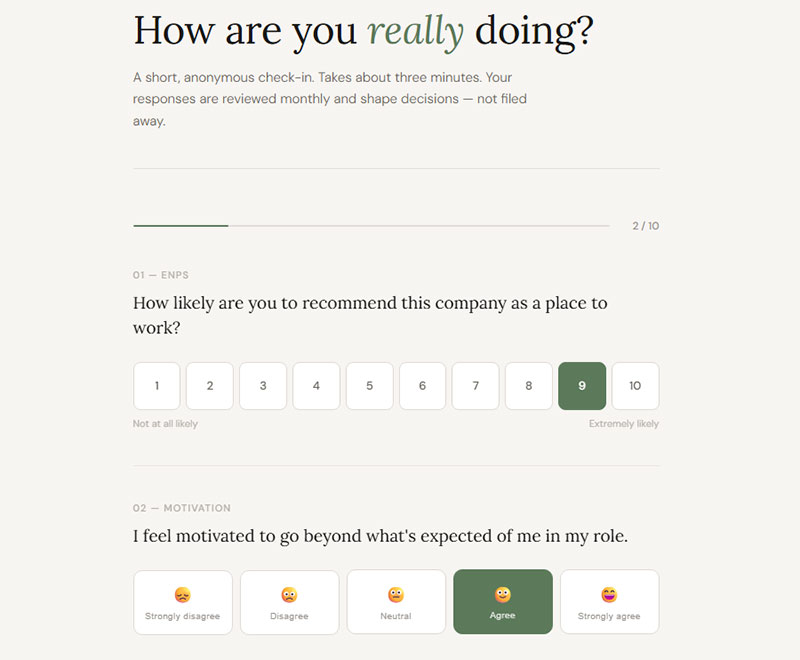
- “On a scale of 1-10, how likely are you to recommend this company as a place to work?” (This is the Employee Net Promoter Score question, or eNPS. It’s the single most tracked engagement metric across platforms like 15Five and Achievers.)
- “I feel motivated to go beyond what’s expected of me in my role.” (Likert scale, 1-5)
- “I’m proud to tell people where I work.”
- “I see myself still working here in two years.”
- “My work gives me a sense of personal accomplishment.”
- “I understand how my role contributes to the company’s goals.”
- “I feel valued for the work I do.”
- “I have the tools and resources I need to do my job well.”
- “I would rate my overall job satisfaction as high.” (1-5 scale)
- “What one thing would make your experience here better?” (Open-ended)
Monthly cadence works best for engagement questions. Weekly is too aggressive for this category and leads to survey fatigue. Quarterly is fine if you’re just getting started, but monthly gives you enough data points to spot trends before they become problems.
Gallup’s 2025 global report found that only 21% of employees worldwide were engaged in 2024, costing an estimated $438 billion in lost productivity. The gap between engaged and disengaged workers isn’t just a morale issue. It directly hits the bottom line. And the only way to track that gap in real time is through consistent, well-designed feedback survey questions.
Manager Effectiveness Pulse Survey Questions
Managers account for 70% of the variance in team engagement, according to Gallup. That single statistic explains why manager-focused pulse questions deserve their own dedicated category.
Google’s Project Oxygen research confirmed this. The study analyzed over 10,000 data points from performance reviews and employee feedback surveys. The original goal was to prove that managers don’t matter. The data showed the opposite. Teams with highly effective managers were happier, performed better, and had lower turnover.
After implementing its eight-attribute manager development program, Google saw favorable employee ratings for managers rise from 83% to 88%.
Here are pulse survey questions that measure manager effectiveness:
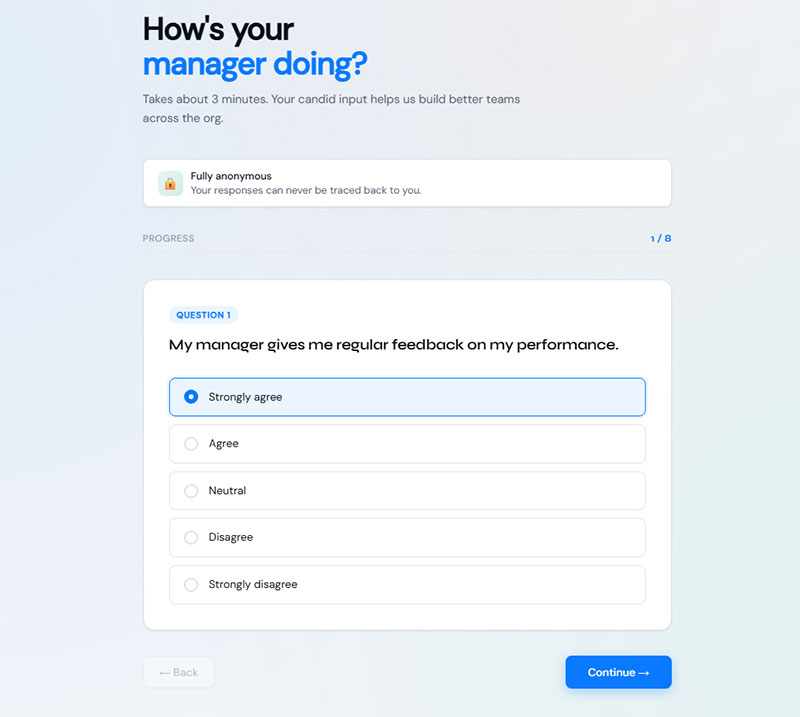
- “My manager gives me regular feedback on my performance.”
- “I feel comfortable raising concerns with my direct manager.”
- “My manager recognizes my contributions in a meaningful way.”
- “My manager communicates expectations clearly.”
- “My manager supports my professional development.”
- “I receive enough one-on-one time with my manager.” (1-5 scale)
- “My manager treats all team members fairly.”
- “What could your manager do differently to better support you?” (Open-ended)
Annual reviews are too slow for catching management issues. By the time you learn that a specific team’s manager isn’t providing adequate support, half the team may already be looking elsewhere.
Gallup’s 2024 global data showed manager engagement itself fell from 30% to 27%. The biggest drops were among managers under 35 and female managers. When managers are disengaged, their teams follow. That cascade effect makes these questions some of the most actionable in your entire survey program.
One thing worth noting: always keep manager feedback anonymous. If employees suspect their responses can be traced back to them, you’ll get inflated scores that tell you nothing useful. Most WordPress survey plugins and dedicated platforms handle anonymity by default, but double-check your settings.
Work-Life Balance and Wellbeing Questions
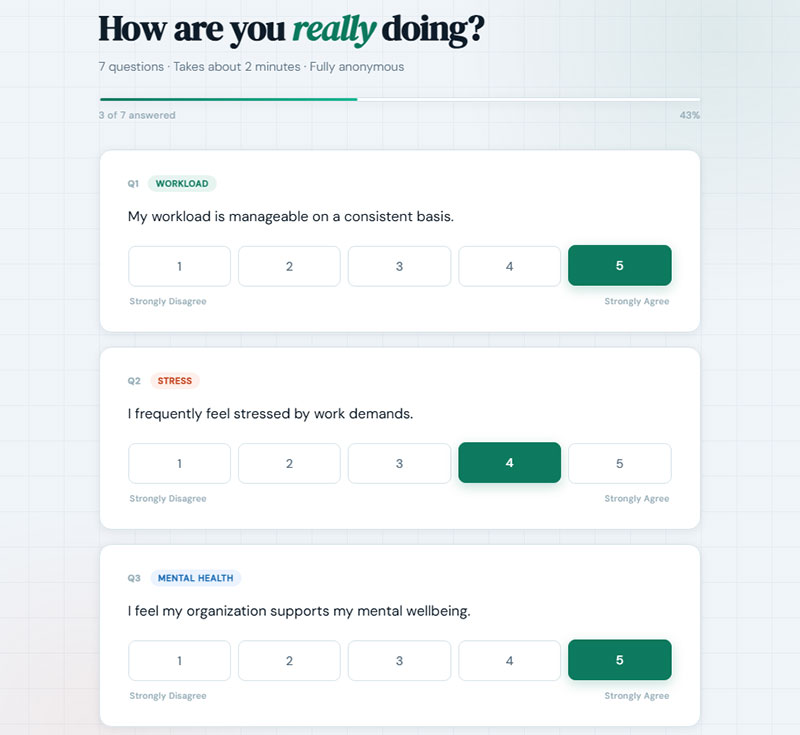
52% of employees reported feeling burned out in 2024, according to research published in the International Journal of Indian Psychology. Women reported burnout at 59%, compared to 46% for men.
The World Health Organization classifies burnout as a syndrome resulting from chronic workplace stress that hasn’t been successfully managed. It shows up as exhaustion, cynicism, and reduced professional effectiveness. Those three dimensions are exactly what wellbeing pulse questions should target.
These questions became standard in most pulse survey programs after 2020, and they’re not going away.
Additional wellbeing questions to consider:
- “I feel physically well enough to perform at my best.”
- “I have access to resources that support my mental health.”
- “My team respects boundaries around working hours.”
- “I’ve taken adequate time off in the past month.” (Yes/No)
- “Rate your overall wellbeing this week.” (1-10 scale)
BCG’s 2024 global study found that 48% of workers across eight countries are currently dealing with burnout. And here’s what’s tricky: burnout rates were roughly the same across remote, hybrid, and in-person workers. The work setting alone doesn’t explain it. Manager quality and workplace culture are what actually move the needle.
That’s why pairing wellbeing questions with manager effectiveness questions in the same survey cycle gives you a clearer picture. If one team reports high burnout and low manager support, you’ve found the problem. If you’re looking to build effective internal feedback forms that capture this kind of data, keep questions short and focused on observable behaviors rather than vague feelings.
Company Culture and Belonging Questions
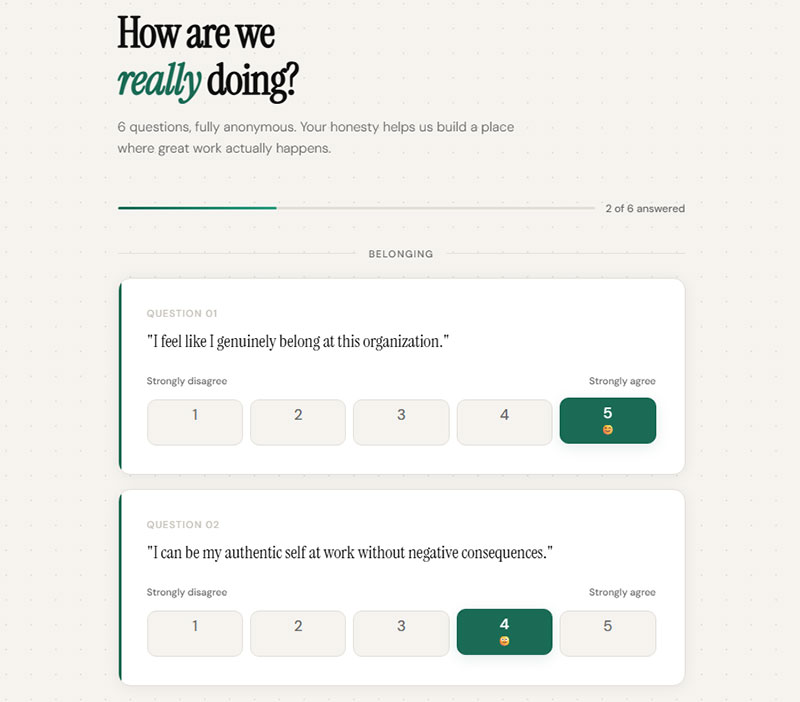
Culture questions are different from engagement questions. Engagement asks “how connected are you to your work?” Culture asks “how connected are you to this place and these people?”
Amy Edmondson’s research on psychological safety at Harvard is the framework most HR teams reference here. Her work showed that teams where people feel safe to take risks, admit mistakes, and speak up without fear of punishment consistently outperform teams where people stay quiet to protect themselves.
Gallup’s 2024 findings showed that only 39% of employees strongly felt that someone at work cares about them as a person, down from 47% in 2020. That eight-point drop signals a real erosion of belonging.
Pulse questions for measuring culture and belonging:
- “I feel like I belong at this organization.”
- “My team values different perspectives and backgrounds.”
- “I can be my authentic self at work without negative consequences.”
- “I trust my colleagues to support me when I need help.”
- “The company’s stated values match how things actually work here.”
- “I feel included in decisions that affect my work.”
How these differ from generic satisfaction questions: satisfaction questions ask whether someone is happy. Culture questions ask whether someone feels safe, included, and aligned. You can be satisfied with your paycheck and benefits while feeling completely disconnected from the team around you. Those are different problems requiring different solutions.
Gallup also found that only 46% of employees feel clear about what’s expected of them, down from 56% in early 2020. Lack of clarity feeds directly into cultural disengagement. When people don’t know what’s expected, they withdraw.
Gen Z employees were particularly affected. They showed a five-point decline in engagement compared to the prior year, with drops in clarity of expectations, recognition, and development opportunities. For organizations with a younger workforce, culture and belonging questions aren’t optional. They’re early warning systems.
If you’re running these surveys through a website, applying solid form design principles matters. Clean layouts, logical question grouping, and mobile-friendly formatting all affect completion rates, especially with younger respondents who will abandon a clunky form in seconds.
Career Growth and Development Questions
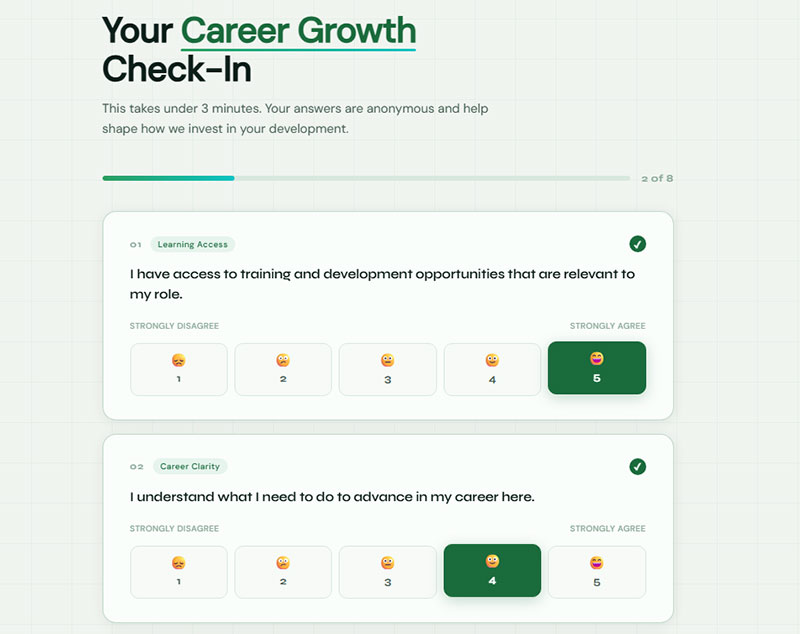
Career growth questions are leading indicators of voluntary turnover. By the time someone hands in their resignation, the decision was made weeks or months earlier. These questions catch that shift before it’s too late.
LinkedIn’s Workplace Learning Report consistently ranks learning and development as a top driver of employee retention. And it makes sense. People who feel stuck don’t stay. Took me a while to realize this wasn’t about offering more training courses. It’s about whether employees believe there’s a real path forward for them at the company.
Pulse questions focused on career growth and development:
Access to learning: “I have access to training and development opportunities that are relevant to my role.”
Career path clarity: “I understand what I need to do to advance in my career here.”
Manager involvement: “My manager has had a meaningful conversation with me about my career goals in the past three months.”
Skill development: “I’m building skills that will help me grow professionally.”
Opportunity perception: “I believe there are good career opportunities for me at this organization.”
Autonomy: “I have the freedom to explore new approaches and ideas in my work.”
And one open-ended question that pulls a lot of weight: “What skill would you most like to develop in the next six months?”
Gallup’s data showed that only 30% of employees believe someone at work encourages their development, down from 36% in 2020. That six-point drop is significant, because development-focused conversations are one of the strongest predictors of whether someone stays or leaves.
The University of Phoenix Career Optimism Index found a mismatch worth paying attention to: most employers say they offer career development opportunities, but employees don’t share that perception. Pulse surveys can surface that gap before it turns into a retention crisis.
Workers under 35 are especially sensitive to this category. Gallup’s 2024 report noted that younger employees showed notable declines in feeling like they have opportunities to do what they do best. If your organization skews younger, run career growth questions at least quarterly.
One practical tip: pair these questions with different types of survey questions to get both quantitative scores and qualitative insights. A Likert scale tells you the problem exists. An open-ended response tells you what to actually do about it.
Communication and Transparency Questions
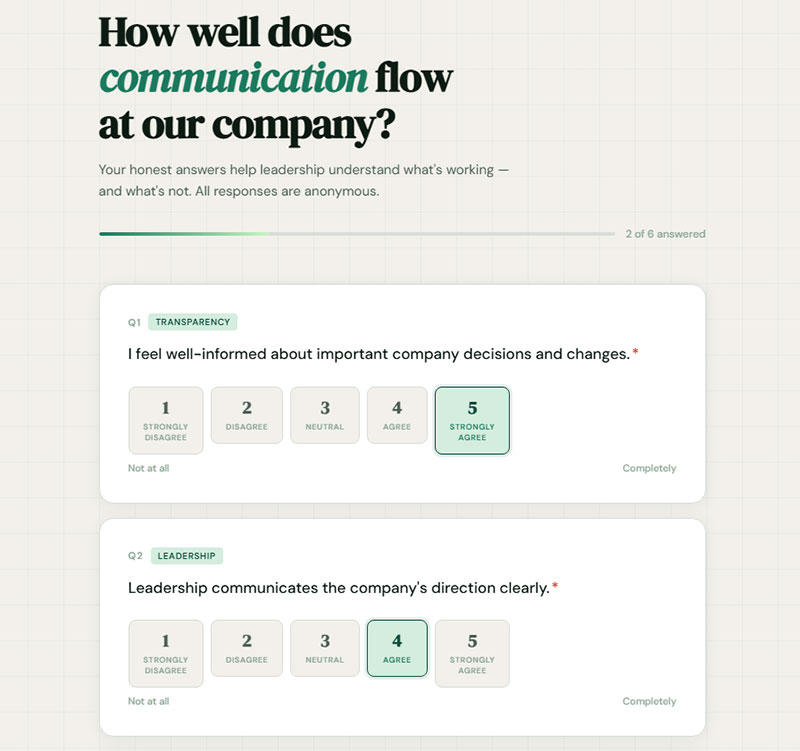
Communication breakdowns show up in pulse survey data long before they show up in exit interviews. That’s what makes this category so useful. Structured interview process feedback collected consistently across your team reduces bias and improves hiring quality over time.
Forbes Advisor’s State of Workplace Communication report found that over 40% of workers say poor communication erodes their trust in leadership. For remote workers, that number climbs even higher, with 54% reporting a trust gap tied directly to communication issues.
Here are pulse survey questions that measure communication and organizational transparency:
- “I feel well-informed about important company decisions and changes.”
- “Leadership communicates the company’s direction clearly.”
- “I have access to the information I need to do my job effectively.”
- “My team communicates openly and honestly with each other.”
- “When decisions are made, I understand the reasoning behind them.”
- “I feel comfortable sharing ideas or concerns with leadership.” (1-5 scale)
Grammarly’s 2024 State of Business Communication report found that miscommunication costs U.S. businesses roughly $1.2 trillion annually. That’s not a typo. And most of that cost comes from wasted time, stalled projects, and lost talent.
Why these questions matter right now: Gallup data shows only 23% of U.S. employees strongly agree they trust their organization’s leadership. But when leaders communicate clearly and inspire confidence in the future, 95% of employees say they fully trust their leaders. The gap between those two numbers is entirely a communication problem.
Microsoft ran into this during its 2023 layoffs. Internal pulse data reportedly showed communication scores dropping weeks before the formal announcements. Teams that received direct, honest updates from their managers maintained higher engagement scores than teams that learned about changes through external news coverage. The lesson: people don’t need good news. They need clear, honest information.
One practical consideration. If you’re collecting open-ended responses in this category, solid form validation prevents incomplete or garbled submissions that waste everyone’s time.
Change Management and Adaptability Questions
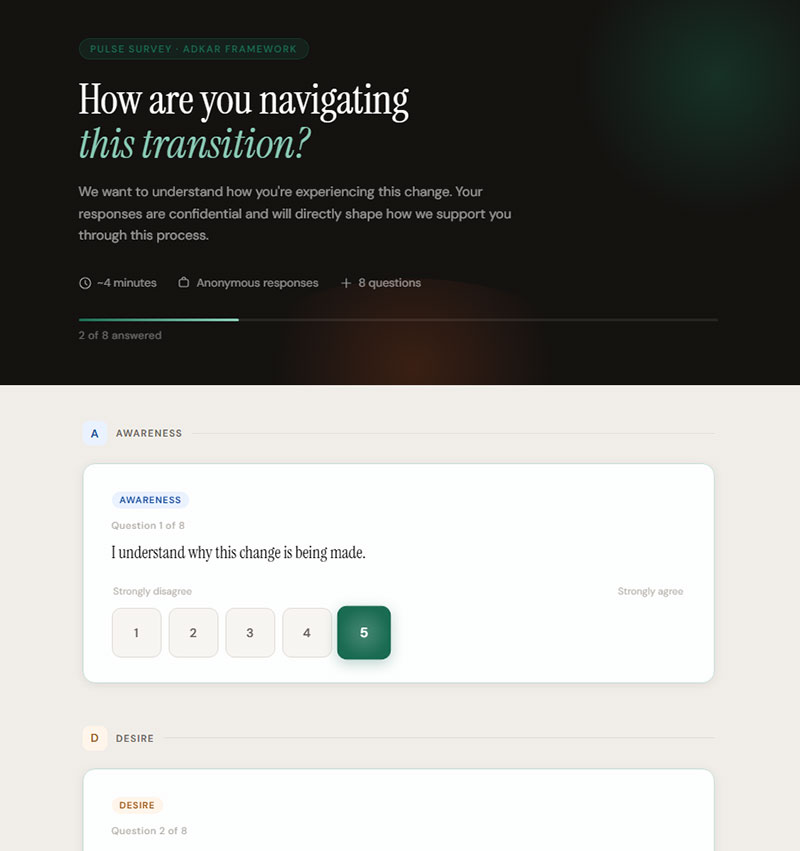
These are not questions you run every month. They’re situational, designed for specific moments: restructuring, mergers, new technology rollouts, leadership transitions, or major policy shifts.
McKinsey’s data shows that 70% of change programs fail to hit their goals, mostly because of employee resistance and weak management support. Pulse surveys during transitions help you spot that resistance early enough to actually do something about it.
The Prosci ADKAR Model provides a useful framework for designing change-related questions. ADKAR stands for Awareness, Desire, Knowledge, Ability, and Reinforcement. Each element maps to a specific question type:
Additional change-focused questions worth including:
- “I feel confident in the organization’s ability to manage this transition.”
- “My manager has been helpful in guiding me through this change.”
- “What would help you feel more prepared for this change?” (Open-ended)
Gartner research found a telling disconnect: 74% of leaders say they involve employees in change strategy, but only 42% of employees feel they were truly included. Pulse surveys during change initiatives close that gap by giving workers a direct channel to flag concerns.
Prosci’s own research shows that nearly 75% of organizations expect more change initiatives over the next three years. That means the workforce is going to face continuous transition. Running pulse checks during those periods isn’t optional. It’s how you keep people from burning out or checking out entirely.
If you’re building these surveys on a website, using conditional logic lets you show different follow-up questions based on how someone responds. That way you collect more targeted data without making the survey longer for everyone.
Which wellbeing, burnout and psychological safety questions should you ask?
Two or three statements cover workload and energy, and three or four cover psychological safety. Word all of them about the past two weeks. A pulse flags strain. It doesn’t diagnose burnout.
Gallup’s State of the Global Workplace 2026 report shows why that distinction matters. In it, 40% of employees worldwide experienced a lot of stress the previous day. That’s worth tracking as a signal, but a day of stress is not burnout.
- “My workload this week was manageable.” If it scores low, the team lead reviews open commitments in the next planning meeting.
- “I had enough energy left after work to do things I care about.” A low score sends the manager to check overtime patterns.
- “I took the time off I needed in the last month.”
Psychological safety gets its own block. Amy Edmondson tested it across 51 work teams in a manufacturing company (Administrative Science Quarterly, 1999), defining it at the team level as a shared belief that the team is safe for interpersonal risk taking.
Her seven-item scale is the validated source that pulse items are adapted from. The original mixed in reverse-keyed statements, which short versions flip to positive wording so a fast reader doesn’t misanswer.
- “I can raise a problem on this team without it being held against me.”
- “When someone makes a mistake here, the team helps fix it.”
- “I can disagree with the plan and still be taken seriously.”
- “It is safe to try something new on this team.”
The construct describes a team, not a person. A score from three respondents describes three people, so report it only above a minimum group size.
Questions for remote and hybrid teams
Work location alone doesn’t flag a problem. Gallup’s 2026 data put 30% of fully remote employees as engaged, against 17% of on-site workers whose jobs cannot be done remotely.
Friction is the better thing to ask about.
- “I get the information I need from my team without chasing people.”
- “I know when my teammates are available.”
- “My meeting load this week left room for focused work.”
The team lead owns every one of these.
What manager, team and inclusion questions give honest answers?
Ask about the manager and the team separately, and word every item about the respondent’s own experience. A blended “leadership” item hides which of the two needs work.
Gallup’s Beck and Harter wrote in 2015 that managers account for at least 70% of the variance in engagement scores across business units. That makes manager items the most actionable block in a pulse, and the hardest to report fairly.
The reason is group size. Microsoft’s Viva Glint documentation (updated May 2026) warns that percent favorable swings widely in small groups with no real change in sentiment, so manager items belong in team-level reports as mean scores with a minimum group size.
- For the manager, use “My manager gave me feedback this month that I could act on.” and “I know what my manager expects of me this quarter.” A low score goes to the manager and the manager’s own manager, with a coaching plan.
- The team block can run on “People on my team help each other when workload spikes.” and “Decisions here come with a reason, not just an announcement.” Low scores get raised by the team lead in the next team meeting.
- Inclusion gets “My perspective is taken seriously in team discussions.” and “I feel I belong on this team.” HR and the team lead review those together.
Inclusion items stay about the respondent. “My teammates treat everyone fairly” asks for a judgment about other people and returns guesses.
Which onboarding, change and post-training questions fit a pulse?
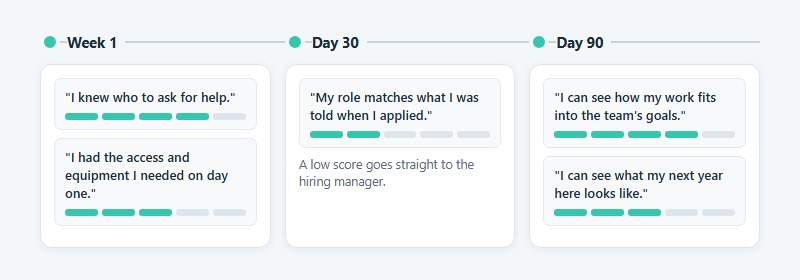
Event-driven pulses go out at fixed moments. Onboarding checks land at week 1, day 30 and day 90. Change items go out right after a decision lands, and training items two to four weeks after the session. Each one asks what happened since the event, not about the event itself.
Gallup’s 2019 onboarding research sorts what new hires need into five questions. They cover what we believe in around here, what my strengths are, what my role is, who my partners are, and what my future looks like. The checkpoints below map onto them.
- At week 1, ask “I knew who to ask for help.” and “I had the access and equipment I needed on day one.”
- Day 30 gets “My role matches what I was told when I applied.” A low score goes straight to the hiring manager.
- By day 90, the statements are “I can see how my work fits into the team’s goals.” and “I can see what my next year here looks like.”
Microsoft Learn’s employee experience module phrases its onboarding items in the same retrospective way, anchored to the first days on the job (feeling welcomed, knowing who to contact). A pulse covers only the checkpoints, so teams that want a longer first-90-days questionnaire can pull from a broader bank of onboarding feedback questions.
Small cohorts break anonymity. With two or three new hires per quarter, route results to the onboarding owner as named feedback and say so in the invite.
Change pulses cover why the change is happening, what it does to workload, and whether there’s a plan people believe in.
- “I understand why this change is happening.”
- “My workload is manageable under the new process.”
- “I know what is expected of me during the transition.”
- “I trust leadership to adjust the plan if it is not working.”
For training, ask about use on the job, not enjoyment of the session. “I have used something from the training in my work” and “My manager supports me in applying it” show whether the learning transferred.
Session ratings and content feedback belong in a separate, longer set of questions about the training itself, and an employee training feedback form is a ready starting point for it. The pulse tracks behavior.
Which question format and response scale should each pulse question use?
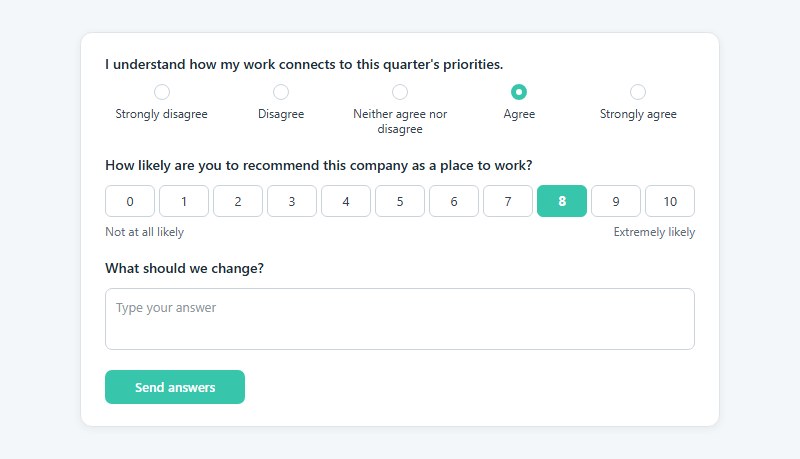
Most statements work on a fully labeled 5-point agreement scale. The eNPS question uses 0-10, and each pulse gets one open text box. Yes/no and multiple choice handle whatever is left.
| Format | Scale | Best for | Limit |
|---|---|---|---|
| Likert agreement | 5-point, every point labeled | Driver statements on recognition, clarity, support | Midpoint draws neutral answers |
| eNPS | 0-10 | One recommendation question per round | Score does not say why |
| Open-ended | Free text | One “what should we change” box | Slow to code; repeat boxes cut completion |
| Yes/no | Two options | Fact checks, such as access on day one | No gradation to trend |
| Multiple choice | Pick one or several | Choosing a topic or channel | Options change, trends break |
The agreement scale carries most pulse statements, and Likert scale question examples show the usual label sets from strongly disagree to strongly agree. Label every point. Krosnick and Fabrigar’s 1997 review found fully labeled scales beat endpoint-only scales on reliability and validity, as Survey Practice summarizes. A Likert field in a form shows several statements as a grid on one scale, with the labels you type.
Keep the scale fixed between rounds. Pew Research Center tested a political ideology question in 2018 surveys (published in 2020), setting an endpoint-labeled 7-point scale against a fully labeled 5-point scale, and found respondents landing in different categories on the two, so a mid-program change breaks the trend line.
Reading the results is where two conventions diverge. Microsoft’s Viva Glint documentation counts 4 and 5 as favorable on a 5-point scale, yet recommends the mean score as more reliable for small teams.
Gallup’s 2019 onboarding analysis reported top-box results instead. Employees who strongly agree they understand “how we do things at this organization” were 4.7 times as likely to strongly agree their onboarding was exceptional.
Pick one convention before the first round and keep it. Mean scores suit small teams, while top-box makes more sense for a single question where only the best answer counts.
Longer surveys draw on the full range of survey question types, but a pulse stays with the five above because each added text box or branching question costs completion time.
How do you word a pulse survey question so the answer is usable?
A usable item asks about one thing, uses neutral wording, names a specific behavior and covers a stated time frame. Fail any of those and the score can’t point to an action.
Vantage Circle’s April 2026 question guide states the cut rule bluntly. If a low score would trigger no action or conversation, the question does not belong.
- Kantar defines a double-barreled question as one that covers two or more topics but allows a single answer, and its own example asks whether a service agent was friendly and efficient. Each item should cover one thing only.
- On neutrality, the General Medical Council’s survey design guidance flags “How good was this course?” as leading, because the wording presupposes the course was good. A plain statement that respondents can agree or disagree with works better.
- Specific wording names the behavior that moves the score, such as progress or recognition, instead of a mood like “happy”.
- Anchor every item to the last two weeks or the last month. Without that, people answer from a general impression and the score can’t show movement between rounds.
Weak items and their fixes look like this.
- “My manager is supportive and communicates clearly.” gets split into two items, “My manager helps me when I hit a problem” and “My manager makes priorities clear.”
- “Don’t you agree the new tools make work easier?” becomes “The new tools help me finish my work.”
- “I am happy at work.” is better as “My work this month gave me a sense of progress.”
- “I always feel heard.” turns into “I felt heard in team discussions this month.”
- “Meetings are a waste of time.” works as “My meetings this week were worth the time.”
Wording changes cost you the trend line. Workday Peakon’s employee guide says re-asking the same question is the most accurate way to show whether experience is improving over time.
So edit an item only when it fails a test, and treat the edited version as a new item.
How many questions and how often? Sources disagree
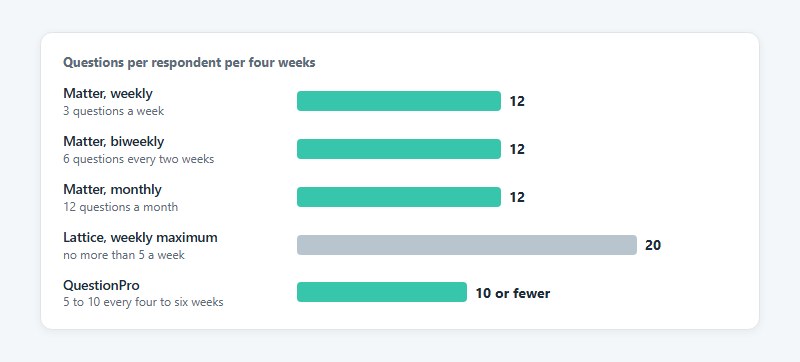
Use 3 to 5 questions for a weekly or biweekly pulse and 5 to 10 for a monthly or quarterly one. The shorter the gap between sends, the shorter the survey.
Published guidance does not agree on the exact numbers (help-center figures as of November 2026).
- Lattice says no more than 3 to 5 questions per pulse, on a weekly, biweekly or monthly cadence.
- Matter suggests 3 questions weekly, 6 biweekly and 12 monthly.
- QuestionPro goes with 5 to 10 questions every four to six weeks, or once a quarter.
- Vantage Circle gives 5 to 15 questions in its April 2026 guide, but 3 to 5 on its own product support page (2022).
The gap narrows once you count questions per respondent per four weeks. Matter’s presets land on 12 each time. Lattice’s weekly maximum reaches 20, while QuestionPro’s cadence stays at or under 10.
Length is not the main fatigue driver. McKinsey (2021) reviewed more than 20 academic articles, called the length explanation a myth, and found the top cause was the belief that the organization would not act on results.
Practical ways to avoid survey fatigue start from that finding. Act on the last round before sending the next.
Pick the cadence from how fast you can act, then size the survey to the cadence.
A full set of one eNPS question, 3 to 5 drivers and one open box runs 5 to 7 items, which fits a biweekly or monthly rhythm. Weekly sends rotate 3 items from that set.
How to build a pulse survey from a question bank
The order matters here, because each step limits the next one.
- Pick one topic and the decision it informs. Recognition feeds manager habits, workload feeds planning, onboarding feeds the first-90-days program.
- Name an owner for every question before it goes out. No owner, no question.
- Draw 1 outcome item, 3 to 4 drivers and 1 open-text box from that topic’s set.
- Freeze the wording of 2 or 3 core items and leave one slot for a rotating topical item, such as a reorganization.
- Choose the channel and check what it does to anonymity (email link, Slack, Microsoft Teams, or a survey platform).
- Announce the purpose, the anonymity rule and the date results will be shared, then send.
The fixed core gives you the trend line. The rotating slot keeps the pulse relevant without breaking it.
Channels differ more than they look.
- A Slack form built with the Workflow Builder form step can post responses into a channel message, lets owners download them as CSV, and can send a confirmation to the person who submitted (Slack documentation on Salesforce Trailhead, as of November 2026). Treat a Slack-native form as identified feedback.
- Lattice lets employees answer a pulse from the Apps menu in Slack, and the platform’s own anonymity rules still apply (Lattice help center, as of November 2026).
- Google Forms is trickier. A Google Docs Editors Community answer (October 2023) lists three settings that force a sign-in: Verified email collection, response editing, and Limit to 1 response. Don’t promise anonymity with any of them on.
Teams building the pulse in a form tool can start from a ready-made survey form template and trim it to 5 to 7 items. Open the link on a phone before sending. On a WordPress form, permissions by role or user limit who can open the entries.
How do you score a pulse survey and act on the results?
eNPS is the percentage of promoters (scores 9 and 10) minus the percentage of detractors (0 to 6), a number between -100 and +100. Favorability is the share of respondents who chose the agree side of an item, and response rate tells you how much weight the data carries.
Take 100 respondents, where 40 score 9 or 10, 45 score 7 or 8, and 15 score 0 to 6.
40% minus 15% gives an eNPS of +25. The 45 passives count in the total but not in the subtraction.
Report favorability for the agreement items and eNPS for the single recommendation question. Never average the two into one number, because a 0-10 scale and a 5-point scale don’t share units.
Response rate also hides a second metric. Lattice separates participation (people who answered at least one question) from response rate (questions answered out of questions sent), so a pulse can show strong participation and a weak response rate when respondents skip later items or the text box.
There is no shared benchmark for either number. Matter and Vantage Circle, for instance, publish different “good” ranges, so compare a team with its own earlier rounds.
Teams new to the analysis side can follow a general guide to analyzing survey data, then go back to the item owners named at the build stage. A Google Sheets integration on the form puts each response in a spreadsheet for that math.
Closing the loop is the part that gets skipped. In Quantum Workplace’s May 2023 panel of 1,068 employees, about two-thirds said their organization fails to act effectively on survey results.
Quantum Workplace’s advice from that research is to act on fewer items and plan actions together with employees, then report progress regularly. For a pulse, that looks like this:
- Share the result with the team that answered, and pick one or two low items rather than all of them.
- Name an owner and a date for the action, and report back before the next pulse.
When does a pulse survey not work?
A pulse falls flat when the group is too small to stay anonymous or when nobody can act on the result. It also falls short when a topic needs more depth than 5 to 7 items give. Every time, the fix is a different tool, not a better question.
- Platform defaults for minimum group size sit between 3 and 5. Workday Peakon’s lowest selectable threshold is 3 (documentation updated February 2025), Workleap Officevibe shows team scores at 3 active respondents but written comments only at 5, and Quantum Workplace recommends 5 for confidential engagement surveys.
- Low trust changes the math. Quantum Workplace advises against thresholds under 5 when trust looks shaky, such as a low response rate or comments raising confidentiality worries.
- Holiday dips matter too. A participation drop in a period such as summer holidays can push a group under its threshold, and Workday Peakon documents a separate per-round comment threshold for that case.
- If there’s no capacity to act, pause the pulse until an owner and a date exist for the last round’s findings.
Below the threshold, roll results up to the next level of the organization or hold a conversation instead of a survey.
Compensation structure and benefits design need a longer instrument, and so does a cultural diagnosis. A pulse can flag them but can’t size them.
Pulse survey or annual engagement survey?
Run the annual survey to choose topics and the pulse to track them. Qualtrics frames the annual survey as the detailed baseline and the pulse as the way to see what changes between those readings.
The annual survey draws on a wider bank of employee satisfaction questions, so it can size problems that a pulse only flags.
It gives a broad baseline across many themes and sets priorities for the year, though you only get one or two data points to work with.
The pulse stays on a single topic at a time. It gives you a trend line between annual readings, and results reach managers while the issue is still current.
McKinsey (2021) leaves the rhythm to the organization, with an annual or biannual diagnostic for some and quarterly pulses for others.
Pulse Survey Questions FAQ
What is a pulse survey?
Pulse surveys track one topic, such as engagement or manager support, through a few statements sent between annual surveys. They run anywhere from weekly to quarterly, so shifts in sentiment show up while the cause is still recent.
How long does a pulse survey take to complete?
Two to three minutes for the usual 5 to 10 questions, according to QuestionPro’s pulse survey guidance (as of November 2026).
Open-text boxes add the most time, which is why one per pulse is enough.
Should a pulse survey be anonymous?
Confidential is the safer promise than anonymous. Small Improvements states that its pulse surveys are not strictly anonymous, because sending each invitation requires identifying the employee, and its reports aggregate results at a minimum group size of three (help center, as of November 2026).
Tell respondents in the invite which of the two you offer.
Which tools can run a pulse survey?
Dedicated platforms such as Workday Peakon, Workleap Officevibe, Lattice, Qualtrics and Microsoft Viva Glint handle scheduling and reporting, and they enforce minimum group sizes.
Google Forms or Microsoft Forms cover a one-off pulse, but anonymity then depends on the form settings you choose.
When to Retire a Pulse Survey Question
Retire a pulse survey question after two consecutive rounds in which its result triggered no action, and replace it from the rotating slot, never from the fixed core.
An item scored round after round with no owner acting on it feeds the inaction that drives survey fatigue, so it costs more than the data returns.
When the question budget is full, retire items with no owner first, since nobody can act on their scores. Items with no action left to take go next. Rotating items whose topic has closed go last, because their trend line carries the least history.
The trade-off is comparability. Retiring an item ends its comparison with earlier rounds, which is why core items stay unless they fail a wording test.
Teams rebuilding the next round can follow a walkthrough on how to create a survey form.