








A new client doesn’t sign with an accounting firm because a landing page convinced them. They sign because someone they trust vouched for the firm, or because the firm showed…
Table of contents
Most interior designers who stay booked solid can’t tell you the last time they ran an ad. A referral comes in, someone looks over a portfolio, a call gets scheduled. That’s often the entire system.
It’s a smaller world than it looks from outside. Independent designers and small firms handle client acquisition themselves, and most of that demand runs through referral partners, trade platforms, and their own back catalog of past work.
Before a discovery call even gets booked, plenty of firms are already checking the inquiry against a fixed project minimum, because there’s no point spending an hour on the phone with someone whose budget doesn’t clear it.
Here’s the part that catches people off guard: even a warm referral doesn’t skip the research step. A Houzz survey of more than 900 homeowners found that 62 percent of those who found a professional through word of mouth still checked that professional’s website, reviews, and portfolio before making contact (Houzz, 2021). The referral opens the door. The online profile decides whether anyone actually walks through it.
What Is Lead Generation for Interior Design
Handing over tens of thousands of dollars before a single sketch exists is a heavier ask than most purchases require, and that’s the gap ordinary marketing doesn’t really account for. The term covers the channels and follow-up steps that move someone from mildly curious to a booked discovery call.
What Counts as a Lead in This Field
Liking a photo on Instagram doesn’t count for much. A lead here is someone who takes a specific step toward actually hiring somebody.
- Discovery call request: a homeowner books time to talk through a project
- Referral introduction: a contractor or past client passes along a name and number
- Qualified inquiry: someone fills out a project questionnaire with budget and timeline
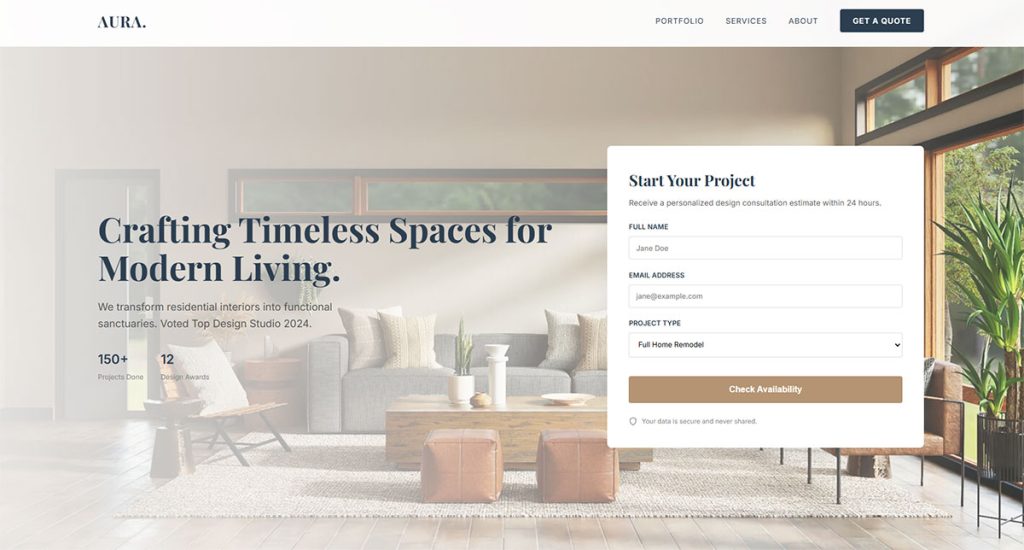
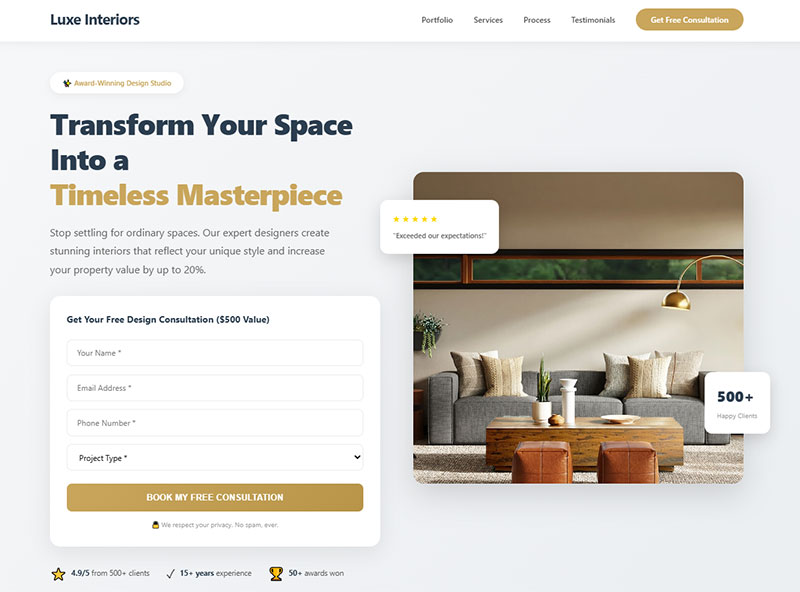
A generic message box on a homepage collects the same three fields it always has, while forms built specifically to qualify a prospect ask about budget range and project type before the conversation even starts.
How It Differs from General Home Services Marketing
The mechanics of lead generation work the same whether someone sells roofing or sells room design. What changes is how fast the buying decision moves, and that affects everything downstream.
- Higher trust threshold before a first payment
- Longer research phase, often months of browsing a client portfolio before contact
- Purchase tied to taste and identity, not just function
What Lead Generation Does Not Include
Press coverage and design awards build reputation, sure. But none of that is lead generation on its own.
- Branding work with no capture mechanism attached
- Follower growth on Instagram or Pinterest with no inquiry path
- Award submissions that never link back to a contact point
How the Interior Design Lead Generation Funnel Works
A contact typically moves through a discovery call, a portfolio review, a proposal, and then a signed contract, and each stage exists to filter out people who aren’t actually a fit. The funnel gets narrower on purpose.
- Discovery call: a short conversation to confirm budget, timeline, and scope
- Portfolio review: the prospect studies past work to judge style fit
- Proposal: a scoped quote with a design retainer or fee structure attached
- Signed contract: the lead becomes a client and work begins
Anyone building out a lead generation funnel for a design business will notice most of the drop-off happens between the discovery call and the proposal, right where price gets real.
A warm lead who ghosts after seeing a quote usually signals a budget mismatch that should have been caught earlier. It’s not a pricing problem.
Where Interior Design Leads Come From
Referral and directory platforms, organic content, and paid advertising cover most of where these leads actually originate. Most firms that stay booked run at least two of the three at once instead of betting everything on a single channel.
| Channel type | Typical lead cost | Lead quality | Best suited for |
|---|---|---|---|
| Referral and directory | Low to moderate | High, pre-warmed by trust | Established firms with past clients |
| Organic content | Low, but slow to build | Moderate to high | Firms with a strong visual portfolio |
| Paid advertising | Moderate to high | Variable, needs filtering | New firms needing volume fast |
Referral and Directory Channels
Houzz reports a community of over 70 million homeowners and design enthusiasts, alongside more than 3 million construction and design professionals (Houzz, 2024). That kind of scale is why a directory presence still beats most paid tactics for design-specific inquiries.
- Houzz, for homeowner-facing project matching
- Angi and Thumbtack, more contractor-heavy but useful for renovation-adjacent leads
- HomeAdvisor, mainly for home improvement crossover projects
Organic Content and Social Channels
A portfolio built around before and after photos does more selling than any pitch a designer could write.
- Instagram, for visual storytelling and direct messages from prospects
- Pinterest, for long-tail discovery months before someone is ready to hire
- A portfolio website on Squarespace or WordPress, as the landing spot once someone clicks through
Once that traffic lands somewhere, knowing how to use website forms for lead generation decides whether a visitor turns into a name in a CRM or just another bounce.
Paid Advertising Channels
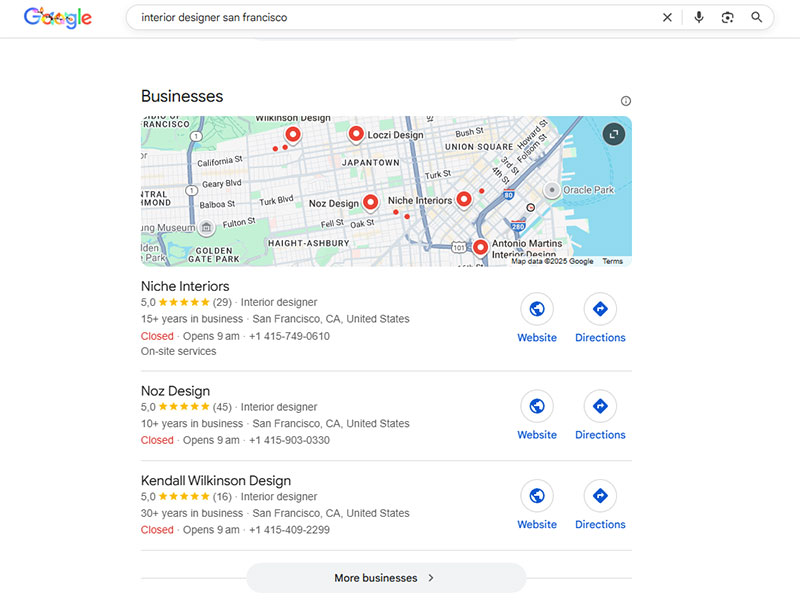
Google Ads catches people who are already searching for a designer nearby, so it sits closer to bottom-of-funnel intent than most paid options. Facebook Ads and Meta Ads Manager work earlier in the process, before anyone has typed a search query, targeting by demographic and interest instead. Google Business Profile is free to set up and backs both of those up in local search.
New firms without a client portfolio yet often lean on paid channels first, then shift budget toward referrals once past-client referrals start arriving on their own. That sequencing choice gets covered in more depth among general lead generation strategies.
How Much Interior Design Leads Cost
Cost per lead in this industry sits closer to home improvement benchmarks than to luxury retail or legal services. It also swings hard by channel, so a single average number hides more than it reveals.
LocaliQ’s 2025 Search Advertising Benchmarks put the home and home improvement category at:
- Average cost per lead: $90.92
- Average cost per click: $7.85
- Average conversion rate: 7.33 percent, meaning roughly 1 in 14 clicks becomes a lead
Referral and organic leads usually cost less in dollars but more in time. A portfolio takes months to build the kind of trust a paid click can’t buy instantly.
A firm chasing the lowest number on a spreadsheet, without checking conversion rate benchmarks by industry, can end up optimizing for cheap traffic that never converts.
Which Client Profile Converts Best for Interior Design Leads
The best-converting client clears the firm’s budget minimum and fits a project type the firm actually delivers well. Timeline matters too, and it’s probably the detail people fudge the most on an intake form.
Chasing every inquiry regardless of fit is what quietly inflates cost per lead on even the cheapest channel.
Hiring an interior designer costs an average of $8,525 in the United States, with most projects landing between $2,058 and $15,215 (HomeAdvisor, 2025).
A designer whose minimum project size sits above that range needs a qualification step early, before a discovery call gets booked with someone who can’t afford the work.
- Budget fit: does the stated range clear the firm’s project minimum
- Project type fit: full remodel, single room, or e-design, matched against what the firm actually delivers
- Timeline fit: is the homeowner ready now or still in the research phase
Getting this right starts with the intake form itself. Choosing the right fields for capturing high-quality leads filters out mismatched inquiries before they ever reach a calendar.
The wrong client profile doesn’t just waste time. It shows up later as a lower close rate on every channel a firm runs.
How to Build a Referral Network for Interior Design Leads
A referral network turns finished projects into a standing source of new ones. It works because trust transfers from the referrer to the designer, which cuts short the research phase most homeowners would otherwise go through before making contact.
Trade and Vendor Partnerships
Contractors, architects, and real estate agents all sit upstream of a design project, whether they realize it or not.
- Contractors, who need a designer once structural work is underway
- Architects, for new builds and full renovations that require design from the ground up
- Real estate agents, especially around staging and post-purchase renovation
- Showroom and vendor reps, who see clients shopping before they’ve hired anyone
Professional Association Networks
The American Society of Interior Designers counts more than 30,000 members across the United States and Canada, which is enough scale to make trade associations a real referral channel rather than just a credential to list on a website. ASID is the largest general membership body and works for both residential and commercial introductions, while IIDA leans more commercial with stronger workplace design ties. NKBA sits concentrated around kitchen and bath specialists, which makes it useful specifically for remodel-heavy referral flow.
Past Client Referral Programs
A finished project is the highest-trust lead source a design firm has. Most firms undersell this by waiting around for referrals instead of just asking for them.
- Ask at the point of highest satisfaction, right after the reveal
- Make the ask specific: a name and a warm introduction, not a vague request to spread the word
- Keep a simple incentive in place, even something small, so the ask feels reciprocal
Which Software Tools Manage Interior Design Leads
Design-specific platforms handle lead capture and client management in one place. General CRM tools get layered on top for nurture and email. The two solve different problems, and most established firms end up running one of each.
Studio Designer’s acquisition of Mydoma brought the two platforms together to support nearly 20,000 interior designers across the United States and Canada (Studio Designer, 2024). Firms like Ken Fulk and Pembrooke & Ives are named among the larger studios already running on Studio Designer’s platform.
Houzz Pro
- Built-in access to the Houzz homeowner marketplace
- Lead quality drops in markets with heavy designer saturation, though
Studio Designer and Mydoma
- Deep project, billing, and client portal management
- Lead generation is secondary here to back-office operations
DesignFiles
- Strong mood board and presentation tools that support the portfolio review stage
- No built-in homeowner marketplace to source new inquiries
General tools like HubSpot, Mailchimp, and SaveMyLeads get added on top when a firm needs automated follow-up or wants inquiries synced straight from a website form into a CRM.
Most of that syncing depends on how the intake form was built in the first place, which is why so many firms lean on guides for how to create lead capture forms before wiring anything to a CRM.
For firms running a WordPress site instead of a page builder like Squarespace, pairing the CRM with dedicated WordPress lead generation plugins is usually the simplest way to get inquiries flowing automatically.
How to Generate Interior Design Leads Step by Step
Generating leads in order beats running every tactic at once. The sequence below assumes a firm starting from close to zero, before its budget gets split across five channels that none of them fully support.
- Define the ideal client profile before building anything else.
- Pick two or three channels instead of spreading thin across all of them.
- Set up an intake form and connect it to a CRM before any traffic arrives.
- Launch outreach, ads, or content on the chosen channels.
- Review results monthly and shift budget toward whatever is actually converting.
Most of the general thinking behind how to generate leads for a service business applies here too, though the order matters more in design than it does in most industries.
The most common sequencing mistake is running paid ads before the portfolio or intake form is ready. Every click ends up landing on a site that can’t convert it.
How to Nurture and Follow Up With Interior Design Leads
A captured lead isn’t a client yet. It becomes one through a follow-up cadence that starts fast and tapers off over two to three weeks.
- Day 0: reply within the hour, ideally with a specific next step, not a generic thank-you
- Day 2: send a short email with two or three portfolio pieces matching the stated project type
- Day 5: a direct check-in asking if they have questions about scope or budget
- Day 10: a final nudge before the lead moves to a longer-term nurture list
Research published in the Harvard Business Review found that firms contacting a lead within one hour were nearly seven times more likely to qualify it than those waiting just one hour longer, and roughly 60 times more likely than firms that waited 24 hours (Oldroyd, McElheran, and Elkington, 2011).
Speed matters most on day zero. The cadence after that is what separates a warm lead from one that’s gone cold by week two.
Most firms build this sequence once and reuse it project after project. Starting from existing lead nurturing templates is faster than writing each email from scratch.
Whatever gets sent should end with a clear next action. Vague sign-offs are exactly why strong call to action phrasing matters even in a simple follow-up email.
How to Track Interior Design Lead Generation Performance
Referred customers carry a lifetime value at least 16 percent higher than customers acquired through other channels, based on a Journal of Marketing study tracking roughly 10,000 customers of a German bank (Schmitt, Skiera, and Van den Bulte, 2011). That gap alone is why tracking channel performance on cost alone misses the point.
- Conversion rate: percentage of leads that become discovery calls
- Close rate: percentage of discovery calls that become signed contracts
- Client lifetime value: total revenue per client, including referrals they generate afterward
None of these numbers mean much without attribution, which is why knowing how to track form submissions in Google Analytics matters just as much as the CRM itself.
A firm that never looks past cost per lead will keep funding the cheapest channel even after it stops producing signed clients.
Reviewing a short list of lead generation KPIs monthly is usually enough to catch that shift before a full quarter of budget gets wasted on it.
When Lead Generation Does Not Work for Interior Design
Lead generation fails quietly more often than it fails loudly. A firm can run ads, post content, and still end most months short on signed clients, and the cause is rarely the channel itself.
- Budget mismatch: the channel’s typical lead can’t afford the firm’s minimum project size
- Niche too broad: targeting every homeowner in a metro area instead of a defined project type or style
- No follow-up system: leads arrive and sit for days before anyone responds
- Unready website: paid traffic lands on a portfolio site with no clear next step
A Survey Booker audit of 132 UK surveying firms’ response times found nearly 16 percent never responded to a test inquiry at all, and only about 37 percent replied within an hour (Survey Booker, 2020). That single gap explains a large share of the leads a design firm pays for and then never converts.
A portfolio site that loses visitors mid-form is often the quieter version of the same problem. The fixes documented for improving form abandonment rate apply just as well to a design intake form as they do to any other industry.
None of this means the channel was wrong. It usually means something behind the channel wasn’t ready for the traffic it was sending.
FAQ on Lead Generation For Interior Design
What Is the Difference Between a Lead and a Qualified Lead in Interior Design
Not every inquiry deserves to be treated the same way. A lead is anyone who makes contact through a discovery call, referral, or inquiry form, while a qualified lead has confirmed budget, project type, and timeline matching the firm’s capacity. Mixing the two up inflates cost per lead without adding any signed clients.
Is Houzz Pro Worth It Compared to Other Directories
Houzz Pro earns its cost mainly through directory reach, since Houzz reports millions of homeowners browsing for professionals. Angi and Thumbtack skew toward contractors rather than design-specific searches, and returns often drop in saturated metro markets with heavy designer competition.
Is Paid Advertising Worth the Cost Compared to Organic Content
Paid ads move fast, though each lead costs more than one earned through referrals or a strong client portfolio. Organic content is slower to build, but once it’s working it keeps generating inquiries without ongoing spend. Most firms blend both instead of relying on just one.
How Many Leads Does an Interior Design Business Need Each Month
The right number depends on close rate and project size, not lead volume alone. A firm converting one in four qualified leads needs far fewer inquiries than one converting one in ten, so close rate matters more than chasing a bigger lead count.
What Mistakes Do Interior Designers Make When Generating Leads
Common mistakes include quoting price before qualifying the project, treating every channel with the same message, and never tracking which source actually produced a signed client. Skipping a referral ask after a finished project also wastes an easy, low-cost lead source.
Do Interior Designers Need a Website to Generate Leads
Not strictly. Houzz, Instagram, and referrals can generate inquiries on their own. That said, a dedicated portfolio site still helps once traffic needs somewhere to land, especially for paid ads or Google Business Profile clicks.
How Long Does It Take to See Results From Interior Design Lead Generation
Paid channels can produce inquiries within weeks, though qualified ones take a bit longer to show up. Referral and organic content need three to six months to build enough trust for a steady flow, and consistency across whatever channel mix gets chosen matters more than raw speed.
What Should You Fix First in Lead Generation For Interior Design?
Lead generation for interior design breaks down fastest at the intake step, not the channel choice. A slow reply or an unqualified inquiry wastes spend before a discovery call ever gets booked.
A single lead priced at that home improvement search average sits at just over one percent of the typical signed project value, a ratio neither figure shows on its own.
A short list of fixes takes priority over any channel decision, roughly in this order:
- Client profile, so unqualified inquiries stop reaching the calendar
- Intake and response system, so a captured lead doesn’t go cold
- Channel mix, only once the first two hold up under real traffic
Trade partners sit on the other side of that referral relationship, and lead generation for architects covers how they generate and qualify their own inflow.