






A new client doesn’t sign with an accounting firm because a landing page convinced them. They sign because someone they trust vouched for the firm, or because the firm showed…
Table of contents
Gartner puts a number on it: B2B buyers now spend just 17% of their total purchasing time actually meeting with potential suppliers, out of the entire stretch between noticing a problem and signing a contract.
Everything else happens without you in the room. People research alone, compare vendors alone, and build a shortlist alone, long before anyone from your sales team picks up a call.
That’s really the whole argument for learning how to generate leads for your business. It’s rarely about a weak pitch or a bad product. It’s about showing up early enough in that self-directed research phase to be one of the names already on the shortlist, instead of a name someone stumbles on after the decision is basically made.
Get in front of that buyer while the list is still being built, not after, and the difference shows up in your pipeline.
What Is Lead Generation
Somewhere between a stranger noticing your brand and that stranger paying you money, there’s a moment where they hand over contact information, or at least engage enough that a follow-up makes sense. Making that moment happen on purpose, instead of hoping it happens by accident, is what lead generation actually is.
It sits between brand awareness and the sale itself. A closer look at what lead generation covers as a discipline breaks down how marketing and sales typically split ownership of that handoff, and in practice, that split looks different at almost every company that’s actually good at it.
The terms are worth keeping straight. A lead is someone who’s shared contact information, through a form, a call, or an event sign-up. A prospect is a lead that’s been checked for fit, meaning someone confirmed they could plausibly buy. A customer is a prospect who paid. People blur these together constantly, and it’s usually the reason marketing and sales argue about whose pipeline numbers are real.
It also happens to be where B2B marketing budgets go. Industry research puts lead generation at roughly 36% of spend, the largest single share, ahead of brand building (about 30%) and demand generation (about 20%). That figure traces back most consistently to LinkedIn’s own marketing research rather than Content Marketing Institute’s benchmark studies, so treat it as a directional industry number rather than something pulled from one clean, single source.
People conflate demand generation with lead generation constantly, even though the two do different jobs. Demand generation builds awareness and interest before anyone’s ready to hand over an email address. The cleaner way to think about lead generation versus demand generation comes down to one question: does the activity end with a named, contactable record, or not.
Inbound Lead Generation vs Outbound Lead Generation
Inbound is everything that pulls people toward you without you reaching out first: blog content, SEO, gated resources, organic social. Outbound flips the direction. You’re the one initiating, through cold email, cold calling, paid ads, or direct mail, often before the person has shown any interest at all.
The split between inbound and outbound lead generation ends up shaping more than tactics. It affects budget, how fast results actually show up, and who owns that first conversation, marketing or a sales development rep.
HubSpot is the textbook inbound case. It grew from a two-person blog into a public company mostly by giving things away for free, Website Grader being the best-known example, and letting that free tool pull leads in on its own.
Marketing Qualified Leads vs Sales Qualified Leads
An MQL, short for marketing qualified lead, has done something that signals real interest: downloaded a guide, sat through a webinar, visited the pricing page more than once. Nobody’s called them yet, but the behavior is there.
Getting to an SQL takes more work. A sales qualified lead has actually been checked against budget, authority, need, and timeline, which is a fancier way of saying someone confirmed this person can buy, wants to buy, and has a reason to buy soon.
Most B2B pipelines lose momentum right at that handoff, and it’s almost never because the lead was bad. It’s because marketing and sales define “ready” differently, and nobody wrote the definition down.
How Does the Lead Generation Process Work
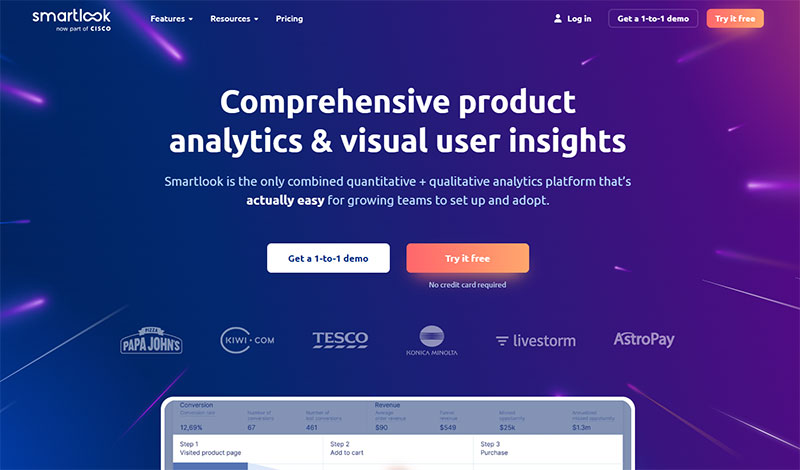
Ruler Analytics’ 2026 report, covering more than 110 million sessions across thirteen industries, found the average multi-touch website conversion rate sits at 5.13%.
That number covers the whole arc a lead moves through, and the arc looks roughly the same no matter which channel brought someone in. Someone becomes aware of the brand, gets captured through a form or a call, gets nurtured with follow-up content over days or months, gets checked for fit against budget and timeline, and eventually converts into a paying customer. The stage-by-stage version of that path is covered in what a lead generation funnel actually looks like.
Salesforce built its entire product category around tracking exactly where a contact sits inside that arc, which is a decent part of why CRM adoption tends to track closely with how mature a company’s lead generation actually is.
Lead Capture and Data Collection
Capture happens at one specific moment, usually a form submission, a phone call, or a chat conversation, and everything downstream depends on what gets collected right then. Website forms tied to a specific offer, phone and chat transcripts logged into a CRM, event badge scans, business card drops at a trade show booth. All of it counts.
Data quality at this stage decides everything that happens later. A form asking only for an email address captures more leads. A form that also asks for company size and role captures fewer, but the ones it does capture are worth a lot more to a sales team.
Lead Nurturing and Scoring
Forrester Research is widely cited for a finding that’s held up for years: companies with mature nurturing programs generate 50% more sales-ready leads at a 33% lower cost than companies that skip nurturing entirely. It’s circulated across the industry long enough that it’s worth treating as a long-standing benchmark rather than something tied to one recent report.
Scoring is how that nurturing gets prioritized. Points get assigned to behavior, opening an email, revisiting a pricing page more than once, and to firmographic fit, industry, company size, job title. Once a lead crosses a set threshold, it moves out of marketing’s queue and into sales, closing the loop back to that MQL-to-SQL handoff.
What Are the Main Lead Generation Channels
Organic search, paid search, social media, email, referral, and events cover most B2B and B2C lead generation activity between them.
Some of these compound. Organic search and content marketing keep producing leads long after the work is published and the invoice is paid. Paid search doesn’t work that way. The moment spend stops, the leads stop.
| Channel | Typical Cost | Compounds Over Time |
|---|---|---|
| Organic search / content | Low ongoing cost, high setup effort | Yes |
| Paid search (Google Ads) | Around $70 per lead (WordStream, updated November 2025) | No |
| Paid social (LinkedIn, Meta) | $25 to $150 per lead | No |
| Email marketing | Low cost, high ROI | Yes |
| Referral / word of mouth | Low direct cost | Yes |
B2B and B2C businesses tend to lean on different mixes, and it’s not arbitrary. B2B leans toward LinkedIn, email, and referral because deals usually involve multiple stakeholders and longer research cycles. B2C leans toward paid social and search, since purchase decisions happen faster and involve fewer people signing off.
Which channel to prioritize first really comes down to budget, sales cycle length, and how fast the business needs pipeline. That decision gets covered in more depth across specific lead generation strategies built for different business models.
How Does Content Marketing Generate Leads
Content Marketing Institute’s 2025 B2B benchmark report found content marketing helped generate demand and leads for 74% of B2B marketers over the past 12 months, the second most common outcome behind brand awareness, which 87% of marketers credited to content marketing.
NetLine’s 2025 State of B2B Content Consumption Report, based on 7.9 million registrations, found demand for gated content, meaning content placed behind a form, increased 83.8% since 2020. That’s not a small shift. It suggests buyers are more willing to trade an email address for something genuinely useful than they were five years ago, not less.
Blog posts, comparison pages, and case studies pull in the organic traffic. A percentage of that traffic converts through an offer, and the offer is usually gated, which is where gated content comes back into the picture.
Lead Magnets and Gated Content
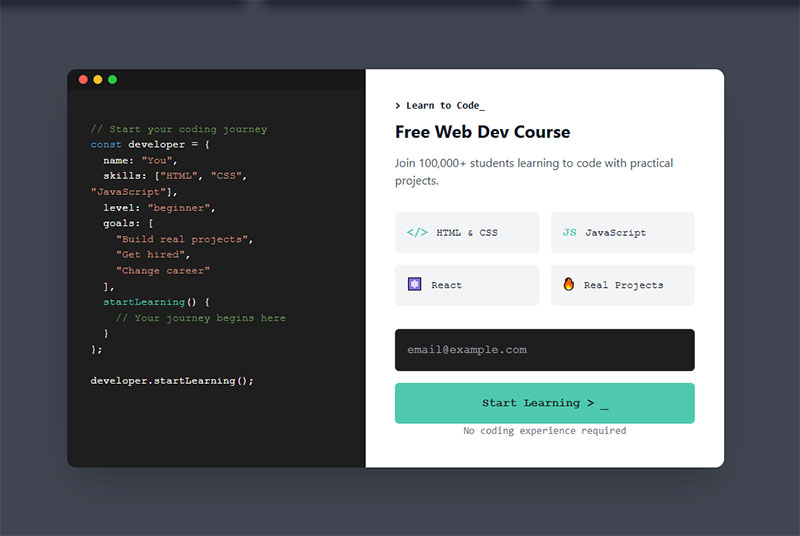
Most lead magnets fall into a handful of familiar shapes: ebooks and long guides, templates and checklists, or a free tool or calculator that solves one specific problem on the spot.
Ahrefs built a large share of its customer pipeline around exactly that last category, its free backlink checker being the obvious example, gating the deeper reports behind a sign-up form while keeping the basic tool open to anyone.
What the lead magnet actually offers matters more than which format it takes. A closer look at what a lead magnet actually offers makes this pretty clear: a generic checklist converts worse than a tool that solves one specific, immediate problem, even a small one.
Webinars and Video Content
Content Marketing Institute’s 2025 B2B research rates video as the single most effective content type, cited by 58% of B2B marketers, ahead of case studies and customer stories at 53%. On the distribution side, in-person events (52%) and webinars (51%) rate above email and organic social.
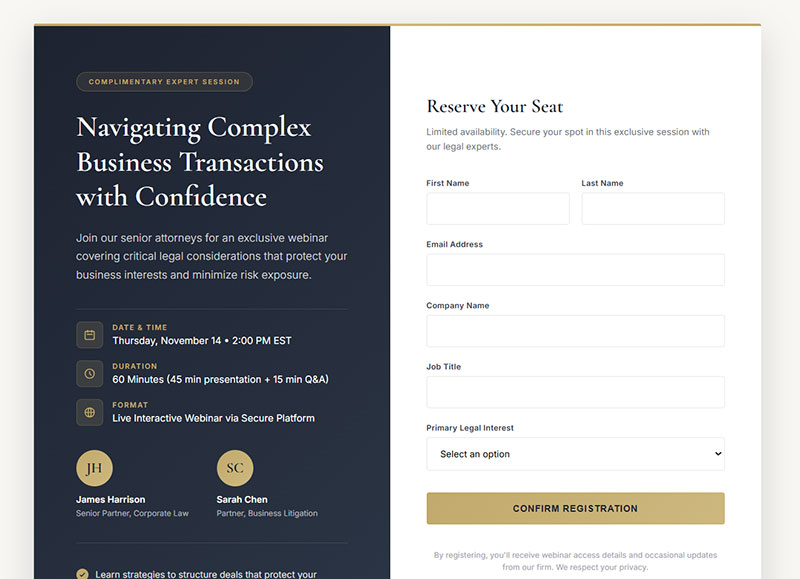
Sign-ups collected through webinar registration forms do double duty, capturing the lead and qualifying it at the same time, since only people with genuine interest bother registering for something that requires an actual time commitment.
Video shortens the trust-building step content marketing usually depends on. A five-minute product walkthrough can do what three blog posts would otherwise take to accomplish, and for a lot of buyers, watching someone actually use the thing beats reading about it.
How Do Paid Ads Generate Leads
Paid ads produce lead volume fast, on a timeline content marketing simply can’t match. The tradeoff is that the cost stops the moment the budget does. There’s no lingering organic tail.
| Platform | Avg. Cost Per Lead | Strength |
|---|---|---|
| Google Ads | $70.11 (WordStream, updated November 2025) | High-intent search traffic |
| LinkedIn Ads | $75 to $150 | B2B decision-maker targeting |
| Meta Ads | $25 to $60 | Broad reach, lower intent |
Google Ads and Search Intent Targeting
WordStream’s November 2025 benchmark update puts the average Google Ads conversion rate at 7.52%, up from 6.96% the prior period, with an average cost per lead of $70.11.
Search ads catch people already typing what they need into the search bar, which is the whole reason search tends to beat paid social on conversion rate even when the cost per click is higher. Intent is already there. The ad just has to not get in the way of it.
Match type and negative keyword lists decide whether that budget actually reaches people ready to convert, or gets burned on people who were just browsing and clicked out of curiosity.
Meta and LinkedIn Ads for Lead Forms
Native lead forms cut out a step. Instead of clicking through to a landing page that might be slow to load or badly designed, the person fills out a form that’s already pre-populated with their information, without ever leaving LinkedIn or Meta’s app.
LinkedIn Lead Gen Forms aim at job title and company size. Meta Lead Ads aim at interest and behavior data instead. Different platforms, different signals, same basic mechanic.
Studying real lead generation form examples from both platforms shows a pretty consistent pattern: fewer fields raise the completion rate, and lower the average lead quality at roughly the same rate. There’s no free lunch here.
How Does Social Media Generate Leads
Organic social activity builds trust before a lead ever reaches a form. Paid social buys reach and speeds that same process up, for a price.
LinkedIn’s own marketing research puts B2B adoption for lead generation at 89% of marketers, with 62% saying the platform actually produces leads for them, and about 40% rating it the most effective channel specifically for high-quality leads.
Platform behavior shifts depending on the audience. LinkedIn dominates B2B by a wide margin. Instagram and TikTok carry more weight for B2C brands selling straight to consumers.
Organic Social Content and Communities
Community participation is a cheap lead source most companies leave on the table: niche Slack groups, subreddits, LinkedIn groups built around one specific problem instead of a broad industry label.
Gong grew a meaningful share of its sales pipeline through LinkedIn posts written by its own sales reps and executives, not through the company page by itself. That’s worth sitting with for a second, because most companies still pour all their social budget into the brand account and treat individual employees as an afterthought.
Consistency beats production value here. A rough, honest post from a real employee usually outperforms a polished post from a brand account, and it’s not close.
LinkedIn Outreach and Social Selling
Social selling layers direct outreach on top of organic posting. Comment on a prospect’s post before sending a connection request, reference something specific from their profile or recent activity instead of a generic opener, and skip the pitch entirely in that first message.
The sequence is what actually matters. Cold connection requests followed immediately by a pitch convert far worse than requests that follow some kind of genuine interaction first, even a small one like a thoughtful comment.
How Do Landing Pages and Forms Convert Visitors Into Leads
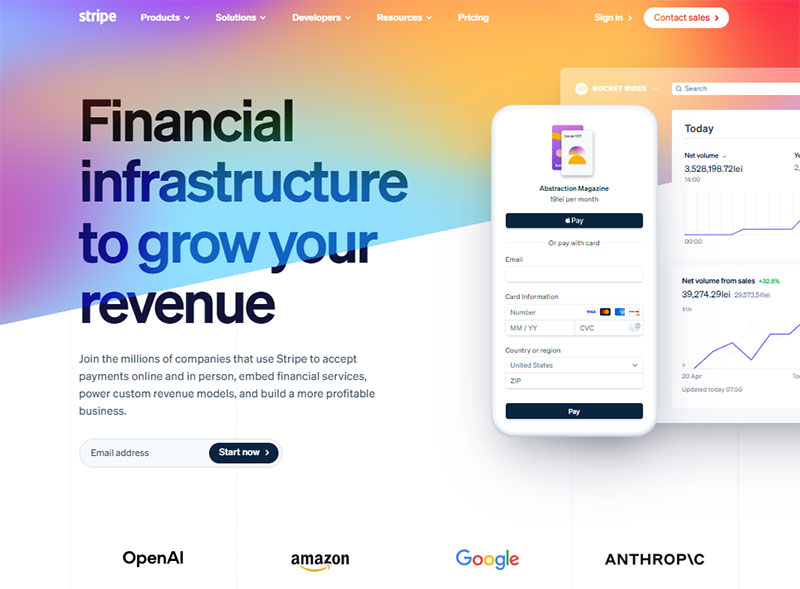
Every channel above eventually points to the same bottleneck: a landing page and a form.
Unbounce’s Conversion Benchmark Report, built from more than 57 million analyzed conversions across 41,000 landing pages, puts the median dedicated landing page conversion rate at 6.6%.
| Industry | Median Conversion Rate | Source |
|---|---|---|
| Events / entertainment | 12.3% | Unbounce |
| B2B SaaS | 3.8% | Unbounce |
| Professional services | 1% to 3% | First Page Sage |
| Legal services | 7.4% | First Page Sage |
Traffic quality, message match, and offer relevance explain most of that spread between industries. Page design matters too, just less than most teams assume when they’re debating button colors.
A single, visible call to action beats a page offering three competing next steps, every time. Load speed matters just as much. Portent’s analysis of page-load data found conversion rates drop by an average of 4.42% for every additional second of load time within the first five seconds, with the decline continuing at a slightly smaller rate past that point.
Form Length and Field Optimization
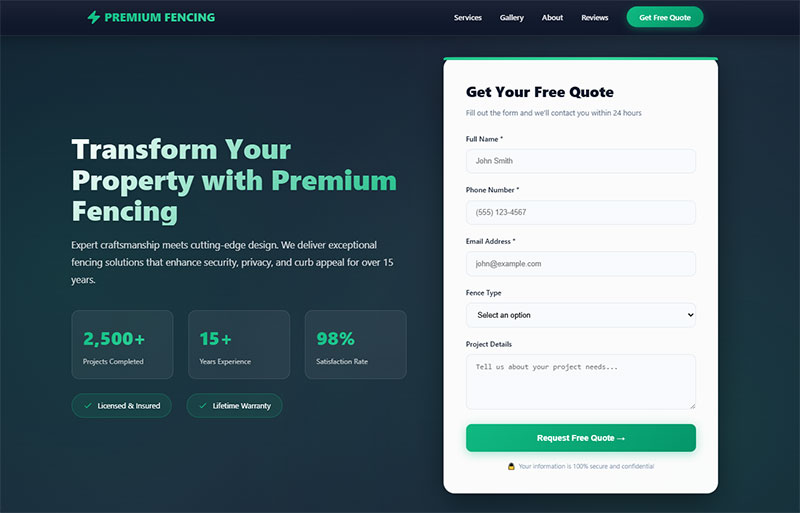
Shorter forms consistently beat longer ones. Benchmark data across multiple sources shows conversion rates falling sharply as field count goes up, and the steepest drop-off usually lands somewhere between four and seven fields.
Ask for an email and one qualifier on first contact, nothing more. Company size, budget, and role can wait for a later step. And the field count really should match the offer’s value: a free checklist earns one field, a demo request can reasonably ask for several.
Choosing the best form fields for capturing high-quality leads is a tradeoff, not a formula. More fields means fewer leads, but better ones.
Multi-step forms that collect the same information as one long form tend to convert better than the single-step version, mostly because visitors who finish a short first step are more likely to finish the rest too. There’s a bit of momentum built in.
A/B Testing and Conversion Rate Data
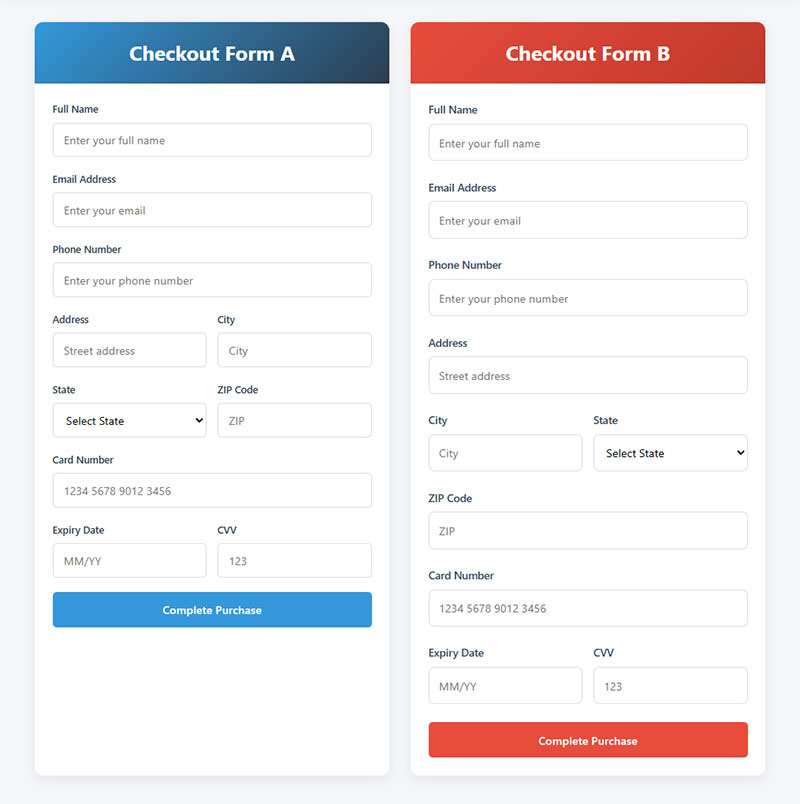
Real testing isolates one variable at a time: headline, form length, CTA color, image versus no image. Change everything at once and you’ll never know which change actually mattered.
Unbounce built its benchmark report from its own page-builder customer base, which is a big part of why the data holds up. It reflects real accounts making real changes, not a lab sample built for a press release.
Specific, sourced tactics for how to increase form conversions tend to beat generic redesigns, since they target the one field, sentence, or button actually causing people to drop off.
How Does Email Marketing Nurture and Convert Leads
Email keeps working long after the first form fill, carrying a lead through the gap between showing initial interest and actually being ready to buy.
Litmus research puts email’s average return at $36 to $42 for every $1 spent, ahead of every other channel measured in the same benchmark set.
That return depends entirely on structure, though. A single blast to an unsegmented list performs nowhere near what a sequence built around behavior and source actually does.
Drip Sequences and Segmentation
A drip sequence fires automatically off a trigger, a form fill, a pricing page visit, a demo request someone started and never finished. The welcome sequence is the easy one, it just sets expectations and delivers the lead magnet that was promised. Educational sequences take longer, building trust through content aimed at one specific problem rather than a broad pitch, and eventually a sales sequence introduces pricing, case studies, and an actual offer once someone’s warmed up enough to want that.
Segmenting by source matters just as much as segmenting by behavior. Someone who signs up through a lead nurturing template built for webinar attendees shouldn’t land in the same first email as a cold newsletter subscriber who just wandered in from a blog post.
Email Deliverability and Open Rate Benchmarks
MailerLite’s 2025 benchmark data, drawn from 3.6 million campaigns, puts the average email open rate at 43.46%, with a click-to-open rate of 6.81% and a click rate of 2.09%.
HubSpot’s benchmark research shows B2B open rates running lower, averaging 39.5%, since business inboxes tend to filter more aggressively than personal ones.
Deliverability comes down to authentication, SPF, DKIM, DMARC records, more than subject line writing ever will. A well-written email that lands in spam converts at zero, regardless of how clever the subject line was.
How Does Cold Outreach Generate B2B Leads
Cold outreach skips the waiting period content marketing requires. It goes straight to a named prospect instead of hoping the right person eventually finds a blog post.
| Channel | Typical Response Rate | Notes |
|---|---|---|
| Cold email | 0.45% to 3.43% | Wide range by list quality and measurement method (Belkins, Instantly) |
| LinkedIn InMail | 18% to 25% | Higher intent, smaller daily volume |
| Cold calling | Varies by industry | Still standard for enterprise and mid-market deals |
That gap in the cold email row isn’t a typo.
Belkins’ 2025 benchmark report, based on 7.5 million emails, recorded a 0.45% average reply rate for strict net-new outreach, measured as replies divided by total emails sent. Instantly’s platform-wide data across billions of sends put the average response rate at 3.43%, a very different number for what’s broadly the same category of activity.
The disagreement comes down to methodology, not one report being wrong. Belkins’ figure isolates first-touch, no-relationship contacts using a stricter denominator than in past years. Instantly’s figure blends warmer, multi-touch sequences into the same average, which naturally pulls the number up.
Cold Email Campaigns
Subject line and list quality decide most of the outcome before a single word of body copy even gets written. Verified, role-matched contacts beat broad company lists, and short subject lines beat clever ones almost every time. The ask matters too: one clear call to action outperforms an email trying to do three things at once.
Follow-ups do real work here, more than people expect. A meaningful share of replies to a cold sequence arrive after the second or third message, not the first one.
Cold Calling and LinkedIn Sales Navigator
LinkedIn’s own Sales Navigator research shows users saving roughly 65 hours a year through its AI-powered prospecting and tool-switching features, time that would otherwise go toward building lists and researching accounts by hand.
PTC used Sales Navigator’s account insights to reach more than 2,000 new prospects, generating over $4.5 million in closed deals from that single initiative. That’s a real number attached to a tool a lot of sales teams still treat as a nice-to-have rather than core infrastructure.
Cold calling still works for enterprise and mid-market deals, where an actual human conversation can move a stalled deal forward faster than one more email ever would.
What Tools and Software Support Lead Generation
Every channel and tactic covered so far eventually runs through software: somewhere to store the contact, score it, and hand it off to sales.
| Category | Examples | Core Job |
|---|---|---|
| CRM | Salesforce, HubSpot, Pipedrive | Store and track contacts through the pipeline |
| Marketing automation | HubSpot, ActiveCampaign, Mailchimp | Run nurture sequences automatically |
| Lead enrichment | ZoomInfo, Apollo.io | Fill in missing contact and company data |
| Chat capture | Drift, Intercom | Qualify visitors in real time on-site |
Chat tools increasingly compete with static forms for the same job now. The choice between chatbots and forms usually comes down to traffic volume, and how much qualification needs to happen before an actual human gets pulled in.
WordPress-built sites often handle this differently than custom-built ones, leaning on dedicated WordPress lead generation plugins to connect forms straight to a CRM without touching any custom code.
CRM and Marketing Automation Platforms
The two categories overlap more than their labels suggest. A CRM tracks where a contact sits in the pipeline. Marketing automation decides what that contact gets sent next, automatically, based on what they’ve done.
IDC’s Worldwide Semiannual Software Tracker puts Salesforce at 20.0% of global CRM revenue in 2025, its thirteenth consecutive year holding the top spot. Thirteen years is a long time to stay on top of anything in software.
Zoho passed one million paying customers and 150 million users in February 2026, worth mentioning mainly because the CRM market extends well past the two or three brands most lead generation guides bother naming.
Lead Enrichment and Prospecting Tools
Enrichment fills the gaps a form leaves behind: job title, company size, direct phone number, technology stack. Apollo.io’s vendor-reported figures put its database at roughly 200 to 275 million contacts and 30 to 73 million companies, depending on when exactly that figure was published. ZoomInfo’s vendor and third-party estimates range from roughly 100 million to several hundred million profiles, plus real-time intent signals layered on top.
The work never really finishes, and how fast B2B contact data actually goes stale is genuinely contested. A commonly cited industry benchmark puts decay at roughly 22.5% a year, but that figure traces back to older annual-snapshot research. More recent continuous-monitoring studies, including a 2026 study from data-quality vendor Cleanlist itself, suggest actual decay may run considerably higher, with some datasets showing 50-70%+ turnover a year in high-mobility industries. Either way, that’s why enrichment ends up being a subscription rather than a one-time cleanup job.
How Do You Measure Lead Generation Performance
Volume alone says nothing about whether a lead generation program is actually working. Cost, speed, and conversion, looked at together, say a lot more.
A short list of lead generation KPIs to track consistently beats checking a different metric every week depending on what looks good that day.
Cost Per Lead and Customer Acquisition Cost
First Page Sage’s channel analysis puts organic search CAC between $647 and $1,786 depending on content depth, against $802 in CAC for paid B2B search.
Industry data commonly puts average B2B SaaS customer acquisition cost around $702, a figure attributed to HubSpot’s research and repeated across most marketing benchmark roundups at this point. That number climbs fast once a deal involves enterprise procurement and a legal review.
Cost per lead and CAC aren’t answering the same question, even though people use them interchangeably. Cost per lead measures the top of the funnel. CAC measures everything it actually took to close, sales time included.
Lead Velocity and Conversion Rate Tracking
Lead velocity rate tracks month-over-month growth in qualified leads specifically, not raw traffic and not total leads.
A monthly lead velocity rate of 15% to 30% is commonly cited as healthy for a scaling B2B SaaS pipeline, a benchmark popularized in growth circles associated with SaaStr founder Jason Lemkin, who calls LVR one of the most important predictive metrics in SaaS.
Attribution ties a closed deal back to the channel that actually produced it. Setting up form submission tracking in Google Analytics is usually the first real step, since most leads still start with a form no matter how many channels feed into it.
What Common Mistakes Reduce Lead Generation Results
Most lead generation problems trace back to a handful of repeated mistakes. It’s rarely a broken channel.
| Mistake | Why It Happens | Fix |
|---|---|---|
| Chasing volume over qualification | MQL count looks good in reports | Score leads before counting them as wins |
| Long forms on cold traffic | Sales wants more data upfront | Cut fields, gather the rest later |
| No lead scoring | Every lead looks equally urgent | Rank by behavior and fit before handoff |
| Nurture stops after one email | Sequences never get built past the welcome message | Build a full multi-stage sequence |
| Marketing and sales disagree on “qualified” | No shared definition was ever set | Agree on MQL and SQL criteria in writing |
Salesforce’s State of Sales 2024 report, based on a survey of 5,500 sales professionals across 27 countries, found only 13% of MQLs convert to SQLs, down from roughly 18% in 2022.
That decline lines up closely with the last mistake in the table above. Definitions of “qualified” have drifted apart faster than most teams have bothered realigning them.
Speed makes every other mistake on that list worse.
The original 2007 MIT and InsideSales.com Lead Response Management Study found leads contacted within five minutes were 21 times more likely to qualify than those contacted after thirty minutes. A separate Harvard Business Review audit of 2,241 firms found the average first response time was 42 hours, with 23% of firms never responding at all.
Fixing form abandonment solves the second mistake in that table. It does nothing for the fourth or fifth. Most lead generation programs need more than one fix running at the same time, which is the annoying part nobody wants to hear.
FAQ on How To Generate Leads For Your Business
How Long Does It Take to See Results From Lead Generation
Paid channels like Google Ads and LinkedIn Ads produce leads within days. Organic channels, SEO and content marketing included, usually take three to six months before they compound into something meaningful.
Most B2B pipelines need 90 days before conversion data becomes statistically meaningful enough to act on.
How Much Should a Business Budget for Lead Generation
B2B marketing budgets typically put the largest single share toward lead generation, often more than brand building and retention combined. A common starting benchmark is 10 to 15 percent of projected revenue, adjusted down for referral-heavy or bootstrapped businesses that get leads a cheaper way.
What Conversion Rate Should a Lead Generation Campaign Aim For
There’s no universal number, whatever anyone tells you. Landing pages typically convert between 2% and 12% depending on industry and offer, while cold outreach sits well under 5%.
Compare results against your own channel and industry, not some generic average pulled from a blog post.
Can a Business Generate Leads Without Spending Money on Ads
Yes. Organic search, referral programs, community participation, and social selling all produce leads without any ad spend at all.
They cost time instead of money, and they compound slower, but they remove the dependency on budget that paid channels create.
How Many Leads Does a Small Business Need Each Month
Work backward from the sales target. Divide the revenue goal by average deal size to get the number of customers needed, then divide that by your close rate to find the lead volume required to hit the number consistently.
Who Should Own Lead Generation, Marketing or Sales
Marketing usually owns top-of-funnel capture and nurturing. Sales owns qualification and the close.
Misalignment happens when neither team agrees on what actually counts as a qualified lead, which is exactly why a shared definition matters more than whatever the org chart says.
Is Outsourcing Lead Generation to an Agency Worth It
It depends on internal capacity, honestly. Agencies bring speed and specialized tooling, but they rarely understand the product as well as someone who works there every day.
Many businesses outsource cold outreach and paid ads while keeping content and nurturing in-house, which tends to be a reasonable middle ground.
How Does B2B Lead Generation Differ From B2C Lead Generation
B2B involves longer sales cycles and multiple decision-makers, favoring LinkedIn, email, and referral. B2C decisions happen faster with fewer people involved, favoring paid social and search instead.
The forms, offers, and nurture sequences that work for one usually fail the other. Copying a B2C playbook into a B2B funnel is a common, expensive mistake.
How Is Lead Generation ROI Calculated
Subtract total lead generation cost from the revenue those leads produced, then divide by the cost. A campaign spending $10,000 that closes $50,000 in deals returns 4x, or 400 percent ROI, before sales team time even gets factored in.
What Industries Need Lead Generation the Most
Industries with high-consideration purchases and longer research phases rely on it most: software, financial services, real estate, legal, healthcare. Low-consideration retail and impulse-purchase categories lean far more on immediate conversion than structured lead capture ever gets a chance to matter.
Conclusion
Most people searching for how to generate leads for your business jump straight to channels: which platform, which ad format, which script works best for a cold call. That’s backwards, and it’s probably the single most common mistake on this whole list.
Fix the landing page and form first. A channel sending traffic to a page that converts at 1% wastes budget no amount of channel-switching will ever recover.
Once conversion is solid, add one acquisition channel at a time. Layer in lead scoring and a defined MQL-to-SQL handoff before doubling spend, not after the money’s already gone out the door.
Mechanics before volume. That order is the actual difference between a funnel that compounds and one that just burns cash a little faster every quarter.
Pull your form’s completion rate this week. Under 3% means fix that before touching ad spend or outreach volume at all.