







Most lead magnets don’t work. They get downloaded, skimmed for 30 seconds, and forgotten. Meanwhile, your email list fills up with people who will never buy anything. The problem isn’t…
Table of Contents
Most law firm websites have a phone number, a contact page, and not much else to capture visitor information. That is a problem when 96% of people seeking legal advice start with a search engine but are not ready to call an attorney yet.
Lead magnets for law firms close that gap. They give potential clients something useful, a checklist, a calculator, a free case review, in exchange for an email address or phone number.
This guide covers the specific types that work for legal practices, how to match them to your practice area, and what it takes to turn a download into a signed retainer. No generic marketing advice. Just what actually produces clients for firms running on tight budgets and tighter timelines.
What Is a Lead Magnet for a Law Firm?
A lead magnet for a law firm is a free resource offered to potential clients in exchange for their contact information. Usually an email address, sometimes a phone number.
Think downloadable checklists, free case evaluations, legal guides, or interactive calculators. The visitor gets something useful. The firm gets a way to follow up.
This is different from a standard contact form sitting on your website. A contact form asks for commitment. A lead magnet offers value first, then asks. That distinction matters more than most attorneys realize.
Legal marketing runs on trust. People searching for a personal injury attorney or a family law firm are stressed, cautious, and comparing options. They are not ready to call your office after reading one blog post. A lead magnet gives them a reason to share their details without the pressure of scheduling a consultation right away.
Where do these show up? Practice area pages, blog posts, dedicated landing pages, and exit-intent popups. Some firms embed them directly into their content. Others build standalone pages around a single offer.
The mechanics are simple. The strategy behind picking the right one for your practice area is where it gets tricky.
Lead Magnets for Law Firms To Try
Why Most Law Firm Websites Fail to Capture Leads
Here is the uncomfortable reality. 87% of law firms have a website, but only 35% have actually gained clients directly through it, according to the American Bar Association.
That gap is massive.
Most firm websites rely on two things: a phone number and a “Contact Us” page. Both require a visitor to be ready to talk to an attorney right now. And most visitors are not at that stage yet.
Clio’s research found that 48% of law firms were unreachable by phone during test inquiries. Only 33% even responded to email outreach. So the few visitors who do reach out are often met with silence.
The average conversion rate for legal websites sits around 2.07%, according to industry benchmarks. That means out of every 1,000 visitors, roughly 20 become leads. The rest leave and probably visit a competitor’s site next.
The Trust Deficit Problem
Someone searching “do I have a wrongful termination case” is not shopping for an attorney. Not yet. They are looking for information.
If the only option on your site is “Call Now” or “Schedule a Free Consultation,” you are skipping three steps in the decision process. There is a gap between “I have a question” and “I want to hire a lawyer.”
Lead magnets fill that gap. They meet people where they actually are in the lead generation funnel, not where firms wish they were.
Firms using intake software and online tools saw 20% higher revenue and 12% better conversion rates, according to Clio’s Legal Trends data. The ones that added client-facing technologies like online scheduling and messaging generated roughly 2x more leads and revenue compared to firms that did not.
Your website traffic is probably fine. Your capture strategy is the problem.
Legal Checklists and Guides
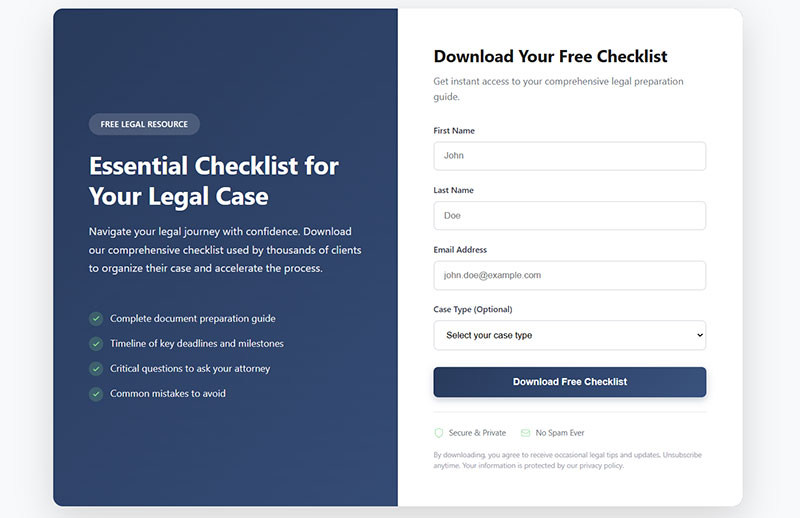
Downloadable checklists and PDF guides are the most common type of lead magnet used by law firms. And for good reason. They match the exact mindset of someone early in a legal situation.
A person Googling “what to do after a car accident” does not want to read a 3,000-word article. They want a step-by-step list they can save to their phone.
Examples that work across practice areas:
- “Divorce Preparation Checklist: 15 Documents You Need Before Filing” (family law)
- “What to Do in the First 72 Hours After a Workplace Injury” (workers’ comp)
- “Estate Planning Starter Guide for Parents with Young Children” (estate planning)
- “Your Rights During a DUI Stop” (criminal defense)
A GetResponse study found that 58.6% of marketers reported short-form written content like checklists converted better than longer formats. Guidebooks came out on top among long-form options at 67.2% conversion rates.
Canva, Google Docs, or a tool like Beacon.by can handle the design. You do not need a graphic designer to produce something that looks professional.
How to Structure a Legal Guide That Converts
Keep it between 2 and 5 pages. Seriously. Took me a while to learn this, but nobody downloads a 30-page legal ebook and actually reads it. Short guides get opened. Long ones collect digital dust.
Every guide should end with a clear next step that brings the reader back to your firm. “Still unsure if you have a case? Call us for a free 15-minute review” works better than a generic firm bio on the last page.
One thing to watch: bar association advertising rules vary by state. A checklist that crosses the line from general information into specific legal advice could create compliance issues. Have your guides reviewed before publishing. Stick to educational content that informs without advising on individual situations.
The American Bar Association notes that 53% of lawyers who maintain blogs on their websites have gained clients directly or through referrals. Pairing blog content with a downloadable guide turns a passive reader into a lead you can actually contact later.
Free Case Evaluation and Consultation Offers

A “Free Case Review” is technically a lead magnet, even if it does not look like one. It is still a value exchange. The visitor gives you their contact details and case information. You give them an initial assessment at no cost.
This format works best for practice areas where the potential client already knows they have a legal issue. Personal injury. Employment law. Immigration. Medical malpractice.
ALM Global’s research shows that 67% of legal clients base their hiring decision on response speed. Firms responding within the first five minutes of an inquiry see a 400% higher conversion rate than slower competitors.
Turning a Contact Form Into a Qualifying Tool
There is a big difference between a generic lead generation form and a structured intake form built to qualify leads before they reach an attorney.
A standard contact page asks for name, email, and a message box. That tells you almost nothing about whether this person has a real case.
A qualifying intake form asks targeted questions:
- What type of legal issue are you facing?
- When did the incident occur?
- Have you spoken to another attorney?
- What is your preferred method of contact?
Tools like Clio Grow and Typeform let you build forms with conditional logic, where the next question changes based on the previous answer. Someone selecting “car accident” sees different follow-ups than someone selecting “slip and fall.”
MyCase reported that firms using customized intake forms captured 58,395 leads in 2023, with a 17.6% conversion rate from lead to client. That is well above the industry average. The form does the pre-screening, so attorneys spend time on qualified prospects instead of dead ends.
Interactive Legal Tools and Calculators
Static PDFs are losing ground. According to HubSpot’s 2024 data, gated ebooks now convert below 0.9%. Interactive tools like quizzes and calculators? They convert upward of 5.2%.
That is nearly a 6x difference. And it makes sense if you think about what people actually want when they land on a law firm’s website.
They want answers. Specific ones. “How much might my personal injury case be worth?” is a question a blog post cannot answer in a satisfying way. But a settlement estimate calculator can give them a ballpark number in 60 seconds.
Platforms like Outgrow and Calconic let you build these without writing code. Some firms invest in custom-built tools, but off-the-shelf solutions work fine for most.
The real value here is dual. The visitor gets immediate, personalized feedback. The firm gets detailed data about the prospect’s situation before the first phone call. That is better lead generation for law firms than a static PDF ever delivered.
Why Calculators Outperform Downloads
People engage differently with tools than with documents. A calculator requires input. It creates a back-and-forth interaction that feels more like a conversation than a download.
ConvertFlow found that 43% of marketers using quizzes as lead magnets reported better list quality within 60 days. Not just more leads. Better ones.
If you are exploring different lead magnet ideas for your firm and have the budget for it, an interactive tool is probably the highest-ROI option on the table right now.
Email Courses and Drip Sequences as Lead Magnets
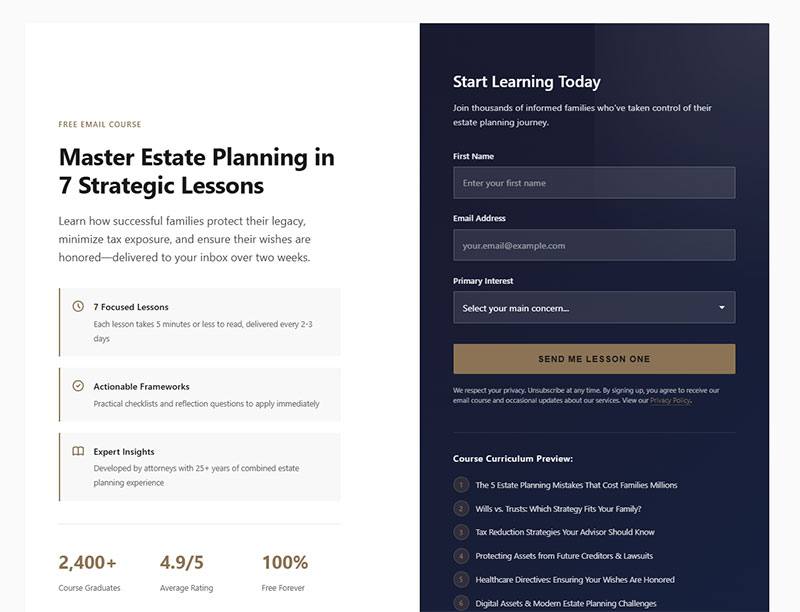
A single download is a one-time interaction. An email course keeps your firm in someone’s inbox for days or weeks. And in legal marketing, the decision timeline is rarely instant.
Imagine this: “5-Day Email Course: Understanding Your Rights After a Workplace Injury.” Day one covers immediate steps. Day three explains the claims process. Day five includes a direct invitation to schedule a free consultation.
Each email builds familiarity. By day five, the reader has heard from your firm more than any competitor.
Email marketing generates an average of $36 for every $1 spent, according to Litmus. Automated email sequences generate 320% more revenue than one-off campaigns, per Campaign Monitor data. Those numbers are not specific to legal, but the principle applies.
Setting Up a Legal Drip Campaign
Mailchimp works for basic sequences. ActiveCampaign offers more advanced automation with tagging and behavioral triggers. Lawmatics is built specifically for law firm marketing and ties directly into case management.
Keep frequency reasonable. One email every two to three days during the course, then transition to a monthly newsletter. Nobody wants daily emails from an attorney’s office.
The content should educate without dispensing legal advice. Explain the process. Share common mistakes people make. Reference real outcomes (anonymized, obviously). The goal is to position the firm as knowledgeable and approachable, not to replace a consultation.
Learning how to create a lead magnet that works as a multi-part sequence requires more planning upfront. But the payoff is a warmer prospect who already trusts your firm before they ever pick up the phone.
And here is the thing most firms miss. 80% of legal consumers move on to another firm if they do not get a response within 48 hours, according to Martindale Avvo data. An automated email sequence makes sure those people hear from you immediately, even when your team is in court or out of the office.
Webinars and Recorded Legal Workshops
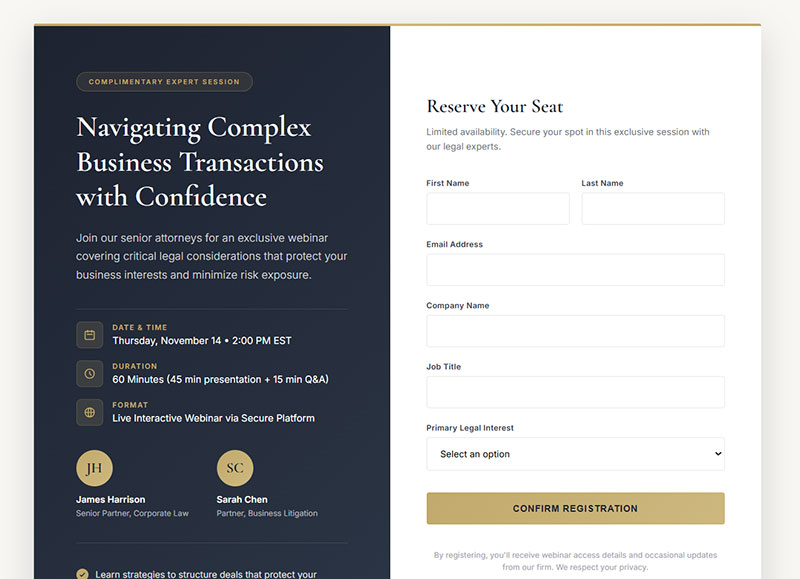
Webinars are not just for SaaS companies and marketing gurus. They work for law firms, too. Especially in practice areas where people need education before they need representation.
ON24’s 2025 Benchmarks Report found that 57% of webinar registrants convert to actual attendees. That registration itself is the lead capture. Name, email, phone number, all collected before the event even starts.
GoToWebinar data shows webinars with a clear call to action convert up to 47% of attendees into leads. Compare that to a static PDF download sitting at under 1%. The format just works differently because it creates a live, personal connection.
Best Practice Areas for Legal Webinars
Estate planning is the most natural fit. Topics like “What Every Parent Needs to Know About Wills and Trusts” draw an audience that is planning ahead, not in crisis mode. These attendees are more likely to follow through with a consultation.
Business law works well for topics like annual compliance, entity formation, or employment law changes. Small business owners attend these regularly.
Elder law and immigration also see strong webinar performance. Both areas involve complex, multi-step processes where a 45-minute walkthrough builds confidence in the firm’s expertise.
Turning Recordings Into Evergreen Lead Magnets
The live event is just the starting point. Record it. Gate the replay behind a webinar registration form and let it collect leads for months.
Zoom handles the live event. Wistia or Demio can host the gated recording. Some firms use Vimeo with a simple email wall in front of it.
Content Marketing Institute found that 55% of B2B marketers used webinars to distribute content in the past year, and the average cost per webinar lead is just $72, far below the $111 average cost per lead for legal search ads reported by LocaliQ.
Templates and Sample Legal Documents
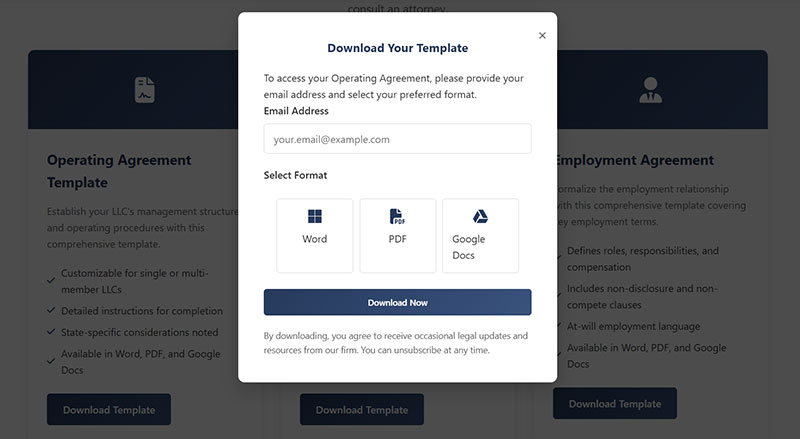
People want something they can use right now. That is why downloadable templates outperform most other gated content examples in legal marketing.
An NDA template. A basic demand letter outline. A sample LLC operating agreement. A will template for simple estates. These are the kinds of resources that make someone think, “This firm actually knows what they are doing.”
HubSpot’s 2024 data showed interactive tools and templates converting at 5.2%, nearly six times higher than traditional gated ebooks. Templates sit right in that high-performing category because they offer immediate, usable value.
Where Templates Fit in the Client Journey
Early-stage research: Someone Googling “free NDA template” is probably handling something themselves. They download your template, realize the situation is more complex than expected, and now your firm is the first name they think of.
Mid-funnel comparison: A business owner comparing LLC structures downloads your entity comparison worksheet. That worksheet includes a “Need help deciding? Schedule a free call” link at the bottom.
The template does not replace the attorney. It proves the attorney’s value. Firms like LegalZoom built an entire business around this concept, but local and mid-size firms can use it as a lead generation tactic instead of a product.
Ethical Boundaries to Keep in Mind
Templates walk a line. Providing a sample document is fine. Providing a filled-out document with advice tailored to a specific situation crosses into practicing law.
Include a clear disclaimer on every template: “This document is for informational purposes only and does not constitute legal advice.” Most state bar associations accept this approach as long as the content stays general.
The American Bar Association notes that 97% of law firm websites lack personal content, according to FinancesOnline. A well-designed template section sets your firm apart from nearly everyone.
How to Match a Lead Magnet to a Practice Area
Not every lead magnet works for every type of law. A settlement calculator makes zero sense for an estate planning firm. A webinar about trust structures would bore someone searching for a DUI lawyer at 2 AM.
Matching the format to the practice area is where most firms get it wrong. They pick whatever seems easiest to create instead of what fits their audience’s mindset.
Matching Format to Client Mindset
Crisis searchers (personal injury, criminal defense, employment disputes) need speed. They are not going to sit through a webinar. A short downloadable guide or an instant free case evaluation works. Unbounce data shows legal landing page forms convert at 21% on mobile versus 15.9% on desktop in the legal industry, confirming most of these visitors are on their phones.
Planners (estate planning, business formation, real estate closings) have time. They will attend a 45-minute webinar. They will download a 5-page guide. The lead capture form templates for this audience can ask more questions because the urgency is lower.
Researchers (immigration, tax law, intellectual property) want data. Eligibility checkers, process flowcharts, and FAQ-style email courses match their information-gathering behavior.
Landing Page and Conversion Setup for Law Firm Lead Magnets
You can have the best lead magnet on the internet. If the delivery mechanism is broken, nobody will ever see it.
The landing page is where the exchange happens. Visitor gives contact info. Firm delivers the resource. Everything about that page needs to reduce friction and build trust in the same breath.
Unbounce’s 2024 report, based on 41,000 landing pages and 464 million pageviews, shows the median conversion rate for legal landing pages at 6.3%. Top performers hit 13.1% or better. The difference between those two numbers is worth a lot of signed cases.
What a High-Converting Legal Landing Page Includes
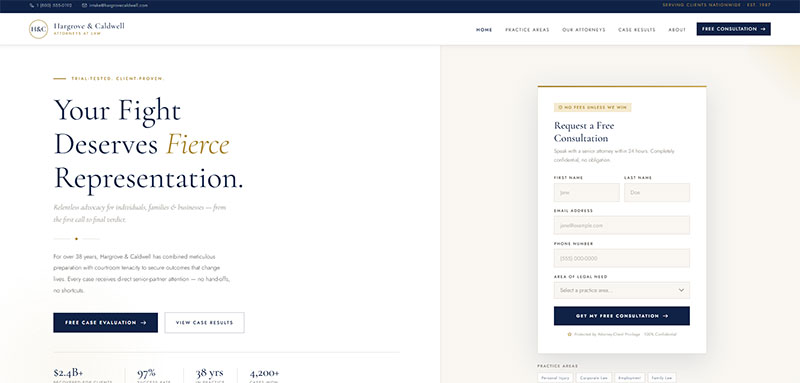
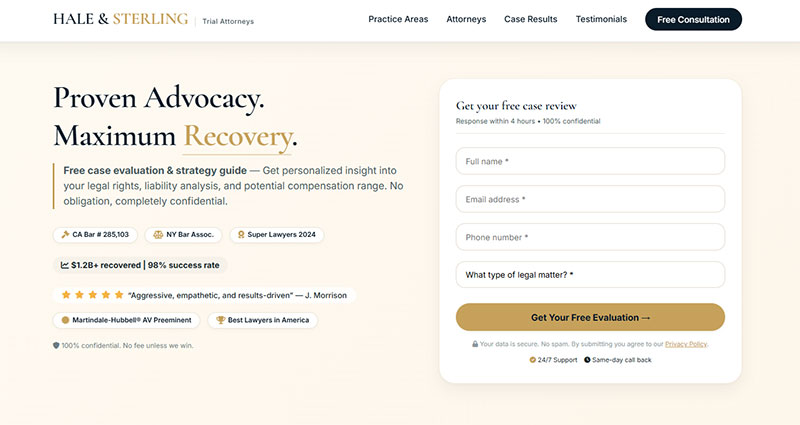
Above the fold: A headline that matches the visitor’s search query, a 1-2 sentence description of the lead magnet, and the form. Nothing else.
Trust signals: State bar memberships, case result numbers, client review snippets, Super Lawyers or Martindale-Hubbell badges. Testimonials on landing pages increase conversions by 34%, according to research compiled by Genesys Growth.
The form itself: Name, email, phone, and one qualifying question. That is it. Every extra field drops your conversion rate. Good form design keeps things clean and fast.
Tools like Unbounce and Leadpages let you build dedicated landing pages without touching your main site. WordPress with Elementor works too, especially if your firm already runs on WordPress. For firms focused on increasing form conversions, A/B testing headlines and button copy is where the biggest gains come from. Only 17% of marketers actively A/B test, per Cropink data, despite it producing an average 37% improvement in conversion rates.
Where to Place Lead Magnets on a Law Firm Website
A standalone landing page is just one option. Smart firms distribute their lead magnets across multiple touchpoints.
- Embedded within blog posts that relate to the lead magnet topic
- Sidebar CTAs on practice area pages
- Sticky bars that follow the visitor as they scroll
- Exit intent popups that trigger when someone moves to leave the site
Invesp research shows companies with 40+ landing pages generate 500% more conversions than those with fewer than five. For a law firm with multiple practice areas, that means building a separate landing page for each lead magnet, not funneling everyone to the same generic page.
After someone downloads a resource, the thank-you page is prime real estate. Offer a related lead magnet or a direct link to book a consultation. Most firms waste this page with a generic “Thanks for downloading” message. Do not be one of them.
Measuring Lead Magnet Performance for Law Firms
Downloads are nice. Signed retainers pay the bills. If you are not tracking what happens after someone grabs your lead magnet, you are flying blind.
The whole point of a lead magnet is to start a path from stranger to client. Measuring only the first step tells you almost nothing useful.
Metrics That Actually Matter
Conversion rate: What percentage of landing page visitors fill out the form? The legal industry median sits at 6.3% (Unbounce). If yours is below that, the page needs work.
Cost per lead: LocaliQ data puts the average CPL for legal services at $111.05. If your lead magnet generates leads at a lower cost than paid search, it is pulling its weight.
Lead-to-consultation rate: How many downloads turn into actual phone calls or meetings? This is where lead magnet quality separates from lead magnet quantity.
Lead-to-client rate: The nationwide average new-call-to-case conversion rate is 7%, ranging from 3% to 30% depending on intake quality, according to Martindale-Nolo. Your lead magnet leads should perform at or above this number.
Tracking the Full Journey in Google Analytics 4
GA4 replaced Universal Analytics in July 2023. Every law firm website now relies on it for reporting, and it handles lead magnet tracking differently than the old system.
Set up event tracking for key actions: form submissions, PDF downloads, calculator completions, and webinar registrations. GA4’s event-based model lets you track each of these as a unique conversion event without extra coding if you are using Google Tag Manager.
Pareto Legal recommends connecting GA4 to your CRM (Clio Grow, Lawmatics, or Lead Docket) so you can trace a lead from the initial magnet download all the way to a signed case. This is the only way to calculate true ROI on your legal content marketing.
When to Retire or Refresh a Lead Magnet
A checklist about 2023 child support guidelines is useless in 2025. Legal content goes stale fast.
Review performance quarterly. If downloads drop month over month for three straight months, something changed. Maybe the topic lost relevance. Maybe competitors released something better. Maybe your landing page just needs a new headline.
MyCase data showed that law firms using intake software to make data-backed marketing decisions represented 98% of firms surveyed. The tools exist. Use them to figure out which lead magnets are producing clients and which ones are just producing email addresses that go nowhere.
FAQ on Lead Magnets for Law Firms
What is a lead magnet for a law firm?
A lead magnet is a free resource, like a checklist, guide, or calculator, offered to website visitors in exchange for their contact information. It starts the client intake process before someone is ready to call your office directly.
What types of lead magnets work best for attorneys?
Checklists, free case evaluations, settlement calculators, and lead magnet best practices suggest short-form content performs strongest. Interactive tools like quizzes convert at roughly 5.2%, nearly six times higher than static PDFs.
Are lead magnets ethical for law firms?
Yes, as long as the content stays educational and does not cross into specific legal advice. Include a disclaimer on every resource. Check your state bar association’s advertising rules before publishing anything.
How much does it cost to create a legal lead magnet?
A basic PDF checklist costs nothing if you use Canva or Google Docs. Interactive calculators built on platforms like Outgrow or Calconic start around $20 to $95 per month depending on features and traffic volume.
Which practice areas benefit most from lead magnets?
Personal injury and family law see the highest returns because visitors are actively searching for answers. Estate planning, immigration, and business law also perform well due to longer decision timelines that favor nurturing.
How do I deliver a lead magnet on my law firm website?
Build a dedicated landing page with a short form. Tools like Unbounce, Leadpages, or WordPress with Elementor handle this. After form submission confirmation, deliver the resource via email or an instant download link.
How do I measure if my lead magnet is working?
Track conversion rate, cost per lead, and lead-to-client rate. Set up event tracking in Google Analytics 4 for form submissions and downloads. Connect GA4 to your CRM to follow leads from download to signed retainer.
Can I use AI-generated content for my legal lead magnets?
You can use AI tools to draft content, but have an attorney review everything for accuracy. Google’s guidelines prioritize helpful, people-first content regardless of how it was produced. Accuracy matters more than the method.
How often should I update my law firm’s lead magnets?
Review performance quarterly. Legal information changes frequently. A child support checklist from two years ago may reference outdated state formulas. Refresh content whenever laws change or download rates drop consistently.
Do lead magnets replace a contact us page?
No. Your contact us page templates still serve visitors who are ready to reach out directly. Lead magnets capture the larger group of people who are researching but not yet ready to make a call.
Conclusion
Lead magnets for law firms are not a marketing trend. They are a practical fix for the gap between website traffic and actual client conversions. The firms getting results are the ones matching the right format to the right practice area and tracking performance all the way to the signed retainer.
Start with one lead magnet. A checklist, a calculator, or a gated webinar replay. Build a dedicated landing page, connect it to your CRM, and measure what happens after the download.
Most of your competitors are still relying on a phone number and a generic website form for lead generation. That is your advantage. Use it.
The best lead magnet tools make this easier than it was even two years ago. Pick one, build something useful, and let the data tell you what to do next.