









A new client doesn’t sign with an accounting firm because a landing page convinced them. They sign because someone they trust vouched for the firm, or because the firm showed…
Table of contents
Attorneys and legal services carry the highest average cost per click of any industry, at $9.87, according to WordStream’s 2026 Google Ads Benchmarks report, which analyzed more than 13,000 US search campaigns. That number says something on its own: everyone in this space is bidding on the same clicks, so the firms that come out ahead are the ones tracking signed cases, not just calls or form fills.
Lead generation for law firms turns a stranger with a legal problem into a name, a phone number, and eventually a signed retainer agreement. Solo practitioners run it.
So do national personal injury firms with intake teams the size of a small call center, and somewhere in between there are regional practices doing roughly the same thing on a smaller scale.
What sets the legal version apart from lead gen in most other fields is the layer of advertising and solicitation rules wrapped around every step of it.
What Is Lead Generation for Law Firms

Somewhere between an ad and a signed retainer, a person with a legal problem turns into something a firm can actually work with: a name, a phone number, a case type. Getting someone to that point, and then past it, is basically the whole job.
Marketing builds awareness. Lead generation is the layer underneath it that converts that awareness into contact information the firm can act on, then hands the file to intake.
That basic mechanic, capturing someone’s contact information before they become a paying customer, works the same way across industries.
What makes the legal version different is the layer of rules wrapped around it. Bar advertising regulations, solicitation restrictions, and contingency-fee economics all shape what a firm can say, who it can contact, and how much a single case is worth chasing.
It isn’t the same thing as brand awareness advertising, which builds recognition without ever asking for contact information. It isn’t SEO on its own either, since organic search is one channel feeding the process rather than the whole process. And intake is a separate stage still, one that only starts once a lead already exists.
A firm can rank well, run ads, and still generate almost nothing if the path from click to contact form is broken.
Lead Sources and Channels for Law Firms
Law firms pull leads from search-driven channels, from legal directories, and from referrals and reputation, the reviews and word-of-mouth kind of visibility that never shows up on an ad dashboard. Most firms run more than one of these at once, since each channel tends to reach people at a different point in their decision to hire a lawyer.
Search and paid channels
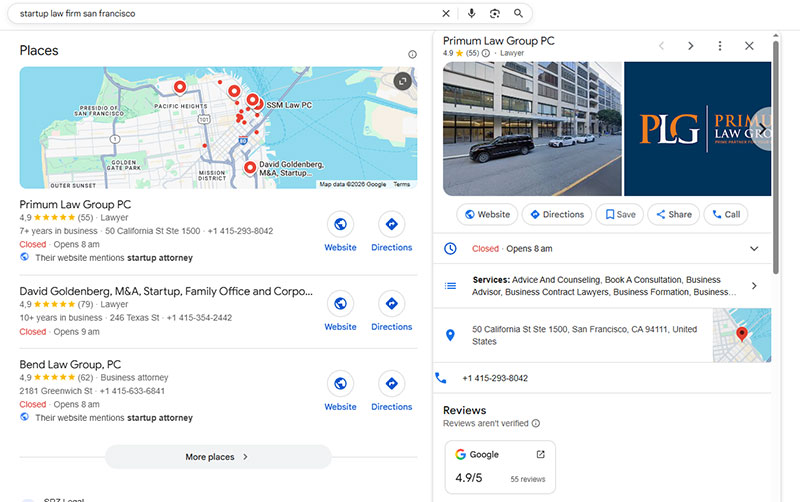
On the search side, firms typically work with a mix of the following:
- Google Business Profile, which drives visibility in the local map pack for near-me searches
- Google Local Services Ads, a pay-per-lead format that sits above standard search results
- Google Ads, priced per click rather than per lead, competing directly on high-value keywords
- organic SEO, which builds compounding traffic without a per-lead cost
Traffic from every one of these eventually lands on the same mechanism: a short landing page form asking for a name, phone number, and case type.
Turning that visitor into a completed submission is a distinct skill from driving the traffic itself, and it’s worth studying on its own rather than assuming a good ad automatically means a good form fill.
Legal directories
Directories work as a secondary layer of visibility, useful mainly for firms that haven’t yet built strong organic rankings.
- Avvo
- Martindale-Hubbell
- FindLaw
- Justia
- Lawyers.com
Directory leads generally carry lower intent than someone searching directly for a specific practice area. The person browsing a profile page isn’t necessarily ready to pick up the phone yet.
Referral and reputation channels
Word of mouth still fills more law firm calendars than most marketing budgets do.
Plenty of long-established personal injury firms built their practice on referral relationships for years before ever touching a digital campaign, then layered SEO and PPC on top once word-of-mouth alone stopped covering growth targets on its own.
That split, leads a firm earns through direct search versus leads it’s handed through a personal relationship, is close to the distinction between attracting demand and being pushed toward it by someone else’s recommendation.
Online reviews on platforms like Yelp sit somewhere in between. They’re driven by past client relationships, but people find them the same way they find anything else in a search bar.
Cost Per Lead for Law Firms
Cost per lead for a law firm ranges from under fifty dollars to well over a thousand, and the single biggest driver of that spread is practice area, not channel. Practice area moves the number more than anything else does:
- Personal injury: average $284 per lead, with a cost per signed case of $468 at a 7% lead-to-case conversion rate, based on a 2026 analysis of $3.3 million in Google Ads and Local Services Ads spend across 13 plaintiff-side firms (Rankings.io)
- Family law: $75 to $300 per lead (Legal Brand Marketing, 2025)
- Criminal defense: $50 to $200 per lead (Legal Brand Marketing, 2025)
- Google Local Services Ads: $35 to $250 per lead depending on market and practice area (Oyova)
Cost per lead by practice area
Personal injury sits at the top of the pricing scale because case value and competition are both high at once.
A few things push that number around within the practice area itself: geographic competition, since dense metro markets bid lead prices higher than smaller ones; injury type, with catastrophic or mass tort cases commanding far more than a routine slip and fall; and expected settlement size, which sets a ceiling on what a firm can reasonably pay per lead in the first place.
In contingency-fee practice areas, many firms cap lead spend at a fraction of the case’s expected value rather than treating cost per lead as a fixed budget line.
Cost per lead by channel
Channel choice moves cost independently of practice area, and the two behave on opposite timelines.
Paid channels cost something the moment you turn them on, and that cost scales directly with budget. It also stops dead the second spending stops. Organic channels work the other way around. The cost sits up front, tied up in content and technical work, then eases off per lead as rankings mature.
A firm running both at once is really running two different cost curves side by side, not one blended number.
Which Channel Works Best by Practice Area
No single channel wins across every practice area, because the searches themselves carry different intent and different case economics.
| Practice Area | Best Channel | Typical Cost Per Lead | Conversion Behavior |
|---|---|---|---|
| Personal injury | Local Services Ads, PPC | $150 to $500+ | Fast, high competition |
| Family law | SEO, directories, content | $75 to $300 | Steady, review-driven |
| Criminal defense | Local Services Ads, SEO | $50 to $200 | Time-sensitive, quick |
| Immigration | Content, referrals | Lower paid competition | Long research cycle |
| Business or estate law | Referral networks, LinkedIn | Not typically lead-priced | Slow, relationship-driven |
The Law Office of Michael P. Sheehy, a criminal defense practice in Lynnwood, Washington, saw a 400% increase in qualified leads after an SEO campaign that lifted its website traffic and rankings for key local search terms.
Mueller Family Law grew leads by 35% and increased website traffic by 63% after building a data-driven advertising strategy with its agency, and went on to hire three new attorneys off the back of it. It’s a good example of how much room paid and organic search still have in family law once a campaign is actually built around the practice area’s specific searches, instead of a generic template.
Family and immigration attorneys often lean on a practice-specific resource, a checklist or downloadable guide, as the incentive that earns the contact information in the first place.
Budget threshold matters here too. Below a certain monthly spend, paid channels rarely generate enough volume to be worth the setup, and organic or referral sources end up carrying more of the load anyway.
Exclusive Leads Versus Shared Leads
Shared leads get sold to more than one firm at the same time. That means the person who just filled out a contact form might hear from three or four different attorneys within the hour, sometimes before they’ve even closed the browser tab.
Exclusive leads don’t get split up that way. One firm gets the lead, full stop, and that exclusivity is a big part of why it costs more.
The price gap exists for a reason. Rankings.io’s 2026 analysis found shared leads convert to signed clients at roughly 2% to 5%, while exclusive live-transfer leads can convert as high as 20%.
A cheap lead that rarely signs is, in practice, more expensive per case than a costlier one that reliably does.
Shared leads still make sense in a few situations. A firm that’s brand new and has no other lead flow yet can still benefit from the volume. A practice area with thin margins already might still pencil out fine even at a low conversion rate. And a firm testing a new geographic market before committing to exclusive pricing can use shared leads to feel out demand first.
Buying Leads Versus Building Organic Lead Generation
This is the core decision most firms face before spending a dollar on marketing: pay for leads directly, or invest in traffic the firm actually owns over time.
Buying leads
Buying leads gets a firm moving fast. There’s no content or technical buildup required, and volume scales up or down with whatever the budget allows.
The catch is that the cost never really goes away. Shared models put a firm into a bidding war for the same prospect other firms are calling at that exact moment, and none of it compounds once the spending stops.
Buying leads works best for new practices with no established marketing channel yet, and as a supplemental strategy rather than a permanent one.
Building organic

Firms that commit to a sustained SEO and content push targeting their core practice areas have documented traffic increases in the hundreds of percent within six to twelve months, though results vary widely depending on a site’s starting authority and how competitive its local market is.
Building organic reach draws on the same broader playbook that applies across industries, adapted here to bar advertising rules and contingency-fee case economics.
Cost per lead tends to fall as rankings mature, and the firm keeps control of its own branding and lead exclusivity the whole way through. Traffic keeps showing up without more spend behind it, month after month.
None of that happens quickly, though. Gains build over several months, longer in competitive metro markets, and only after sustained content and technical investment that has to happen well before any payoff shows up.
Compliance Rules for Law Firm Lead Generation
Compliance is not optional overhead in legal lead generation. It’s the layer that separates this from every other industry’s version of the same process.
Advertising and solicitation rules
Model Rule 7.1 requires that any communication about a lawyer’s services be truthful and not misleading, and that covers implied claims buried in ad copy or a landing page just as much as it covers an outright false statement. Model Rule 7.2 governs advertising formats and limits what a firm can pay a third party for referring or recommending its services. Then there’s Model Rule 7.3, which restricts direct solicitation of a specific prospective client, particularly in person or by live phone contact, when that person hasn’t already reached out on their own.
These are American Bar Association model rules, and individual states adopt their own versions. The State Bar of California, for instance, applies its own advertising rules that can differ in detail from the ABA’s baseline language.
Communication and contact rules
The Telephone Consumer Protection Act adds a separate layer on top of bar rules, covering how a firm or its lead vendor can call or text someone who submitted a form.
Violations carry statutory damages of $500 to $1,500 per call or text under 47 U.S.C. § 227, and that liability can attach to the firm even when a third-party lead vendor made the actual contact.
A few practical habits keep a firm inside these lines. Get documented consent before calling or texting a lead, not just an assumption based on the fact that someone filled out a form. Keep a record of where each lead came from and what disclosure language it saw at the moment consent happened. And audit any third-party lead vendor’s own compliance every so often, since their violation can still expose the firm that bought the lead from them.
The Intake Process From Contact to Signed Retainer
Everything covered so far (channel choice, cost per lead, exclusivity) only matters if intake actually turns that contact into a signed client. A lead that never gets a callback is, financially, identical to a lead that was never generated in the first place.
- First contact and response: the clock starts the moment a phone rings or a form lands, and speed at this stage does more to determine outcome than anything upstream of it
- Qualification: a staff member or the attorney checks the inquiry against practice area fit and rough case value before investing more time
- Consultation scheduling: a calendar link or a live scheduler locks in a time before the prospect has a chance to call a competitor instead
- Retainer signing: the case moves from inquiry to client once the fee agreement, often contingency-based, is signed
Only 33% of law firms reply to a prospective client’s email, and 48% are essentially unreachable by phone, meaning they don’t answer and never call back either, according to Clio’s 2024 Legal Trends Report, based on a secret-shopper study of 500 US firms.
What the form itself asks matters too. A well-built intake form filters out mismatched inquiries before a human ever has to.
Studying strong intake form examples is a faster way to fix a leaky step than rebuilding the whole process from scratch.
Michael G. Hostilo Attorneys at Law, a personal injury firm in Georgia, replaced paper contracts and manual follow-up with electronic signature software, signed 374 new clients through eSign in eight months, and lifted its monthly conversion rate by 20%.
Technology That Supports Law Firm Lead Generation
Technology doesn’t generate leads on its own. It closes the gap between the moment a lead arrives and the moment someone actually acts on it, which sounds obvious until you look at how often that gap goes unaddressed.
| Tool | Purpose | Best Fit |
|---|---|---|
| Clio, Lawmatics | Intake CRM and marketing automation | Firms managing high lead volume |
| CallRail | Call tracking and attribution | Firms running PPC or LSAs |
| HubSpot, Salesforce | General CRM pipeline | Larger or multi-office firms |
| Live chat, chatbots | After-hours capture | Firms losing evening or weekend leads |
Firms that adopt online client intake tools see 50% more incoming potential clients and earn 50% more revenue on average, per Clio’s 2024 Legal Trends Report.
Live chat and static forms solve overlapping but different problems, and the comparison between chatbots and traditional forms is worth reading before picking one over the other for a law firm site.
Call tracking deserves its own mention. Without it, a firm running both SEO and PPC at once has no reliable way to know which channel actually produced a given phone call.
That blind spot is exactly what turns a reasonable cost-per-lead number into a guess dressed up as data.
Metrics That Show Whether Lead Generation Is Working
Cost per lead answers one question. Cost per acquired client answers the one that actually matters.
Cost per lead is simply what the firm paid to generate one inquiry, whether or not that inquiry ever became a client. Cost per acquired client divides total spend by the number of leads that actually signed, and that number is the one that should really be driving budget decisions. Then there’s the lead-to-signed-client conversion rate, the percentage of inquiries that become paying clients, which is probably the single metric most likely to expose a broken intake process rather than a weak channel.
Referral traffic converts at 8.8% for law firms, the highest-converting channel measured, according to Ruler Analytics’ legal marketing benchmarks.
That single figure explains why firms keep investing in relationships and reviews even after their paid channels are already running well.
Marketing qualified leads and sales qualified leads mean something slightly different here than in most industries. A marketing qualified lead has filled out a form or called in, but hasn’t been screened for case fit yet. A sales qualified lead has already passed that screening and is ready for a consultation.
Setting up form submission tracking in Google Analytics is one of the cheapest ways to see where that gap between the two actually happens.
How to Build a Law Firm Lead Generation Strategy
- Set targets by practice area. Decide what a lead is worth before spending anything, since the acceptable cost per lead for personal injury looks nothing like the acceptable cost for criminal defense.
- Choose a channel mix. Match the channel to the practice area rather than defaulting to whatever an agency happens to be selling that quarter. A strong landing page built around a single practice area tends to outperform sending paid traffic to a general homepage.
- Set up tracking before spending. Call tracking and form tracking need to exist before the first ad runs, not after the first invoice arrives. A clear call to action on every page that touches paid traffic matters more than most firms assume at this stage.
- Launch, measure, reallocate. Move budget toward what’s converting and away from what isn’t, on a monthly cycle rather than a quarterly one.
Firms achieving at least 20% compound annual growth spend 16.5% of revenue on marketing, compared with 5% among firms with no growth, per the Hinge Research Institute’s High Growth Study.
Yet only 46% of law firms report having a marketing budget at all, and that figure drops to just 14% among solo attorneys, according to American Bar Association survey data.
A strategy without a budget behind it is a wish list, not a plan.
When Law Firm Lead Generation Fails
Lead generation fails in a small number of predictable ways, and none of them are about picking the wrong ad platform.
Slow response time kills conversion regardless of lead quality, and this is the one that surprises firms most. A national audit found that 35% of calls to small and mid-sized law firms go unanswered during business hours, costing the industry an estimated $109 billion annually, according to the 2025 Law Leaders “Silent Lines” study.
Wrong channel for the practice area wastes budget fast, too. Running expensive PPC for a low case-value matter burns through cost per lead that the case can never recover, no matter how well the ad itself performs.
Compliance violations can shut a channel down entirely. A solicitation complaint tied to Model Rule 7.3, or a TCPA dispute over an unconsented text, does more damage than a slow month of leads ever would.
Buying leads without the intake capacity to handle the volume is its own trap. Paying for exclusive leads only helps if someone actually answers the phone fast enough to make that exclusivity worth what was paid for it.
Friction inside the form itself is a quieter failure mode. Reducing form abandonment often recovers more leads than any new ad campaign would.
A firm with no spare intake capacity should slow lead spend before it scales it. A firm with an unresolved compliance gap should fix that before running another campaign. And a firm below the budget threshold for its market shouldn’t expect paid channels to outperform referrals yet, no matter how the math looks on paper.
Lead generation is not the priority for every firm at every stage. A firm at capacity, with more inquiries than it can handle, gets more value from fixing intake than from generating leads it can’t act on anyway.
FAQ on Lead Generation For Law Firms
What’s the difference between a lead and a signed client?
Not much happens at the lead stage. It’s just a name, phone number, and case type coming in through a form or a call. Signing doesn’t happen until later, once someone has actually executed a retainer agreement or contingency fee contract following intake.
Cost per lead measures that first, thinner moment. Cost per acquired client measures the outcome that actually pays the bills.
Do referral networks count as lead generation?
Yes. A referral network generates a lead the moment a contact submits information or calls after a personal recommendation.
It behaves differently from search traffic because trust already exists before first contact, which is a big part of why referral leads convert at a higher rate.
Can a solo attorney do lead generation without an agency?
Yes, within limits. A solo practitioner can manage Google Business Profile, basic on-site forms, and directory listings without outside help.
Paid channels like Google Ads and Local Services Ads usually need dedicated time or a freelancer once volume grows past what one person can babysit.
How do you calculate ROI on legal marketing spend?
Divide total revenue from signed cases sourced from a channel by that channel’s total marketing spend to get return on ad spend.
A channel returning five dollars for every dollar spent outperforms one returning two, even if the second one produces more raw leads on paper.
How long before lead generation shows results?
Paid channels like Local Services Ads and PPC can produce calls within days of launch, sometimes the same week.
Organic channels, including SEO and content, typically take several months to compound into a steady stream of signed clients.
Is SEO or PPC better for a law firm starting out?
PPC delivers faster volume for a firm with no existing traffic and a marketing budget ready to spend immediately.
SEO costs less per lead over time but requires months of content and technical work before it pays off, so the honest answer depends on how much runway the firm has.
What Should You Fix First in Lead Generation for Law Firms?
Lead generation for law firms breaks first at response speed, not at channel selection, and the fix that pays back fastest closes the gap between an inquiry arriving and a staff member actually answering it.
Fixing that gap follows a set order. Spending on traffic before intake just widens the leak.
- Audit response time and intake capacity first.
- Close compliance gaps in consent and solicitation.
- Scale channel spend only once both of those hold up.
That priority holds even as firms adopt new tools. Clio’s 2024 Legal Trends Report found AI use among lawyers rose from 19% to 79% in a single year, a shift reshaping which parts of intake get automated first.
Firms that fix intake before scaling spend accept slower short-term volume for a lower cost per signed case later.
The next step is choosing which lead generation KPIs to track once intake and compliance stop being the weak link.