




Black Friday 2026 is on Friday, November 27, with Cyber Monday following on November 30. For WordPress site owners it’s the one week a year when the plugins and services…
Table of contents
Field count does more damage to a form than almost anything else you can get wrong. In NP Digital’s December 2024 analysis of 404 landing pages, a one-field form converted at 18.2% and a form with nine or more fields at 4.2%.
That gap is a big part of why templates exist. A lead capture form template is a pre-built web form layout that collects a prospect’s contact details in exchange for an offer, with the fields, copy, consent text and routing already set for one conversion goal.
Marketing teams pick one by what they’re offering, whether that’s a newsletter signup, a content download, a quote request or a demo, and by how many fields that offer can carry.
Which lead capture form template fits which goal?
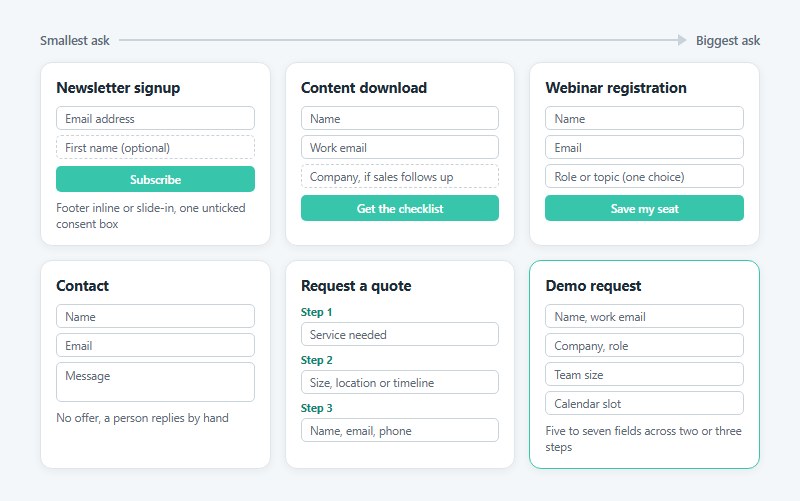
Start with how much the visitor is committing to. A newsletter signup is a tiny ask and a content download is a little bigger. Contact and quote forms sit in the middle, and a demo request is the biggest.
Field count, layout and routing all follow from that position. What comes next runs from lowest commitment to highest, with a build spec for each type.
Newsletter signup form
Ask for an email address and nothing else.
First name is the only extra field worth adding, and honestly even that is optional. A few newsletter signup layouts you can copy show how little the form needs to hold.
Put it inline in the footer or use a slide-in. Add one unticked consent box that says what subscribers will receive and how often, and send entries straight into the email platform list. A Mailchimp integration with field mapping can sync only the contacts who ticked that box.
Content download form
Gating only pays when the asset is worth an email address to the reader. If it isn’t, skip the gate.
- Name and work email, with company added only if sales will follow up
- Works inline beside the asset description, or as a popup on the download button
- The consent line should name the download and any marketing emails that come with it
- The email platform sends the delivery message, and the CRM keeps the contact record
Webinar registration form
A webinar has a date on it, which raises intent. That makes one qualifying question affordable.
Ask name, email and a single choice such as role or the topic they care about, then send the join link and reminders from the same form. A general webinar registration form template gives you a base to trim down.
The mistake I see most is piling company size and budget onto what is a free event signup, sometimes with a phone number on top.
Contact form
Contact forms are the simple ones. A name, an email and a message box, no offer, and a person replies by hand.
Lead capture forms promise something. They run two to four fields, say what the visitor gets, and push the entry into a CRM or email list without anyone touching it.
The gap in what each promises the visitor is the whole story behind how a contact form differs from a lead generation form. Use the contact template for questions and a lead template for anything with an offer attached.
Request a quote form
Quote requests need detail, so split them into short steps instead of one long page.
- The service or product needed, as a single choice
- Size, location or timeline
- Name, email and phone
The catch is that contact details come last, so an abandoned quote leaves no lead behind unless the tool saves partial entries.
Demo request form
Demo requests get the longest form.
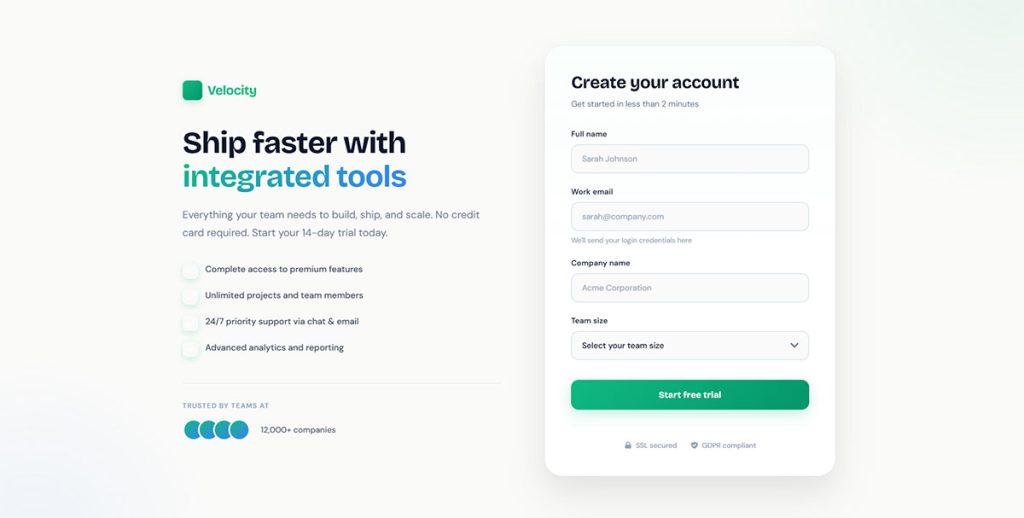
Someone asking for a sales call has already decided the product matters, and NP Digital’s form-length analysis says high-intent pages such as demo and pricing requests tolerate more friction than other pages. Five to seven fields across two or three steps (name, work email, company, role, team size, then a calendar slot) fit that.
Route every submission to the CRM with an owner already assigned.
Lead Capture Form Templates
Modern Newsletter Signup Form
See the Pen
Modern Newsletter Signup Form by Bogdan Sandu (@bogdansandu)
on CodePen.
Modern Lead Capture Form – Download Resource Page
See the Pen
Modern Lead Capture Form – Download Resource Page by Bogdan Sandu (@bogdansandu)
on CodePen.
Modern Event Registration Form with Advanced UX Features
See the Pen
Modern Event Registration Form with Advanced UX Features by Bogdan Sandu (@bogdansandu)
on CodePen.
Modern Waitlist Lead Capture Form
See the Pen
Modern Waitlist Lead Capture Form by Bogdan Sandu (@bogdansandu)
on CodePen.
Modern Quote Request Lead Capture Form
See the Pen
Modern Quote Request Lead Capture Form by Bogdan Sandu (@bogdansandu)
on CodePen.
Multi-Step Lead Capture Form with Progress Tracking
See the Pen
Multi-Step Lead Capture Form with Progress Tracking by Bogdan Sandu (@bogdansandu)
on CodePen.
Modern Survey-Style Lead Capture Form
See the Pen
Modern Survey-Style Lead Capture Form by Bogdan Sandu (@bogdansandu)
on CodePen.
Modern Popup Lead Capture Form
See the Pen
Modern Popup Lead Capture Form by Bogdan Sandu (@bogdansandu)
on CodePen.
Modern Inline Lead Capture Form
See the Pen
Modern Inline Lead Capture Form by Bogdan Sandu (@bogdansandu)
on CodePen.
Modern Split-Screen Lead Capture Form
See the Pen
Modern Split-Screen Lead Capture Form by Bogdan Sandu (@bogdansandu)
on CodePen.
(Tip: View full page)
Modern Contest Lead Capture Form
See the Pen
Modern Contest Lead Capture Form by Bogdan Sandu (@bogdansandu)
on CodePen.
Modern SaaS Free Trial Lead Capture Form
See the Pen
Modern SaaS Free Trial Lead Capture Form by Bogdan Sandu (@bogdansandu)
on CodePen.
How many fields should a lead capture form have?
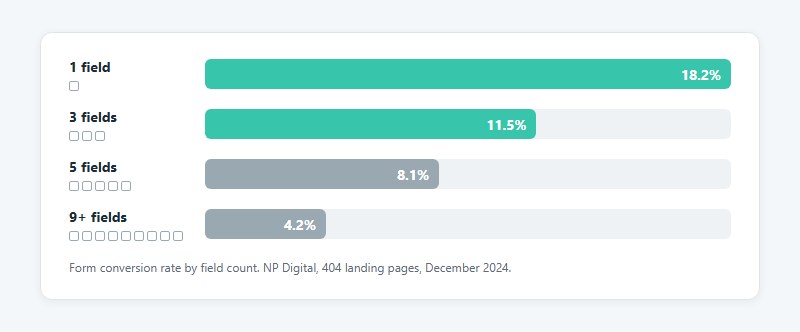
Between one and four. Top-of-funnel offers get one or two fields, and core lead generation forms can stretch to three or four.
NP Digital’s December 2024 analysis of 404 landing pages put numbers on it.
- A single field converted at 18.2%
- Three fields managed 11.5%
- Five fields dropped to 8.1%
- Nine or more landed at 4.2%
The steepest losses come in the first two fields, and each later field costs less than the one before. NP Digital counted submissions and has no lead-quality data, so the fact that longer forms cut volume doesn’t mean they bring in better leads.
Phone number goes first, unless someone will actually call within the day. Company size is next, then job title. Which fields earn their place depends on what sales does with the answer, a call covered in a guide on which fields separate high-quality leads from noise.
Short forms make sense when the offer is free and the traffic is paid or content-driven, as long as sales can handle the volume.
Add fields when the answers route or price the request, as with quotes and demos. SmartBug Media advises asking only for what matters at each funnel stage, with more questions reasonable for more valuable content. And if the team already has more leads than it can work, trimming fields stops being the goal.
Which field types, order and copy convert best?
Open with the easiest field. Phone and company questions go near the end, and the button should say what the visitor gets.
Required, optional and hidden fields
Email is required, along with whatever sales can’t follow up without. Anything that sharpens routing but isn’t needed to reply can be optional. Hidden fields pick up UTM source, campaign and page URL without asking the visitor anything.
Typeform fills hidden values from URL parameters, and WPForms does it with smart tags (both per vendor documentation, October 2026). WPForms Basic also runs real-time format checks, so a mistyped email or phone number is caught before submit.
Conditional logic and progressive profiling
Ask follow-up questions only when an earlier answer needs them.
That is the job of conditional logic, and it keeps a form that collects a lot from looking like it does.
Progressive profiling spreads the remaining questions across visits. HubSpot’s progressive fields swap a question a returning contact has already answered for the next one in a queue, so that contact sees new questions instead of repeats.
One catch on HubSpot. Conditional logic and progressive fields need a Professional or Enterprise tier, and multi-step forms need a paid plan, so the free plan stops at a plain form (HubSpot, October 2026).
Button text and form copy
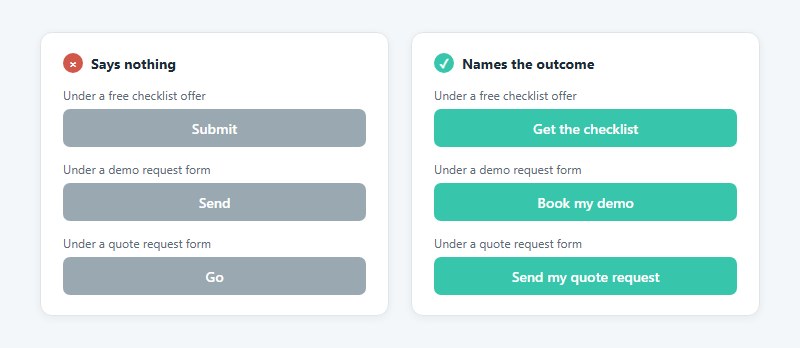
“Submit” tells the visitor nothing.
Name the outcome instead, and echo the page headline. A handful of call-to-action wording examples shows the pattern.
Buttons that say Submit, Send or Go are weak. Get the checklist, Book my demo or Send my quote request tell people what happens next.
Finding the field that loses people
WPForms 2.0 (July 2026) adds analytics that report interactions, time spent, errors and abandonment for every field, with the full field table on Pro and Elite. Typeform shows drop-off rates by question on its Business plan and higher. The field with the highest abandonment is the one to move down the form or remove.
Single-step or multi-step, and where should the form sit?
Four fields or fewer can stay on one step. From five up, split it. And put the form right after the visitor has read the offer.
Single-step vs multi-step
The evidence points two ways. NP Digital’s data says every added field costs conversions, while an earlier Venture Harbour case study questions the shorter-forms rule, since its own enquiry form went from 0.96% to 8.1% after moving from one page to several steps.
Venture Harbour launched a multi-step form tool, Leadformly, which has since been discontinued, so treat that result as a vendor case. Formstack’s 2015 Form Conversion Report, as covered by Demand Gen Report, put multi-page forms near 14% and single-page forms near 5% across about 650,000 users.
That benchmark is more than a decade old and compares customer averages, so it does not isolate the effect of steps. Read together, the sources agree that perceived length drives abandonment.
Field count sets how much friction a form carries, and steps decide how much of it the visitor sees at once. Fix the field budget first, then split.
Single-step forms show the whole ask at once, so nothing surprises the visitor. They need no step tracking or progress bar and work in every builder, free tiers included. The downside is that conversion falls sharply from five fields up, and a long column looks heavy on a phone screen.
Multi-step forms do more for the visitor.
- A low-effort first question starts the commitment
- The same fields feel shorter
- Answers can branch, so people skip what does not apply to them
- Qualifying questions can come before contact details
They also cost something.
- Every step is another place to leave
- Abandoned steps lose early answers unless the tool saves partial entries, as WPForms Pro does
- Support varies by tool, since WPForms includes multi-page forms from Basic while HubSpot needs a paid plan for them
For a closer side-by-side, see how multi-step and single-step forms compare.
Inline, popup, slide-in or landing page
Inline forms sit in the page content, which suits downloads and contact pages. Popups open on a trigger, so they’re a good match for newsletter signups, and slide-ins do the same job with a smaller panel that leaves the page readable. A standalone landing page with nothing but the form is best for paid traffic.
Timing matters as much as format. Typeform’s popup embeds can launch on page load, after a delay, on scroll or on exit intent (Typeform Help Center, October 2026), and WPForms Pro builds distraction-free form landing pages (WPForms pricing page, October 2026).
A popup interrupts and an inline form waits, which is the core of the inline versus popup trade-off. On placement, Typeform’s own guidance is to keep short forms on high-intent, lower-funnel pages.
Which form builder has the best lead capture form templates?
None of them wins outright. HubSpot and Formstack suit teams that live in a CRM, Typeform is better for short conversational forms, and Gravity Forms or WPForms make more sense on WordPress sites.
| Builder | Cost to start (October 2026) | Lead capture strength |
|---|---|---|
| HubSpot | Free forms; paid Marketing Hub tiers add premium features | Submissions land in HubSpot CRM automatically |
| Typeform | Basic $28/month billed annually ($39 monthly), 100 responses/month | One question at a time; logic from Basic |
| Jotform | Free Starter plan with Jotform branding | 20,000+ templates, 150+ integrations |
| Google Forms | Free with a Google account; included in Google Workspace | Premade templates, answer-based logic, Sheets export |
| Gravity Forms | $59/year, 1 site, no free tier | HubSpot and Mailchimp add-ons on the entry license |
| WPForms | $49.50 first year (standard $99), 1 site; free Lite version | Multi-page forms with progress bar on every paid plan |
| Formstack | From $83/month billed annually; 14-day free trial | 300+ integrations, separate native Salesforce plan |
Prices and plan limits come from each vendor’s own pricing page, checked in October 2026.
Where each entry tier stops
Typeform’s Basic plan caps responses at 100 a month, and branding comes off only from Plus at $56 a month billed annually. On HubSpot, conditional logic needs a Professional or Enterprise tier, and multi-step forms need a paid plan.
Gravity Forms has no trial, and Salesforce and webhooks need Elite at $259 a year. WPForms first-year prices are introductory and renewals run at full price. Jotform’s free forms carry its branding until a paid plan, and Formstack’s entry plan allows 25 forms and 1,000 submissions per form.
Choosing without overpaying
For one two-field newsletter form, a free option is enough. HubSpot’s free forms, Jotform’s Starter plan or WPForms Lite on WordPress will do the job, and there are several free WordPress form plugins worth checking before paying anyone.
If the form must write to HubSpot from WordPress, the license tier decides the price. Gravity Forms Basic includes the HubSpot add-on for $59 a year, while WPForms needs its Elite plan, $299.50 in the first year and $599 at standard price.
Salesforce needs Elite on both. The full gap is laid out in WPForms against Gravity Forms.
How do you add consent and spam protection to a lead capture form?
Start with a consent line that names what the person will receive. Add double opt-in where the audience or platform calls for it, then pick one bot filter that doesn’t turn away real visitors.
Consent comes first, because the rules differ by region. Spam filters can be swapped later without touching the law.
GDPR consent checkbox wording
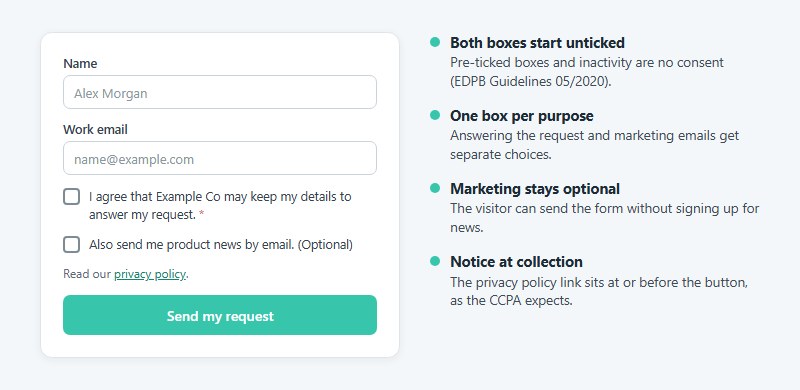
Consent has to be a clear affirmative act, and it has to be specific.
The European Data Protection Board’s Guidelines 05/2020 treat pre-ticked boxes and inactivity as no consent at all, and require a separate choice for each purpose.
Bundling terms, privacy policy and marketing emails under one box is the common shortcut. Separating them means one box to store the request (“I agree that [Company] may keep my details to answer my request”) and a second, optional box for marketing (“Also send me product news by email”).
Builders handle the box differently. Zoho CRM webforms can include an opt-in checkbox, while Pipedrive has no default consent field and documents a workaround, which is a custom field with a Yes option added to the form as a required input. On WordPress, IvyForms has a dedicated GDPR field for that box.
For the wider checklist, see a guide to building GDPR compliant forms.
Double opt-in
With double opt-in, a confirmation email sits between the form submit and the subscription. The visitor submits the signup form and gets an email with a unique link. The address joins the audience only after that click.
That is Mailchimp’s flow, and Mailchimp turns it on by default for some audiences whose primary contact address is in the EU (Mailchimp Help, October 2026).
It does have a limit. Double opt-in for email contacts works only on Mailchimp’s own signup forms, and Mailchimp sends form integration and API users to a developer.
Use it for newsletters. Skip it for demo requests, where a confirmation step sits between the buyer and sales.
CCPA and CAN-SPAM
| Law | Model | What the form side must do |
|---|---|---|
| GDPR | Consent first | Capture a clear affirmative action for each purpose |
| CCPA | Notice and opt-out | Show a notice at collection, with a privacy policy link, at or before the form |
| CAN-SPAM | Opt-out afterward | Explain how to opt out in each marketing email and honor requests within 10 business days |
The CCPA applies to for-profit businesses in California that top $26.625 million in annual revenue (the original $25 million, adjusted for inflation from January 2025), buy, sell or share the personal information of 100,000 or more California residents or households, or earn half their revenue from selling or sharing personal information (California Privacy Protection Agency, October 2026).
The FTC’s CAN-SPAM guide sets penalties of up to $53,088 per violating email and makes no exception for business-to-business mail.
The regimes disagree on timing. GDPR wants consent before the first email, while CAN-SPAM wants a working opt-out after it. A form that serves both audiences should follow the stricter one.
Honeypot, reCAPTCHA, hCaptcha and Cloudflare Turnstile
- A honeypot field is a hidden input that bots fill and people never see, so the visitor faces no puzzle
- Google reCAPTCHA runs a risk assessment on each submission, free up to 10,000 assessments a month on the Essentials tier (Google Cloud documentation, October 2026)
- hCaptcha works as a drop-in reCAPTCHA replacement, but its passive modes start on the Pro plan, not the free one (hCaptcha plan comparison, October 2026)
- Cloudflare Turnstile is a managed, non-interactive or invisible widget that works without showing a CAPTCHA, and Cloudflare states it is WCAG 2.2 AA compliant (Cloudflare documentation, October 2026)
WPForms builds its anti-spam protection on the honeypot technique. It is on by default and can be switched off per form in the form builder under Settings, then Spam Protection and Security. The principle is explained in how a honeypot field catches bots.
There is a known failure mode, though. WordPress developer Bill Erickson reported in 2020 that spam bots skip the built-in WPForms honeypot field because the plugin is so widely used, and he recommends a custom honeypot unique to your site instead.
Start with a honeypot and add a CAPTCHA only if spam gets through. Every challenge is a chance to lose a real visitor.
How do you connect a lead capture form to your CRM and email platform?
If the builder has a native integration for your CRM, use it. If not, Zapier works, and a webhook makes sense when you control the receiving system. IvyForms offers both routes, a Zapier new entry trigger and webhooks.
Native, Zapier or webhook
| Method | Best for | Where it breaks |
|---|---|---|
| Native integration | One CRM, standard fields | Limited to the vendor’s field set and plan tier |
| Zapier | A CRM with no native connector, or routing in several steps | One more subscription and one more system to monitor |
| Webhook | Your own database or a custom CRM | Needs a developer to receive and retry the data |
Typeform includes webhooks and integrations from its Basic plan, and its webhooks send each response to any URL as soon as it is submitted (Typeform pricing page, October 2026).
Salesforce, Zoho CRM and Pipedrive
- Salesforce Setup generates a web-to-lead form that creates up to 500 leads a day, with reCAPTCHA on by default and an optional auto-reply template (Salesforce Help, 2026)
- Zoho CRM webforms feed Leads, Contacts, Cases and Vendors, and records go to the administrator unless an assignment rule, round robin included, says otherwise
- Pipedrive Web Forms belong to the LeadBooster add-on and send submissions in as deals or leads (Pipedrive Knowledge Base, September 2026)
Salesforce documents the 500-a-day ceiling, so a campaign spike needs a plan before launch. In Zoho, set the assignment rule first.
Field mapping, scoring and ownership
Map every form field to a CRM property, hidden fields included, or the source data captured at the form never reaches the lead record.
Scoring and routing add a second layer. Typeform ties lead enrichment and scoring to its Growth Flow plan, from $266 a month billed annually after a 14-day trial (Typeform pricing page, October 2026).
Where a new lead sits in the lead generation funnel decides who follows up. A newsletter subscriber enters a nurture sequence, and a quote request goes to the account owner.
How to launch and test a lead capture form template
Taking a template from draft to a tracked, tested form is mostly a matter of doing things in the right order.
From template to live form
- Delete every template field you will not use, and mark as required only what sales cannot work without.
- Add the consent line, the privacy policy link and the thank-you message or redirect.
- Switch on the spam filter and check that it does not block a phone submission.
- Map each field to a CRM or email platform property and set an owner or assignment rule.
- Submit a test entry from desktop and mobile, then check the CRM record, the auto-reply and the thank-you page.
- Publish the form and confirm the form_submit event reaches Google Analytics 4.
- Review after a fixed window, change one thing, and test again.
Salesforce’s web-to-lead form has a built-in debug mode. Remove the comment markers from the debug and debugEmail inputs in the generated HTML, add your email address, and each test submission returns a debugging email (Salesforce Help, 2026).
The thank-you screen is the first thing a new lead sees. Use confirmation message wording that says what happens next and when.
Tracking submissions in Google Analytics 4
Google Analytics 4 enhanced measurement records form_start on a visitor’s first interaction with a form in a session, and form_submit when the form is sent. The gap between the two shows how many people started and did not finish.
Those events carry form_id, form_name, form_destination and form_submit_text, and all four appear in reports only after you create custom dimensions for them, according to Google Analytics Help. When the automatic events are not enough, a Google Tag Manager Form Submission trigger can listen for form submissions and fire a tag.
The setup is walked through in a guide to tracking form submissions in Google Analytics.
Testing one change at a time
Change one variable per test.
Button text, one removed field and a layout switch each deserve their own run, otherwise a win has no cause. Judge each test on form_submit against form_start, then on whether the leads still turn into conversations.
When a lead capture form template falls short
Custom quotes and multi-product enquiries outgrow a template’s single path. Low-intent traffic is a different problem, since an accidental ad click does not become a lead because the form is better.
Regulated data is stricter again. Typeform offers a HIPAA business associate agreement only on Enterprise and Growth Custom plans, and Jotform limits its HIPAA features to Gold and Enterprise plans (vendor pages, October 2026). And a template cannot know your processing purposes, so its consent wording is a starting point, not legal advice.
For an offer that needs a back-and-forth, a chat flow can replace the form, a trade-off laid out in chatbots vs forms.
Before editing a template, compare its rate with conversion rate benchmarks by industry. A form that already sits at its benchmark is not the problem.
If three tests in a row move nothing, stop editing the form and look at the offer and the traffic, and at how fast sales follows up.
Lead Capture Form Templates FAQ
What does a lead capture form template include?
Usually the field set, the headline and button copy, the consent line, the thank-you step and the routing rule for one goal.
You edit those instead of building a form from a blank canvas.
Do lead capture forms need to be mobile responsive?
Yes. A form that only works on desktop loses every visitor who opens the page on a phone. These mobile form best practices cover the phone side of the build.
WPForms lists mobile-friendly forms on every plan, and its Basic plan adds a phone field with country detection (WPForms pricing page, October 2026).
Can I build a lead capture form in plain HTML without a builder?
Yes. A form is an HTML form element with input fields and a submit button that posts to a service or script you control.
Salesforce’s web-to-lead tool generates that markup for you to paste into your site (Salesforce Help, 2026). Add the consent checkbox, spam filter and validation yourself, following best practices for HTML forms.
What should the thank-you page say after someone submits a lead capture form?
Confirm receipt and say what happens next and when. If there is an asset, deliver it on the page itself.
Builders support a message or a redirect. WPForms offers a custom thank-you message or redirect page, and Salesforce’s web-to-lead form takes a redirect URL.
What is the difference between a lead magnet and a lead capture form?
The form is the gate. The lead magnet, whether that’s an ebook, checklist or report, is what visitors get for going through it.
The pairing matters because, per NP Digital, longer forms need stronger intent signals, and a more valuable offer supplies them. For the offer side, see what a lead magnet actually is.
Which Lead Capture Form Template to Publish First
Publish the content download form first. Two fields, one step and a free asset give the cleanest read on what a lead capture form template earns.
Demo and quote forms come second, since they depend on intent that cold traffic does not yet show. Review the first form at day 30.
Submissions that get no replies to follow-up point to the offer, while submissions that stall between form_start and form_submit point to the form.
The cost is context. Two fields hand sales more contacts with less information, so qualification moves into the follow-up email.
This order holds as of October 2026 and changes if a builder moves multi-step forms or webhooks into a higher tier.
Once the first form earns replies, a step-by-step guide to creating lead capture forms covers the next build.