








A new client doesn’t sign with an accounting firm because a landing page convinced them. They sign because someone they trust vouched for the firm, or because the firm showed…
Table of contents
A visitor lands on a page, reads for a bit, and closes the tab. No email, no name, nothing anyone can follow up on. That’s the default outcome for most site traffic, and it’s the exact problem a lead generation funnel exists to solve: turning an anonymous browser into a contact someone can actually reach.
The gap between an average funnel and a genuinely strong one is bigger than most people assume. Unbounce’s own benchmarking data puts the top quartile of landing pages at an 11.4% conversion rate, a number most funnels never get anywhere close to.
What Is a Lead Generation Funnel
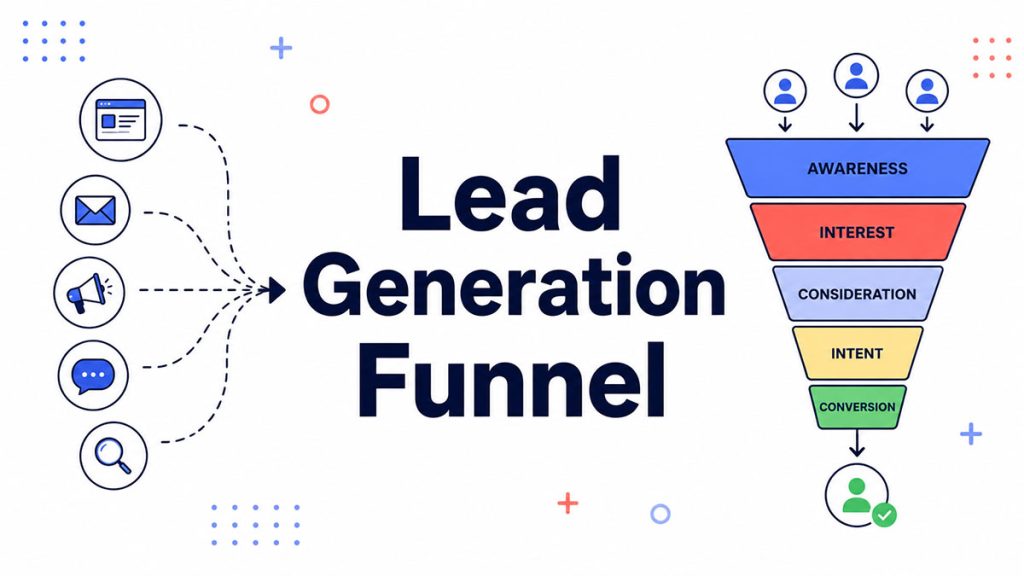
Picture a stranger browsing a site with zero intent to buy anything that day. A lead generation funnel is the process built to move that person through awareness, then interest, then consideration, until they hand over contact information and turn into something trackable: a lead.
The shape matters. Wide at the top, narrow at the bottom, because most visitors drop off before reaching the final step.
Lead generation itself, the broader practice of attracting and capturing prospects, has been around a lot longer than the funnel model. The funnel is just the shape somebody put on it later.
The idea traces back to the AIDA model, attention, interest, desire, action, from early 20th century advertising theory. It got adapted for digital marketing once landing pages and email capture became standard tools, and today it shows up across SaaS, ecommerce, real estate, and professional services in more or less the same shape.
For context, Unbounce’s Q4 2024 Conversion Benchmark Report, built from 41,000 landing pages and 57 million conversions, puts the median landing page conversion rate at 6.6% across all industries. That 11.4% top-quartile figure mentioned above is well out of reach for most funnels running today.
How a Lead Generation Funnel Differs From a Sales Funnel
A lead generation funnel stops the moment somebody becomes a qualified lead. Everything after that, the actual conversations, the negotiating, the paperwork that ends in a closed deal, belongs to the sales funnel instead.
Marketing owns the front half of this, everything from first awareness up through lead capture, and tracks it in marketing qualified leads (MQLs). Sales takes over from there. Its numbers look different too: sales qualified leads (SQLs), and eventually, closed revenue.
Treating both as one funnel causes a specific measurement problem. Marketing ends up getting credit or blame for outcomes it doesn’t actually control, and nobody can tell where a stalled deal actually broke down.
CRM platforms like Salesforce and HubSpot handle this by splitting the two into separate pipelines with a defined handoff point in between. First Page Sage’s analysis of B2B client data between 2019 and 2025 puts the average MQL to SQL conversion rate at 13% across industries, though it ranges from about 10% in fields like legal services and real estate up to 26% in industries like HVAC and business insurance.
What Are the Stages of a Lead Generation Funnel
A prospect moves through top, middle, and bottom of funnel on the way from stranger to lead, and each stage assumes a different mindset from whoever’s reading it.
| Stage | Visitor Status | Typical Content |
|---|---|---|
| Top of funnel | Anonymous, browsing | Blog posts, social content, paid ads |
| Middle of funnel | Interested, unidentified | Lead magnets, gated content, email opt-ins |
| Bottom of funnel | Identified, evaluating | Demos, consultations, free trials |
Top of Funnel Activities
At the top of the funnel, awareness building runs through a handful of channels: organic search traffic from SEO content, paid social campaigns on Meta Ads and LinkedIn Lead Gen Forms, plus display advertising and the occasional industry press mention.
Traffic at this stage comes from both pull and push channels. The split between inbound and outbound lead generation decides which channels get budget first.
Middle of Funnel Activities
This is where a cold lead becomes a warm one. Content locked behind an email address, commonly called gated content, moves a visitor from anonymous browsing into a tracked, named contact.
Ebooks, templates, webinars, and free tools all live here. The offer has to be specific enough that someone trades their email for it, not so broad that it attracts the wrong audience.
Bottom of Funnel Activities
Down at the bottom, visitors start doing things that reveal actual buying intent: requesting a demo, checking the pricing page, signing up for a free trial, booking a consultation.
Drop-off compounds at every transition. A visitor who clicks a paid ad, downloads a lead magnet, then never opens a follow-up email represents three separate points of loss, not one.
What Are the Core Components of a Lead Generation Funnel
A funnel is also built out of physical parts, separate from the stage-by-stage mindset stuff above.
A lead magnet anchors the middle of the funnel. It’s the specific offer exchanged for contact details, and it sets the tone for the entire capture step. Weak offer, weak signup rate, pretty much every time.
The landing page is a dedicated page built around one conversion goal, and that’s exactly how it differs from a homepage in one key way: a single job, instead of a dozen competing links fighting for attention.
Then there’s the opt-in form, the actual mechanism where the exchange happens. Field count decides whether people finish it or bail halfway through, and looking at real opt-in form examples makes clear how little friction the best-converting ones actually ask for.
After that comes the thank-you page and confirmation email, the moment that confirms the trade actually went through on both ends.
Last is the CRM or email platform, where the lead lands, gets tagged by source, and turns into a record somebody can act on.
How Does a Lead Generation Funnel Work Step by Step
The mechanics run in a fixed order, even when the channels and offers underneath them change.
- A traffic source (paid ad, organic search, referral) delivers a visitor to a landing page
- The visitor exchanges contact information for the lead magnet through the opt-in form
- The lead enters a CRM or email platform and gets tagged by source and campaign
- An automated sequence begins, often built from existing lead nurturing templates rather than written from scratch
- The lead gets scored based on engagement and routed to sales once it crosses a threshold
Step two is where most volume gets lost. Splitting that exchange into multi-step forms rather than single-step forms tends to lift completion, particularly once field count climbs past three or four.
HubSpot’s analysis of 40,000 customer landing pages found forms with 3 fields converted at roughly 25%, while forms with 5 fields dropped to around 21%. Every field added past that point costs measurable volume.
B2B and B2C Lead Generation Funnel Differences
B2B and B2C run on different logic entirely. A B2B funnel can stretch across weeks, sometimes months, with several people signing off before anything closes. B2C moves faster than that, often down to minutes, and it’s mostly price and impulse doing the driving.
On the B2B side, lead magnets tend to be whitepapers, ROI calculators, webinar registration forms, that sort of thing, leaning hard on authority and data to make a case. B2C skips most of that and goes straight for urgency and instant value.
Optifai’s 2025 pipeline study of 939 companies puts the median B2B SaaS sales cycle at 84 days. Gartner’s research shows the average B2B buying committee has grown to 6.8 stakeholders, up from 5.4 in 2020, which is a direct reason B2B funnels take longer to clear.
Storyly, a B2B mobile engagement platform, combined exit-intent popups with content-gating on its product pages and saw an 80% higher conversion rate on its Contact Sales form, according to an OptinMonster case study. The tactic pushed already-interested visitors toward a sales conversation instead of letting them leave.
What Metrics Measure Lead Generation Funnel Performance
A handful of numbers actually decide whether a funnel is working, more than the dashboard metrics people tend to stare at instead. The full list of lead generation KPIs to track goes deeper, but the ones below carry most of the weight.
- Conversion rate is the share of visitors who become leads.
- Cost per lead (CPL) is total spend divided by leads generated, and it needs to get broken out by channel to actually mean anything.
- MQL rate tracks leads that clear marketing’s qualification bar.
- SQL rate tracks the MQLs that sales accepts and moves forward with.
- Funnel velocity is the average time a lead takes to move between stages.
Conversion Rate Benchmarks by Industry
Blended averages hide more than they reveal. Conversion rate benchmarks by industry vary from around 3.8% in SaaS to 12.3% in events and entertainment, per Unbounce’s 2024 data.
First Page Sage’s 2025 report found B2B professional services landing pages, consulting, staffing, manufacturing, typically convert at just 1 to 3%. Deal complexity and longer sales cycles explain most of that gap.
Cost Per Lead by Channel
| Channel | Average CPL |
|---|---|
| Referrals | $25 |
| Affiliate marketing | $73 |
| Facebook Ads | $142 |
| LinkedIn Ads | $408 |
Sopro’s 2025 State of Prospecting report backs this spread, and First Page Sage’s cross-industry average lands at $198 for paid channels versus $164 for organic.
Every additional form field raises cost per lead because fewer visitors finish it, and the data on form fields backs that up directly. Cutting a form from seven fields to three can drop CPL by half or more on identical ad spend.
What Tools Power a Lead Generation Funnel
Every stage of the funnel runs on dedicated software. Picking the wrong one for a given job is a common reason funnels underperform.
| Tool | Category | Notable Fact |
|---|---|---|
| Unbounce, Leadpages, Instapage | Landing page builders | Purpose-built for single-goal pages |
| Typeform, OptinMonster | Forms and quizzes | OptinMonster has over 1 million active installs |
| HubSpot, ActiveCampaign, Marketo | CRM and automation | HubSpot reported 258,258 paying customers in Q1 2025 |
| Calendly | Scheduling and demo booking | Used by 86% of the Fortune 500 |
Unbounce, Leadpages, and Instapage exist mainly so somebody can publish a single-goal landing page fast, without waiting on a developer’s queue. For forms and quizzes, Typeform handles the conversational multi-step stuff well, and exit-intent popup plugins built for WordPress, OptinMonster being the obvious example, catch visitors right before they’d otherwise leave a page unconverted. On the CRM and automation side, tools like HubSpot, ActiveCampaign, and Marketo tag leads, run the nurture workflows, and hand qualified contacts over to sales once they’re ready.
Calendly’s own newsroom reports 86% of the Fortune 500 use the platform, with more than 20 million users across 230+ countries, mostly for the bottom of funnel step where a lead books a demo directly.
On the WordPress side, a site owner rarely needs five separate tools running at once. A good set of WordPress lead generation plugins can cover forms, popups, and CRM syncing from inside one dashboard instead.
Ad platforms round out the stack. Google Ads and Meta Ads drive top of funnel traffic, while LinkedIn Lead Gen Forms let a B2B visitor submit contact details without ever leaving the LinkedIn feed.
What Causes a Lead Generation Funnel to Leak Leads
Most funnels don’t fail from lack of traffic. They fail at the exchange point, where an interested visitor decides the form isn’t worth finishing.
Too many competing goals is a common one. A landing page that asks visitors to download a guide, book a call, and follow a newsletter link all in the same breath ends up diluting every single option on it. Core landing page form best practices basically boil down to picking one action and removing everything else.
Asking for too much too soon is another one. A phone number and company revenue on the very first touch feels like a demand, not a fair trade, especially before any trust has been built.
Page speed matters more than people give it credit for, particularly on mobile. Somebody who clicked through from a paid ad has approximately zero patience for a page that stalls before the form has even rendered.
Then there’s the silence after signup. A lead who downloads a guide and hears nothing for a week has usually mentally moved on by the time a follow-up email finally shows up.
And sometimes the lead magnet just doesn’t match where somebody actually is in the funnel. Offering a free trial to someone still in the awareness stage skips steps they haven’t taken yet. Go the other direction, a beginner blog post shown to someone who’s ready to buy, and you’re just wasting whatever patience they had left. Reviewing the different types of lead magnets against each stage of the funnel heads this off before it happens.
Zuko Analytics, which tracks form behavior across millions of sessions, reports that roughly two-thirds of form starters never complete the form they began. Field count is one factor, but Zuko’s own data shows friction sources vary widely by industry, so the fix is rarely as simple as deleting fields at random.
Fixing this starts with the basics. Practical tips for improving form abandonment rate usually address more than one of these causes at once.
Examples of Lead Generation Funnels in Practice
A handful of models cover most of what a live lead generation funnel actually looks like once it’s running.
| Funnel Type | Industry | Documented Result |
|---|---|---|
| Free trial funnel | SaaS | Signup to onboarding sequence |
| Quiz funnel | Ecommerce (BedGear) | 490% increase in conversions |
| Webinar funnel | B2B | 57% registration-to-attendance rate |
| Valuation tool funnel | Real estate | 144 leads at $24.50 CPL |
Take the SaaS free trial funnel first. A paid ad sends traffic to a free trial landing page, the visitor signs up with nothing more than an email and a password, and a behavior-triggered onboarding sequence takes it from there.
Ecommerce runs a slightly different play with quiz funnels. Mattress company BedGear added a personalized PillowID product-recommendation quiz to its site, and shoppers who completed it were 4.9 times more likely to buy. The quiz drove a 490% increase in conversions overall, according to Digioh. Worth looking through real quiz template examples, since the best-converting ones usually ask far fewer questions than you’d expect.
B2B leans heavily on webinar funnels instead. A LinkedIn ad drives the registration, the live session does the work of building authority, and the follow-up sequence pushes attendees toward an actual sales call. ON24’s platform data across millions of sessions in 2024 puts the average B2B webinar registration-to-attendance rate at 57%.
Real estate has its own version built around valuation tools. A Bay Area agency built a lead magnet landing page around a home valuation tool, and over 98 days and $3,536 in ad spend, the campaign generated 144 seller leads at $24.50 per lead and produced 2 signed listings, according to a Luxury Presence case study.
How to Optimize a Lead Generation Funnel for Higher Conversion
Optimization work tends to concentrate on a short list of levers, and none of them require rebuilding the funnel from scratch.
- Test headlines, form length, and CTA placement against each other
- Add testimonials or client logos near the conversion point
- Retarget visitors who left without converting
- Automate lead scoring so sales only sees the high-intent contacts
- Segment nurture emails by source and behavior instead of running one blanket sequence
Field count is usually the fastest test to run. A widely cited case study from web agency Imaginary Landscape found that cutting a contact form from 11 fields down to 4 increased conversions by 120%, a bigger jump than most single-variable tests produce. A guide on how to increase form conversions covers the rest of the field-level tactics worth testing.
WordStream’s 2025 benchmark report, built from over 16,000 US ad campaigns, puts the average search conversion rate at 7.52%. That baseline is what an A/B test needs to beat before a change counts as a real win, not noise.
Segmentation compounds over time rather than delivering an instant lift. Klaviyo’s benchmark data shows segmented email lists return roughly 3 times the revenue per recipient of unsegmented lists, $0.19 versus $0.06.
Visitors who leave an exit-intent form unfinished are still worth chasing. Retargeting them with the same offer, rather than a generic ad, keeps the original intent alive instead of starting the relationship over.
None of these tactics fix a fundamentally broken offer. Lead generation strategies built around the wrong audience won’t improve much no matter how many fields get cut.
FAQ on Lead Generation Funnels
How Long Does It Take to Build a Lead Generation Funnel
A basic version, one landing page, one lead magnet, one email sequence, can go live inside a week if nothing gets stuck in review. Anything more involved, multi-step nurture sequences with full CRM integration, usually runs 3 to 6 weeks, mostly depending on how fast content gets produced.
How Much Does It Cost to Set Up a Lead Generation Funnel
Depends entirely on scope. Someone building it solo with a free landing page tool and a free CRM plan can launch for close to nothing. Hand the same job to an agency for custom design work and it runs into the thousands, and that’s before any ongoing ad spend gets added on top.
Does a Lead Generation Funnel Require Paid Advertising
No, it doesn’t. Organic channels, SEO content, referrals, email lists someone already owns, can fill a funnel with zero ad spend. What paid traffic actually buys is speed, since organic growth through search rankings and word of mouth takes months to build any real momentum.
Is a Lead Generation Funnel the Same as a Marketing Funnel
No, and the difference matters. A marketing funnel covers the whole customer journey, first impression all the way through repeat purchase and brand loyalty. A lead generation funnel only handles one slice of that: the stretch between anonymous traffic and a captured, contactable lead.
What Is Lead Recycling in a Lead Generation Funnel
Lead recycling is what happens to contacts who went cold, downloaded a lead magnet, then never booked a call. Instead of getting deleted, they get sent back into an earlier nurture stage. A surprising number of them convert months later, usually once timing or budget finally lines up.
Can a Small Business Run a Lead Generation Funnel Without a Website
Yes, technically. A link-in-bio page, a social media DM funnel, or just a single hosted form through something like Typeform can capture leads without a full site behind it. Conversion rates tend to run lower this way, but setup takes hours instead of weeks.
How Many Leads Should a Funnel Produce Each Month
There’s no universal answer here. It depends on traffic, industry, and deal size, and a B2B funnel selling large contracts genuinely needs far fewer leads than a B2C funnel moving a cheap product. Track conversion rate per stage instead of chasing a raw lead count.
How Often Should a Lead Generation Funnel Be Redesigned
Review it every quarter, and rebuild any single stage where conversion rate has dropped two quarters running. Full redesigns, new magnet, new page, new sequence, tend to become necessary every 12 to 18 months, roughly whenever the offer or the audience has shifted enough to matter.
Can One Business Run More Than One Lead Generation Funnel at a Time
Yes, and most growing companies end up doing exactly this. One business will often run separate funnels by product line, by audience segment, or by traffic source, each with its own landing page, its own lead magnet, and its own CRM tag so attribution stays accurate.
Can AI Tools Run a Lead Generation Funnel Automatically
AI handles specific pieces of this well, lead scoring, email personalization, chatbot qualification sitting on a landing page. What it can’t do yet is run the whole funnel unattended. Offer strategy and channel budget decisions still need an actual person making the call.
Conclusion
Once the actual requirements are clear, the build order tends to flip. Fix the capture mechanism first, the opt-in form and the thank-you flow, before spending another dollar pushing traffic at it. A funnel that converts well at low volume will scale. One that leaks at high volume just burns budget faster, and no amount of extra traffic fixes that.
Expect the first full sales cycle to look worse than any benchmark promises. A new CRM pipeline needs real lead scoring data before the numbers mean anything at all, and that takes months, not days.
Pick one warm lead channel, referrals, retargeting, organic search, whichever fits, and give it a full quarter before adding a second. Depth in one channel beats a thin presence spread across half a dozen, and it’s usually the fastest route to a funnel that actually pays for itself.