





A new client doesn’t sign with an accounting firm because a landing page convinced them. They sign because someone they trust vouched for the firm, or because the firm showed…
Table of contents
Most companies aren’t short on leads. They’re short on leads who actually buy, which is a different problem with a different fix.
Lead generation strategies exist to close exactly that gap, turning someone who clicked a link into a name and an email address a sales rep can actually work with, ideally before a competitor gets there first.
Generating high-quality leads still ranks as a top challenge for 30% of marketers, even as overall lead volume keeps climbing (HubSpot, 2026). More leads isn’t really the problem most teams have anymore. Better leads is.
Content, paid outreach, referrals, email nurturing, webinars: they all dump into the same funnel eventually, but rarely at the same cost per lead. A cheap inbound lead and an expensive outbound one can both close, or neither can, and the channel alone never tells you which.
What decides that is the strategy behind each channel, not the channel itself.
What Is Lead Generation
Somebody fills out a form on a pricing page and marketing throws them straight into an email sequence. A rep gets a notification an hour later and calls, and the person who filled out the form has no real idea why a stranger is now asking about their budget. That gap between form fill and actual conversation is what lead generation is supposed to manage: identifying who’s shown real interest, attracting more people like them, and capturing enough contact detail that someone on the sales side can follow up without guessing.
An anonymous visitor becomes a named contact somewhere in that process. A follower becomes a lead. A referral becomes a phone number sitting in a CRM. None of that happens automatically.
Worth separating out early: a lead, a prospect, and a marketing qualified lead get used interchangeably by people who should know better, and they’re not the same thing.
- A lead has shared contact information, nothing more
- A prospect fits the buyer profile and has been checked for fit and budget
- A marketing qualified lead (MQL) has engaged enough, through downloads, repeat visits, or email clicks, to signal readiness for a sales conversation
Demand generation happens earlier, building awareness before anyone hands over an email address, while lead generation picks up right after, once interest is ready to become a captured contact. Teams that keep generating traffic without generating leads almost always have this confusion baked in somewhere, which is why the difference between lead generation and demand generation matters more than it sounds like it should.
Where this sits in the funnel matters too. Lead generation lives at the top and middle, the stretch where curiosity turns into an actual name on file rather than just a pageview. Mapping out every stage between that first click and the handoff to sales is what a lead generation funnel is for.
That tracks with what’s actually happening industry-wide. HubSpot’s 2026 State of Marketing report, surveying over 1,500 global marketers, found 56% say generating leads is easier now than a decade ago, and 93.8% report lead quality improved over the past year (HubSpot, 2026).
Two directions cover almost everything else here. Inbound means the buyer finds the business on their own, through content, search, or a social post that caught their eye, and shows up already curious about what’s being sold.
Outbound flips that. The business reaches out first, cold, before the person on the other end has shown any interest at all, whether that’s a paid ad interrupting a scroll, a cold email, or an actual phone call.
Most companies run both at once. The split just depends on budget and how long the sales cycle usually runs.
How Does Inbound Lead Generation Work
Somebody who found a blog post through Google already believes the problem is worth solving, they just haven’t picked who solves it yet. That’s the real advantage inbound has over everything else on this list: the visitor shows up with some interest already baked in, before a sales rep or an ad has said a word to them.
That head start is also why inbound tends to close at a lower cost per acquisition over the long run, even though it takes longer to get moving. The tradeoff shows up fast in any comparison of inbound and outbound lead generation: inbound is slower to build and cheaper to sustain once it’s actually running.
76% of B2B marketers say content marketing has directly helped generate demand or leads (Content Marketing Institute, B2B Content Marketing Outlook for 2024).
Content Marketing and Blogging
Not everything needs to sit behind a form to do its job. Gated and ungated content both pull search traffic toward the same specific offer eventually, they just take different paths there:
- Long-form guides built around real buyer questions
- Comparison and alternative pages for commercial-intent search terms
- Case studies that show a specific, provable result
63% of marketers say content marketing has nurtured relationships with existing leads over the past year, on top of the demand it generates (Content Marketing Institute, B2B Content Marketing Outlook for 2024).
Search Engine Optimization
Most marketing teams end up standardizing on Ahrefs or Semrush for keyword research and rank tracking. Honestly it doesn’t matter much which one, they cover mostly the same ground at this point.
What matters more is which terms get targeted. Ranking for commercial-intent phrases like “best X for Y” or “X alternatives” pulls in visitors much closer to an actual buying decision than ranking for a broad definitional search ever will. That gap in intent is also why technical SEO work (crawl budget, indexation, page speed) matters just as much for lead generation as it does for raw traffic volume.
Organic Social Media
LinkedIn dominates this category by a wide margin. 89% of B2B marketers use LinkedIn for lead generation, and 62% say it produces leads effectively (Sprout Social).
A few tactics show up again and again on the platforms that actually convert:
- Native lead gen forms built directly into the platform, pre-filled with profile data
- Employee advocacy that extends reach without ad spend
- Short-form video pulling attention on Instagram Reels and TikTok
How Does Outbound Lead Generation Work
Nobody’s raised their hand yet when outbound starts. That’s the real difference from inbound: paid ads, cold email, and phone calls all go out to a defined buyer profile before that person has expressed any interest in the product at all.
It skips the waiting period inbound requires, trading inbound’s lower cost per lead for something faster and more expensive: an actual first conversation, sooner, even if it costs more to get there.
Belkins’ 2025 cold outreach benchmark study, built on 16.5 million emails, found larger, less-targeted campaigns averaged just 2.1% reply rates, while smaller lists of 50 recipients or fewer averaged 5.8% in the same data set (Belkins, 2025).
The CAN-SPAM Act sets the baseline for commercial email in the US: a working unsubscribe link, accurate sender information, and no misleading subject lines. GDPR goes further for contacts in the EU, requiring a documented lawful basis before that first cold email goes out, which rules out most untargeted list-buying for that region.
Paid Advertising
Budget matters, but channel choice decides who actually sees the ad in the first place, and that call has to come first.
Google Ads catches people already searching for a solution, which is why it tends to convert better than platforms reaching people who weren’t looking for anything at all. LinkedIn Ads costs more per click but lets you target by job title, company size, and industry, useful when the buyer profile is narrow. Meta Ads works differently again, reaching audiences by interest and behavior rather than active intent, so it’s more of a numbers game than a precision one.
Cold Email and Cold Calling
Reply rates for cold outreach have compressed hard since 2022. Most current benchmarks sit in the low single digits unless someone’s actually doing the personalization work, and most teams aren’t.
Apollo.io, Outreach.io, and Salesloft handle the mechanical side of this at scale: sequencing, follow-up timing, reply tracking. None of them write the email that actually gets a reply.
Personalization tied to a real trigger, funding news, a job change, a product launch, still consistently beats a generic template blasted out to a purchased list. It just takes longer to find the trigger than to write the template.
What Role Do Landing Pages Play in Lead Generation
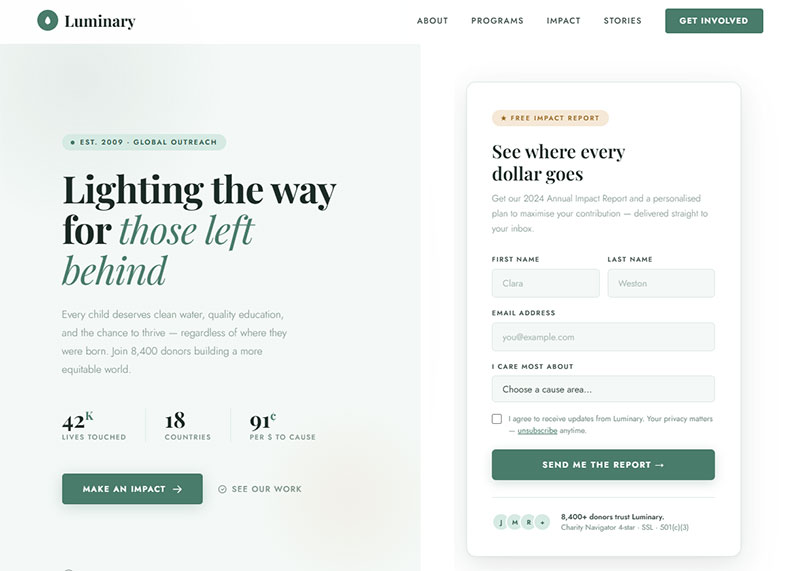
Strip the navigation menu off a page and conversion rate usually goes up, not down. That’s basically the whole trick behind a landing page: one offer, one call to action, one form, and nothing else competing for the click.
A dedicated landing page consistently outperforms a homepage for capture, mainly because it removes every path except signing up. A homepage has to serve investors, job applicants, existing customers, and cold traffic all at once. A landing page only has to serve one of those, which is why it converts better even though it usually looks worse.
To maximize conversions, you should embed forms anywhere on your site where users are most engaged.
Unbounce’s Conversion Benchmark Report (Q4 2024, built on 41,000 landing pages and 464 million visits) puts the median landing page conversion rate at 6.6% across industries. SaaS landing pages sit lower, at a 3.8% median, reflecting longer consideration cycles and higher-friction offers like demo requests (Unbounce, 2024).
A handful of elements show up on nearly every landing page that actually converts:
- A headline that states the offer, not the company tagline
- One form, positioned above the fold
- A single, repeated call to action
- Proof: logos, a testimonial, or a specific number
| Builder | Best For | Standout Feature |
|---|---|---|
| Unbounce | Running A/B tests at scale | Smart Traffic auto-routing |
| Instapage | Matching ad copy to page copy | Dynamic text replacement |
| HubSpot landing pages | Teams already on HubSpot CRM | Native lead scoring handoff |
Seeing real layouts side by side helps more than reading a spec sheet. This set of lead generation form examples covers a wide range of industries and offer types.
Form Design and Field Count

Every field added to a form trades submission volume for lead quality, and there’s no way around that tradeoff, only ways to pick where on it you want to sit.
Shorter forms convert more visitors. A longer form filters out the people who were never going to buy in the first place, which sounds like a loss until you count how much sales time gets wasted chasing the wrong ones. Matching field count to the offer, instead of defaulting to name-email-phone every single time, is covered in more depth in this breakdown of which form fields actually capture higher-quality leads.
General landing page form best practices hold regardless of field count. Clear labels. Inline validation. A submit button that names the actual outcome instead of just saying “Submit.”
What Are Lead Magnets and How Do They Work
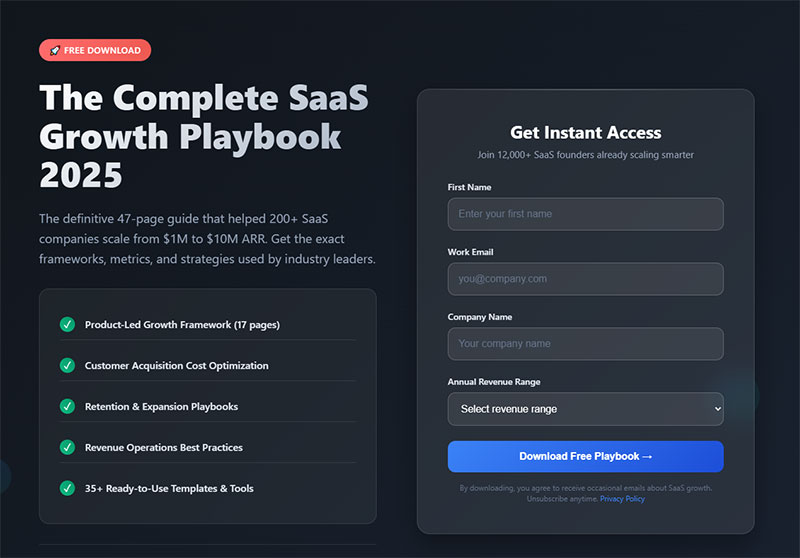
Trade a checklist for an email address and most people will take that deal without thinking twice, assuming the checklist actually solves something. That’s the entire mechanic behind a lead magnet: gated content or a free tool offered in exchange for contact information, built to fix one specific problem for one specific audience rather than trying to be useful to everyone.
Anyone unclear on the mechanics can start with what a lead magnet actually is and how it differs from general content marketing.
NetLine’s 2024 report, built on 6.2 million first-party content registrations, measured a 14.3% year-over-year rise in gated content demand during 2023. Ebooks alone accounted for 39.5% of all gated content requests in that data set (NetLine, 2024).
| Lead Magnet Metric | Figure | Source |
|---|---|---|
| Interactive form conversion rate | 47.3% | Outgrow, 2025 |
| Traditional static form conversion rate | 2.8% | Outgrow, 2025 |
| Ebook share of gated content demand | 39.5% | NetLine, 2024 |
That gap between static and interactive formats explains why quizzes and calculators keep replacing the old default. Browsing the full range of lead magnet types helps match a format to the audience instead of defaulting to another PDF.
Gated Content Versus Open Content
Every gate is a trade. Put content behind a form and reach drops immediately, but now there’s an email address attached to whoever cared enough to fill it out.
Gated content sits behind that form, so nobody reads it without handing over an email first. Ebooks, whitepapers, templates, and webinar recordings almost always live here. Open content works the opposite way. It ranks, gets shared, builds trust over time, and collects no contact information on its own, which covers most blog posts, most video, and any tool with a free tier attached.
Placement decides whether a lead magnet even gets seen. A well-timed popup form triggered on exit intent catches visitors who were already leaving, without interrupting anyone still actually reading.
How Does Email Marketing Generate and Nurture Leads
A welcome email goes out the second someone signs up, then nothing happens for three days, then a case study lands in their inbox right when they’ve mostly forgotten why they subscribed. Good email marketing doesn’t look like that. It moves a captured lead from cold contact toward sales-ready buyer through a sequence that’s actually triggered by what that person does, not just a countdown timer.
Litmus’ 2025 State of Email survey, covering nearly 500 marketing professionals, found email returns $36 for every $1 spent, the highest ROI of any channel marketers track in that report (Litmus, 2025).
Segmentation by behavior, industry, and funnel stage is what actually decides which sequence a contact receives. Skip it and send one blast to everyone, and you’ve thrown away the one advantage email has over every other channel here.
Mailchimp covers entry-level automation well enough for smaller lists that don’t need much branching. ActiveCampaign goes deeper, with behavior-based branching and lead scoring built in. Klaviyo is built specifically around ecommerce and purchase data, so it’s the obvious pick if that’s the business model.
None of this works if the first form is bad. Capture starts the whole sequence, and getting that initial form right matters as much as anything that follows it. Sign up form best practices cover the small stuff, confirmation copy, field order, that quietly affects opt-in rate before a single email even goes out.
Worth keeping straight: a nurture email and a cold outbound email are not the same animal, even though both technically land in an inbox uninvited. Nurture goes to someone who already opted in and expects to hear more. Cold outbound goes to someone who’s never interacted with the brand at all, which is exactly why open rates and reply rates between the two rarely compare directly, people get annoyed by different things. Ready-made lead nurturing templates shortcut the setup for teams building their first sequence.
How Do Webinars and Events Generate Leads

Getting into a webinar means filling out a form first, always. A seat gets traded for contact details before anyone’s confirmed they’ll actually show up, whether it’s a 20-person product demo or a 2,000-person industry event with three sponsors attached.
ON24’s 2026 Digital Engagement Benchmarks Report, based on 2025 platform data, found the average registration-to-attendance conversion rate reached 60%. Average attendance climbed to 239 people per session, an 11% year-over-year increase, with average engagement holding steady at 49 minutes (ON24, 2026).
None of that matters if the form itself is bad. Webinar registration forms need the same care as a landing page form, short, clear, matched to how sales actually plans to follow up, because a sloppy form is the fastest way to turn a good topic into a mediocre attendee list.
| Platform | Best For | Notable Feature |
|---|---|---|
| Zoom Webinar | Teams already on Zoom | Familiar interface, fast setup |
| ON24 | Enterprise engagement tracking | Interactive console with engagement scoring |
| GoToWebinar | Recurring, scheduled series | Automated recurring registration |
Trade shows work through a completely different mechanism: badge scanning, a QR code, or an actual business card dropped in a fishbowl at the booth. A WordPress event registration form covers the pre-event side instead, collecting that same contact and interest data before anyone’s even walked the show floor.
Webinar attendees also tend to convert at a higher rate than someone who just filled out a cold form. Makes sense, sitting through 49 minutes of actual content is a bigger commitment than typing an email into a popup and moving on.
How Does Referral and Partner Marketing Generate Leads
A recommendation from someone you already trust does more work than most ad campaigns, and referral and partner marketing is basically that idea turned into a repeatable system. Someone who already has a relationship with a prospect makes the introduction, and gets a reward or a revenue share in return.
A referred lead shows up with borrowed trust instead of cold skepticism, which is exactly why sales teams tend to prioritize these contacts over anything sourced from a purchased list.
How the incentive gets structured decides participation rate more than any other part of the program design. Some programs run percentage discounts applied to the referrer’s next invoice. Others use account credit that stacks with every successful introduction, or just pay flat cash, more common in B2B affiliate and partner setups specifically.
The global affiliate marketing platform market was valued at $22.58 billion in 2025 and is projected to reach $35.70 billion by 2033 (Grand View Research, 2025), a scale that shows how much revenue now moves through partner channels instead of direct paid acquisition.
| Platform | Best For | Notable Feature |
|---|---|---|
| PartnerStack | SaaS partner and affiliate programs | Automated recurring commission payouts |
| Impact | Enterprise partnership management | Cross-channel partner tracking |
| ShareASale | Ecommerce affiliate networks | Large built-in merchant marketplace |
Co-marketing partnerships, two companies running a joint webinar or a shared guide together, split both the audience and the resulting lead list along whatever rule they agreed on going in, instead of leaning on one brand’s traffic alone.
Tracking runs on referral codes or unique tracked links tied to each referrer, so credit and payout land on the right source even when a lead doesn’t convert for weeks.
What Tools Automate Lead Generation
Nobody should still be copying a lead’s email out of a form notification and pasting it into a spreadsheet in 2026, and yet plenty of teams do exactly that. The tools here exist to automate capture, scoring, and handoff, so a lead moves from form submission to a rep’s queue without a human touching it in between.
CRM platforms hold the system of record everything else in this stack feeds into.
| CRM | Best For | Notable Feature |
|---|---|---|
| Salesforce | Large, complex sales organizations | Deep customization and app ecosystem |
| HubSpot CRM | Marketing and sales on one platform | Free tier with native marketing tools |
| Pipedrive | Small sales teams wanting simplicity | Visual, drag-and-drop pipeline view |
Salesforce holds a 20.0% share of the global CRM market, the largest of any vendor for the 13th consecutive year (IDC, 2025).
Marketing automation platforms sit on top of that CRM layer, running the sequences and scoring rules that decide what a given lead sees next. Marketo handles enterprise-grade workflow branching and account-based campaigns, the kind of setup that usually needs a dedicated ops person to run properly. ActiveCampaign layers automation workflows with lead scoring built in, without quite that level of complexity. HubSpot Marketing Hub‘s real advantage is boring but useful: it shares data natively with HubSpot CRM records, so nothing needs to be synced by hand.
Drift and Intercom handle conversational capture instead, qualifying a visitor through a chat flow before any human joins the conversation.
Data enrichment tools append firmographic detail onto what’s otherwise a bare form submission. Clearbit, ZoomInfo, and Apollo.io’s own contact database fill in company size, industry, and job title automatically the moment an email lands in the CRM.
Routing rules decide who gets a lead next, by territory, deal size, or round robin, so a hot lead doesn’t sit unread in a shared inbox for a day before anyone notices it.
WordPress setups can automate that same capture-to-CRM handoff without any custom development work. A roundup of WordPress lead generation plugins covers which ones sync directly with the platforms listed above.
How Is Lead Quality Scored and Qualified
https://www.youtube.com/watch?v=Kk6Vdfdwmxw&pp=ygUSTGVhZCBRdWFsaXR5IFNjb3Jl
Not every lead deserves the same amount of sales attention, obviously, but plenty of teams treat them that way anyway. Scoring is the fix: points get assigned to specific actions and attributes, then the whole thing runs through a qualification framework before a rep spends real time on any single contact.
Every signal that feeds a score starts as a captured data point, the same kind gathered through website forms built for lead generation, then weighted by how strongly it actually predicts a sale rather than how easy it is to measure.
Marketing Qualified Leads Versus Sales Qualified Leads
An MQL is marketing’s judgment call, not sales’. It means the contact has engaged enough, through content downloads, repeat visits, or a string of email clicks, to be worth a sales conversation, even though nobody’s confirmed budget or timeline yet.
An SQL is a different level of scrutiny entirely. A sales rep has actually vetted the lead by that point, confirming fit, authority, and enough real interest to justify a demo or a proposal.
The handoff between the two should be a formal step, not a vibe. Most teams that get this right define it with an explicit checklist, so marketing and sales agree on what “ready” actually means before a lead moves anywhere.
Lead Scoring Models
Predictive scoring isn’t just theory. Bonterra rebuilt its go-to-market motion around it and saw a 445% year-over-year increase in influenced pipeline (6sense, customer case study), which is the kind of number that gets a CFO’s attention fast.
Once a lead actually reaches a sales rep directly, BANT is still the framework most teams fall back on:
- Budget: can they actually pay for this
- Authority: can this person approve the purchase
- Need: does the problem match what’s being sold
- Timeline: is there a real date driving urgency
Predictive lead scoring exists to filter unqualified contacts out before they ever reach that rep’s queue in the first place. Vendors report meaningful drops in unqualified handoffs once a model’s trained on enough historical data, though “enough” is doing a lot of work in that sentence, it usually means more data than a small sales team has sitting around. Skip this layer entirely and reps end up chasing contacts who were never going to buy, which is a more expensive failure than just missing a lead outright.
What Metrics Measure Lead Generation Performance
Cost per lead looks great on a slide and tells you almost nothing on its own. Real measurement here means tracking cost, conversion, and revenue together, at every stage between that first click and a closed deal, not just the stage that happens to make the number look best.
The average B2B cost per lead sits at $198 across channels, and the average cost per sales-qualified lead reaches $1,357 (FirstPageSage, 2024 B2B Lead Generation Benchmarks Report).
Conversion rate needs to get tracked separately at each stage of the funnel: visitor to lead, lead to MQL, MQL to SQL, SQL to closed deal. Blend all of that into one number and you’ve hidden exactly the stage that’s actually broken.
Lead-to-customer close rate is the metric that catches a program generating volume with no revenue behind it. A channel with a low cost per lead and a weak close rate is often more expensive than it looks sitting on a dashboard.
| Attribution Model | How Credit Is Assigned | Best For |
|---|---|---|
| First-touch | 100% to the first interaction | Short cycles, simple funnels |
| Last-touch | 100% to the final interaction before conversion | Direct-response campaigns |
| Multi-touch | Credit split across every touchpoint | Longer B2B cycles, several channels |
Good reporting tools pull all of this into one place instead of five disconnected spreadsheet exports nobody fully trusts. Google Analytics 4, HubSpot’s native reporting, and Salesforce dashboards can each connect a form fill to downstream revenue, though GA4 takes noticeably more manual event setup to get there than the other two. That setup usually starts with knowing how to track form submissions in Google Analytics, since form completions aren’t captured by default and a lot of teams don’t realize that until months into a campaign.
How Does B2B Lead Generation Differ From B2C
One buyer decides alone in B2C, sometimes in the time it takes to scroll past three more posts. B2B doesn’t work that way at all: a whole group of stakeholders has to reach something like consensus before money moves.
The typical B2B buying decision now involves 13 internal stakeholders and 9 external influencers, a figure that keeps growing for complex or strategic purchases (Forrester, 2026).
On the B2B side, LinkedIn and email dominate outreach, sales cycles stretch out for months, and content leans hard on whitepapers and case studies built for a technical or financial evaluator who’s going to read the whole thing.
B2C flips almost every part of that. Social ads and marketplaces dominate discovery instead, purchase decisions happen in minutes or days rather than months, and content leans on reviews, demos, and social proof aimed at satisfying one person’s immediate want.
The average B2B sales cycle ran 10.1 months in 2025, down from 11.3 months the year before, as economic pressure pushed buyers to engage sellers earlier (6sense, 2025).
Volume and value trade off in opposite directions between the two models. B2C programs chase a high volume of lower-value leads. B2B programs go the other way, chasing a small number of high-value accounts worth pursuing individually, sometimes for months, before a single deal closes.
The mechanics behind capture differ too. Generating B2B leads through website forms usually means longer forms built to qualify a stakeholder’s role and budget upfront. Generating B2C leads through website forms goes the opposite direction, short single-field capture built for speed over qualification, because a B2C buyer will abandon a five-field form without a second thought.
FAQ on Lead Generation Strategies
What Is the Best Lead Generation Strategy for Small Businesses
No single channel wins for every business. Small businesses with tight budgets typically see the fastest return from referral programs and local search, since both lean on existing trust rather than a large paid advertising budget.
How Long Does It Take to See Results From a New Lead Generation Strategy
Paid channels like Google Ads or LinkedIn Ads can produce leads within days. Inbound content and SEO usually take three to six months to gain traction, since organic rankings and traffic compound slowly rather than appearing overnight.
Can Lead Generation Be Fully Automated
Capture, scoring, and routing can run on autopilot through a CRM and marketing automation tools. Strategy, messaging, and relationship-building still need human judgment, especially for outbound personalization and cold email tied to a real trigger.
How Many Leads Does a Business Need Each Month to Hit Its Sales Target
Work backward from the revenue goal: divide it by average deal size, then by the lead-to-customer close rate. A team closing 10% of leads at a $5,000 average deal needs roughly 20 leads per $10,000 in monthly revenue targeted.
What Percentage of Revenue Should Go Toward Lead Generation
Gartner’s 2025 CMO Spend Survey puts average marketing budgets at 7.7% of company revenue. Lead generation usually draws a meaningful share of that total, especially paid media, though early-stage companies often spend a higher percentage to build initial pipeline.
Do Lead Generation Strategies Work for Local Businesses
Yes, though the channel mix shifts. Local businesses see stronger results from Google Business Profile optimization, local SEO, and referral programs than from broad content marketing built for a national, faceless audience.
How Often Should a Lead Magnet Be Refreshed
Every 12 to 18 months at minimum, sooner if the data, tools, or examples inside go stale. An outdated lead magnet still collects emails, but it damages trust the moment a prospect opens it and notices.
Can Social Media Alone Generate Qualified B2B Leads
Rarely on its own. Social platforms build awareness and warm an audience, but B2B buyers still convert through a landing page, a form, or a direct message, not a like or a share.
What Is the Difference Between Lead Generation and Sales Prospecting
Lead generation attracts and captures contact details at scale, often through marketing channels. Prospecting is a sales-led activity: a rep manually researches and reaches out to specific accounts that fit a target profile, one at a time.
How Do You Generate Leads Without a Website
A website helps, but it isn’t required to start. LinkedIn outreach, in-person referrals, marketplace listings, and a simple landing page hosted through a form tool can all capture contact details before a full site exists.
Conclusion
Most teams don’t fail at lead generation strategies by picking the wrong channel. They fail by running five channels at once with no baseline to judge any of them against, so nothing ever really gets fixed because nobody can tell what’s actually broken.
Start with one landing page and one traffic source. Fix the form, the offer, and the follow-up sequence before adding a second channel, because a messy multi-channel launch hides exactly which lever moved the needle, and that’s the mistake actually worth avoiding.
Once conversion rate optimization stabilizes on that single page, layer in lead scoring and a nurture sequence. Then expand into outbound or referral programs, but only once there’s a working benchmark in hand to compare against.
Expect the first 90 days to produce more data than revenue. That’s normal. It’s also the input every later budget decision ends up depending on, whether anyone planned it that way or not.