




Gallup’s 2024 data shows only 31% of U.S. employees feel engaged at work. Annual surveys can’t catch that kind of decline fast enough. Pulse surveys can. These short, frequent questionnaires…
Table of Contents
A messy order process costs you money before you even notice it. Missed items, wrong quantities, confused customers, double entries.
Order form templates fix that by giving every transaction a clear, repeatable structure. Whether you’re processing sales orders in Microsoft Excel, collecting bulk orders through Google Forms, or running a digital checkout with Stripe or PayPal, the right template keeps things accurate and fast.
This guide covers the components of a solid order form, the different types (sales, purchase, wholesale, food, custom product), how to build one from scratch, and the design practices that actually reduce errors and improve completion rates.
What Is an Order Form Template
An order form template is a pre-structured document that businesses use to collect buyer details, product selections, quantities, pricing, and payment terms during a purchase transaction.
Think of it as the backbone of any sales workflow. Whether you’re running a retail shop, a wholesale distribution company, or a catering business, you’re using some version of this document every single day.
The format varies. Some are printable order forms on paper. Others are fillable PDF files or digital order forms built with tools like Google Forms, Jotform, or Typeform.
What stays consistent is the function: standardize how orders come in, reduce manual errors, and speed up fulfillment.
B2B transactions rely heavily on structured purchase order documents to keep accounting clean. Small businesses often start with a simple order form in Microsoft Word or Google Docs before graduating to something more robust.
A well-built order form template also doubles as a record. It captures the who, what, how many, and how much in one place. That’s useful for inventory tracking, customer disputes, and tax season.
The key difference between a generic website form and a proper order form? Structure. Order forms follow a specific sequence: customer info, line items, totals, terms. Skip a section or jumble the order, and you’ll create confusion on both sides of the transaction.
Order Form Templates
Premium Single Product Order Form
See the Pen
Premium Single Product Order Form by Bogdan Sandu (@bogdansandu)
on CodePen.
A sophisticated, conversion-focused product order form built with vanilla HTML, CSS, and JavaScript. Features a contemporary glassmorphism design with smooth animations and premium UX patterns.
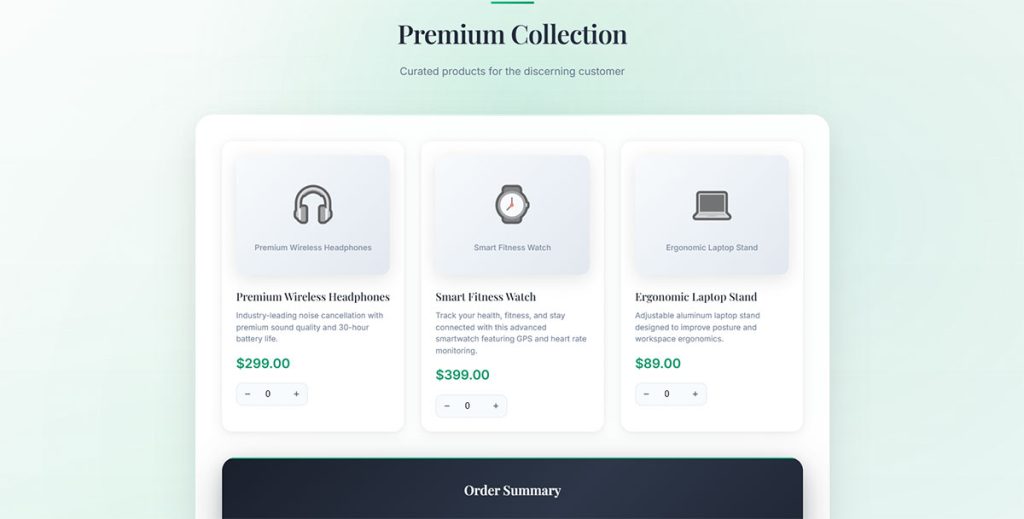
Premium E-commerce Order Form
See the Pen
Premium E-commerce Order Form by Bogdan Sandu (@bogdansandu)
on CodePen.
A sophisticated, fully-functional e-commerce order form featuring:
Design highlights:
– Glassmorphism & backdrop blur effects
– Multi-layered gradient backgrounds
– Custom typography (Inter + Playfair Display)
– Elegant green color palette (#10b981)
– Professional product placeholders with icons
Aurora Headphones Pre-Order Form
See the Pen
Aurora Headphones Pre-Order Form by Bogdan Sandu (@bogdansandu)
on CodePen.
A sleek, conversion-optimized pre-order form built with vanilla HTML, CSS, and JavaScript. Showcases a bold product highlight section, responsive layout, and intuitive input fields designed for a seamless checkout experience.
Wholesale Order Form UI
See the Pen
Wholesale Order Form UI by Bogdan Sandu (@bogdansandu)
on CodePen.
A professional, conversion-focused wholesale order form built with vanilla HTML, CSS, and JavaScript. Features a clean, business-ready layout with dynamic product selection, real-time order summaries, and responsive design for a seamless bulk ordering experience.
Modern Product Order Form
See the Pen
Modern Product Order Form by Bogdan Sandu (@bogdansandu)
on CodePen.
A stylish, user-friendly product order form built with vanilla HTML, CSS, and JavaScript. Features an interactive product selection grid with prices and descriptions, a dynamic order summary that updates in real time, and a clean delivery information section. Designed with responsive layouts and smooth UX patterns for fast, hassle-free online ordering.
Modern Service Request Form
See the Pen
Modern Service Request Form by Bogdan Sandu (@bogdansandu)
on CodePen.
A sophisticated, fully-functional service booking form featuring cutting-edge glassmorphism design principles and smooth micro-interactions. Perfect for home service businesses like plumbing, cleaning, electrical work, and more.
Premium Consultation Booking Form
See the Pen
Premium Consultation Booking Form by Bogdan Sandu (@bogdansandu)
on CodePen.
A sophisticated, professional booking form designed for consultancy services and premium businesses. Features a warm, earth-toned color palette that breaks away from typical blue/purple gradients, creating a unique and memorable user experience.
Premium Freelance Service Order Form
See the Pen
Premium Freelance Service Order Form by Bogdan Sandu (@bogdansandu)
on CodePen.
A stunning, modern freelance service order form built with vanilla HTML, CSS, and JavaScript. Features sophisticated animations, glassmorphism design, and premium UX patterns that create an engaging user experience.
Premium Custom Artwork Order Form
See the Pen
Premium Custom Artwork Order Form by Bogdan Sandu (@bogdansandu)
on CodePen.
A sophisticated, fully-functional artwork ordering form featuring cutting-edge glassmorphism design principles and premium UX patterns. Built with vanilla HTML, CSS, and JavaScript – no frameworks required.
SaaS Trial to Paid Upgrade Form
See the Pen
SaaS Trial to Paid Upgrade Form by Bogdan Sandu (@bogdansandu)
on CodePen.
A sophisticated, conversion-optimized upgrade form designed for SaaS platforms transitioning users from free trials to paid subscriptions. This form combines modern web design principles with psychological conversion tactics to maximize upgrade rates.
What Are the Components of an Order Form Template
Every order form template, regardless of industry, shares a set of core sections. The layout and the number of form fields change depending on the business, but the building blocks stay the same.
What Information Does the Buyer Section Include
Buyer name, company name (for B2B), billing address, shipping address, phone number, and email. For repeat customers, pre-filled fields from a CRM like Salesforce or HubSpot cut this step down significantly.
What Fields Does the Product or Service Section Contain
This is where the actual order lives. Item description, SKU or product code, unit price, quantity, and line item total.
A pricing table format works best here. Clean rows, clear columns. If you’re using Microsoft Excel or Google Sheets, built-in formulas handle the math automatically.
How Are Payment Terms Displayed on an Order Form
Payment method (credit card, bank transfer, PayPal, Stripe), due date, tax calculation, subtotal, shipping cost, and grand total. Wholesale order sheets often include deposit requirements and bulk pricing tiers.
For online order forms, connecting to a WordPress payment form setup or a payment gateway like Square keeps the checkout process smooth.
What Role Does the Terms and Conditions Section Play
Return policy, cancellation terms, delivery timeframe, warranty details, and a signature line. Skipping this section is one of the most common mistakes in order form design.
If you’re collecting personal data, your form also needs to be compliant with data protection regulations. Building GDPR compliant forms is not optional for businesses operating in or selling to the EU.
What Are the Different Types of Order Form Templates
Not all order forms do the same job. The type you pick depends on your industry, your sales model, and whether you’re selling products, services, or both.
What Is a Sales Order Form Template
A sales order form documents a confirmed customer purchase. It’s created after the buyer agrees to buy, usually by a sales rep.
Typical fields include sales representative info, customer account number, itemized pricing with discount codes, and a delivery date. Most order management systems like QuickBooks or Zoho generate these automatically.
What Is a Purchase Order Form Template
A purchase order goes the other direction. The buyer issues it to a supplier to authorize a purchase.
It includes a PO number, vendor details, requested delivery date, and an approved budget. Purchase orders are standard in construction, manufacturing, and government procurement. They’re a legal commitment.
What Is a Work Order Form Template
Work order forms are used in maintenance, repair, and field service operations. Think HVAC companies, property management firms, IT support teams.
The form covers the job description, assigned technician, materials needed, labor cost estimate, and completion status. These are often built as multi-step forms to separate the request phase from the execution phase.
What Is a Wholesale Order Form Template
Built for bulk orders between manufacturers, distributors, and retailers. Minimum order quantities, case or pallet counts, and tiered pricing are the defining fields.
A wholesale order sheet in Excel with auto-calculation formulas saves hours of manual entry. Most distributors keep a product catalog linked directly to the form.
What Is a Food Order Form Template
Restaurants, catering companies, and food service businesses use these daily. Menu items, portion sizes, dietary restrictions, delivery or pickup selection, and special instructions are the core fields.
Food order forms for events often include a section for table assignments and serving times. Took me a while to realize that the best food order forms are the ones that look like menus, not spreadsheets.
What Is a Custom Product Order Form Template
For businesses offering personalized or made-to-order products. Engraving text, color options, material preferences, size selections, and upload fields for reference images.
If your custom order form needs file attachments, a WordPress form with file upload capability handles that without extra development work.
What Is an Online Order Form Template
A digital order form built specifically for e-commerce and web-based businesses. It integrates with payment gateways, shopping carts, email autoresponders, and CRM systems.
Online form builders like Jotform, Typeform, Cognito Forms, and 123 Form Builder make it possible to create these without coding. WordPress forms are another popular route, especially with plugins like Gravity Forms or WPForms.
The big advantage of digital over paper? Conditional logic. Show or hide fields based on what the buyer selects. If someone picks “wholesale,” the form reveals bulk pricing tiers. If they choose “single item,” it stays simple.
Beyond these e-commerce examples, our broader form templates library includes dozens of other templates.
How to Create an Order Form Template
Building a solid order form template is not complicated, but getting the details right matters more than most people think. Here’s how to approach it step by step.
How Do You Define the Purpose of Your Order Form
Start with the transaction type. Are you selling physical products, digital services, or subscriptions? A merchandise order form for a clothing brand looks nothing like a service order form for a consulting firm.
Match the form structure to your actual order workflow. If your business handles both one-time purchases and recurring orders, you probably need two separate templates.
How Do You Choose the Right Format for Your Order Form
Paper forms still work for trade shows and in-person sales. But for most businesses in 2026, digital is the default.
Your options:
- PDF (Adobe Acrobat) for print-ready, fixed-layout forms
- Excel or Google Sheets for forms that need auto-calculations
- Word or Google Docs for simple, text-based order request sheets
- Web-based form builders (Jotform, Typeform, Gravity Forms) for real-time submissions and payment integration
If you’re running a WordPress site, free WordPress form plugins can get you started without any upfront cost.
How Do You Structure the Layout and Field Order
Logical flow matters. Buyer info first, then line items, then totals, then terms. That’s the sequence people expect, and breaking it confuses buyers.
Use tables for itemized product lists. Clear section labels. Plenty of whitespace. Good form design is about reducing the mental effort it takes to fill something out.
Avoid cramming 30 fields onto one screen. If your order form gets long, break it into steps. A multi-step form template keeps the experience manageable and improves completion rates.
How Do You Add Calculation Fields for Pricing
Subtotal, tax percentage, shipping cost, discount, grand total. These five fields handle 90% of order form math.
In Excel and Google Sheets, use formulas like =quantity*unit_price for each line item. Web-based form builders handle this with built-in calculation widgets.
Static PDF forms can’t auto-calculate (unless you use Adobe Acrobat’s form field scripting). That’s a real limitation if your orders have variable pricing.
How Do You Include Branding on Your Order Form
Company logo at the top. Brand colors in the header and section dividers. Business contact details, registration number, and website URL in the footer.
Canva is a quick option for designing branded PDF order forms. For web-based forms, most builders let you customize colors, fonts, and add logo uploads. Your order form is a touchpoint. It should look like it belongs to your brand, not like a generic blank template pulled from a random site.
What Are the Best Practices for Order Form Templates
A form that works and a form that works well are two different things. These practices close that gap.
How Does Keeping Forms Simple Reduce Order Errors
Every extra field is another place for mistakes. Ask only for what you actually need to process the order.
Clear labels, consistent formatting, and logical field grouping do more for accuracy than any validation script. If a buyer has to guess what a field means, your form needs editing. Following web form best practices goes a long way here.
Why Is Mobile Compatibility Important for Order Forms
More than half of web traffic comes from phones. If your order form doesn’t render properly on a 6-inch screen, you’re losing orders.
Responsive layouts, large tap targets, and single-column designs are non-negotiable for mobile forms. Test on actual devices, not just browser resize.
How Does Adding Confirmation Steps Improve Accuracy
A review page before final submission catches mistakes that individual field validation misses. Show the full order summary, let the buyer confirm, then process.
After submission, send a form submission confirmation message by email. It reassures the buyer and creates a paper trail for both sides.
How Do Pre-filled Fields Speed Up Repeat Orders
Returning customers don’t want to type their address every time. Saved addresses, default payment methods, and customer account data pulled from your CRM make reordering fast.
This is where connecting your order form to systems like Salesforce, HubSpot, or Zoho through Zapier pays off. Less friction, more repeat business. If you’re focused on increasing form conversions, pre-filled fields are one of the easiest wins.
FAQ on Order Form Templates
What is an order form template?
An order form template is a pre-built document that collects buyer details, product selections, quantities, and payment information during a purchase. Businesses use them in PDF, Excel, Google Sheets, or web-based formats to standardize order collection and reduce processing errors.
What should an order form template include?
Every order form needs a buyer information section, an itemized product or service list with pricing, a payment terms area, and a terms and conditions section. Tax calculation fields and a signature line are also standard components.
How do I create an order form template for free?
Use Google Forms, Google Docs, or Google Sheets for a free digital order form. Microsoft Word and Excel also work. For more features like payment integration, Jotform and Cognito Forms offer free tiers with basic functionality.
What is the difference between a sales order and a purchase order form?
A sales order form is created by the seller to confirm a customer’s purchase. A purchase order form is issued by the buyer to authorize a transaction with a supplier. They move in opposite directions within the same workflow.
Can I use an order form template for online sales?
Yes. Online order form templates built with tools like Typeform, Jotform, or Gravity Forms integrate directly with payment gateways such as Stripe, PayPal, and Square. They support real-time submissions and automated email confirmations.
What is the best file format for an order form template?
It depends on the use case. PDF works for print-ready forms. Excel and Google Sheets handle auto-calculations well. Web-based forms built through WordPress or form builder software are best for digital submissions and CRM integration.
How do I make my order form mobile-friendly?
Use a single-column layout, large tap targets, and responsive design. Web-based form builders like Typeform and Jotform handle this automatically. If you’re building a custom form, test it on actual phones and tablets before going live.
How do I add automatic calculations to an order form?
In Excel or Google Sheets, use formulas to multiply quantity by unit price for each line item. Web-based form builders include built-in calculation widgets for subtotals, tax, shipping, discounts, and grand totals without any coding.
What types of businesses use order form templates?
Retail stores, wholesale distributors, restaurants, catering companies, construction firms, healthcare suppliers, and educational institutions all use them. Any business that processes product or service orders benefits from a structured order form template.
How do I reduce errors on my order form?
Keep it simple. Use clear field labels, logical section order, and required field markers. Add a review step before final submission. For digital forms, form validation rules catch typos, missing data, and incorrect formats automatically.
Conclusion
The right order form template removes guesswork from every transaction. It gives your buyers a clear path from product selection to payment, and gives your team clean data to work with on the fulfillment side.
Whether you’re building a fillable PDF in Adobe Acrobat, setting up an editable order form in Google Sheets, or connecting a web-based form to your Shopify or WooCommerce store, the structure stays the same. Buyer info, line items, totals, terms.
Don’t overcomplicate it. Start with a blank order form that matches your sales model. Add branding, calculation fields, and a checkout process that works on mobile.
Then test it. Get a real customer to fill it out. Watch where they hesitate. That’s where your form needs work.
A good order entry form doesn’t just collect data. It builds trust, speeds up order fulfillment, and cuts down on back-and-forth that slows your entire supply chain documentation process.