




Most lead magnets don’t work. They get downloaded, skimmed for 30 seconds, and forgotten. Meanwhile, your email list fills up with people who will never buy anything. The problem isn’t…
Table of Contents
63% of roofing business owners say generating new leads is their biggest growth challenge.
Without a steady pipeline of qualified prospects, even the best roofing contractors plateau. Or worse, shrink.
Lead generation for roofing has shifted dramatically. Homeowners search Google before asking neighbors. They read reviews before returning calls. Storm chasers compete with digital marketers for the same roof repair jobs.
The roofers winning today combine traditional methods (referrals, door knocking) with modern digital channels (local SEO, Google Ads, Facebook Lead Ads).
This guide breaks down what actually works. You’ll learn cost benchmarks by channel, conversion rate expectations, website elements that capture leads, and which strategy combinations fit your budget.
No fluff. Just the tactics top roofing companies use to keep their phones ringing.
What is Roofing Lead Generation
Roofing lead generation is the process of attracting homeowners and property managers who need roof repair, replacement, or inspection services.
It turns strangers into prospects through marketing channels, website inquiries, and referral systems.
The goal? Get qualified contacts into your sales pipeline before competitors do.
Types of Roofing Leads
Residential roofing leads come from homeowners dealing with leaks, storm damage, or aging shingles.
Commercial roofing prospects typically involve property managers, building owners, and facility directors needing TPO, EPDM, or flat roof services.
Storm damage leads and insurance claim roofing jobs often convert faster because urgency drives the decision.
The Sales Cycle Connection
A roofing sales funnel moves prospects from initial awareness through estimate request to signed contract.
Most residential jobs close within 2-4 weeks. Commercial projects stretch longer due to bidding processes and approval chains.
Your lead generation funnel should match these timelines with appropriate follow-up sequences.
How Does Lead Generation Work for Roofing Companies
Lead generation for roofing contractors works by placing your business in front of property owners actively searching for roof services, then capturing their contact information through forms, calls, or chat.
Research from Forrester shows modern buyers complete 66% to 90% of their purchasing journey before ever contacting a contractor. Your visibility in those early stages makes or breaks your lead pipeline.
The Process Flow
Homeowner notices a problem (missing shingles, water stain, hail damage).
They search Google for “roof repair near me” or “roofing contractor” in their city.
Your website, Google Business Profile, or paid ad appears. They click.
A lead generation form or phone call captures their information.
Conversion Paths
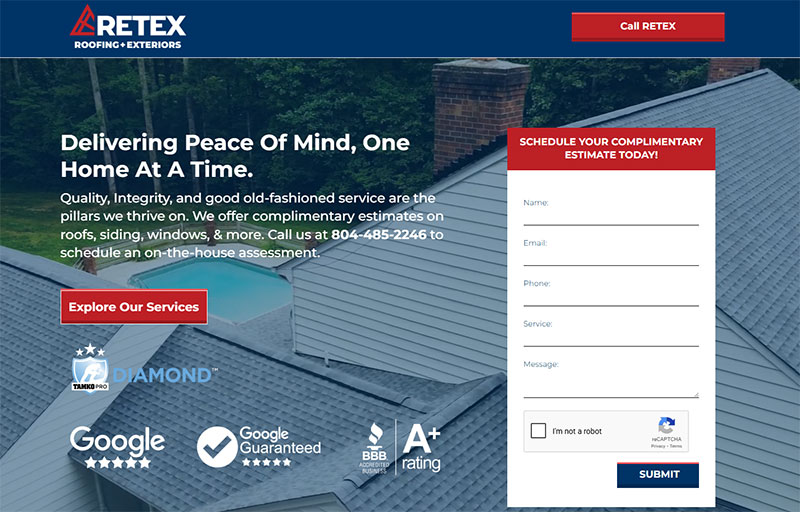
Phone calls remain the highest-intent conversion for roofing. Industry data from Invoca shows that calls convert at rates up to 46% when handled properly.
Speed matters. Contractors who respond within 5 minutes are 21 times more likely to qualify the lead than those who wait 30 minutes.
27% of calls to home services companies go unanswered, according to Invoca platform data. Each missed call is lost revenue.
Form fills work well for estimate requests and roof inspection bookings where urgency is lower. Landing pages targeting 10% to 15% conversion rates typically succeed, while average roofing conversion rates hover around 10%.
Live chat and chatbots capture after-hours inquiries when your office is closed. Data from TransUnion shows 79% of consumers still consider phone important for business communications, but 41% prefer SMS to book their first appointment.
Lead Qualification Criteria
Not every inquiry becomes a job. The average close rate for roofing companies is 27%, though top performers exceed this benchmark significantly.
Referral leads close at over 50%, while non-referral leads convert around 30%. According to Roofing by the Numbers 2025, 71% of roofers rely on word-of-mouth referrals as their main source of new business.
Key qualification points:
- Property ownership verification (renters can’t authorize roof work)
- Roof age and material type
- Service area confirmation
- Timeline and budget expectations
- Insurance involvement for storm damage claims
Using the right form fields for capturing high-quality leads filters out tire-kickers early.
Lead Source Performance Tracking
Monitor conversion rates by source. You might close 40% of leads from one channel but only 10% from another.
Google Ads leads average $187 per lead for roofing (the highest in home services). Cost per click ranges from $15 to $20 in small markets and $50 to $100 in major metros.
Digital door knocking costs $3 to $5 per lead. Traditional canvassing converts 1 in 10 to 15 homes into inspection appointments, jumping to 30% to 50% after storms.
Industry research shows only 28% of roofers use a CRM to track leads. Those who adopted CRM plus marketing automation reported generating 2x more leads year-over-year.
What Are the Cost Benchmarks for Roofing Leads
Roofing companies face some of the highest customer acquisition costs in home services, with Google Ads leads averaging $187 per lead according to recent industry data.
Average Cost Per Lead by Channel
| Channel | Cost Per Lead (CPL) | Notes |
| Google Ads (Search) | $70 – $250+ | High intent; costs vary by industry (e.g., Legal/Home Services are $130+). |
| Facebook Ads (Meta) | $25 – $95 | Demand creation; cheaper volume but requires more nurturing/follow-up. |
| Local Services Ads | $30 – $150 | Pay-per-lead; highly reliable for local contractors; Google Screened. |
| Third-Party Lead Gen | $15 – $90 | Shared leads are cheaper ($15-$40); exclusive leads/calls cost $60-$100+. |
| Organic SEO | $15 – $45 | Lowest blended CPL over time; requires 6+ months of upfront investment. |
| Referrals | $0 – $30 | Highest conversion rate; cost is usually a small reward or gift card. |
Conversion Rate Benchmarks
Referral leads close at 50%+ rates. Non-referral leads average around 30%.
This gap explains why word-of-mouth remains the gold standard despite digital marketing growth.
Your conversion rate benchmarks should account for lead source when measuring performance.
ROI Calculations
Average residential roof replacement runs $8,000-$15,000. Commercial jobs go higher.
At a $200 cost per lead and 25% close rate, you spend $800 to acquire an $8,000+ job.
That math works. But it falls apart fast if your close rate drops or lead quality tanks.
Which Digital Marketing Channels Generate Roofing Leads
Digital channels now drive the majority of roofing leads. Research from Roofing by the Numbers 2025 shows 63% of roofing business owners cite lead generation as their top growth challenge.
90% of homeowners use Google before choosing a roofer. Top 3 Google Maps results capture over 70% of calls.
How Does Local SEO Attract Roofing Customers
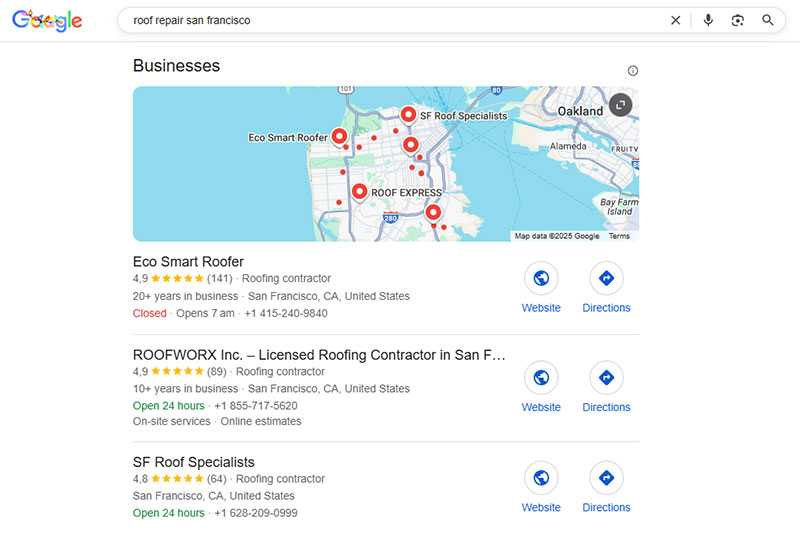
Local SEO positions your roofing company in the Google Map 3-Pack when homeowners search “roofers near me” or “roof repair [city name].”
This organic visibility costs nothing per click once you rank. 76% of people who search for something nearby on smartphones visit a business within a day.
Google Business Profile Optimization
Claim and verify your listing. Add photos of completed roof projects, your team, and equipment.
Keep NAP (name, address, phone) consistent across all directories. Respond to every review within 24-48 hours.
Data from 2024 shows 81% of customers read Google reviews when evaluating local businesses. 21% of customers find local businesses through Google.
Local Keyword Targeting
Target service + location combinations: “roof replacement Dallas,” “emergency roof repair Houston,” “commercial roofing Austin.”
Create dedicated landing page forms for each major service area.
Review Acquisition
Reviews directly impact local pack rankings. Ask every satisfied customer.
Research shows that 71% of roofers rely on word-of-mouth referrals. Online reviews are the digital version of that same trust signal.
Roofers who ask for reviews average 500+ jobs per year, compared to just 100 for those who don’t. That’s a fivefold difference in booked jobs.
Timeline Expectations
An Ahrefs survey of SEO professionals shows SEO takes 3 to 6 months to yield results. Local pack rankings can improve in 4 to 8 weeks with consistent Google Business Profile activity.
Budget accordingly. Once ranking, leads flow without ongoing ad spend, yielding the lowest long-term cost per lead.
What Role Does Google Ads Play in Roofing Lead Generation

Google Ads puts your roofing company at the top of search results immediately, bypassing the SEO timeline.
You pay per click. Data from LocaliQ shows the average cost per click for roofing is $10.70, with some campaigns reaching $54+ in ultra-competitive segments. AgencyAnalytics data shows median roofing CPC at $8.57, nearly five times the industry average.
Average cost per lead for roofing sits at $228.15 according to 2025 LocaliQ benchmarks (the highest in home services). Cost per lead ranges from $150 to $300 for qualified leads, though some markets see costs between $175 to $220.
Local Services Ads for Roofers
Google Local Services Ads appear above standard search ads with a “Google Guaranteed” badge.
You pay per lead, not per click. Leads come as phone calls or messages directly through Google.
Search Campaign Structure
Organize campaigns by service type: roof repair, roof replacement, storm damage, commercial roofing.
Use location targeting to stay within your service radius. Exclude areas you don’t serve.
Data shows roofing conversion rates from search ads typically hover around 10%, with best-in-class campaigns reaching 15%. The average click-through rate is 3.70%.
Landing Page Requirements
Each ad group needs a dedicated landing page with matching messaging.
Include a clear headline, trust signals (licenses, insurance, reviews), and a prominent contact form above the fold.
Fast load times matter. Landing pages loading under 2 seconds convert up to 50% better than those taking 5 seconds. Pages loading under 3 seconds see 2x higher conversion rates.
How Do Social Media Ads Work for Roofers
Facebook and Instagram ads reach homeowners before they start searching, building awareness and capturing early-stage interest.
ServiceTitan data from October 2024 shows lead generation ads cost around $3.06 per lead. WordStream benchmarks put the average Facebook CPL at $21.98 across industries (substantially lower than Google Ads’ $66.69).
Cost per lead runs lower than Google ($30 to $80) but intent is also lower. Case studies show successful campaigns generating leads for $10 to $40 per lead.
Facebook Lead Ads
Facebook Lead Ads let users submit contact info without leaving the platform.
Forms pre-populate with name, email, and phone from their profile. Friction drops. Submissions increase.
Research shows landing pages with personalized content generate about 75% more click-throughs. The average conversion rate for Facebook ads across industries is 8.78%.
Audience Targeting
Target by location radius, homeowner status, home value, and age demographics.
Custom audiences retarget website visitors. Lookalike audiences find similar homeowners.
57% of marketers are investing in Facebook in 2024. It generates the highest ROI (tied with Instagram) compared to other social platforms.
Retargeting Strategies
Someone visited your roof replacement page but didn’t call? Show them ads for the next 30 days.
Retargeting converts warm traffic that wasn’t ready on first visit. The average cost per click for Facebook is $1.92 for lead campaigns (compared to $5.26 in Google Ads).
What Traditional Methods Generate Roofing Leads
Digital dominates the conversation, but traditional lead generation strategies still drive significant business for roofing contractors. The most successful companies layer both approaches.
How Effective Are Referrals for Roofing Companies
Referrals remain the most effective lead source in roofing. Period.
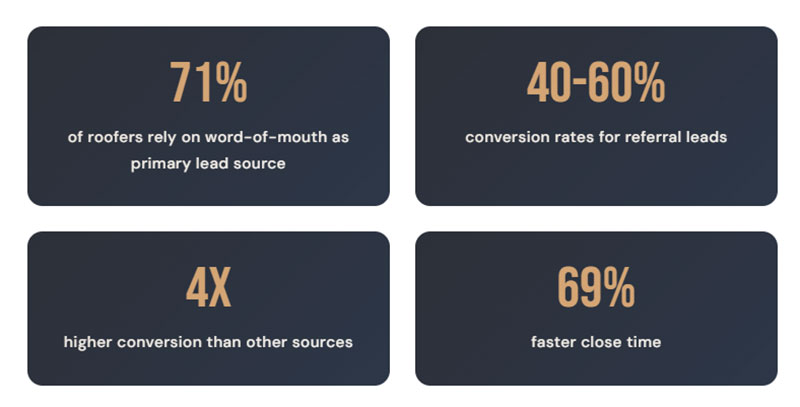
Roofing by the Numbers 2025 found 71% of roofers rely on word-of-mouth from past customers as their primary lead source. Over 60% of companies report at least 25% of customers come from referrals, with top performers generating 75%+ through this channel.
Referral Closing Rates
The numbers speak for themselves:
- 40-60% conversion rates for referral leads (gFour Marketing)
- 30% conversion rate for non-referral leads
- 4x higher conversion than other sources (ReferralRock)
- 69% faster close time (ProLine Roofing CRM)
Trust transfers from the person recommending you. Nielsen reports 92% of consumers trust recommendations from friends and family more than any advertising.
Referral Program Structures
Cash and incentives:
- Offer $100-$500 for successful referrals
- Some roofers donate to charity in the customer’s name
Timing matters:
- Ask at project completion when satisfaction peaks
- Follow up 6-12 months later for neighbor work
Here’s the gap: 83% of customers are willing to refer after a positive experience, but only 29% actually do without prompting.
The long-term value:
According to referral marketing research, referred customers have 16% higher lifetime value and 37% higher retention rates than non-referred customers.
Partner Referrals
Build relationships with insurance agents, real estate agents, and home inspectors. These professionals encounter homeowners needing roofs constantly.
Word-of-mouth marketing generates more than twice the sales of paid advertising. Businesses with formalized referral programs see 30% higher conversion rates and 54% lower cost per lead than other channels.
What is Storm Chasing in Roofing Lead Generation
Storm chasing involves tracking severe weather events and canvassing affected neighborhoods for hail and wind damage leads.
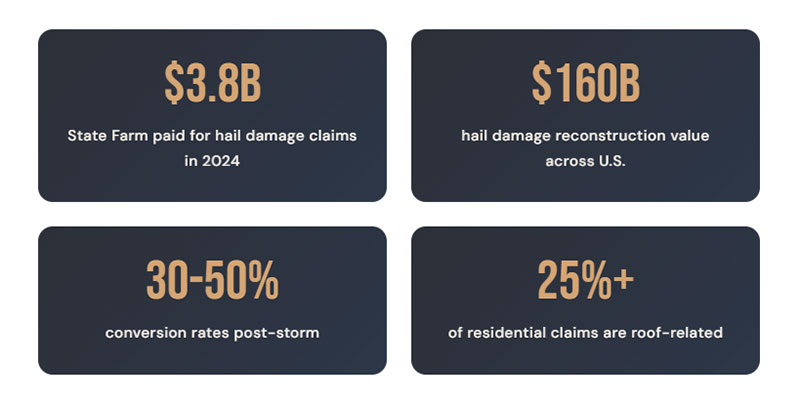
The opportunity is massive. State Farm paid $3.8 billion for hail damage claims in 2024 alone. The Insurance Information Institute shows hail damage costing approximately $160 billion in reconstruction value across the U.S.
Controversial among some contractors, but undeniably effective when done ethically.
Conversion rates:
- Normal canvassing: 1 in 10-15 homes convert to inspection appointments
- Post-storm situations: 30-50% conversion rates (GlassHouse)
Tracking Methods
Weather apps and hail tracking websites alert you to storms in your service area. Arrive quickly after the event. Homeowners dealing with fresh damage are motivated buyers.
Insurance Claim Connection
Storm damage jobs often go through homeowner’s insurance. Learn the claims process inside out.
Helping homeowners navigate insurance builds trust and differentiates you from competitors. Roof-related claims accounted for over 25% of all residential claim value in 2024, with wind and hail driving more than half of all claims (Fixr).
How Does Door-to-Door Canvassing Perform for Roofers

76% of roofing companies still use door-to-door canvassing in some form.
The global door-to-door market hit $200.14 billion in 2024 and is growing 6.4% annually through 2030 (Grand View Research). Door-to-door sales generate approximately $30 billion yearly.
Old school? Yes. Dead? Not even close.
Target Neighborhood Identification
Focus on neighborhoods with aging roofs (15-20+ years old) or recent storm activity. Drive-by inspections identify visible damage: missing shingles, sagging sections, moss growth.
The U.S. roofing repair market reached $15.72 billion in 2023, projected to grow to $21.7 billion by 2030 at 4.5% annually (Knockio).
Conversion Expectations
The math requires volume:
- 2-3% conversion rate on cold door knocks (Knockio)
- 1 lead per 50 knocks for top performers (GlassHouse)
- 100 doors = 1-3 estimates = typically 1 closed job
Cost comparison:
- Door-to-door: $3-5 per lead (mainly labor costs)
- Google Ads: $150+ per lead
Research shows door-to-door has a 1 in 14 transformation rate, compared to 1 in 38 for phone calls and 1 in 100,000 for emails or social media (Gerber & Green, Field Experiments study).
Combine canvassing with generating leads for your business through digital channels for a balanced approach.
How Do Roofing Lead Generation Companies Operate
Third-party lead providers like Service Direct, CraftJack, HomeAdvisor, and Angi sell roofing contractor leads through pay-per-lead models.
You pay per contact, not per click. The average roofing lead costs $20 to $200 depending on service type and exclusivity (LettrLabs).
Exclusive vs Shared Leads
Exclusive roofing leads go to one contractor only. Higher cost, better conversion.
Shared leads get sold to 3-5 competing roofers simultaneously. Cheaper upfront, but you’re racing to respond first.
The numbers:
- Exclusive leads: Higher end of pricing spectrum, better ROI
- Shared leads: $75-$150 per lead (Improve & Grow)
- Contact rate: 70-80% of purchased leads reached (Fixr)
- Appointment set rate: 20-35% convert to in-home appointments
- Close rate: 3-8% of leads become paying jobs
Pay-Per-Lead Pricing Structures
Most platforms let you set budgets, pause campaigns, and adjust pricing by service area.
Platform pricing examples:
- 99Calls: $49 organic leads (Roofing Webmasters)
- CraftJack: $13-$72 average (faster response = discount)
- Google Local Services Ads: $75-$150 per qualified call (Inquirly)
- Service Direct: Varies by market competitiveness
RoofClaim offers $99 exclusive leads and has helped roofers sell over 10,000 jobs across eleven states.
DIY vs Third-Party Comparison
Building your own website forms for lead generation costs more upfront but eliminates ongoing per-lead fees.
Long-term cost perspective:
- SEO-generated leads: Lowest cost per lead long-term
- Google Ads: $187 average per lead (GlassHouse), highest in home services
- Digital door knocking: $3-5 per lead
- Third-party platforms: $150-$300 for quality leads (Contractor Marketing Pros)
Third-party leads work for quick volume. Owned channels build long-term equity.
The most successful roofing companies use both, shifting budget based on seasonal demand. Industry data shows the construction/home improvement average customer acquisition cost sits around $610 (GlassHouse).
What Website Elements Convert Roofing Visitors into Leads
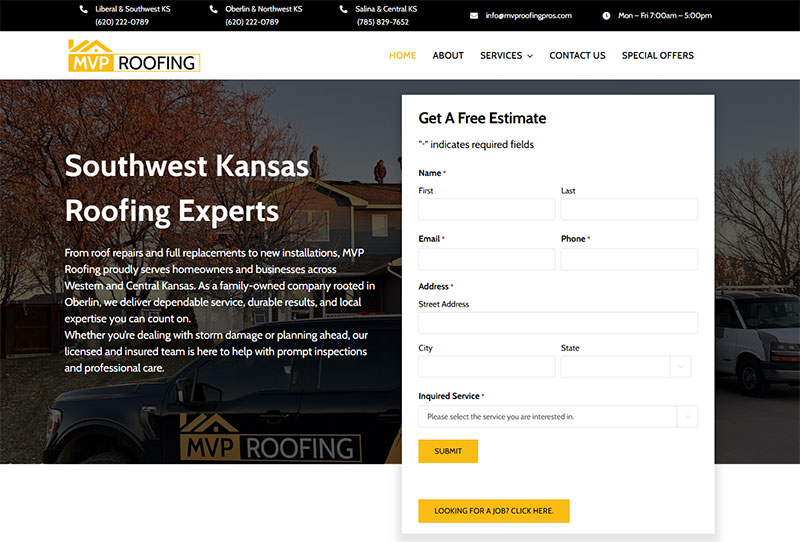
Your website is a 24/7 salesperson. If it loads slow or looks outdated, homeowners bounce to competitors.
Mobile-First Design Requirements
Over 55% of people run an online search before booking a home service (LocaliQ). Your site must work flawlessly on mobile.
Non-negotiable mobile elements:
- Thumb-friendly buttons
- Readable text without zooming
- Click-to-call functionality
74% of smartphone users will abandon a mobile website if it takes more than 5 seconds to load (ThriveMyWay). Mobile pages load 70.9% slower than desktop on average (HubSpot).
Page Load Speed
The numbers are brutal:
- 1-second load time: 40% conversion rate (Portent)
- 2-second load time: 34% conversion rate
- 3-second load time: 29% conversion rate
- 5+ seconds: Half the conversion rate of fast sites
47% of customers expect a webpage to load in 2 seconds or less (Skilled.co). Pages loading under 3 seconds see 2x higher conversion rates (Podium).
A B2B site loading in 1 second has a conversion rate 3x higher than one loading in 5 seconds, and 5x higher than one loading in 10 seconds (Portent).
Quick wins:
- Compress images
- Minimize code
- Use quality hosting
- Test with Google PageSpeed Insights
For every 0.1-second improvement in mobile load time, conversions improve by 8.4% (Deloitte/NitroPack).
Instant Estimator Tools
Only 21% of roofers use free instant estimating tools on their websites (industry data).
Homeowners love instant answers. Adding a “get a quote” calculator captures leads when buying intent peaks.
Huge competitive advantage since most competitors don’t offer this.
Contact Form Placement and Design
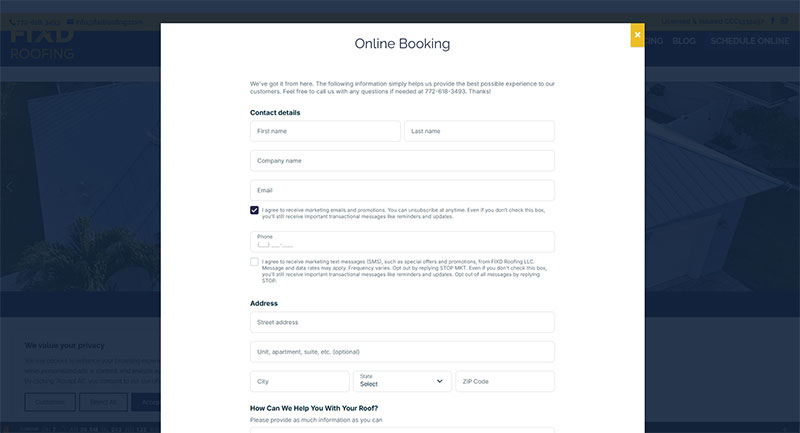
Place your primary website form above the fold on every service page.
Form field strategy:
- Name
- Phone
- Service needed
- Address
Every extra field drops conversions. Keep it minimal.
Following form design principles directly impacts your cost per roofing lead.
Service Listings and Geographic Coverage
List every service clearly: roof repair, roof replacement, storm damage, commercial roofing, inspections.
73% of homeowners seek out roofing companies via word of mouth/recommendation, followed by 54% using search engine results (Roofing Contractor 2024 Survey).
Create location pages for each city and neighborhood you serve. Helps local SEO and user clarity. Over 50% of organic traffic comes from long-tail search terms that don’t appear in keyword research tools (Roofing Webmasters).
How Should Roofers Qualify and Nurture Leads
Generating roofing leads is half the battle. Proper qualification and nurturing determines how many convert to signed contracts.
Lead Scoring Criteria
Score leads based on property ownership, timeline urgency, budget range, and service match.
Hot leads (active leak, insurance claim in progress) get immediate callbacks. Warm leads enter nurture sequences.
Response Time Importance
Speed kills in roofing sales. According to Vendasta and Ricochet360, first responders win 35-50% of sales, with some research showing this can reach 78%.
The brutal timeline:
- Within 5 minutes: Contractors are 21x more likely to qualify the lead (Harvard Business Review/Lead Response Management Study)
- After 30 minutes: Lead qualification chances drop by 80% (Image Building Media)
- Within 1 minute: Conversions improve by 391% (Velocify)
According to Workato, 99% of companies fail to respond within 5 minutes. The average lead response time is a staggering 47 hours.
Target under 5 minutes for phone leads during business hours. After-hours inquiries need morning-first callbacks.
CRM Systems for Roofing
| CRM System | Core Functionality | Best Suited For | Starting Price |
|---|---|---|---|
| AccuLynx | All-in-one platform covering CRM, production management, estimating, supplier ordering (ABC Supply, QXO, SRS), and accounting integration. AI-powered lead intelligence ranks prospects by conversion likelihood. | Residential insurance restoration and retail roofing companies from startups (3+ users) to multi-location enterprises requiring comprehensive workflow management. | Custom pricing per user/month (no published rates). Monthly subscription, cancel anytime. |
| JobNimbus | Highly customizable CRM with visual Boards for pipeline tracking, SumoQuote integration for proposals, payment processing with financing options, and mobile app (4.8-star rating). Recently acquired marketing and sales tools. | Home exteriors contractors (roofing, restoration, solar, gutters, siding) seeking flexibility and customization. Ideal for teams comfortable with initial setup investment for tailored workflows. | Role-based pricing: account-based CRM fee plus Admin/Sales/Field user fees. Free 14-day trial. (Estimated $250-$350/month range reported) |
| ServiceTitan | Enterprise-grade platform originally for HVAC/plumbing, now expanding roofing features. Includes dispatch optimization, spec-based estimating, dynamic pricing, GPS tracking, and opportunity management. GAF Preferred CRM partner. | Larger roofing operations ($10M+ revenue), PE-backed companies, or multi-market businesses needing enterprise visibility, advanced reporting, and service/production integration. | Custom pricing based on technician count and features. Generally higher-priced (enterprise-level). Contact required for quote. |
| Roofr CRM | Sales-focused platform featuring Instant Estimator for web lead capture, $13 measurement reports (2-hour delivery), branded proposals with e-signatures, material ordering integration (ABC Supply, QXO, SRS), and invoice tracking. | Small to mid-size roofing contractors prioritizing speed to lead, fast proposal generation, and streamlined sales workflow. Best for growth-focused teams needing quick quote turnaround. | Free plan available. Paid tiers: Pro, Premium, Elite (tiered pricing). No monthly fee option with pay-per-report ($13-19/report). |
| iRoofing | Mobile-first DIY measurement app with satellite/drone/blueprint capabilities, AI roof visualizer, pitch detection, digital catalogs, branded pitch books, light CRM functions, and e-signature contracts. Access for 3 devices per subscription. | Field-focused contractors and sales reps requiring on-site measurement, visualization, and estimation tools. Ideal for companies emphasizing in-person sales presentations and mobile workflow. | $149/month (150 imagery credits, 3 users). Annual: $1,489/year (1,500 credits). Free unlimited training and support included. |
AccuLynx, JobNimbus, and HubSpot CRM track leads from first touch through job completion.
According to Roofing by the Numbers 2025, only 28% of roofers currently use a CRM to track leads. Those who adopted CRM plus marketing automation reported generating 2x more leads year-over-year.
Automated task reminders prevent leads from falling through cracks. Pipeline visibility shows where deals stall.
Email Automation Sequences
According to Salesforce, 80% of sales require at least five follow-up attempts after initial contact before closing.
Yet according to Peak Sales Recruiting, 70% of reps send only one email to prospects. By sending follow-up emails, you improve your chance of getting an answer by 25%.
The follow-up advantage:
- First follow-up email: 49% increase in reply rates (Growth List)
- First follow-up: 220% surge in reply rates compared to initial email (Peak Sales Recruiting)
- Multiple follow-ups: 160% increase in response rates (Growth List)
According to HubSpot, follow-up emails increase the chance of a response by 11%. Companies that send follow-up emails see a 50% increase in customer engagement (InboxPlus).
Build sequences using Mailchimp, ActiveCampaign, or Constant Contact: estimate follow-up, testimonial shares, seasonal maintenance reminders.
Proper increasing form conversions combined with email nurturing maximizes every lead’s potential.
Follow-Up Cadence
According to Yesware, 80% of sales deals take five or more follow-ups to close, yet 44% of reps stop after the first attempt.
Recommended sequence:
- Day 1: Phone call + email with estimate
- Day 3: Follow-up call
- Day 7: Email with customer testimonials
- Day 30+: Add to long-term nurture list
According to Growth List, 75% of customers expect to receive 2-4 phone calls before a business gives up trying to reach them.
What Metrics Track Roofing Lead Generation Success
Tracking the right numbers separates profitable roofing marketing from expensive guesswork.
Cost Per Lead (CPL)
Total marketing spend divided by leads generated. Track by channel.
According to LocaliQ’s 2025 Home Services benchmarks, roofing CPL via Google Ads averages $228.15, with Roofing & Gutters showing the highest costs at $10.70 CPC.
According to 99 Calls’ 2024 data, roofing lead costs vary dramatically by month. The median CPL ranges from $96 (low) to $315 (high) depending on seasonality and competition.
Channel cost comparison:
- Google Ads: $187-$228 per lead (GlassHouse/LocaliQ)
- SEO/Organic: Near $0 (excluding labor/agency costs)
- Referrals: Near $0 (excluding referral rewards)
- Digital door knocking: $3-5 per lead (GlassHouse)
- Third-party lead brokers: $75-$350 depending on exclusivity
Google Ads CPL running $250 while SEO delivers $30 leads? Shift budget accordingly.
Cost Per Acquisition (CPA)
Total spend divided by closed jobs. The metric that actually matters.
According to GlassHouse, construction and home improvement companies average around $610 in customer acquisition costs.
A $50 lead that never closes costs infinite CPA. A $200 lead that closes is profitable.
Lead-to-Close Ratio
According to Best Roofer Marketing, the industry average close rate sits around 27% for standard leads.
Close rates by source:
- 50%+ for referrals (Best Roofer Marketing)
- 30-50% for storm damage leads (Improve & Grow)
- 20-35% appointment set rate from roof replacement leads (Fixr)
- 10-20% for third-party leads (Improve & Grow)
- 3-8% overall lead-to-close rate for purchased leads (Fixr)
According to LocaliQ 2025 data, Roofing & Gutters shows a 3.70% conversion rate on Google Ads, among the lowest in home services.
Track by source. If Facebook leads close at 10% while Google closes at 35%, reallocate spend.
Customer Lifetime Value
According to Local Value, the average residential roofing job generates $15,000 in revenue.
But that customer also needs gutters, repairs, and eventually another replacement.
CLV calculation example (Local Value):
- Initial job: $15,000
- Referral rate: 20-30% for roofing
- Uplift from referrals: 25%
- True lifetime value: $18,750
Factor in referrals they send. True lifetime value often exceeds 3x initial job revenue.
Marketing ROI Calculations
Simple formula: (Revenue from marketing – Marketing cost) / Marketing cost x 100.
Real ROI example (Improve & Grow):
- Average job value: $12,000
- Gross margin: 35%
- Close rate: 20%
- Cost per lead: $200
- ROI: 533% (5:1 return)
Aim for 300%+ ROI minimum. Top roofing companies hit 500-1000% on optimized channels.
Which Strategy Combinations Work Best for Roofing Companies
No single channel wins alone. The best roofing lead generation combines multiple approaches matched to your budget and growth stage.
Marketing Budget Guidelines
According to industry benchmarks, roofing companies should allocate 5-10% of annual revenue to marketing (One Thing Marketing, Apex Roofer Marketing).
Budget allocation by growth stage:
- Maintaining current position: 1-3% (Profit Roofing Systems)
- Moderate growth: 5-7% (Profit Roofing Systems)
- Aggressive growth: 8-12% (GoDuo, Amra And Elma)
- New businesses: 12-20% to establish brand recognition (GoDuo)
According to Hook Agency, roofing companies typically spend 50% on lead generation channels, 30% on brand awareness, and 20% on miscellaneous efforts.
Small Operations (Under $100k Marketing Budget)
Focus on Google Business Profile optimization and referral program development first.
According to Amra And Elma, many roofers fail to fully optimize their Google Business Profile, resulting in lost visibility in local searches.
Add one paid channel (Local Services Ads or Facebook) once organic foundation is set.
Use lead capture form templates to get professional forms live quickly without custom development.
Medium Businesses ($100k-$500k Budget)
Layer SEO, Google Ads, and social advertising together. Test third-party lead sources for volume spikes.
According to Roofing Webmasters, 70% of roofing companies are unhappy with their SEO provider. Choose carefully based on proven track records.
Invest in CRM and marketing automation. Track attribution across channels.
Consider multi-step forms to qualify leads better before sales team engagement.
Large Operations ($500k+ Budget)
Full omnichannel presence: SEO, PPC, social, email, direct mail, TV/radio in major markets.
According to Welcome Wagon, 85% of marketers agree direct mail delivers the best conversion rate of all channels they use.
Dedicated marketing team or agency partnership. Sophisticated attribution modeling.
A/B test contact form templates and landing pages continuously. Small conversion lifts compound at scale.
Seasonal Adjustments
According to JobNimbus Marketing, searches for “roof repair” consistently spike during late spring and early summer, with another smaller peak in early fall.
According to Google Trends data analyzed by JobNimbus Marketing, roofing-related searches begin climbing in March, peak from May through July, and show a smaller surge in September.
Seasonal strategy:
- Ramp paid advertising before storm season and spring busy periods
- According to Verisk, roof insurance claims topped $30 billion in 2024, with the majority occurring during spring and summer storm seasons
- Scale back during slow winter months in northern climates
- Shift to commercial roofing focus where residential slows
- According to JobNimbus Marketing, weather-based content performs 67% better than generic roofing content
Storm season preparation: According to AccuWeather 2025 forecasts, 1,300 to 1,450 tornadoes are expected (above the historical average of 1,225). According to Roofing Contractor, 1,796 confirmed tornadoes occurred in 2024, the second most on record.
Similar principles apply across home services, from lead generation for contractors to specialized trades like lead generation for home builders.
FAQ on Lead Generation For Roofing
How much do roofing leads cost?
Roofing leads range from $13-$250 depending on channel. Google Ads averages $187 per lead. Facebook runs $30-$80. Third-party providers like CraftJack charge $13-$72. Organic SEO delivers the lowest long-term cost once rankings establish.
What is the best way to generate roofing leads?
Combining local SEO, Google Business Profile optimization, and referral programs delivers the best results. Layer in paid advertising (Local Services Ads, Facebook) for faster volume. No single channel wins alone.
Are roofing lead generation companies worth it?
Third-party lead providers like HomeAdvisor, Angi, and Service Direct work for quick volume. Expect shared leads and competition. Building owned channels (website, SEO) costs more upfront but eliminates per-lead fees long-term.
How do I get free roofing leads?
Referrals from satisfied customers cost nothing. Google Business Profile optimization generates free organic visibility. Nextdoor posts reach local homeowners without ad spend. Door-to-door canvassing requires time, not money.
What is a good conversion rate for roofing leads?
Referral leads close at 50%+ rates. Standard marketing leads average 25-30%. If your close rate drops below 20%, examine lead quality, response time, and sales process. First responder advantage matters significantly.
How quickly should I respond to roofing leads?
Under 5 minutes is ideal. First responder wins 35-50% of competitive leads. After-hours inquiries need morning-first callbacks. Speed separates closers from companies wondering why leads don’t convert.
Do Facebook ads work for roofing companies?
Facebook ads generate cheaper leads ($30-$80) than Google but with lower purchase intent. Facebook Lead Ads capture contact info without users leaving the platform. Best for retargeting and building local brand awareness.
How do I qualify roofing leads before sending estimators?
Verify property ownership, confirm service area, assess timeline urgency, and check roof age. Using the right designing lead capture forms with qualification questions filters out tire-kickers before wasting estimator time.
What CRM should roofing companies use for lead management?
AccuLynx and JobNimbus are built specifically for roofing contractors. HubSpot CRM and Salesforce work for larger operations. Any CRM beats spreadsheets for tracking leads, follow-ups, and pipeline visibility.
How do I track ROI on roofing lead generation?
Calculate cost per lead and cost per acquisition by channel. Track lead-to-close ratios from each source. Use call tracking and UTM parameters to attribute closed jobs back to specific campaigns and ad spend.
Conclusion
Lead generation for roofing separates thriving contractors from those struggling to fill their schedule.
The playbook is clear. Optimize your Google Business Profile. Build a referral program that rewards past customers. Layer in paid channels like Local Services Ads and Facebook advertising when budget allows.
Track everything. Cost per lead means nothing without cost per acquisition data. A $200 lead that closes beats a $50 lead that ghosts you.
Speed wins. Respond in under 5 minutes. Use AccuLynx or JobNimbus to manage your pipeline. Automate follow-ups through Mailchimp or ActiveCampaign.
The roofing companies dominating their markets aren’t doing one thing well. They’re doing ten things consistently.
Pick two strategies from this guide. Implement them this week. Measure results for 90 days. Then add more.