







A new client doesn’t sign with an accounting firm because a landing page convinced them. They sign because someone they trust vouched for the firm, or because the firm showed…
Table of contents
A sales rep at a production builder gets a form fill from someone in Ohio. No land, no pre-approval, just curious about a floor plan they saw online. That’s not a lead yet, or at least not one worth chasing hard.
Home builder lead generation is the work of turning browsing like that into something closer to an appointment: a person with a lot, a number in mind, and financing that’s at least started moving. Custom, semi-custom, and production builders all run some version of this alongside their regular real estate marketing, and a lot of them track it wrong. Raw form volume looks good on a dashboard. Cost per qualified lead is the number that actually predicts whether the sales team hits its numbers this quarter.
Sixty-seven percent of home builders offered sales incentives in December 2025, the highest share since the pandemic, according to the NAHB/Wells Fargo Housing Market Index. When that many competitors are discounting to move inventory, converting the buyers already sitting in your pipeline matters more than finding new ones.
Land ownership, budget clarity, and financing status are what separate a casual inquiry from something worth a sales rep’s time. Get those three data points early and an appointment has a real shot at becoming a signed contract.
What Is Lead Generation for Home Builders?

The output isn’t just a name and a phone number. It’s a person with land, a budget, and enough intent to sit down with a sales rep or walk a model home.
Compare that to general lead generation, where the decision cycle might run days. Here it stretches over months, and the ticket size runs into hundreds of thousands of dollars, so the process behaves differently at nearly every stage.
It also isn’t real estate lead generation for resale homes, and it isn’t remodel or repair lead generation, even though people lump all three together in casual conversation. A qualified home building lead comes with land, budget clarity, or both. A resale real estate lead is shopping an existing inventory of homes. A remodel lead wants work done on a home they already own. Three different buyers, three different sales motions, three different follow-up sequences.
Anyone weighing lead generation against demand generation should keep that distinction in mind, since demand generation builds brand awareness long before someone is ready to fill out a form.
The core output is a scheduled consultation, model home visit, or design center appointment. Not an email address sitting in a spreadsheet somewhere.
What Makes a Home Builder Lead Sales-Qualified?
Not every form fill deserves a follow-up call. A sales-qualified lead for a home builder clears a handful of checkpoints before it ever reaches the sales team.
- Land or a buildable lot, already secured, under contract, or actively being shopped
- A real budget number, not a vague “somewhere in the mid $400s”
- Financing that’s at least pre-qualified for a construction loan, or close to it
- A timeline to break ground within 6 to 18 months, not “someday”
Capturing those data points at the form stage, instead of digging for them on a phone call, is what separates strong form fields for high-quality leads from a bare name-and-email box.
A lead missing all four isn’t dead. It’s just early, and it belongs in a nurture sequence rather than a sales queue.
How Does the Home Builder Lead Generation Funnel Work?
The funnel for a home builder runs longer and slower than almost any other consumer purchase. A prospect moves from awareness, to research, to a model home or virtual tour, to a design consultation, to a signed contract, and each stage in a lead generation funnel filters out people who aren’t ready yet. That’s the entire point of tracking stages separately instead of just counting form fills.
Response speed decides more of the outcome than most builders assume. Companies that respond to a new lead within 5 minutes are 21 times more likely to qualify that lead than ones that wait 30 minutes, according to the MIT and InsideSales.com lead response study.
Traffic entering the top of the funnel splits into two broad categories, and the split matters for budgeting.
- Inbound: organic search, referrals, content, reviews
- Outbound: paid ads, marketplace leads, cold outreach
The difference between the two, covered in more depth in this look at inbound versus outbound lead generation, shows up directly in cost per lead and in how much trust a prospect already has before the first phone call.
How Long the Home Builder Sales Cycle Typically Runs
| Build Type | Typical Sales Cycle | Main Friction Point |
|---|---|---|
| Spec home | 1 to 3 months | Inventory availability |
| Semi-custom | 3 to 6 months | Floor plan and lot matching |
| Fully custom | 6 to 12 months | Design decisions, financing |
A spec home sells off a finished or nearly finished product, so the decision compresses into weeks.
A fully custom build stretches because the buyer is deciding on a lot, a design, and a lender all at once, often in parallel, and any one of those can stall the other two.
Which Lead Sources Generate the Best Results for Home Builders?
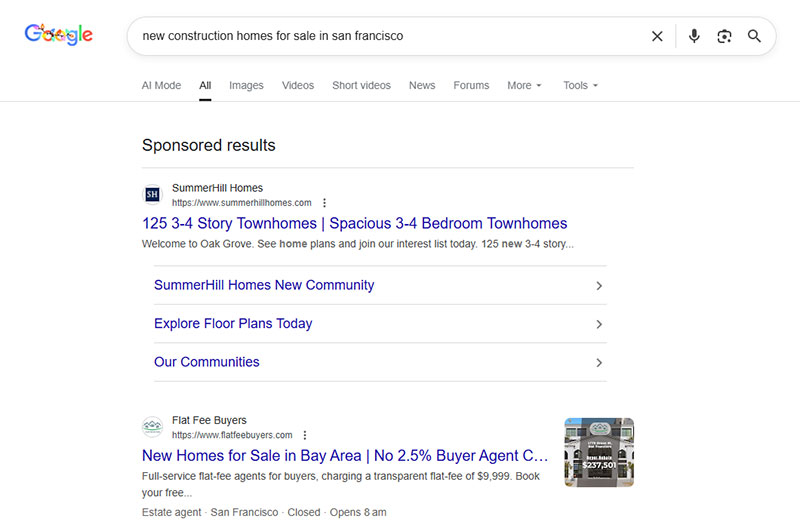
A handful of channels bring in most of a home builder’s leads, and they don’t perform the same way at all. Paid channels move fast and cost more per lead. Owned channels cost less per lead but take months to build any real momentum.
| Channel | Speed to First Lead | Relative Cost | Best For |
|---|---|---|---|
| Google Ads / paid search | Days | High | Filling an immediate pipeline gap |
| Google Local Services Ads | Days to weeks | Moderate | Pay-per-lead with built-in screening |
| Referral program | Months | Low | Repeat markets, custom builders |
| Lead marketplaces (Angi Leads, HomeAdvisor, Thumbtack) | Days | Moderate to high | Filling short-term capacity |
| Organic search / local SEO | Months | Low, ongoing | Long-term, compounding pipeline |
A Google Local Services Ads lead averages $53 across home service categories, according to SearchLight Digital’s 2026 survey of 888 contractors, well below what most builders pay through open paid search auctions.
Facebook Ads Manager and Nextdoor work differently again, leaning on visual proof, finished homes, interiors, before-and-after lot photos, rather than search intent.
None of these channels replace each other. Builders who rely on a single source are the ones who feel every algorithm change and every seasonal dip. Picking the right mix comes down to what stage the business is in, which is where broader lead generation strategies come in handy as a starting checklist.
How Do Local Search and Website Design Generate Home Builder Leads?
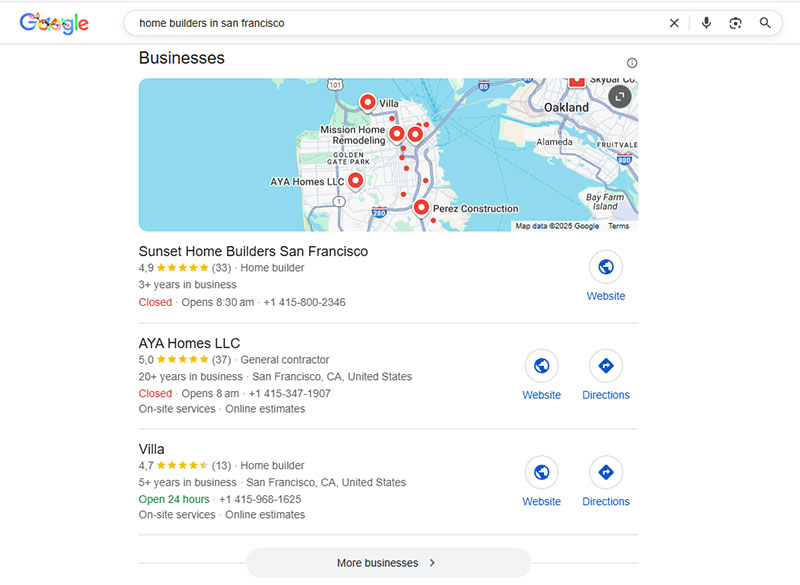
Local search and the builder’s own website work together, not separately. One brings a prospect in. The other decides whether that prospect leaves a phone number or bounces.
According to a Mower survey of 308 U.S. homeowners who built within the past two years, 49 percent of recent new-build homeowners used search engines to research a builder. Another 47 percent visited builder websites directly, and 46 percent browsed social media.
Google Business Profile Setup for Home Builders
Google checks a handful of things before a builder’s profile shows up in the map pack:
- Category accuracy (Home Builder or Custom Home Builder, not general contractor)
- Consistent name, address, and phone across every directory
- Recent, geo-tagged project photos
- A steady cadence of new reviews, not a burst followed by silence
Builders running multiple active communities need a separate profile for each one. A shared profile dilutes the map pack ranking for every location attached to it.
This is where Google Business Profile optimization and local SEO for builders overlap almost completely. One is the platform. The other is the discipline of actually using it well.
Website Elements That Convert Visitors Into Leads
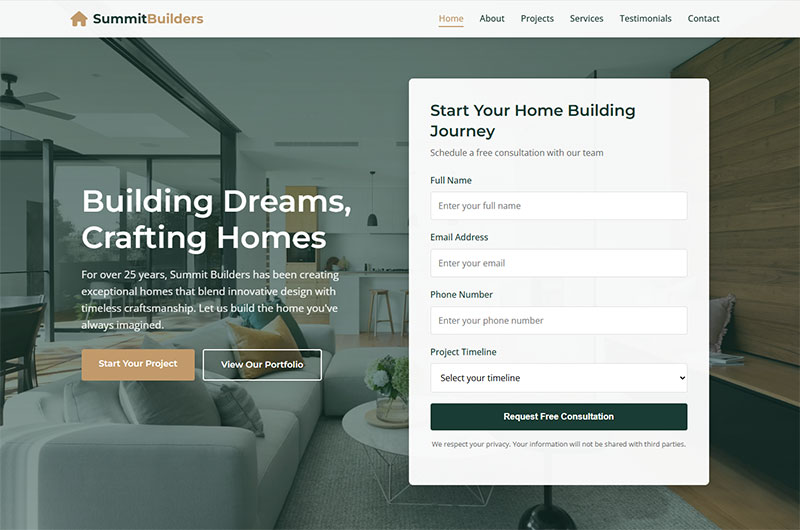
A builder website earns nothing by simply existing.
- Floor plan pages with pricing ranges, not just square footage
- A virtual tour or 3D rendering of the current model home
- A design center walkthrough showing real material choices
- A visible path back to a form on every page, not just the homepage
The difference between using website forms for lead generation deliberately and bolting a generic contact box onto every page shows up directly in form completion rates.
A plain contact box and a purpose-built lead form aren’t interchangeable. The gap between contact forms and dedicated lead generation forms matters more for builders than for most local service businesses, since the fields needed, lot status, budget, timeline, are specific to the industry.
Google Search Console and Google Analytics 4 close the loop, showing which floor plan or community page actually produces form submissions rather than just traffic.
How Much Does a Home Builder Lead Cost?
Cost per lead swings wildly depending on the channel and the build type. The number that actually matters is cost per qualified lead, filtered by land ownership, budget, and timeline, not the raw price a platform quotes.
Construction and general contracting leads average $165.67 per lead through paid search, based on LocaliQ and WordStream’s 2025 analysis of more than 3,000 home service campaigns. Blend all channels together and the industry average drops to $47.94 per lead, according to Builder Funnel’s benchmarks.
Referral leads close at 25.6 percent. PPC-sourced leads close at 15.73 percent, per that same Builder Funnel data. That gap alone explains why plenty of builders keep investing in referral programs even when the cost per lead there is harder to measure cleanly.
Tier 1 exclusive custom home leads run $200 to $500 each and can still be profitable against a $250,000-plus project.
A boosted social post with strong creative can land a lead closer to $21, though the qualification rate on that lead is usually far lower than a referral.
Tracking cost per lead in isolation misses the point. It only means something next to conversion rate, which is why both numbers belong on the same dashboard, covered in more depth among these lead generation KPIs worth tracking.
Builders comparing their own numbers against a wider base should check conversion rate benchmarks by industry before deciding whether a given cost per lead is actually a problem or just noise.
Should Home Builders Buy Leads or Generate Their Own?
Both approaches work. They just work for different situations.
Buying leads, through Angi Leads, HomeAdvisor, Thumbtack, or an exclusive lead service, gets you moving fast. Leads are often available the same week, with no content or SEO investment required upfront. The catch is that shared leads frequently land on the desks of three to five competing builders at once, and there’s little control over how qualified any of them actually are.
Generating your own leads through SEO, a referral program, or owned paid ads works differently. You own the contact and the entire follow-up sequence, and cost per lead tends to drop over time as content and reviews build up. It just takes 3 to 12 months to see real volume, and it needs an actual internal process behind it, not just ad spend thrown at the problem.
Most builders end up running both at once, using purchased leads to smooth out slow months while an owned pipeline builds underneath it. Building that owned pipeline usually means installing dedicated capture tools, the kind covered in this roundup of WordPress lead generation plugins, rather than relying on a single static contact page.
The underlying approach isn’t unique to home building. It follows the same fundamentals laid out in any guide on how to generate leads for a business, just applied to a longer sales cycle and a bigger ticket.
A small custom builder doing 6 homes a year has different math than a production builder doing 200. The buy-versus-build decision should follow that math, not some general rule pulled from a different industry.
Which CRM and Lead Tracking Tools Do Home Builders Use?
Two categories of software cover the same ground from opposite starting points. Builder-specific platforms bolt selling onto construction management. General CRMs bolt construction tracking onto a standard sales pipeline.
| Tool | Category | What It Tracks |
|---|---|---|
| Buildertrend | Builder-specific | Leads, change orders, client communication |
| CoConstruct | Builder-specific | Selections, budgets, design communication |
| HubSpot | General CRM | Pipeline stages, email sequences, form data |
| Salesforce | General CRM | Custom sales pipelines, reporting |
| JobNimbus | General CRM | Lead source, job status, mobile field updates |
Builder-specific tools win when the sales timeline and the construction timeline share the same client record, a change order and a lead note sitting side by side. General CRMs win when a builder already runs marketing automation elsewhere and just needs a pipeline that plugs into it.
Whichever platform runs the pipeline, a lead needs to land there with structure intact, not as a raw email notification a sales rep has to retype by hand. That’s the case for purpose-built lead capture forms that push field data straight into the CRM record, land status and budget range included.
Call tracking closes the attribution gap software alone can’t. CallRail’s own home services data puts the industry-wide missed call rate at 14 percent, revenue lost before a form or a CRM record ever even gets involved. Pairing call tracking with tracking form submissions in Google Analytics gives a full picture across both calls and web forms, instead of just one or the other.
How Do You Nurture a Home Builder Lead From Inquiry to Signed Contract?
A lead that goes quiet for a week is a lead that found another builder.
The nurture sequence follows a fairly predictable pattern, and skipping a stage usually shows up later as a stalled deal.
- Instant response, call or text within minutes of the form submission
- Email follow-up with floor plans, pricing ranges, and next steps
- Model home or design consultation booking
- Design center walkthrough with real material samples
- Contract proposal with financing options attached
Top sales performers need roughly 5 touchpoints to convert a new prospect into a meeting. Average performers need close to 8, according to RAIN Group’s research on top performance in sales prospecting.
Every message in that sequence needs somewhere specific to go. A generic “contact us” close doesn’t move a prospect forward the way one clear next action does, which is where strong call to action examples earn their keep in every nurture email.
Mailchimp and similar tools handle the scheduling side automatically, firing the right email on the right day without a salesperson remembering to send it manually. Builders running the same sequence on repeat benefit from working off tested lead nurturing templates rather than writing every follow-up from scratch.
How Do Referrals and Reviews Generate Home Builder Leads?
Referrals and reviews sell the same thing from two different directions. A referral is a warm introduction. A review is proof for someone who never got one.
| Trust Channel | Who Initiates | Best Timing to Ask |
|---|---|---|
| Referral program | Past client or realtor partner | Move-in day or first walkthrough |
| Online review | Past client, unprompted or asked | Two to four weeks after closing |
| Realtor / lender partnership | Third-party professional | Ongoing, not one-time |
The vast majority of consumers still check reviews before contacting a business. Only 4 percent say they never read reviews at all, according to BrightLocal’s 2025 Local Consumer Review Survey of 1,026 U.S. adults. Star rating remains one of the biggest early filters, and earlier editions of the same annual survey found many consumers won’t seriously consider a business rated under 4 stars.
That number carries more weight for home builders than for most local businesses, since a review is vouching for a purchase most buyers only make once or twice in their life.
Displaying just five reviews lifts conversion rates by an average of 270 percent compared with no reviews at all, per research from Northwestern University’s Spiegel Research Center. That lift climbs even higher for higher-priced purchases, up to 380 percent. Burying testimonials on a single reviews page is a real cost, not a minor oversight.
The mechanics behind a working referral program are pretty simple. Ask at the moment of highest satisfaction, right around move-in, not months later, and pair that ask with a specific incentive tied to a closed referral rather than a vague thank-you. Track the referral source in the CRM the same way a paid lead source gets tracked, so you actually know which relationships are producing.
Sending a short customer satisfaction survey right after closing does double duty, surfacing problems worth fixing while flagging which clients are happy enough to ask for a referral.
A simple NPS survey question, how likely are you to recommend us, is often the cleanest way to spot who’s ready to be asked before the referral conversation even starts.
Realtor and lender relationships run on the same mechanics at a professional level, feeding a steady trickle of pre-qualified buyers who already trust the person making the introduction. A listing in a directory like the National Association of Home Builders, or a local builders association, adds the same kind of third-party validation search engines weigh as a local trust signal.
When Does Lead Generation Not Work for Home Builders?
Lead generation fails quietly more often than it fails loudly. A builder can rank well, run ads, and still watch the pipeline dry up, and the reason is rarely the channel itself.
Paid lead generation tends to fail for a few specific reasons. No one follows up within the first hour, so ad spend buys attention nobody converts, or the sales team is too small to actually handle the volume a campaign produces. Leads also get treated as interchangeable instead of scored by land, budget, and timeline, which defeats the purpose of scoring them at all.
SEO and content fail for their own reasons too. The site has no dedicated page for each service area or active community, and location content ends up thin or duplicated across markets. Even when ranking works, the website doesn’t convert, so traffic arrives and leaves without a trace.
A form that ignores basic web form best practices, too many fields, no mobile optimization, a buried submit button, bleeds leads before they ever reach the funnel.
Marketplace leads fail in oversaturated markets, where the same shared contact lands on five competing builders’ desks at once and price becomes the only real differentiator left.
There’s also a volume floor worth naming directly. A builder doing 3 to 4 custom homes a year often gets more from a tight referral program and a handful of realtor relationships than from any paid channel, since the fixed cost of running campaigns and staffing follow-up rarely pencils out against that few closings.
Fixing a broken conversion path usually starts with the form itself, and a high form abandonment rate is often the clearest early signal that traffic is arriving but the site isn’t doing its job.
None of this means the channel is broken. It usually means the system behind it, response time, staffing, or the website itself, is the actual point of failure.
FAQ on Lead Generation For Home Builders
Is Lead Generation Different for Custom Builders Versus Production Builders?
Yes. Production builders lean on paid ads, listing sites, and model home traffic tied to active inventory.
Custom builders lean on referral programs, portfolio content, and realtor partnerships instead, since buyers there are committing to a design process rather than a finished spec home.
What Metrics Should a Home Builder Track to Measure Lead Generation Performance?
Cost per qualified lead, lead-to-consultation rate, consultation-to-contract rate, and cost per booked job matter more than raw lead volume ever will.
Tracking leads per active community also flags which locations are underperforming before a sales cycle stalls completely.
How Many Leads Does a Home Builder Need per Month to Hit Sales Targets?
Divide the monthly sales goal by the expected close rate.
A builder targeting 4 signed contracts a month at a 20 percent close rate needs roughly 20 qualified leads, not 20 raw inquiries.
Does a Home Builder Need a Marketing Agency for Lead Generation?
Not always. Builders with in-house marketing staff and enough CRM discipline can run paid ads, local SEO, and referral programs internally without much trouble.
An agency earns its cost when a builder lacks the time or expertise to manage multiple channels at once.
Can a Home Builder Generate Leads Without Paid Advertising?
Yes, through referral programs, local SEO, Google Business Profile optimization, and content built around floor plans and communities.
Growth is slower without paid ads, but cost per lead drops sharply once organic channels compound over several months.
What Is the Difference Between a Lead and a Prospect in Home Building Sales?
Not every contact deserves the same follow-up. Someone who fills out a form with no land, no budget, and no real timeline is still just a lead, regardless of how excited the message sounds.
A prospect has cleared qualification, land, budget, financing, timeline, and is actively considering a specific builder or community, not just browsing options.
What Should a Builder Fix First in Lead Generation for Home Builders?
Lead generation for home builders improves fastest when response speed and qualification get fixed before any new channel gets added.
A faster answer to an existing inquiry produces more signed contracts than a bigger ad budget aimed at more inquiries.
- Response speed and lead scoring
- Local search and website conversion
- Paid channels and marketplace leads
That order holds because the first two fixes cost staff time, not media spend, while paid channels only pay back once the intake process behind them actually converts.
The trade-off is real. Tightening response and qualification first means slower visible lead volume for two to three weeks while paid spend waits its turn.
Builders ready to put that intake process into practice can start with a comparison of WordPress contact form plugins built to route form data straight into a sales workflow.