









A new client doesn’t sign with an accounting firm because a landing page convinced them. They sign because someone they trust vouched for the firm, or because the firm showed…
Table of contents
A therapist’s booking calendar and the country’s actual demand for therapy rarely line up. The Substance Abuse and Mental Health Services Administration’s 2023 National Survey on Drug Use and Health found 58.7 million U.S. adults, 22.8% of the adult population, had a diagnosable mental illness that year.
Only 54% of them received any mental health treatment.
That gap is the whole reason lead generation matters for a private practice.
It’s not about generating interest from nothing. It’s about catching someone at the point where they’re already searching, whether that’s a directory listing, a referral from a doctor, or a plain Google search near closing time, and getting them into a booked first session before they lose momentum and stop looking.
Solo clinicians and small group practices run this across five different channels, and how many open weekly slots a practice actually has sets a hard ceiling on how much of that inquiry volume is even worth chasing.
What Is Lead Generation for Therapists?

A blog post that pulls in readers but gives them no way to book a session isn’t a lead, no matter how much traffic it gets. That’s the line separating lead generation from marketing in general: one produces a contact who can actually be booked, the other just produces awareness.
The concept borrows from the process of turning a stranger into an identified, contactable prospect, though in this field trust and privacy carry more weight than they do almost anywhere else.
People throw around lead, referral, and booked client as if they mean the same thing, and they don’t. A lead is simply someone who filled out a form, sent a message, or called to ask about availability. A referral is a lead who shows up already carrying a recommendation, whether that’s from a doctor, a friend, or a former client. And a booked client is a lead who went all the way through, scheduled, and actually showed up for that first session.
The APA’s 2024 Practitioner Pulse Survey found 53% of psychologists had no openings for new patients, yet they were still contacted by an average of 8.8 people a month seeking care.
That gap between inquiry volume and booking capacity is exactly why the three terms can’t be used interchangeably.
How the Client Acquisition Funnel Moves a Lead to a Booked Session
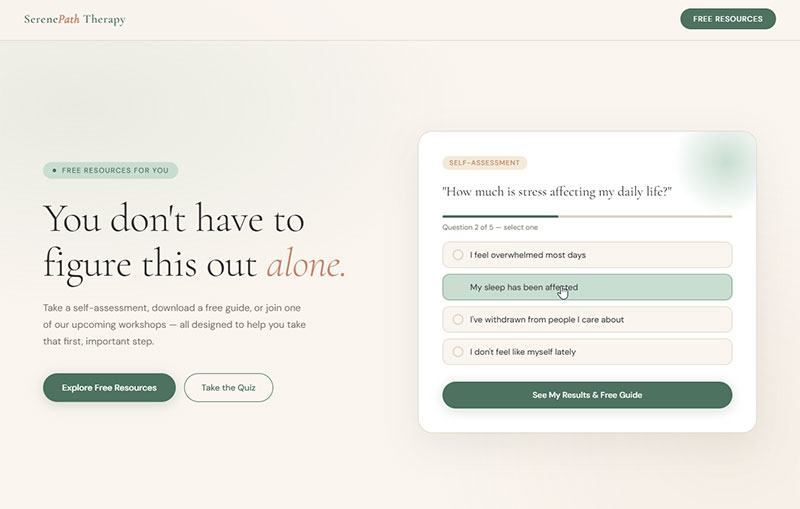
Someone finds a profile or a website and sends a message or fills out a form. That’s the inquiry stage, and it’s where most of this article’s advice actually applies.
If the therapist responds, the next step is usually a short consultation call to check fit, fees, and availability. Assuming that goes well, the prospect books and shows up for a first session, and if the fit holds past that first appointment, they move into ongoing care. That last part, retention, isn’t really a marketing problem anymore. It’s a clinical one.
The inquiry stage usually starts with a form built specifically to capture that first request rather than a generic contact box, since the fields on it decide what a therapist knows before the first call.
Where Most Leads Drop Off Before Booking
Most attrition happens between inquiry and consultation call, not between consultation and first session.
Someone reaching out about therapy is often doing it during a narrow window of readiness. A slow reply lets that window close.
Some practices now route inquiries to always-on answering services such as Frontdesk, which picks up calls and web messages around the clock and books the consultation directly.
The funnel itself is the staged path that carries a prospect from first contact to a signed client, and on paper it looks the same across industries.
The drop-off point in therapy just sits earlier, because the decision to reach out took longer to make in the first place.
Which Lead Sources Bring Therapists the Most Clients?
Almost every new client inquiry in private practice comes in through one of a handful of channels: directories, referrals, paid ads, insurance-based platforms, or content that ranks on its own without any ad spend behind it. What differs sharply between them is cost, how qualified the leads actually are, and how much upkeep each one demands to keep working.
| Channel | Typical Monthly Cost | Lead Quality | Maintenance Effort |
|---|---|---|---|
| Directory listing | $20 to $60 | Moderate, price-sensitive | Low once profile is built |
| Referral network | Near $0 | High, pre-qualified | Ongoing relationship work |
| Paid search or social ads | $200 and up | Variable | High, needs constant tuning |
| Insurance-based platform | Revenue share, not a fee | High volume, mixed fit | Low after credentialing |
| Owned content or local SEO | $0 to $500 | High, compounds over time | High upfront, low later |
Psychology Today, the largest single directory in the space, charges a flat $29.95 a month per listing regardless of location or specialty.
Google Ads and Meta Ads dominate the paid lane, priced per click rather than per month, which is why the cost range above swings so much wider than a directory subscription.
AAMFT’s 2022 workforce study found 64% of marriage and family therapists got new clients from referrals by other providers, compared with 46% who relied on online directories. Experience level changes that mix too: therapists with less than six years in practice leaned on directories far more (53%) than those with over twenty years (40%), who pulled more heavily from their own existing client referrals.
Zencare takes a different approach from most directories by building a professional photo and video shoot into every membership before a listing goes live.
The same pattern shows up across healthcare client acquisition generally, where trust-based channels tend to outperform paid ones on a cost-per-booked-client basis.
How to Optimize a Therapist Directory Profile
A directory profile earns a message in the first few seconds someone spends on it, or it gets scrolled past.
A handful of things decide that outcome before anything else on the page even gets read:
- A clear, friendly, front-facing photo
- Named specialties and treatment modalities
- An opening statement written in first person, not clinical third person
- Fees, insurance panels, and telehealth availability stated plainly
- License type and state, placed where it can be verified at a glance
Most directories truncate a profile’s opening statement in the search-results preview before showing the full bio on the profile page itself. The exact cutoff varies by platform and can change without notice, so the safer bet is writing that opening sentence so it can stand on its own even if everything after it gets cut off.
TherapyDen founder Jeff Guenther has written extensively about testing profile elements against real click data, and one of his more repeated findings is that a photo with a dog in it outperforms a plain headshot on click-through. Make of that what you will.
SimplePractice takes a different route by building a Therapy Finder profile directly into its practice management software, so the profile and the scheduling calendar share the same backend.
How Local Search Visibility Affects Therapist Lead Generation
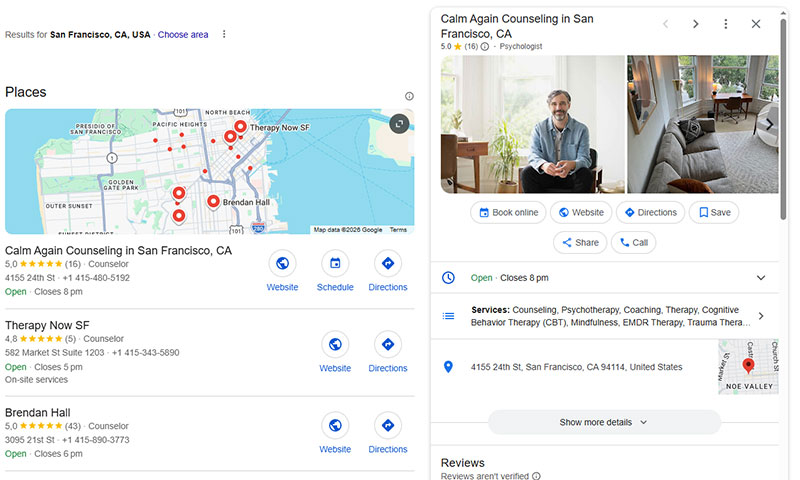
BrightLocal’s 2023 Local Consumer Review Survey found healthcare ranked among the top industries where consumers said reviews mattered most before choosing a provider, with 87% of shoppers overall using Google to evaluate a local business.
For a single-location practice, a Google Business Profile listing works differently from a directory profile, since it controls whether the practice shows up in the map pack for a local search at all.
Proximity is the biggest lever, plain distance between the practice address and whoever is searching. Category selection matters more than people expect too, since “psychotherapist” and “counselor” can rank differently for the exact same search term. And then there’s the review situation: volume and recency count for more than the star rating itself does.
A directory profile and a Google Business Profile aren’t competitors. They’re two separate surfaces a prospective client might land on before ever reaching the practice website.
Brighter Vision, a web design company built specifically for therapists, structures its sites around service-area pages for exactly this reason, one page per city or specialty a therapist wants to rank for locally.
How Referral Networks and Insurance Platforms Generate Therapist Leads
A warm referral shows up already vouched for, by a primary care physician, a psychiatrist, or a past client, and it tends to convert faster simply because the trust work already happened before the person even called. A cold lead carries none of that. It arrives through a directory, a search result, or an ad, with no prior connection to the practice at all.
Insurance-based platforms sit somewhere between the two.
Alma, Headway, Grow Therapy, and similar services credential a therapist with insurance panels and then route client inquiries directly into that therapist’s caseload, in exchange for a percentage of the session fee or a flat platform charge.
Insurance Panels vs. Private Pay
Taking on panels through one of these platforms bumps up inquiry volume almost right away, since it opens the door to the much bigger pool of people who need in-network care. Staying private pay trades that away: the fee per session stays higher and there’s no platform cut, but the pool narrows to people who can pay out of pocket or have out-of-network benefits worth the paperwork hassle.
Neither choice is a lead generation strategy on its own. It’s a decision about which lead sources are even reachable in the first place.
A therapist who builds a referral relationship with two or three primary care physicians in the same building often sees a steadier trickle of clients than one relying only on a directory listing, because the physician relationship keeps sending people long after any single directory campaign fades.
Does Niche Specialization Increase Therapist Lead Quality?
Niching down changes who finds a profile, not how many people see it.
A generalist profile is stuck competing against every other generalist in the same directory search, and that competition comes down to price and open slots more than anything else. Go narrow instead, and the competing pool shrinks a lot, plus the profile actually surfaces when someone filters specifically for that concern.
Choosing a niche is really an exercise in defining an ideal client avatar before writing a single line of profile copy.
Directories such as Zencare and TherapyDen already build their filtering systems around specialty tags, so a profile without a defined niche often gets buried under ones that have one.
There’s a real trade-off buried in here, though. A therapist newly licensed in a small town may not have the search volume to support a narrow niche yet, and staying generalist for the first year or two is a reasonable choice, not a marketing failure.
What Compliance Rules Govern Therapist Marketing
What a therapist can say in a directory profile, an ad, or a website testimonial gets constrained by more than one rulebook, and they don’t all come from the same body.
- HIPAA: restricts using any client information, including a name, photo, or session detail, in marketing without written authorization
- FTC endorsement rules: govern testimonials and reviews for every business in the country, therapists included
- Licensing board codes: add profession-specific limits, and most state boards for psychologists, counselors, and social workers prohibit soliciting testimonials from current clients
- Professional ethics codes: from bodies such as APA, ACA, and NASW, which restrict claims of guaranteed outcomes regardless of what a state board says
The FTC’s Final Rule on the Use of Consumer Reviews and Testimonials, effective October 21, 2024, authorizes civil penalties of up to $51,744 per violation for fake or incentivized reviews.
That rule applies to a therapy practice’s website the exact same way it applies to a retailer’s.
None of this bans marketing itself. It just narrows how a testimonial, an outcome claim, or a piece of client information gets used inside it.
How to Reduce Lead Drop-off During Intake and Booking

The intake stage loses more prospective clients than any directory or ad campaign ever will.
A slow reply, a PDF form that has to be printed and scanned, or a booking process that requires a phone call during business hours all push a ready lead straight back into searching.
- Reply to every inquiry within the same business day, ideally within a few hours
- Replace email or PDF intake with a ready-made template built for that first clinical intake
- Offer online scheduling so a client can book a consultation without waiting for a callback
- Send an automated reminder 24 hours before the first session to cut no-shows
- Follow up once, by text or email, if a lead goes quiet after the consultation call
Tools like Trafft or Amelia handle the scheduling piece on their own, syncing a therapist’s real availability so a lead never books a slot that isn’t actually open.
Most of what determines whether a form gets finished comes down to the same tactics used to raise completion rates on any web form, things like shorter field counts, clear labels, and a visible progress indicator on anything longer than a single page.
A waitlist should say when it typically clears, not just that it exists.
An open-ended “we’ll contact you” reads as a rejection to someone who reached out during a hard week.
How Much Does Lead Generation Cost for a Therapist Practice?
Cost per lead and cost per booked client are two different numbers, and mixing them up leads to bad channel decisions.
- WordStream’s 2024 Search Advertising Benchmarks put the average cost per lead for the Health & Fitness category at $61.56 on Google Ads, with a $4.71 average cost per click
- A directory listing runs $10 to $98 a month depending on the platform, regardless of how many leads it actually produces that month
- A referral relationship costs time rather than money, and converts at a rate high enough that most therapists rank it above every paid channel
The math that matters isn’t the sticker price.
It’s the price divided by how many of those leads actually become paying clients.
A $61.56 Google Ads lead that converts at a low rate can end up costing more per booked client than a $30 directory listing that converts at a much higher one, once the full month’s spend gets divided by actual bookings.
Reading a channel’s numbers against industry-by-industry conversion benchmarks shows whether a specific rate is normal for that channel, or a sign something on the practice’s end needs fixing.
When Lead Generation Strategies Do Not Work for a Therapist Practice
More leads aren’t always the goal, and treating them as one wastes money in a few predictable situations.
The APA’s 2023 Practitioner Pulse Survey found 69% of psychologists who keep a waitlist reported an average wait of up to three months for a first appointment, with 31% reporting waits even longer.
A practice already in that position doesn’t need more inquiries.
It needs a way to manage the ones it already has.
Lead generation is usually the wrong investment in a few specific situations.
- The practice is already running a waitlist longer than a few weeks
- The local market is saturated enough that a paid listing mostly reaches other therapists checking the competition, not clients
- A therapist is newly licensed and still practicing under supervision, where advertising options are often restricted by the supervising license
- The chosen niche is so narrow that local search volume can’t support a paid channel’s minimum spend
Open Path Collective sidesteps the whole question for its member therapists, since it runs on a sliding-scale referral model built around access rather than lead volume.
In each of these cases, the fix is capacity management or pricing, not another directory listing.
Which Therapist Directories Are Worth Paying For?
Picking a directory is really four separate decisions dressed up as one, since the major options differ enough in price and model that they barely compete with each other.
The broad $20 to $60 range mentioned earlier covers Psychology Today, GoodTherapy, and TherapyDen, but it undersells Zencare, whose full-service package runs well past that ceiling.
| Directory | Monthly Cost | Model |
|---|---|---|
| Psychology Today | $29.95 | Flat-fee listing, largest audience |
| GoodTherapy | $30.95 | Flat-fee listing, CE access on higher tiers |
| TherapyDen | $10 to $30 | Free basic tier, paid premium features |
| Zencare | $59 to $98, plus $130 setup | Vetted listing, photography included |
GoodTherapy’s own site lists its basic membership at $30.95 a month, with premium tiers running up to $49.95 and adding continuing-education access on top.
Multiple independent write-ups, including a Harvard course case study on digital health platforms, put Zencare’s rate at $59 to $98 a month, plus a one-time setup fee near $130.
Psychology Today has the largest audience of the four, though profile density in big metro areas makes standing out a lot harder than the raw traffic numbers suggest. GoodTherapy offers comparable reach, with the added bonus of continuing-education access bundled into its higher tiers.
TherapyDen is the cheapest entry point of the bunch, and probably the best place to start if a therapist just wants to test whether directories work at all before committing real budget elsewhere.
Zencare costs the most of the four. That’s mostly justified for therapists who want the included photography and don’t want to go source it separately.
Zocdoc sits slightly outside this comparison, since it charges no listing or subscription fee. Its model runs on pay-per-booking, layered on top of scheduling and insurance matching, rather than a profile-first directory experience.
FAQ on Lead Generation For Therapists
What counts as a marketing lead in a therapy practice context?
A lead is any contact who takes a trackable action toward booking, not just someone who visits a website. A form submission, a phone call, or a message through a directory profile all count. A page view alone doesn’t.
How does a directory’s internal search rank one profile above another?
Directories rank profiles using their own filters: completeness, specialty match, response rate, and sometimes tenure on the platform. Psychology Today and Zencare both prioritize profiles that answer inquiries quickly, which rewards active membership over a listing that’s been left untouched for months.
Is paid advertising worth it compared to free directory listings?
Paid ads convert faster but cost more per lead, often $60 or higher through Google Ads. Free directory listings take longer to gain traction but keep working after the ad budget runs out. Most practices end up running both at once.
How do you write content that generates leads without breaking advertising ethics rules?
Write in educational terms, not promises of outcomes. Describe a modality or concern treated rather than claiming a cure. Skip client stories entirely unless the client wrote them with documented consent, since licensing boards treat implied testimonials the same as stated ones.
How often should a directory profile or website be refreshed?
Update fees, availability, and specialties the moment they change, not on some fixed schedule. Beyond that, revisit the opening statement and photo once a year. A stale profile signals inactivity to both the directory’s algorithm and a person deciding whether to reach out.
Can a solo, private-pay therapist generate leads without social media?
Yes. Directories, referral relationships, and a local-search-optimized website cover most private-pay inquiries without a single post. Social platforms help with niche visibility and word of mouth, but they stay optional, not the load-bearing channel for most solo practices.
What response time to a new inquiry keeps a lead from moving to another therapist?
Same-day is the realistic floor, with a same-hour reply performing better whenever staffing allows it. Someone reaching out about therapy is often acting on a narrow window of readiness, and a multi-day delay reads as disinterest rather than a busy calendar.
What Should a Therapist Fix First in Lead Generation for Therapists?
Lead generation for therapists works best when a practice repairs response speed and its directory profile before adding any new channel, since a referral or a paid ad can’t convert if the intake process behind it still crawls.
SAMHSA’s treatment figure and the APA’s capacity figure, both already cited, point to the same gap from opposite sides. Demand already exceeds the openings therapists report, so a lead generation effort works by routing existing demand toward unfilled caseload capacity, not manufacturing more of it.
The order that actually works: response time and intake get fixed first, the directory profile gets strengthened second, and paid or referral channels come last, once those two are solid.
Fixing those two first delays niche-specific spend, so a generalist profile stays live a little longer while narrower positioning waits its turn.
The intake fix above depends on the form behind it, covered next in a guide to designing a form built for that exact request.