





A form is usually the last thing standing between a visitor and whatever you actually want them to do: buy something, sign up, ask a question. Optimizing that form means…
Table of contents
Gallup’s 2024 data shows only 31% of U.S. employees feel engaged at work. Annual surveys can’t catch that kind of decline fast enough.
Pulse surveys can. These short, frequent questionnaires give HR teams a real-time read on employee sentiment, from team morale to manager effectiveness to burnout risk. But the results are only as good as the questions you ask.
This guide breaks down practical examples of pulse survey questions across the categories that matter most: engagement, leadership, wellbeing, culture, career growth, communication, and change management. Each section includes ready-to-use questions, recommended response formats, and the research behind why specific question types work.
What Is a Pulse Survey?
A pulse survey is a short, frequent employee feedback tool. It typically contains 5 to 15 questions and runs on a weekly, biweekly, or monthly cadence.
Think of it as the opposite of the traditional annual engagement survey. Those long questionnaires take forever to complete, and by the time HR analyzes the data three months later, the workplace has already changed. New hires, new leadership, maybe even layoffs.
Pulse surveys fix that timing problem. They give organizations a real-time snapshot of workforce sentiment on specific topics, whether that’s team morale, manager support, or job satisfaction.
Gallup’s 2024 data found that U.S. employee engagement dropped to just 31%, a ten-year low. And 17% of employees were actively disengaged. Those numbers represent roughly 3.2 million fewer engaged workers compared to the previous year.
That kind of decline doesn’t happen overnight. It builds. And annual surveys are too slow to catch it.
Qualtrics research shows that 77% of employees want to give feedback more than once per year. Most prefer about four times annually. Pulse surveys meet that expectation without burning people out on 60-question marathons.
Platforms like Culture Amp, Lattice, Officevibe, and TINYpulse make it straightforward to set up automated pulse checks. Most let you customize question sets, schedule delivery, and track trends over time with built-in analytics. Peakon (now part of Workday) and Glint (now under LinkedIn) offer similar capabilities at the enterprise level.
The typical response rate for a pulse survey sits around 85%, compared to just 30-40% for traditional engagement surveys. Brevity helps. When you keep the questionnaire short and focused, people actually complete it.
But here’s the thing most organizations miss. Culture Amp CEO Didier Elzinga put it well: employees don’t have survey fatigue. They have lack-of-action fatigue. If nobody does anything with the results, participation drops fast regardless of how short the survey form is.
Employee Engagement Pulse Survey Questions
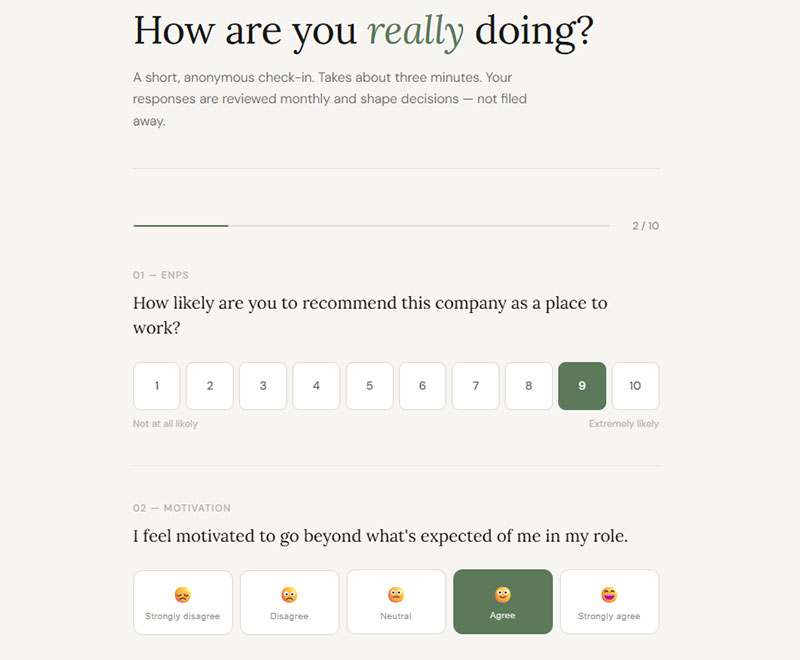
Engagement questions measure the emotional connection between employees and their work. They’re the foundation of any pulse survey program, and they should show up in almost every survey cycle you run.
Gallup’s Q12 framework is the most cited benchmark for measuring employee engagement. It covers twelve elements ranging from role clarity to having a best friend at work. You don’t need to use all twelve in a pulse survey. But pulling from that framework gives your questions research-backed credibility.
Here are engagement-focused pulse survey questions you can use directly:
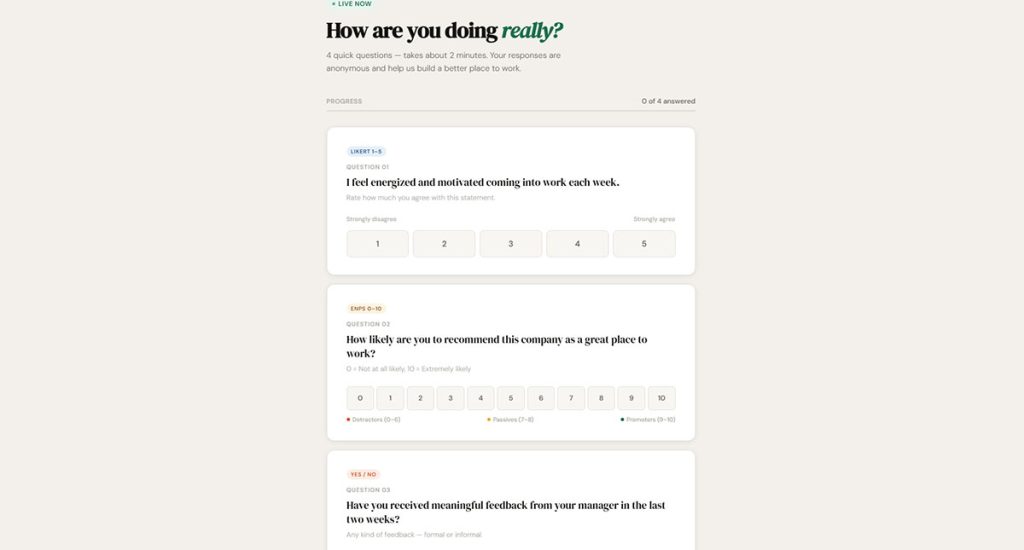
- “On a scale of 1-10, how likely are you to recommend this company as a place to work?” (This is the Employee Net Promoter Score question, or eNPS. It’s the single most tracked engagement metric across platforms like 15Five and Achievers.)
- “I feel motivated to go beyond what’s expected of me in my role.” (Likert scale, 1-5)
- “I’m proud to tell people where I work.”
- “I see myself still working here in two years.”
- “My work gives me a sense of personal accomplishment.”
- “I understand how my role contributes to the company’s goals.”
- “I feel valued for the work I do.”
- “I have the tools and resources I need to do my job well.”
- “I would rate my overall job satisfaction as high.” (1-5 scale)
- “What one thing would make your experience here better?” (Open-ended)
Monthly cadence works best for engagement questions. Weekly is too aggressive for this category and leads to survey fatigue. Quarterly is fine if you’re just getting started, but monthly gives you enough data points to spot trends before they become problems.
Gallup’s 2025 global report found that only 21% of employees worldwide were engaged in 2024, costing an estimated $438 billion in lost productivity. The gap between engaged and disengaged workers isn’t just a morale issue. It directly hits the bottom line. And the only way to track that gap in real time is through consistent, well-designed feedback survey questions.
Manager Effectiveness Pulse Survey Questions
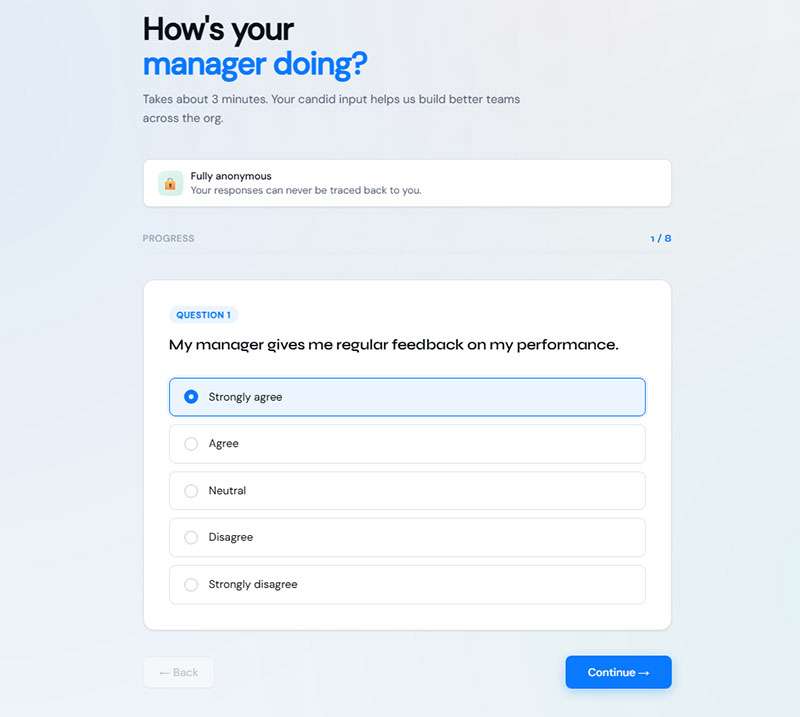
Managers account for 70% of the variance in team engagement, according to Gallup. That single statistic explains why manager-focused pulse questions deserve their own dedicated category.
Google’s Project Oxygen research confirmed this. The study analyzed over 10,000 data points from performance reviews and employee feedback surveys. The original goal was to prove that managers don’t matter. The data showed the opposite. Teams with highly effective managers were happier, performed better, and had lower turnover.
After implementing its eight-attribute manager development program, Google saw favorable employee ratings for managers rise from 83% to 88%.
Here are pulse survey questions that measure manager effectiveness:
- “My manager gives me regular feedback on my performance.”
- “I feel comfortable raising concerns with my direct manager.”
- “My manager recognizes my contributions in a meaningful way.”
- “My manager communicates expectations clearly.”
- “My manager supports my professional development.”
- “I receive enough one-on-one time with my manager.” (1-5 scale)
- “My manager treats all team members fairly.”
- “What could your manager do differently to better support you?” (Open-ended)
Annual reviews are too slow for catching management issues. By the time you learn that a specific team’s manager isn’t providing adequate support, half the team may already be looking elsewhere.
Gallup’s 2024 global data showed manager engagement itself fell from 30% to 27%. The biggest drops were among managers under 35 and female managers. When managers are disengaged, their teams follow. That cascade effect makes these questions some of the most actionable in your entire survey program.
One thing worth noting: always keep manager feedback anonymous. If employees suspect their responses can be traced back to them, you’ll get inflated scores that tell you nothing useful. Most WordPress survey plugins and dedicated platforms handle anonymity by default, but double-check your settings.
Work-Life Balance and Wellbeing Questions
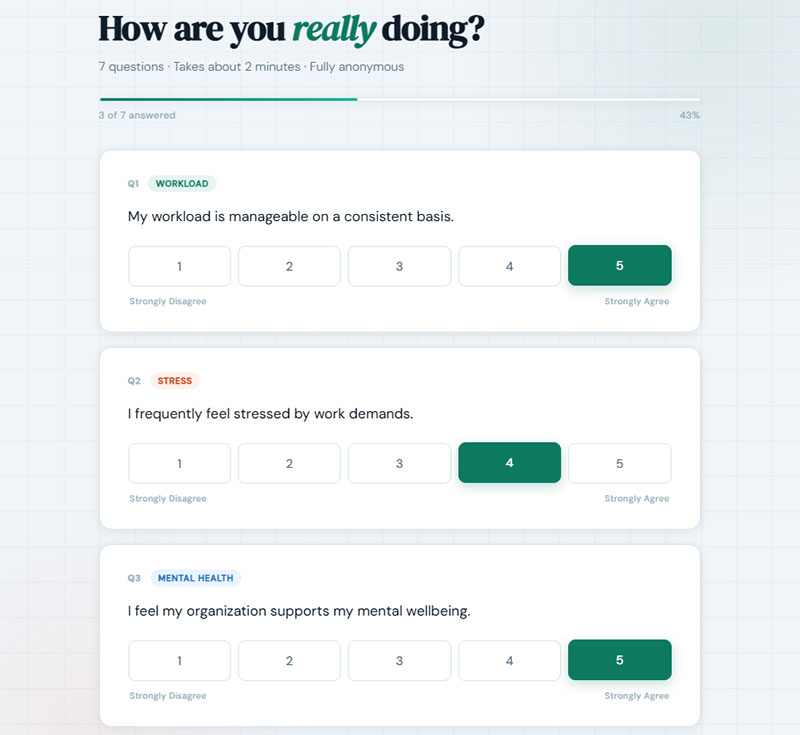
52% of employees reported feeling burned out in 2024, according to research published in the International Journal of Indian Psychology. Women reported burnout at 59%, compared to 46% for men.
The World Health Organization classifies burnout as a syndrome resulting from chronic workplace stress that hasn’t been successfully managed. It shows up as exhaustion, cynicism, and reduced professional effectiveness. Those three dimensions are exactly what wellbeing pulse questions should target.
These questions became standard in most pulse survey programs after 2020, and they’re not going away.
Additional wellbeing questions to consider:
- “I feel physically well enough to perform at my best.”
- “I have access to resources that support my mental health.”
- “My team respects boundaries around working hours.”
- “I’ve taken adequate time off in the past month.” (Yes/No)
- “Rate your overall wellbeing this week.” (1-10 scale)
BCG’s 2024 global study found that 48% of workers across eight countries are currently dealing with burnout. And here’s what’s tricky: burnout rates were roughly the same across remote, hybrid, and in-person workers. The work setting alone doesn’t explain it. Manager quality and workplace culture are what actually move the needle.
That’s why pairing wellbeing questions with manager effectiveness questions in the same survey cycle gives you a clearer picture. If one team reports high burnout and low manager support, you’ve found the problem. If you’re looking to build effective internal feedback forms that capture this kind of data, keep questions short and focused on observable behaviors rather than vague feelings.
Company Culture and Belonging Questions
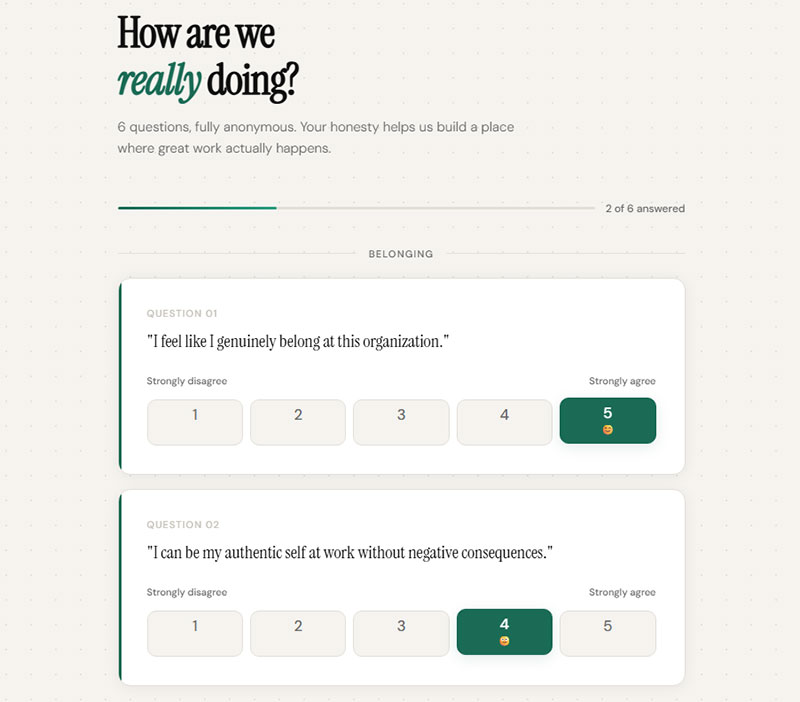
Culture questions are different from engagement questions. Engagement asks “how connected are you to your work?” Culture asks “how connected are you to this place and these people?”
Amy Edmondson’s research on psychological safety at Harvard is the framework most HR teams reference here. Her work showed that teams where people feel safe to take risks, admit mistakes, and speak up without fear of punishment consistently outperform teams where people stay quiet to protect themselves.
Gallup’s 2024 findings showed that only 39% of employees strongly felt that someone at work cares about them as a person, down from 47% in 2020. That eight-point drop signals a real erosion of belonging.
Pulse questions for measuring culture and belonging:
- “I feel like I belong at this organization.”
- “My team values different perspectives and backgrounds.”
- “I can be my authentic self at work without negative consequences.”
- “I trust my colleagues to support me when I need help.”
- “The company’s stated values match how things actually work here.”
- “I feel included in decisions that affect my work.”
How these differ from generic satisfaction questions: satisfaction questions ask whether someone is happy. Culture questions ask whether someone feels safe, included, and aligned. You can be satisfied with your paycheck and benefits while feeling completely disconnected from the team around you. Those are different problems requiring different solutions.
Gallup also found that only 46% of employees feel clear about what’s expected of them, down from 56% in early 2020. Lack of clarity feeds directly into cultural disengagement. When people don’t know what’s expected, they withdraw.
Gen Z employees were particularly affected. They showed a five-point decline in engagement compared to the prior year, with drops in clarity of expectations, recognition, and development opportunities. For organizations with a younger workforce, culture and belonging questions aren’t optional. They’re early warning systems.
If you’re running these surveys through a website, applying solid form design principles matters. Clean layouts, logical question grouping, and mobile-friendly formatting all affect completion rates, especially with younger respondents who will abandon a clunky form in seconds.
Career Growth and Development Questions
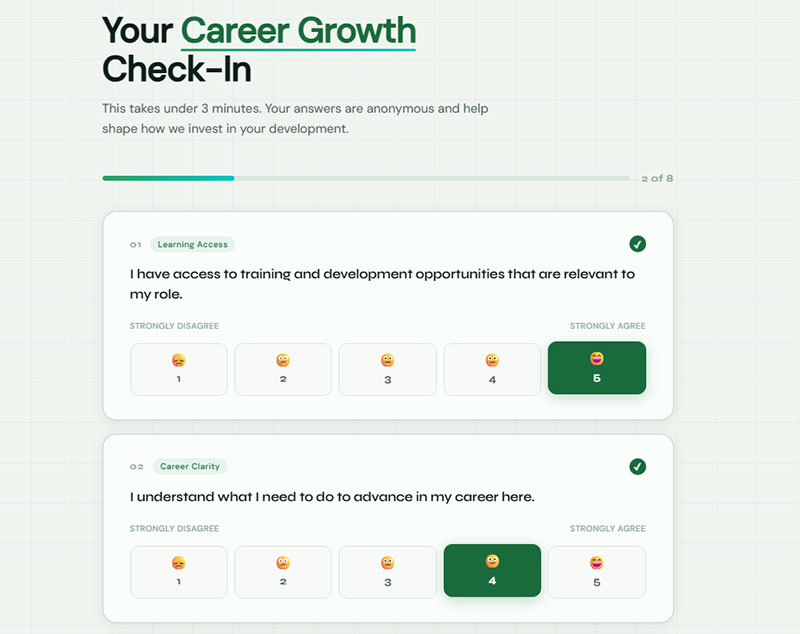
Career growth questions are leading indicators of voluntary turnover. By the time someone hands in their resignation, the decision was made weeks or months earlier. These questions catch that shift before it’s too late.
LinkedIn’s Workplace Learning Report consistently ranks learning and development as a top driver of employee retention. And it makes sense. People who feel stuck don’t stay. Took me a while to realize this wasn’t about offering more training courses. It’s about whether employees believe there’s a real path forward for them at the company.
Pulse questions focused on career growth and development:
Access to learning: “I have access to training and development opportunities that are relevant to my role.”
Career path clarity: “I understand what I need to do to advance in my career here.”
Manager involvement: “My manager has had a meaningful conversation with me about my career goals in the past three months.”
Skill development: “I’m building skills that will help me grow professionally.”
Opportunity perception: “I believe there are good career opportunities for me at this organization.”
Autonomy: “I have the freedom to explore new approaches and ideas in my work.”
And one open-ended question that pulls a lot of weight: “What skill would you most like to develop in the next six months?”
Gallup’s data showed that only 30% of employees believe someone at work encourages their development, down from 36% in 2020. That six-point drop is significant, because development-focused conversations are one of the strongest predictors of whether someone stays or leaves.
The University of Phoenix Career Optimism Index found a mismatch worth paying attention to: most employers say they offer career development opportunities, but employees don’t share that perception. Pulse surveys can surface that gap before it turns into a retention crisis.
Workers under 35 are especially sensitive to this category. Gallup’s 2024 report noted that younger employees showed notable declines in feeling like they have opportunities to do what they do best. If your organization skews younger, run career growth questions at least quarterly.
One practical tip: pair these questions with different types of survey questions to get both quantitative scores and qualitative insights. A Likert scale tells you the problem exists. An open-ended response tells you what to actually do about it.
Communication and Transparency Questions
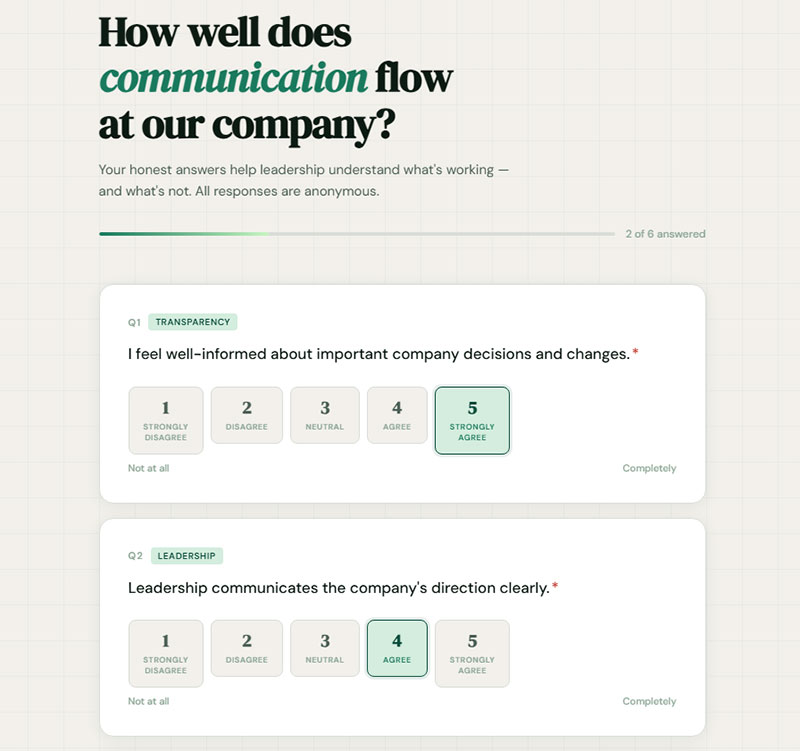
Communication breakdowns show up in pulse survey data long before they show up in exit interviews. That’s what makes this category so useful. Structured interview process feedback collected consistently across your team reduces bias and improves hiring quality over time.
Forbes Advisor’s State of Workplace Communication report found that over 40% of workers say poor communication erodes their trust in leadership. For remote workers, that number climbs even higher, with 54% reporting a trust gap tied directly to communication issues.
Here are pulse survey questions that measure communication and organizational transparency:
- “I feel well-informed about important company decisions and changes.”
- “Leadership communicates the company’s direction clearly.”
- “I have access to the information I need to do my job effectively.”
- “My team communicates openly and honestly with each other.”
- “When decisions are made, I understand the reasoning behind them.”
- “I feel comfortable sharing ideas or concerns with leadership.” (1-5 scale)
Grammarly’s 2024 State of Business Communication report found that miscommunication costs U.S. businesses roughly $1.2 trillion annually. That’s not a typo. And most of that cost comes from wasted time, stalled projects, and lost talent.
Why these questions matter right now: Gallup data shows only 23% of U.S. employees strongly agree they trust their organization’s leadership. But when leaders communicate clearly and inspire confidence in the future, 95% of employees say they fully trust their leaders. The gap between those two numbers is entirely a communication problem.
Microsoft ran into this during its 2023 layoffs. Internal pulse data reportedly showed communication scores dropping weeks before the formal announcements. Teams that received direct, honest updates from their managers maintained higher engagement scores than teams that learned about changes through external news coverage. The lesson: people don’t need good news. They need clear, honest information.
One practical consideration. If you’re collecting open-ended responses in this category, solid form validation prevents incomplete or garbled submissions that waste everyone’s time.
Change Management and Adaptability Questions
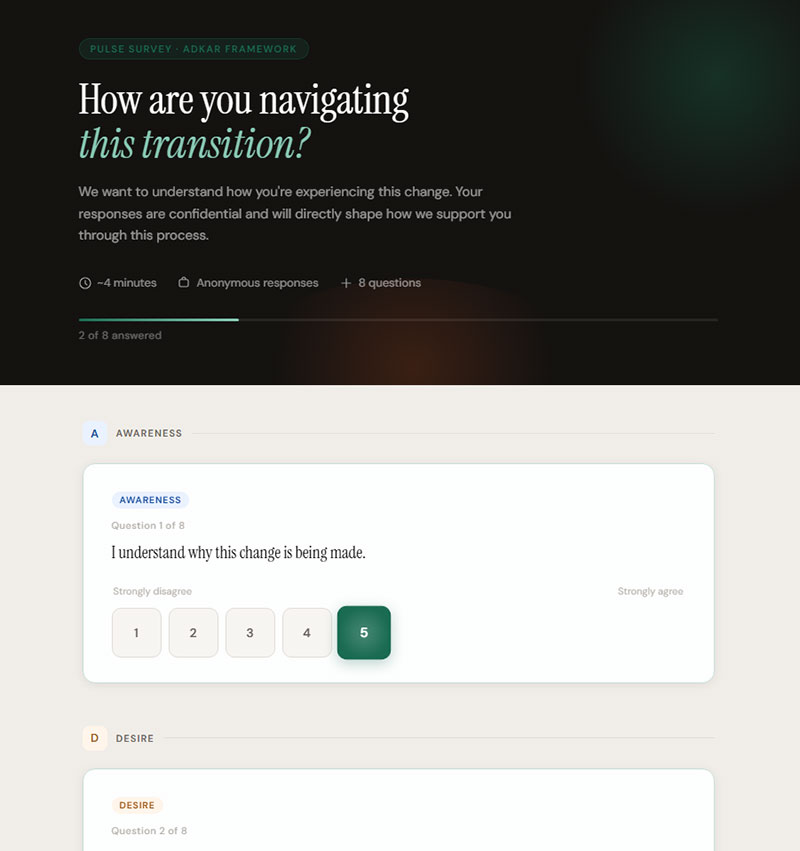
These are not questions you run every month. They’re situational, designed for specific moments: restructuring, mergers, new technology rollouts, leadership transitions, or major policy shifts.
McKinsey’s data shows that 70% of change programs fail to hit their goals, mostly because of employee resistance and weak management support. Pulse surveys during transitions help you spot that resistance early enough to actually do something about it.
The Prosci ADKAR Model provides a useful framework for designing change-related questions. ADKAR stands for Awareness, Desire, Knowledge, Ability, and Reinforcement. Each element maps to a specific question type:
Additional change-focused questions worth including:
- “I feel confident in the organization’s ability to manage this transition.”
- “My manager has been helpful in guiding me through this change.”
- “What would help you feel more prepared for this change?” (Open-ended)
Gartner research found a telling disconnect: 74% of leaders say they involve employees in change strategy, but only 42% of employees feel they were truly included. Pulse surveys during change initiatives close that gap by giving workers a direct channel to flag concerns.
Prosci’s own research shows that nearly 75% of organizations expect more change initiatives over the next three years. That means the workforce is going to face continuous transition. Running pulse checks during those periods isn’t optional. It’s how you keep people from burning out or checking out entirely.
If you’re building these surveys on a website, using conditional logic lets you show different follow-up questions based on how someone responds. That way you collect more targeted data without making the survey longer for everyone.
How to Choose the Right Pulse Survey Questions
You have hundreds of potential questions now. The hard part isn’t finding questions. It’s picking the right five to ten for each survey cycle.
Mapping Questions to Survey Goals
Start with your current business priority, then work backward to the question category that matches.
Rotate question sets across cycles instead of asking everything at once. Keep each pulse survey to 5-10 questions maximum. Achievers’ Engagement and Retention Report found that 41% of employees surveyed more than four times a year report being very engaged. Frequency works, but only when surveys stay short.
SurveyMonkey data shows that nearly 48% of respondents are willing to spend just 1-5 minutes on a feedback survey. Anything longer and completion rates drop fast. That’s your ceiling.
Common Mistakes That Reduce Response Rates
Asking too many questions: Pointerpro’s research found a 17% drop in response rate when surveys exceed 12 questions or take longer than 5 minutes.
Never acting on results: This is the biggest killer. Culture Amp’s CEO calls it “lack-of-action fatigue.” Your third survey will get half the responses of your first if people don’t see changes between cycles.
No anonymity guarantee: Employees who worry about being identified will give you inflated scores. Useless data dressed up as positive results.
Survey timing: Sending pulse surveys on Monday mornings or Friday afternoons consistently produces lower participation. Mid-week, mid-morning tends to perform best.
If you’re looking to reduce abandonment, applying strategies for avoiding survey fatigue makes the biggest difference. Keep questions tight. Show a progress bar. And always, always close the loop on what you learned.
Pulse Survey Question Scales and Response Formats
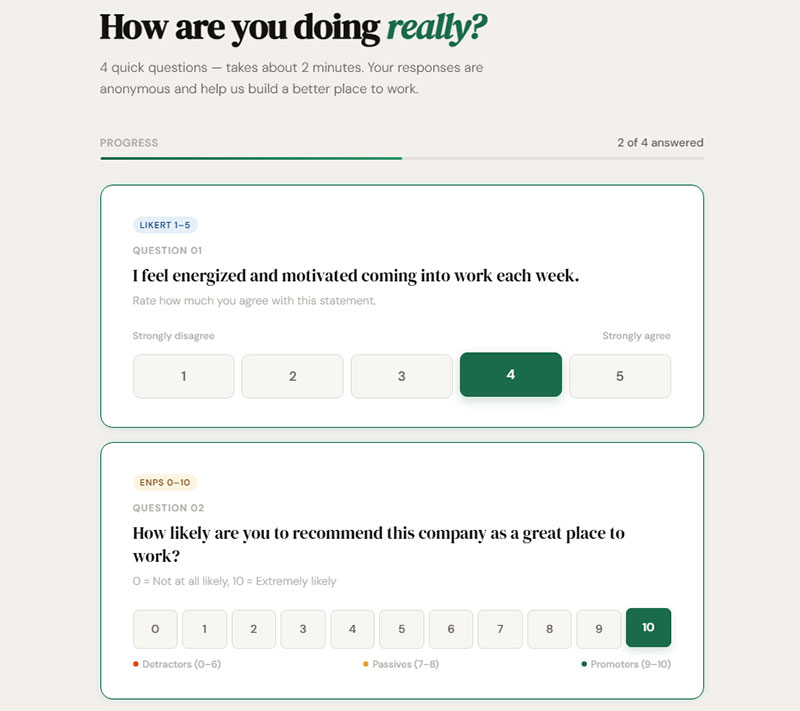
The way you frame answer options changes the quality of data you get back. Not all response formats work equally well for every question type.
Likert scale (1-5 agree/disagree) is the most common format for pulse surveys. It’s fast, familiar, and gives you clean quantitative data you can track over time. Most platforms including Culture Amp, Qualtrics, and Lattice default to this format.
eNPS (0-10 recommendation scale) works specifically for the question “How likely are you to recommend this company as a place to work?” Respondents split into three groups: Promoters (9-10), Passives (7-8), and Detractors (0-6). Hive HR’s research shows the overall eNPS benchmark for Q3 2024 reached 27, with smaller companies (under 250 employees) averaging around 30.
Binary yes/no works for specific behavioral questions. “Did you take adequate time off this month?” or “Have you received feedback from your manager in the last two weeks?” These are fast to answer and simple to analyze when reviewing survey data.
Open-ended text fields pull qualitative depth that scales can’t capture. But use them sparingly. One or two per survey, maximum. Place them at the end. Survicate’s analysis found that completion rates drop noticeably with each additional question, and open-ended prompts take the most effort to answer.
Mix your formats within each survey. Two or three Likert questions, one eNPS if relevant, one open-ended prompt. That combination gives you both quantitative trends and qualitative context without burning through people’s patience.
And if you’re running surveys through your own site rather than a dedicated platform, think about form UX design from the start. Clean labels, clear progress indicators, and mobile-friendly layouts all contribute to better completion rates. Your mileage may vary depending on your audience, but these basics apply everywhere.
FAQ on Examples of Pulse Survey Questions
What is a pulse survey?
A pulse survey is a short, frequent employee feedback tool. It typically contains 5 to 15 questions and runs weekly, biweekly, or monthly. Unlike annual engagement surveys, pulse checks capture real-time workforce sentiment on specific topics like morale, satisfaction, or manager support.
How many questions should a pulse survey include?
Keep it between 5 and 10 questions per cycle. Pointerpro research shows response rates drop 17% when surveys exceed 12 questions or take longer than five minutes. Shorter surveys consistently get better completion rates and more honest answers.
What types of questions work best in pulse surveys?
Mix Likert scale questions (1-5 agree/disagree) with one or two open-ended prompts. Include an eNPS question quarterly for loyalty tracking. Binary yes/no questions work well for behavioral check-ins like “Did you receive manager feedback this month?”
How often should you run pulse surveys?
Monthly is the sweet spot for most organizations. Weekly can cause survey fatigue. Quarterly works for getting started but limits your ability to spot trends early. Qualtrics data shows most employees prefer giving feedback about four times per year.
What is the difference between a pulse survey and an engagement survey?
Engagement surveys are long (40-60 questions), run annually, and cover broad topics. Pulse surveys are short, frequent, and focused on specific areas. Pulse surveys have an average response rate of 85% compared to 30-40% for traditional engagement surveys.
What are good pulse survey questions about manager effectiveness?
Ask about feedback frequency, recognition, communication clarity, and support. Questions like “My manager communicates expectations clearly” or “I feel comfortable raising concerns with my direct manager” align with Google’s Project Oxygen research on effective management behaviors.
How do you measure employee wellbeing through pulse surveys?
Focus on workload sustainability, stress levels, and mental health support. Questions like “My workload is manageable on a consistent basis” target the three burnout dimensions defined by the World Health Organization: exhaustion, cynicism, and reduced effectiveness.
What is an eNPS question in a pulse survey?
The Employee Net Promoter Score question asks: “On a scale of 0-10, how likely are you to recommend this company as a place to work?” Scores categorize employees as Promoters (9-10), Passives (7-8), or Detractors (0-6).
How do you avoid survey fatigue with pulse surveys?
Keep surveys under 10 questions. Rotate question sets across cycles instead of repeating the same ones. Most critically, act on the results. Culture Amp’s CEO points out that employees don’t tire of surveys. They tire of nothing changing afterward.
What tools are best for running pulse surveys?
Platforms like Culture Amp, Lattice, Officevibe, 15Five, and Qualtrics handle automated distribution, anonymity, and trend tracking. For smaller teams, SurveyMonkey or even a well-built web form with proper question design can work.
Conclusion
The right examples of pulse survey questions give you a direct line into what your workforce actually thinks. Not what you assume. Not what annual data told you six months ago.
Whether you’re tracking employee satisfaction, measuring psychological safety, or flagging burnout risk with wellbeing questions, the key is matching your question categories to real business priorities. High turnover? Focus on career development and manager feedback. Post-merger chaos? Run ADKAR-aligned change management checks.
Keep surveys short. Five to ten questions. Rotate topics across cycles. Use a mix of Likert scale ratings, eNPS scoring, and open-ended prompts to capture both trends and context.
And act on what you learn. That’s the part most organizations skip, and it’s the only part that actually moves engagement scores. Your employees will tell you what’s broken. The question is whether you’re listening.