



Most independent coaches never sit through a single sales training. They figure out client acquisition the hard way, usually right after a slow month makes it obvious that referrals and…
Table of contents
A typical B2B software purchase now involves an average of 11 stakeholders, according to Gartner’s B2B buying research, which is why one form fill rarely signals a buyer who is ready to close.
Free trials, live demos, and a technical vetting process do the qualifying instead, replacing the single-touchpoint purchase you’d see in most other B2B categories.
Marketing and sales share the job of tracking each of those stakeholders as they move from a first blog post read to a scored, qualified account a rep can actually work.
What Is Lead Generation for Software Companies?
Compare it to how a marketing agency or a plumber generates leads and the differences show up fast. The qualification bar sits a lot higher here than it does for most service businesses, since the buyer isn’t deciding based on a phone call and a gut feeling.
A form fill on a software site rarely means someone is ready to buy. More often it means someone just kicked off a research project that could stretch on for weeks.
The sales cycle stretches too, because more than one person has to sign off before a deal closes. A developer tests the product and a manager signs off on the budget, then procurement still has to run its security review before any of it becomes real.
What Lead Generation for Software Companies Is Not
It isn’t buying an email list and blasting a pitch to everyone on it.
That approach torches domain reputation fast. Software buyers report unsolicited pitches as spam more often than most other audiences do.
A few things fall outside the definition. Cold list blasts with no segmentation or ideal customer profile behind them don’t count. Neither do brand awareness campaigns with no way to actually capture anyone, or sales activity metrics like calls made, unless a real qualified contact comes out the other end.
It also sits inside a bigger discipline. The line between lead generation and demand generation matters here, since demand generation builds market awareness long before anyone is ready to fill out a form.
At a category level, what counts as a lead in the first place looks different across industries. Software buyers leave a very different trail than someone requesting a plumbing quote.
How the Software Lead Generation Funnel Works
A visitor moves from first contact to signed contract across three broad stages, and mixing up what each stage is supposed to produce is one of the most common reasons a funnel stalls before revenue shows up.
Top, Middle, and Bottom of the Funnel
Awareness content, SEO articles, and paid social sit at the top of the funnel, pulling in people who’ve never heard of your product before.
Once someone starts actively comparing options, they move into the middle, where gated whitepapers, comparison pages, and webinar signups do the work.
By the bottom, a prospect is close enough to a decision that they’re requesting demos, signing up for free trials, and reading your pricing page line by line.
Most software companies leak the most volume moving prospects from the middle into the bottom, right where content stops doing the work and a human has to take over.
Marketing Qualified Lead vs Sales Qualified Lead
A marketing qualified lead just needs to show enough interest to be worth a second look, usually by downloading something, signing up for a webinar, or starting a trial.
A sales qualified lead has cleared a higher bar. Budget, authority, and timeline have all been checked, and a rep has actually agreed to work the account.
| Stage | Trigger | Owned by |
|---|---|---|
| MQL | Content download, webinar signup, trial start | Marketing |
| SQL | Budget, authority, and timeline confirmed | Sales |
Healthy B2B software programs convert between 13% and 25% of MQLs into SQLs, according to Breadcrumbs’ 2026 benchmark data.
A number well below that range usually means marketing and sales are working from different definitions of “qualified,” not that the leads themselves are bad.
Buyer Personas in Software Lead Generation
Software deals rarely close through one contact. A buying committee usually includes someone who’ll use the product every day, someone who controls the budget, and someone pushing the deal forward internally when your team isn’t around.
Technical Buyer, Economic Buyer, and Champion
The technical buyer tests the product for fit, pokes at the integrations, and flags anything that looks like a security or compliance problem.
Money decisions run through the economic buyer, and what they need isn’t a feature list. It’s a business case.
Then there’s the champion, the person inside the account who keeps pushing the deal forward whether or not your team is in the room that week.
Mixing these roles up is a quiet killer. Pitch ROI to a developer, or feature depth to a CFO, and you lose the room fast.
The fields on your capture form decide how early you can tell these personas apart. Choosing the right form fields for capturing high-quality leads means asking for role and company size upfront, not just an email address.
Which Lead Generation Channels Work Best for Software Companies
No single channel carries a software company from zero to a full pipeline on its own.
The right mix depends on deal size, how long the sales cycle runs, and whether the product basically sells itself or needs a rep in the room for every step.
| Channel | Typical cost level | Sales cycle | Best fit |
|---|---|---|---|
| Outbound prospecting | Moderate to high | Longer | Enterprise, complex deals |
| Inbound content | Low to moderate | Longer, compounding | Established brands, SEO-driven pipeline |
| Paid acquisition | High | Short to moderate | Fast pipeline, well-funded teams |
| Referral programs | Low | Short | Existing customer base |
| Product-led growth | Low per lead, high in engineering | Short, self-serve | SaaS with a usable free tier |
Outbound Prospecting
Outbound means finding the right contact and reaching out before they’ve raised a hand.
- Prospecting data from Apollo.io, ZoomInfo, or Cognism
- Cadence tools like Outreach or Salesloft to sequence emails and calls
- LinkedIn Sales Navigator for direct social outreach
This earns its cost with enterprise accounts matching a tight ideal customer profile, where a handful of the right names matters more than volume. Cold calling still gets a foot in the door that email alone can’t manage.
Inbound Marketing and Content
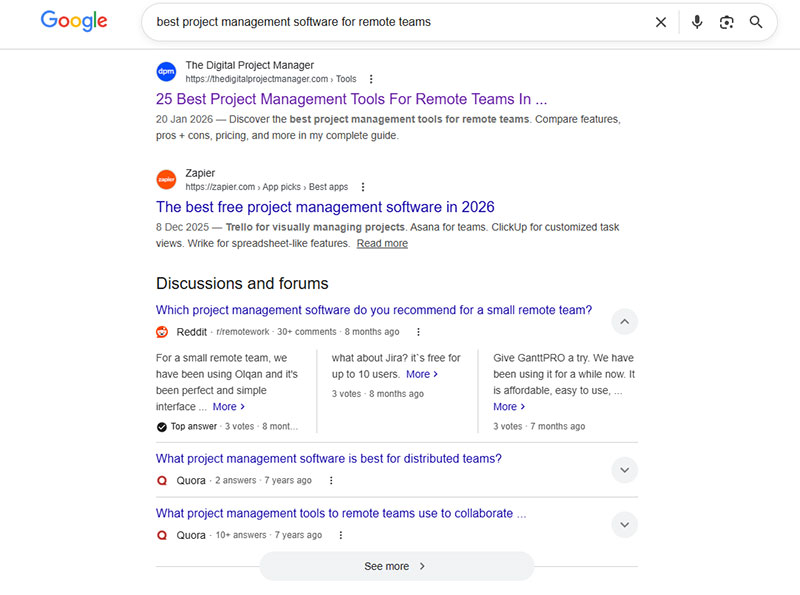
Inbound content pulls prospects in through search instead of interrupting them.
- Blog posts built around how buyers actually search
- Comparison and alternative pages
- Technical guides and whitepapers behind gated content forms
It’s slower to build than a paid campaign, and it takes a while before it produces anything at all. But once it’s live, it keeps generating leads long after you’ve stopped thinking about it.
Paid Acquisition
Google Ads and LinkedIn ads buy speed. Turn on a campaign and you’ll see form fills within days, something outbound and organic content just can’t match. Retargeting ads help pull back the visitors who didn’t convert the first time around.
The tradeoff shows up fast in the bill. Paid channels carry the highest cost per lead of any option on this list.
Fast pipeline. Expensive pipeline.
Referral Programs
A referral from an existing customer shows up already qualified, more or less. Trust is already there, and the sales cycle usually shortens because the champion role is half filled before the first call even happens.
It’s the cheapest lead source most software companies have. Probably the most underinvested one too.
Product-Led Growth
Product-led growth lets the product do the selling before a rep ever gets involved.
- Usage limit reached on the free tier
- A needed feature sits behind a paid plan
- Seat count grows past what the free plan allows
Any one of those moments hands sales a warm signal instead of a cold list. This motion sits at the center of how lead generation works for SaaS companies specifically, since the free trial itself becomes the top of the funnel.
Account-Based Marketing
Account-based marketing flips the funnel around. Instead of chasing individual leads, it targets a named list of accounts with coordinated ads, outreach, and content all pointed at the same handful of companies.
- 6sense and Demandbase for account-level intent data
- Clearbit for firmographic enrichment tied to those target accounts
Outreach lands closer to the moment an account actually starts researching, instead of guessing at timing and hoping you got lucky.
Buyer Discovery Platforms
Software buyers do their own research long before a rep ever hears from them.
- G2 and Capterra for peer reviews and side-by-side comparisons
- Gartner Peer Insights and Magic Quadrant reports for enterprise shortlists
These platforms shape the shortlist before a demo ever gets booked. Product Fruits, a SaaS company, shifted ad budget toward G2’s intent-targeting placements to reach buyers who were already comparing tools in its category.
Lead Qualification Frameworks for Software Sales
A framework gives the team a shared definition of “qualified,” so reps stop burning time on leads that were never going to close.
MEDDIC and BANT are the two most common options in software sales, and they fit different deal sizes.
MEDDIC
MEDDIC stands for Metrics, Economic Buyer, Decision Criteria, Decision Process, Identify Pain, and Champion. It came out of Parametric Technology Corporation in 1996, built by a sales team that kept losing deals despite having a genuinely strong product.
- Metrics: the measurable business outcome the buyer expects
- Economic buyer: the person who actually controls the budget
- Decision criteria and process: how the buyer will evaluate and approve the purchase
- Identify pain: the specific problem creating urgency right now
- Champion: the internal advocate selling on your behalf when you’re not there
Patra, a client of sales training firm Force Management, saw win rates rise 143% and average deal size grow 48% after adopting the framework.
MEDDIC works well for complex, multi-stakeholder deals, and it sharpens forecast accuracy for the whole sales enablement function. The downside is that it’s heavier to run, and honestly overkill for a deal that closes in two calls.
BANT
BANT is lighter. Budget, Authority, Need, Timeline: four questions, one pass, move on. That’s the whole appeal for a shorter sales cycle and a smaller deal.
It’s fast to apply, and you can train a new SDR on it in a single day. What it misses is the internal politics that MEDDIC is built to surface, so it can misjudge a genuinely complex account without anyone noticing until the deal stalls.
Lead Scoring Models
A lead scoring model turns fit and intent signals into a single number, so reps know which leads deserve a call first.
- Job title and seniority
- Company size and industry
- Pages visited and content downloaded
HubSpot, Marketo, and Pardot automate most of this weighting, which cuts down on the manual triage an SDR would otherwise do by hand.
Technology Stack for Software Lead Generation
The tools in a lead gen stack mostly do one of four things: capture a contact, store it, enrich it, or reach out to it.
On the marketing site itself, most software companies capture leads through WordPress lead generation plugins, since a large share of B2B marketing sites still run on WordPress.
Some replace or supplement forms with live chat. The choice between a chatbot and a traditional form usually comes down to whether a visitor wants an instant answer or is fine filling in details and waiting for a reply.
CRM Platforms
The CRM is the system of record for every contact and every deal stage.
- Salesforce for larger, more complex pipelines
- HubSpot for lighter, faster setup
43% of go-to-market teams run Salesforce as their core CRM, according to a 2025 Ascend2 survey of 379 B2B professionals.
Data Enrichment and Prospecting Tools
Raw contact data goes stale fast, so most teams layer enrichment on top of the CRM.
- ZoomInfo and Cognism for verified contact and firmographic data
- Apollo.io and Lusha for prospecting and outreach lists
- Clay and Clearbit for enriching records automatically as new contacts come in
Sales Engagement and Outreach Tools
Sales engagement tools run the cadences, the sequences of emails, calls, and LinkedIn touches that move a prospect toward a reply.
- Outreach and Salesloft for larger sales teams running multiple sequences at once
- Instantly and Lemlist for lean teams running high-volume cold email
Email deliverability suffers fast when volume outpaces personalization, no matter which tool sends the message.
Marketing Automation Tools
Marketing automation handles the nurture side, the emails that keep a lead warm between the first download and the first demo.
- Marketo and Pardot for enterprise-scale nurture programs
- Mailchimp and HubSpot for small and mid-market software companies
Cost and Conversion Benchmarks for Software Lead Generation
Cost and conversion numbers only mean something next to a benchmark. A few figures matter more than the rest here.
Cost Metrics
Software development leads average just under $600 per lead (Sopro, 2025), while B2B SaaS leads average around $188 per lead, roughly a third of that (Sopro, 2025).
The gap tracks deal size and sales cycle length, not just an industry label. Custom software and on-premise deals tend to run longer, more technical sales cycles than subscription SaaS, and that’s what pushes their cost per lead higher.
Conversion Metrics
18.5% is the median trial-to-paid conversion rate for B2B SaaS, based on First Page Sage’s dataset of 86 SaaS companies collected between 2022 and 2025.
Top-quartile performers convert between 35% and 45% of trials, largely on faster time to value in the first week.
Opt-in trials, the ones that don’t ask for a credit card, pull in a much bigger top of funnel, though the average conversion rate comes in lower as a result. Ask for a card upfront instead and the funnel shrinks, but whoever’s left tends to convert at a noticeably higher rate.
These figures shift by vertical and company stage, which is why conversion rate benchmarks broken out by industry are more useful than one blended average, and why a rising churn rate downstream can quietly undo a strong trial conversion number.
Companies running lead generation for SaaS companies specifically should track this number against their own trial model, since opt-in and opt-out trials convert at very different rates.
Compliance Rules for Software Lead Generation Outreach
Two regulations shape almost every outbound and capture decision a software company makes, and getting either one wrong shows up long after the campaign is already done.
GDPR
GDPR covers any prospect based in the EU, no matter where your company is headquartered.
- Consent has to be specific, not bundled into a generic terms checkbox
- Prospects can request their data be deleted at any time
- Storing a contact for outbound without a lawful basis is a violation, not a gray area
Since 2018, EU regulators have issued 2,225 GDPR fines totaling roughly €4.48 billion, with the average fine sitting near €2.14 million, according to the GDPR Enforcement Tracker’s 2024 report.
Building the consent language into the form itself is easier than bolting it on later. Setting up GDPR compliant forms from the start avoids a rebuild once legal flags the gap.
Looking at how other sites word their consent checkboxes is a faster way to get the language right than drafting it from scratch.
CAN-SPAM
CAN-SPAM covers commercial email sent to US contacts, and it works differently from GDPR’s consent model.
- A working unsubscribe link is required in every commercial email, not just newsletters
- Unsubscribe requests have to be honored within 10 business days
- The “from” line and subject line can’t misrepresent who is sending the message
Cold outbound is actually legal under CAN-SPAM even without prior consent, which is the opposite of how GDPR treats that same email.
Running both regimes off one email list is the mistake most teams make. Segment by region before a single cold email goes out, not after a complaint arrives.
How to Build a Software Lead Generation Process Step by Step
Most of the process work happens before the first campaign ever launches. Skip a step here and the whole funnel above it inherits the gap.
- Define the ideal customer profile. Company size, industry, and the specific problem your product solves, before picking a single channel.
- Set up the CRM and scoring model. Every channel needs somewhere to land, and every lead needs a way to get ranked once it does.
- Build the capture layer. Landing pages, gated assets, and demo request forms tied to the ICP from step one.
- Launch channels in sequence, not all at once. Test one channel long enough to read its cost per lead before adding a second.
- Set the marketing-to-sales handoff criteria. Write down what counts as sales-ready, so a lead doesn’t sit unclaimed in a shared inbox.
- Review funnel metrics on a fixed cadence. Weekly for volume, monthly for conversion rate between stages.
Optimizing the capture forms at step three tends to pay off faster than adding a new channel. Small changes that increase form conversions often move the needle more than a bigger ad budget.
Step six only works if you know what you’re tracking. The lead generation KPIs worth tracking narrow that list down to the handful that actually predict revenue.
Rook, a B2B SaaS company selling into regulated enterprise verticals, cut its sales cycle from twelve months to 95 days by shifting its lead mix toward inbound-sourced deals instead of pure outbound.
Common Mistakes That Break Software Lead Generation Programs
Most broken programs aren’t broken because the channels are wrong. They’re broken because of what happens after a lead actually shows up.
Chasing volume over fit is the most common one. A spike in MQLs feels like progress until none of them convert to SQLs, and the sales team starts ignoring marketing’s list entirely.
Skipping a qualification framework causes a similar problem from a different angle. Without MEDDIC, BANT, or even a simple scoring model, reps end up working every lead with equal urgency, and the best ones wait in line behind the worst ones.
Slow follow-up costs more than most teams realize. Responding within 5 minutes makes a lead 21 times more likely to qualify than waiting 30 minutes, according to the MIT and InsideSales Lead Response Management Study. Most software companies don’t miss that window because reps are lazy. They miss it because no one owns lead routing, so a hot demo request sits in a shared inbox until someone happens to check it.
Ignoring form abandonment quietly bleeds volume too. A capture form asking for ten fields before a prospect has seen any value will lose people before they ever hit the CRM. Cutting the friction that drives form abandonment usually recovers more volume than any new ad spend.
Running outbound without a compliance check does the most damage in the least time. One flagged domain from an aggressive cold email push can tank deliverability for every legitimate campaign running behind it.
When Lead Generation Does Not Work for Software Companies
Lead generation fails under a few specific conditions, worth naming plainly.
Without a defined ideal customer profile, targeting collapses before channel selection even matters. Every channel needs a profile to aim at, and without one you’re just guessing.
Products that haven’t found product-market fit yet run into a different problem: leads convert, then churn within a month, because the product hasn’t earned the retention that makes the acquisition spend worthwhile.
No qualification process on the sales side means lead volume outpaces the team’s ability to follow up, and speed to lead collapses under its own backlog.
Long enterprise procurement cycles are the hardest one to fix, because the timeline itself is the problem. The average enterprise sales cycle stretched from 6.4 months in 2015 to 9.3 months by 2023, according to Forrester Research’s B2B Buying Study, which means a lead generation program needs a year of runway before its ROI becomes visible.
Deals that drag past that window close at markedly lower rates than fresh pipeline, and a large share of them end in “no decision” rather than a loss to a named competitor.
None of this means lead generation is the wrong investment. It means the timeline and the qualification bar have to match the deal, not the other way around.
FAQ on Lead Generation For Software Companies
What is the difference between lead generation and demand generation for software companies?
Demand generation builds market awareness and trust before anyone is ready to buy, often through content and community.
Lead generation for software companies converts that awareness into named contacts through trials, demos, and gated assets once a prospect starts evaluating options.
Should software startups start with outbound or inbound lead generation?
Outbound reaches a tight ideal customer profile fast, which suits an early product with a narrow niche.
Inbound content compounds slower but keeps producing free trial signups long after launch.
Most startups end up blending both once the first few paying customers validate the message.
How does lead generation differ between SaaS, enterprise software, and early-stage startups?
SaaS leans on product-led growth and a self-serve free trial. Enterprise software depends on outbound prospecting, MEDDIC-style qualification, and a full buying committee instead.
Early-stage startups run leaner than either, favoring founder-led outbound and community-driven inbound before a repeatable playbook even exists.
What Should You Fix First in Lead Generation for Software Companies?
Fix the qualification framework before expanding the channel mix. A MEDDIC or BANT gap wastes every lead a new channel produces, so pouring more budget into acquisition before that’s solved just means burning cash faster.
A few things need fixing before adding budget to a new channel:
- A shared qualification framework and lead scoring model
- A documented marketing-to-sales handoff, so no lead sits unclaimed
- Channel-level cost per lead and conversion tracking before scaling spend
Tightening qualification first slows lead volume for a quarter, and that’s the trade a team accepts for a pipeline that actually converts instead of one that only looks full.
The next practical step is designing the lead capture forms that sit under every channel covered here, since a qualified funnel still stalls at a form asking for too much too soon.