








A new client doesn’t sign with an accounting firm because a landing page convinced them. They sign because someone they trust vouched for the firm, or because the firm showed…
Table of contents
A financial advisor with a full calendar of referrals rarely thinks about lead generation. The problem shows up later, when referral volume dips one quarter and there’s nothing else feeding the pipeline.
Cerulli’s U.S. Advisor Edition put a number on how common that gap is: 55% of advisors consider acquiring new clients an ongoing challenge (Cerulli, 2025). Referrals used to be enough on their own. For most growing practices, they aren’t anymore.
Independent RIAs, wealth management teams, and solo practices each build their own version of this pipeline, mixing referral networks, lead marketplaces, and paid digital channels in different ratios depending on what they can afford to spend per lead and what they need that lead to turn into.
What Is Lead Generation for Financial Advisors
A name and an email address on a contact form isn’t a lead, not in this business. Somebody has to have real investable assets or income behind them, be far enough along that they’re actually comparing advisors rather than window shopping, and fit whatever profile the advisor has decided to serve. Miss any one of those three and what you’ve got is an inquiry, not a prospect.
That’s what separates lead generation from ordinary sales prospecting here: every single touchpoint has to clear a compliance filter before it ever reaches someone’s inbox. Nothing goes out the way it would in most industries.
The gap between a plain inquiry and a real prospect maps pretty closely onto the difference between contact forms and lead generation forms. One just collects a message. The other collects enough context that someone can actually act on it.
Under all the industry-specific language, this still works the same way lead generation works in any regulated, high-trust field.
Referrals have been the default channel here for decades, and they’re unpredictable. Some months a client sends three friends your way, some months nobody does. That unpredictability, not a taste for marketing jargon, is the actual reason firms build a formal pipeline at all.
How Lead Generation Works for Financial Advisors
Skip a stage in this pipeline and it doesn’t blow up right away. It shows up three weeks later as a wasted fifteen-minute call with someone who was never going to sign anyway.
- Something has to bring the person in first, whether that’s a referral, a marketplace match, a paid ad, or a piece of content they found while searching.
- A form or a phone call captures their contact details and enough basic information to know if they’re worth pursuing.
- Someone checks their assets, income, or timeline against the advisor’s actual minimum, because not every warm lead clears that bar.
- The ones who qualify get kept warm, usually through a drip email campaign or a human following up personally.
- Eventually the prospect books a discovery call, and with any luck becomes a client.
Most advisors never formalize any of this. Broadridge’s 2020 advisor marketing survey found 75% of advisors generate fewer than five leads per month through their own website.
The stages don’t move at the same speed depending on where the lead came from. A warm introduction from an existing client can skip straight to the qualification step. A cold click on a search ad has to earn trust through the whole lead generation funnel before anyone even picks up the phone.
What actually comes out the other end isn’t contacts. It’s booked discovery calls, which is a different thing entirely.
A CRM that logs a name without tracking where that contact sits in the sequence isn’t running a nurture sequence. It’s just a list.
Which Lead Sources Work Best for Financial Advisors
No channel wins outright here. What actually decides the mix is how much client acquisition cost an advisor can tolerate, not whatever’s trending in marketing circles that year.
Most firms land somewhere between inbound and outbound lead generation, and the pipelines that work best tend to run both simultaneously rather than picking a side.
| Source | Typical Cost | Lead Quality | Time to Close |
|---|---|---|---|
| Referrals and centers of influence | Low, mostly time | High, pre-vetted trust | Fast, weeks |
| Lead marketplaces | Moderate, subscription or per-lead | Mixed, varies by platform | Medium, 1-3 months |
| Paid digital ads | Higher, per click or per lead | Mixed, needs nurture | Slower, months |
Referral and Centers-of-Influence Sources
Referrals carry more new business in this industry than every other channel put together, and it isn’t close.
The Cerulli Report’s U.S. Advisor Metrics 2025 found referrals from clients, friends, or family account for 54.2% of new clients industry-wide. Centers of influence, meaning CPAs, attorneys, and similar professionals, add another 13.9% on top of that.
A book of business built mostly on referrals feels stable right up until it doesn’t. Once an advisor’s existing clients stop introducing new people (and eventually they do, clients age out, retire, move away), growth just stalls.
Seminar marketing works on the same trust logic, just aimed at a room full of strangers instead of one person at a time. Firms that pair an educational retirement workshop with a clean sign-up page tend to get better turnout than the ones still relying on paper flyers, which is the same principle behind well-built webinar registration forms for virtual events.
Lead Marketplaces
The mechanics are simple enough. A consumer fills out a short questionnaire about their assets and goals, the platform matches them to a handful of vetted advisors, and the advisor pays a subscription or a per-match fee rather than handing over a commission.
SmartAsset, Zoe Financial, WiserAdvisor, and Paladin Registry all run some version of that model. NerdWallet has a lighter version aimed at a broader, more mass-affluent audience.
SmartAsset reported that its Advisor Marketing Platform delivered more than 89,000 referrals in its first year of operation, with an estimated average of $986,000 in assets under management per lead (SmartAsset, March 2025).
Paid Digital Channels
Paid channels pick up the slack when referrals and marketplace matches don’t cover enough volume on their own.
LinkedIn beats most other social platforms here, and it’s not really a surprise once you think about it. The professional context lines up with how people actually research financial decisions, in a way Instagram or TikTok just don’t.
Broadridge’s 2021 advisor marketing survey found 71% of advisors who got a lead from social media got it via LinkedIn, compared with 58% via Facebook.
Google Ads works on a different logic entirely. It catches people already typing high-intent terms like “retirement planning advisor” into a search bar, rather than interrupting whatever they were scrolling through.
Should Financial Advisors Buy Leads or Generate Them Organically
Most advisors treat this as an either-or decision, and that’s the wrong frame from the start. It’s a build-versus-buy question, and the honest answer for most growing practices is both, in some ratio.
Buying leads gets you volume starting in month one. No content backlog to build first, no waiting around. The marketplace has already done the qualification and initial screening for you, which saves real time. The catch is that cost per lead never goes away. It’s a recurring bill, not an investment that compounds, and exclusivity terms are all over the map. Some platforms will happily sell the same lead to three of your competitors.
Organic generation flips that trade entirely.
- Content and search visibility keep working long after you hit publish, without any additional spend
- The marginal cost per lead drops as the pipeline matures
- It takes months, sometimes many months, before search traffic or referral partnerships actually produce volume
- It needs consistent output. Let the content calendar stall and the pipeline stalls right along with it
Growth-stage RIAs that run both models tend to split the budget rather than betting everything on one side.
A well-built lead magnet or downloadable guide can feed the organic half of that split. Picking the right format from the available types of lead magnets matters a lot more than how often you publish.
In practice, the hybrid setup usually looks like paid or marketplace leads covering near-term volume while a slower set of lead generation strategies builds the organic engine underneath it.
What Financial Advisor Lead Generation Costs
The sticker price on a lead tells you almost nothing by itself. What it converts into is the number that actually matters, and costs vary enormously by channel.
- Average advisor marketing spend reached $15,908 in 2024, per Broadridge’s advisor marketing survey
- Solo advisors spent just under $9,000 on marketing that same year, while advisory teams spent about $23,200 (Broadridge, 2024)
- Average cost per lead on Google Ads sits at $70.11 across industries, with finance and insurance search terms running above that baseline (WordStream, 2025)
- SmartAsset’s matched leads carried an average of $986,000 in assets under management per lead (SmartAsset, 2025)
Here’s where most firms get their budgeting wrong: cost per lead and client acquisition cost are not the same measurement, and treating them as interchangeable is probably the single most common mistake in this field.
Cost per lead only counts what it took to generate the contact. Client acquisition cost divides total spend by however many of those leads actually turned into paying clients, which is a much more honest number.
A $250 marketplace lead that closes at a high rate can end up costing less per client than a $40 ad-driven lead that almost never converts. Comparing raw prices against conversion rate benchmarks by industry puts that trade-off in real context before a firm commits its budget.
Which Clients Financial Advisor Lead Generation Should Target
Targeting decides which channel even makes sense before a single dollar gets spent, and most advisors skip straight past this step.
Broadly, mass affluent households tend to get served well by marketplaces and general digital ads, while high-net-worth and ultra-high-net-worth prospects respond better to centers of influence and referral networks. The line between the two isn’t perfectly clean, but it’s close enough to plan around.
Niche targeting beats broad targeting on cost and close rate, pretty consistently. An advisor who builds an ideal client profile around business owners, physicians, or pre-retirees can write content, pick keywords, and choose channels in a way a generalist practice simply can’t match.
Referral behavior isn’t gender-neutral either, which surprises some advisors. A survey by Edward Jones conducted with Morning Consult found 72% of female clients who came through a referral specifically sought a recommendation from another woman.
That single detail changes who an advisor should actually be asking for introductions. It’s not just a question of which channel gets the budget.
Financial Advisor Lead Generation Technology Stack
The technology underneath all of this decides whether a lead gets followed up on within the hour or quietly goes cold in someone’s inbox.
CRM Platforms
Redtail Technology has been around long enough to be built specifically around advisor workflow, and it shows. Wealthbox came later with a simpler interface, mostly aimed at smaller RIAs that don’t want to fight with a clunky system every day.
General-purpose CRMs show up here too. HubSpot and Salesforce Financial Services Cloud both get used by larger firms that need more customization than an advisor-specific tool typically offers.
Calendly, or something like it, closes the gap between a qualified lead and an actual booked discovery call by cutting out the email back-and-forth over scheduling. Small fix, but it matters more than it sounds like it should.
Marketing Automation and Compliance Tools
Marketing automation platforms built specifically for this industry bundle content, email sequences, and compliance review into a single system, which saves a lot of manual back-and-forth.
FMG Suite, Snappy Kraken, and Broadridge all fall into that category. Each one handles the archiving step that regulated marketing content requires by law.
Global Relay and Smarsh handle that archiving separately, for firms that want a dedicated compliance layer sitting outside their marketing platform.
On the capture side, the plugin choice matters more than most advisors give it credit for. Comparing WordPress lead generation plugins before committing to one saves you from rebuilding the entire form layer six months into a campaign, which happens more often than you’d think.
Whatever tool ends up capturing the lead, the fields on that form decide lead quality more than almost anything else in the stack. That’s the real reason choosing from the best form fields for capturing high-quality leads is worth doing before launch, not after.
A completed Google Business Profile rounds out the stack for advisors leaning on local search. It’s often the very first thing a prospect checks, before they’ve even opened the contact form.
Compliance Rules for Financial Advisor Lead Generation
Every channel above still has to clear one filter before it goes live: the SEC Marketing Rule. Nothing gets published around it.
All advertising has to be fair, balanced, and free of exaggerated or promissory claims. Testimonials and endorsements are allowed now, but only with clear disclosures attached. Hypothetical performance figures need documented policies in place before they can be shown to the public. And advisors have to keep records of every advertisement under the Investment Advisers Act of 1940’s recordkeeping requirements.
The SEC isn’t treating any of this as a paperwork exercise.
Titan Global Capital Management found that out the hard way, becoming the first firm fined under the rule in August 2023. It paid $850,000 after advertising annualized crypto strategy returns as high as 2,700% without the required review policies in place (SEC, 2023).
State-registered advisors used to have fewer options than their SEC-registered peers, mostly because state model rules banned testimonials outright.
That gap started closing in 2026. NASAA’s membership voted in May 2026 to adopt amendments letting state-registered advisers use testimonials, endorsements, and third-party ratings under guardrails similar to the federal rule (NASAA, 2026).
CFP Board, NAPFA, and the Financial Planning Association all backed the change publicly. A testimonial rule that only applies to SEC-registered firms puts smaller, state-registered advisors at a real disadvantage against bigger competitors, and everyone involved seemed to agree on that much.
How to Build a Financial Advisor Lead Generation Strategy Step by Step
Speed matters more here than most advisors assume, once an actual lead exists in the system.
Buyers overwhelmingly go with whoever responds first, not necessarily whoever’s best. Snappy Kraken’s April 2026 industry session on speed-to-lead put leads contacted within five minutes at 21 times more likely to convert than leads left waiting, with 78% of prospects choosing the first business that responds. Five minutes. That’s the whole window in a lot of cases.
- Define the ideal client profile before choosing a channel, not after
- Set up the CRM and lead capture flow first, so no early lead gets lost to a spreadsheet
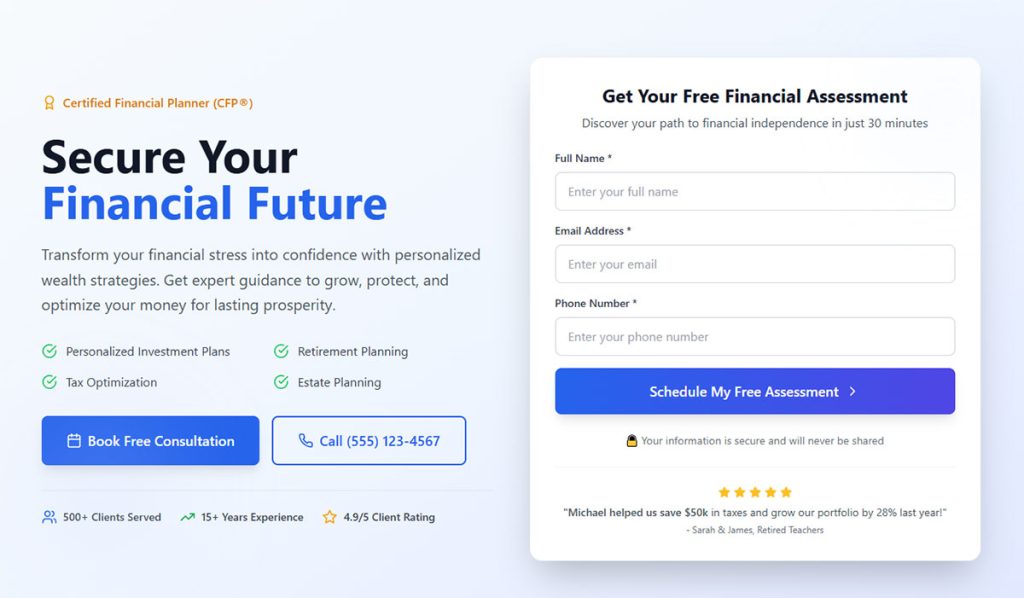
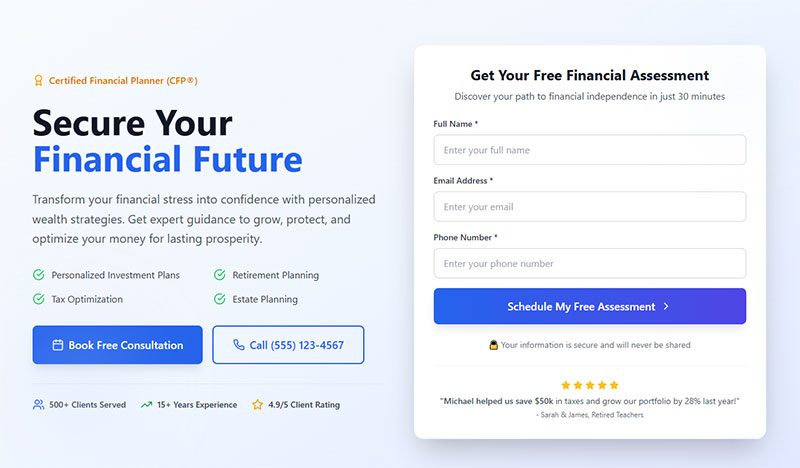
- Build the actual capture form, since the fields on it decide who gets contacted, most firms underinvest here and settle for a bare set of lead capture forms with no context around them
- Pair that form with a landing page built around one offer and one audience, following basic landing page form practices instead of sending traffic to a generic homepage
- Launch one channel first and track cost per lead before adding a second
- Build the nurture sequence, then route every qualified lead through compliance sign-off before anything publishes
Firms that skip step one almost always end up running paid ads at the wrong audience, then blame the channel when it doesn’t work instead of the targeting that was off from the start.
How to Measure Financial Advisor Lead Generation Performance
A pipeline nobody measures gets judged on gut feeling. And gut feeling is a genuinely bad way to decide next quarter’s budget.
- Lead-to-appointment rate, the share of captured leads that book a discovery call
- Appointment-to-client rate, the share of booked calls that become signed clients
- Client lifetime value measured against client acquisition cost, not cost per lead alone
- Marketing spend as a share of revenue, tracked by channel
| Metric | What It Shows | Where It’s Tracked |
|---|---|---|
| Lead-to-appointment rate | Whether capture and nurture are working | CRM pipeline stages |
| Appointment-to-client rate | Whether the discovery call itself converts | CRM or calendar tool |
| Lifetime value to CAC ratio | Whether a channel is actually profitable | CRM plus billing records |
Tracking where a lead actually came from matters just as much as tracking whether it converted.
A firm that tags every single lead as “website,” without separating organic search traffic from paid search campaigns, can’t tell which one is earning its budget and which one is dead weight. That separation starts with knowing how to track form submissions in Google Analytics right at the point of capture.
Most firms are better off reviewing a short list regularly than staring at a dashboard nobody actually checks. A focused set of lead generation KPIs beats forty tiles of noise, every time.
When Lead Generation Does Not Work for Financial Advisors
Lead generation isn’t automatically the right move for every practice. Pretending otherwise just burns budget for nothing.
- Solo advisors already near capacity, since more leads just means more people waiting for a call that never comes
- Firms without a compliance review process in place, since a paid or content channel without sign-off is a regulatory problem waiting to happen
- Advisors in a niche too narrow for marketplace matching algorithms to serve well
- Markets where referral volume already fills the calendar without added spend
Capacity is the one most advisors overlook.
Kitces Research’s 2022 study on advisor productivity found solo firms with no support staff served a median of just 36 clients per advisor, while solo advisors who added support staff served closer to 93.
An advisor sitting near that ceiling doesn’t need more leads. What they need is support staff, or higher minimums, or both. Spending marketing budget on volume before fixing that just produces a stack of prospects nobody has time to call back.
The same logic holds for a firm still building out its compliance review process. Skipping that step to chase volume is exactly how firms end up on the wrong side of an enforcement action instead of in front of new clients.
FAQ on Lead Generation For Financial Advisors
What Is the Difference Between a Lead and a Referral for a Financial Advisor
A referral shows up pre-vetted, through a personal introduction, usually from an existing client or a center of influence. A lead comes from a marketplace, a paid ad, or a content offer, and it still needs qualification before it counts as a real prospect.
What Is the Difference Between Marketing and Lead Generation for a Financial Advisor
Marketing builds awareness and trust over time, through content, branding, and reputation. Lead generation is the narrower piece: turning that awareness into a specific action, a form submission, a booked discovery call, or a qualified prospect actually entering the pipeline.
Can Financial Advisors Succeed Using Referrals Alone Without a Formal Lead Generation System
Some solo advisors can, particularly the ones already near capacity. Growth-stage practices usually hit a ceiling on referrals alone, since client introductions depend on existing relationships rather than anything built to scale.
How Long Does It Take to See Results From Financial Advisor Lead Generation
Paid channels and marketplaces can produce booked calls within weeks. Content marketing, SEO, and referral partnerships usually take three to six months before there’s enough organic search traffic and trust built up for a steady flow of qualified prospects.
What Mistakes Do Financial Advisors Make With Lead Generation
The common ones: skipping the ideal client profile, buying leads without any nurture sequence behind them, ignoring compliance review before publishing, and treating cost per lead as the only number that matters instead of looking at client acquisition cost and lifetime value too.
How Do Financial Advisors Use Testimonials in Lead Generation Under the SEC Marketing Rule
Advisors put client testimonials, marketplace star ratings, and third-party endorsements on websites and landing pages, as long as disclosures identify any compensation and conflicts involved. The SEC Marketing Rule requires those details on every testimonial used to attract new leads.
What Should You Fix First in Lead Generation for Financial Advisors?
Lead generation for financial advisors improves fastest when the CRM and lead capture flow get fixed before any new channel launches. A broken capture step wastes every dollar spent upstream on referrals, marketplaces, or paid campaigns, no matter how good those channels are.
These matter more than any channel swap, roughly in this order: the capture and qualification fields on every form, the follow-up speed between first contact and a booked call, and only then the channel mix itself, once the first two are actually holding steady.
Fixing capture and follow-up before testing new channels will slow top-of-funnel volume for a bit. That’s normal, and it’s worth it.
Close rates on existing leads usually rise enough to offset that dip, since cleaner qualification keeps unqualified prospects out of the pipeline in the first place.
A stronger capture step comes down to the form’s fields and layout. Studying how to design lead capture forms is the logical next step, before shifting any budget toward a new channel.