



A new client doesn’t sign with an accounting firm because a landing page convinced them. They sign because someone they trust vouched for the firm, or because the firm showed…
Table of contents
The inbound vs outbound lead generation split sounds technical, but it’s really about who speaks first. Either the prospect reaches out, or the seller does. Inbound fits markets where buyers already search for the category. Outbound suits contracts large enough to justify choosing accounts by name.
Inbound leads arrive warm, though the engine behind them takes months to build. Outbound leads start cold and show up as soon as the first sequences go out.
Buyer behavior matters here too. Gartner’s survey of 646 B2B buyers, published in March 2026, found that 67% prefer a rep-free experience.
What separates inbound from outbound lead generation?
It comes down to who makes the first move. In inbound, the prospect does, after finding a page in search or getting a recommendation. In outbound, the seller does, by sending a cold email or message, or by calling someone picked from a target list.
Both are forms of lead generation, the work of turning unknown people into contacts a sales team can follow up. The split decides who owns the work and how warm the lead is on day one. It also sets what the first message has to do.
| Dimension | Inbound | Outbound |
|---|---|---|
| Who starts contact | The prospect | The seller |
| Lead temperature | Warm (interest shown first) | Cold (no prior signal) |
| Usual owner | Marketing | SDRs and sales |
| First touch | Form fill, demo request, chat | Cold email, call, LinkedIn message |
| Targeting | Whoever finds the content | Accounts chosen in advance |
Temperature only describes the first contact, not fit. A cold outbound prospect can match your ideal customer profile perfectly. Plenty of warm inbound leads, on the other hand, turn out to be students downloading a template.
Brian Halligan, HubSpot’s co-founder, coined “inbound marketing” in 2005, though the words themselves were older. Call centers had been using inbound and outbound for years, for calls that came in and calls that went out.
The outbound model most B2B teams copy comes from Aaron Ross, who built a separate prospecting team at Salesforce and documented the system in Predictable Revenue (2011).
Which channels and tactics does each approach use?
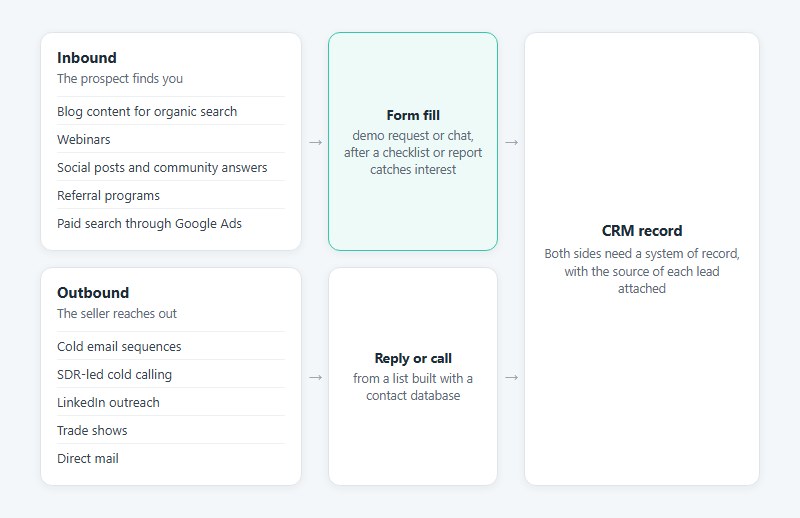
Inbound channels are the ones prospects find without being asked. Outbound is whatever the seller starts, which mostly means cold email, calls and LinkedIn, plus the occasional trade show.
Inbound channels
Attention comes first with inbound, and contact details come second.
- Blog content aimed at organic search
- Webinars, where the registration form is the lead capture (a webinar registration form template gives you a starting point)
- Social posts and community answers
- Referral programs, which send warm introductions from existing customers
- Paid search through Google Ads, pointed at the same landing pages
The conversion step decides whether traffic becomes pipeline. A checklist or benchmark report sitting behind a form turns a reader into a named contact, and the trade-offs of gating content deserve a test on each page before you apply it everywhere. The form’s confirmation settings can then redirect the reader to the asset after they submit.
Outbound channels
Outbound has two jobs, finding the right people and getting messages in front of them.
- Cold email runs as multi-step sequences from a warmed-up domain, sent through tools such as Instantly or Lemlist.
- Cold calling is SDR-led and runs on sales engagement platforms such as Outreach or Salesloft.
- LinkedIn outreach means connection requests and messages, with lists built in LinkedIn Sales Navigator.
- Contact databases such as Apollo.io and ZoomInfo supply the lists behind all of it.
Trade shows and direct mail also count as outbound.
Both sides still need a system of record. Many outbound teams track pipeline in Salesforce. On the inbound side, HubSpot CRM is where you’d see which source each lead came from. On a WordPress site, a form plugin such as IvyForms also logs the source URL and submission date of each entry.
Does inbound cost less than outbound?
Per lead, yes. Per customer, it depends on conversion rates, which is the part most comparisons skip.
HubSpot’s annual State of Inbound surveys showed inbound-dominated companies paying less per lead in every edition from 2009 through 2012. Two data points show the size of the gap.
- Average cost per lead came to $135 vs $346 for inbound-dominated vs outbound-dominated companies, 61% lower for inbound (HubSpot, State of Inbound Marketing, 2012)
- Cost per inquiry was $25.00 vs $41.50 for inbound vs outbound leads, about 40% lower for inbound (SiriusDecisions values, used by David Dodd on CustomerThink)
How far the 2012 figures stretch
The data is 14 years old. Treat it as a direction, not a price list.
HubSpot sells inbound software, so its survey is vendor research and reads best as one data point.
- HubSpot’s 2012 survey covered 972 marketers, polled in January 2012
- Employees with other jobs often do inbound work, so labor goes untracked and inbound cost gets understated (David Dodd, CustomerThink)
Why cost per customer is the better test
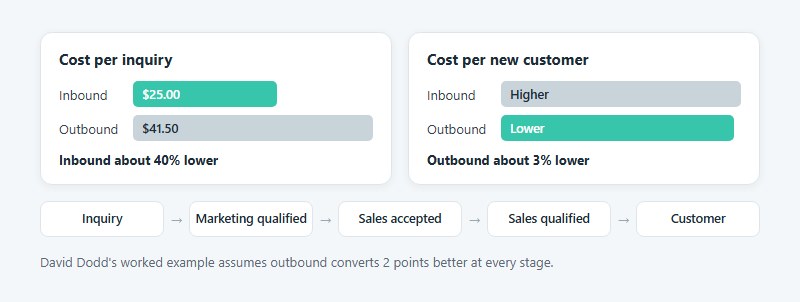
A cheaper lead that converts worse can cost more per customer.
David Dodd’s worked example on CustomerThink shows the effect. Inbound is about 40% cheaper per inquiry, yet once conversion is applied at each stage (inquiry, marketing qualified lead, sales accepted lead, sales qualified lead, customer), outbound lands about 3% cheaper per new customer.
That result rests on an assumed conversion edge for outbound, 2 points better at every stage, and Dodd says so himself. He isn’t trying to crown outbound. His point is to measure at the customer level.
Track cost per qualified opportunity and cost per closed customer by source, next to the other lead generation KPIs worth tracking in your CRM.
Which approach produces better leads?
Inbound leads convert better on average, and outbound lets you choose accounts that fit before anyone shows interest. Which one counts as better depends on whether conversion rate or account fit matters more to your sales team.
Inbound leads are self-selected, because the prospect already named a problem. They convert better on average (SiriusDecisions research, cited by David Dodd). Fit is uneven, though, since students, job seekers and competitors fill in forms too.
Outbound leads match an ideal customer profile written in advance, and the message goes straight to the buying role, often at large or specific accounts picked by name. What they lack is a stated need.
Relevance carries the rest. Gartner’s survey of 632 B2B buyers, published in June 2025, found that 73% actively avoid suppliers who send irrelevant outreach.
The qualification path differs too. Inbound leads are usually scored on behavior, such as pricing page visits, and become marketing qualified leads once they cross a threshold.
Outbound contacts become sales qualified leads only after an SDR has a real conversation. Account selection is the one quality lever only outbound has.
How fast does each approach produce pipeline, and how far does it scale?
Outbound produces replies as soon as sequences go out, but volume stays tied to SDR time and list size, with sending capacity as the hard ceiling. Inbound takes months to build, then keeps producing leads from content already published.
Time to first results
Ahrefs’ May 2025 study found that only 1.74% of new pages reached Google’s top 10 within a year, measured across 1 million random URLs first seen in September 2023.
Random new pages are a harsh sample. Ahrefs’ earlier study found pages on high-authority domains ranked faster, so a program on an established site does better, but the data still says to budget months, not weeks.
Paid search through Google Ads can cover the gap while organic content builds.
Outbound has no ranking delay, only setup. That means a target list and warmed-up sending domains, and somebody has to write the copy.
What caps volume
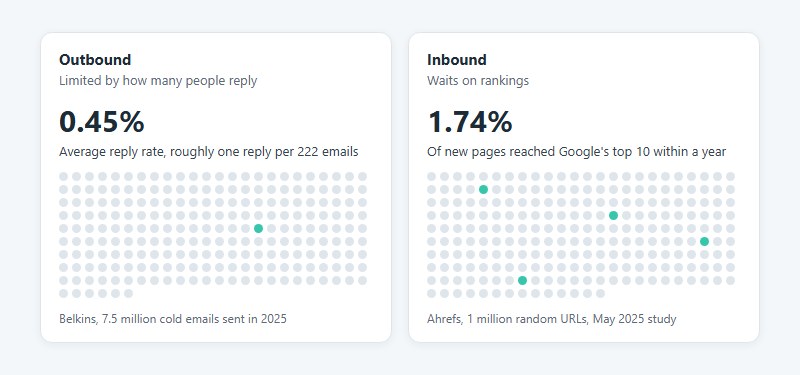
Outbound volume is capped by capacity, and the reply rate sets how much capacity you need.
Belkins tracked 7.5 million cold emails sent in 2025 and measured an average reply rate of 0.45%, counting net-new contacts only. That works out to roughly one reply per 222 emails.
Other benchmark pages quote far higher averages, so check how a reply rate is counted before planning around it.
Predictable Revenue separates new-lead prospecting from closing, so capacity grows by hiring more SDRs. Inbound volume is capped by output and rankings, meaning how many useful pages you publish and how many of them rank.
Put the Ahrefs and Belkins figures together and the bottleneck on each side is clear. Inbound waits on rankings. Outbound is limited by how many people reply.
Control over who you reach
With outbound you choose the account and the role, and even the day of contact. Inbound hands you the topics, and whoever those topics attract shows up.
Outbound buys you control and speed, and the price is constant effort. Inbound scales better, though you give up control and wait longer.
Cold email and cold calling rules by region
Cold outreach to business contacts is allowed in the US, France and Canada when senders meet set conditions, while Germany requires prior consent for email.
The conditions range from a simple opt-out in the US to a relevance test in France. Canada sits in between with a narrow implied-consent test. Treat this as a map, and have counsel check the details before launching in a new market.
Email rules
CAN-SPAM in the US
The FTC’s CAN-SPAM guide states that the law makes no exception for business-to-business email, and each violating message carries penalties of up to $53,088.
None of the core requirements is prior consent. They cover how you send:
- Accurate sender and routing information
- A subject line that matches the content
- A clear disclosure that the message is an ad
- A valid physical postal address
- An opt-out that works for 30 days and is honored within 10 business days
Verkada shows what ignoring opt-outs costs. In August 2024 it settled FTC allegations that it did not honor opt-out requests within 10 business days and paid a $2.95 million civil penalty, the largest the FTC had obtained for a CAN-SPAM violation (FTC and DOJ).
GDPR and national law in the EU
GDPR allows B2B outreach under legitimate interest (Article 6(1)(f)), and breaches of its core principles carry fines of up to 20 million euros or 4% of worldwide annual turnover, whichever is higher (Article 83(5)).
France applies a relevance test. The CNIL’s guidance, updated in June 2026, lets B2B prospecting rest on legitimate interest when the message relates to the recipient’s profession, such as a software pitch to a company’s IT director. Recipients must be told how their data is used and be able to object.
Generic addresses such as info@ or contact@ fall outside these principles, according to the same guidance.
Germany is stricter. Section 7 of the Unfair Competition Act (UWG) requires prior consent for email advertising, with an exception when the sender got the address while selling to that customer (Legal 500, Germany guide, 2025). Privacy Laws & Business reads the rule as applying to business recipients as well.
That makes the signup form part of the outreach setup. Consent collected through forms built to meet GDPR consent rules, with clear wording and a stored record, is what makes email to German contacts lawful. A GDPR consent field adds the checkbox, with editable agreement text and a link to your policy.
CASL in Canada
CASL penalties reach CAD $10 million per violation for an organization, according to BLG’s 2020 analysis of the Federal Court of Appeal’s Compu.Finder ruling.
Consent is the default. Implied consent applies only in defined cases, such as a conspicuously published business address with no notice refusing messages, where the message is relevant to the recipient’s role.
Sources disagree on the business-to-business exemption. Some vendor compliance pages say CASL has none, while BLG describes a narrow one that applies only between organizations with a relationship, and notes the Court upheld the CRTC’s reading of it.
Cold outreach to strangers has no relationship to point to, so it falls back on the implied-consent test.
Calling rules
Most calls to a business that solicit sales from that business are exempt from the do-not-call provisions, according to the FTC’s Q&A for telemarketers.
The National Do Not Call Registry itself is a list of consumers’ numbers, personal cell phones included, so a prospect list that mixes work and personal lines needs scrubbing before an SDR dials it.
- The FTC’s Telemarketing Sales Rule and the FCC’s TCPA rules both govern outbound calls
- Many states add their own do-not-call restrictions
Sender authentication
Since February 1, 2024, every sender to Gmail accounts needs SPF or DKIM, and anyone sending more than 5,000 messages a day also needs DMARC and one-click unsubscribe on marketing mail (Google’s email sender guidelines).
SPF lists the servers allowed to send mail for your domain. DKIM signs each message so receiving servers can verify the sending domain. DMARC tells receivers what to do with mail that fails SPF or DKIM, and reports back to you. A policy of none meets Google’s requirement.
A single SDR mailbox sits far below the 5,000 line, but the all-sender rules still apply, including the spam-rate ceiling. Google tells senders to keep reported spam under 0.10% and never reach 0.30%.
When does each approach stop working?
Outbound stops working when list quality, sender reputation or deal value falls short. Inbound stops working when buyers in the category do not search, or when nobody follows up on the leads it produces.
Where outbound breaks
Google’s sender guidelines tell senders not to buy email addresses and not to mail people who never signed up, because those recipients are more likely to report spam. Cold outbound sits at the edge of that guidance by design, so list quality and relevance decide whether a domain survives.
On the plus side, outbound starts fast and lets you name the accounts and roles. Volume grows as you add people and mailboxes.
It goes wrong in a few ways.
- Bought or scraped lists, which Google names as a sending practice to avoid
- A burned domain: bulk senders lose eligibility for Google’s delivery mitigation until reported spam stays under the ceiling for 7 consecutive days, and any sender with a high rate sees more mail classified as spam (Google sender FAQ)
- Contract values too low to cover SDR salaries, data subscriptions and sequencing tools
Where inbound breaks
Inbound fails quietly. Traffic and form fills keep climbing while sales qualified leads stay flat.
Sometimes there’s simply no demand to capture, because few buyers search for the category. Or a committee or procurement process runs the decision without a search stage. And in some companies leads arrive and no one is accountable for follow-up.
On the upside, leads are self-selected and cost per lead is lower on average, and published assets keep producing after publication.
How do you choose between inbound, outbound or a mix?
Contract value and sales cycle length matter most, along with how many buyers search for the category and how big your team is. Large contracts with a nameable buyer list lean outbound, and existing search demand leans inbound. A long cycle with both usually calls for a mix.
| Situation | Leans toward | Why |
|---|---|---|
| High contract value, accounts you can name | Outbound | Account selection covers SDR cost |
| Buyers already search for the category | Inbound | Demand exists to capture |
| New category, little search volume | Outbound first | Nothing to rank for yet |
| Small team, no SDR budget | Inbound | No outbound headcount needed |
| Long cycle, buying committee | Both | Outbound opens accounts, content informs the group |
When the cheaper option is the wrong choice
Inbound’s lower cost per lead does not help when the market it needs does not exist yet.
A new category has no search demand to capture, which makes it a demand generation problem before it is a lead generation one. Demand generation builds awareness first, so that buyers have something to search for.
Outbound fits those early months better, because it creates the conversations that show which terms buyers will eventually search.
Where account-based marketing fits
Account-based marketing sits between the two. Sales and marketing agree on one named account list, then aim outreach, ads and content at those accounts.
It works for large deals with a short, nameable buyer list. It doesn’t fit broad markets where no such list exists.
A two-list test
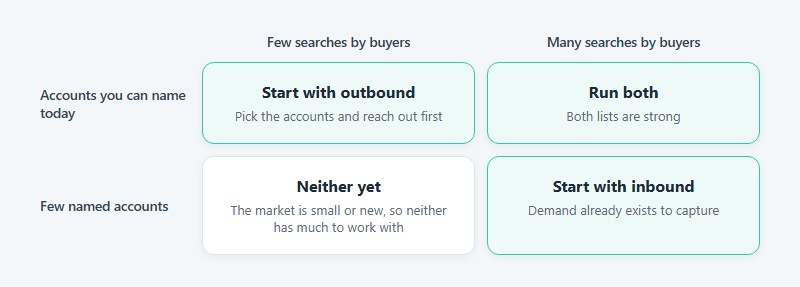
Write two lists. One holds the accounts you can name today, the other the searches your buyers already run.
If you can name the accounts but few searches exist, start with outbound. Many searches and few named accounts points to inbound. When both lists are strong, run both. And if both are thin, the market is small or new, so neither approach has much to work with yet.
How to run inbound and outbound together
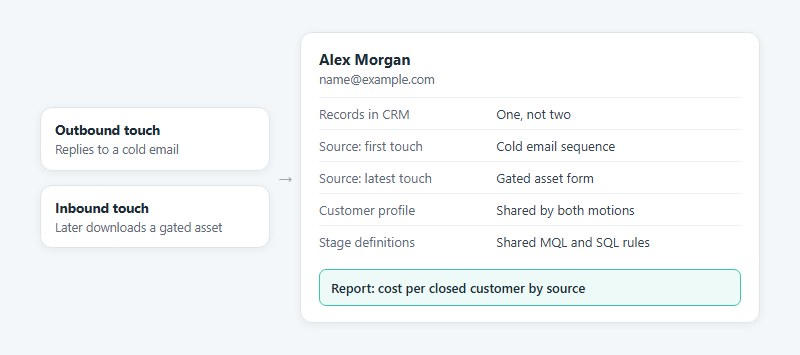
Start outbound for early pipeline while content builds, feed what outbound teaches into inbound, and run both against one ideal customer profile and one set of stage definitions.
- Write one ideal customer profile and one set of marketing qualified lead and sales qualified lead definitions for both motions.
- Launch outbound to a list of named accounts, since it produces conversations while content is still ranking.
- Log every objection and question from calls and replies.
- Turn the repeated ones into content, gate the strongest asset and point paid search at the page that answers the top objection.
- Send outbound prospects to those same pages, in follow-up emails and in ads aimed at the account list.
- Tag every lead with its source in the CRM and report cost per closed customer by source.
- Move budget toward the source with the lower cost per customer, and review it on a fixed schedule.
Both motions feed one lead generation funnel, so a contact who replies to a cold email and later downloads a gated asset should land in a single record, not two.
The setup breaks when each team measures something different. Marketing counts form fills and SDRs count meetings, and nobody ends up owning cost per customer.
Common Questions About Inbound vs Outbound Lead Generation
Is paid advertising inbound or outbound?
It depends on who starts the contact. Paid search that catches someone typing a query behaves like inbound, since the prospect started the search.
Ads pushed to a cold audience lean outbound, though sources split on how to label them.
How fast should a team respond to an inbound lead?
Within an hour at most. A 2011 Harvard Business Review study by James Oldroyd, Kristina McElheran and David Elkington found that firms contacting a web lead within an hour were nearly seven times as likely to qualify it as firms that waited one more hour.
Against a wait of 24 hours or longer, the gap was more than 60 times. A form notification email sent to the rep on each submission is a simple way to start that clock.
Can a small business rely on inbound alone?
Yes, if buyers already search for what you sell and you can wait months for results.
Referrals and paid search can cover the gap while content builds. A market with little search demand needs outbound or demand building first.
Do you need an SDR team to run outbound?
Not at the start. A founder or one salesperson can run outbound from a named-account list and a single sequence.
An SDR team pays off when volume and contract value cover what the team costs, from salaries to data subscriptions and sequencing tools.
Does cold calling still book meetings?
Yes, but results split sharply by rep. Gong Labs’ 2024 analysis of 300 million calls found average reps connect on 5.4% of dials and book a meeting from 4.6% of conversations, against 13.3% and 16.7% for the top quartile.
Gong attributes the gap to direct dials and to targeting the prospects most likely to buy.
When to Move Budget Between Inbound and Outbound
Budget in inbound vs outbound lead generation should move when a source hits a hard limit, not when a dashboard shows a cheaper lead.
Sender reputation and search rankings cap a source before its cost per closed customer turns, so the order of action matters.
- Pause outbound volume when sender reputation weakens.
- Shift spend to the source with the lower cost per closed customer, and add the second approach once the first is stable.
That order accepts slower pipeline in the short term, because pausing outbound removes the fastest source of conversations. Reputation damage reaches every mailbox on the sending domain and recovers slowly.
Position verified November 2026 against Google’s sender guidelines and the CNIL’s June 2026 guidance; a tightening of either changes outbound’s economics.
With the allocation set, the next step is channel-level tactics for B2B company lead generation.