







A new client doesn’t sign with an accounting firm because a landing page convinced them. They sign because someone they trust vouched for the firm, or because the firm showed…
Table of contents
Most nonprofits don’t realize a donor almost gave until months later, long after the moment when a name and an email address could have kept that person in the loop. That’s the whole point of lead generation: catching contact information before the ask, not after it.
A completed capture form counts as progress here, not a completed gift. Development and communications teams run this across the website, the email list, paid social ads, and event registration pages, and plenty of them are still leaving contacts on the table without realizing it.
Only 31% of nonprofits use an email signup popup on their website to capture new contacts, up from 28% the year before, according to the 2026 Nonprofit Tech for Good Report.
What Is Lead Generation for Nonprofits?
A lead and a donor aren’t the same thing, and mixing them up is where a lot of nonprofit marketing goes sideways. A lead has shared a name or an email address. That’s it. A donor has actually given money or time. Everything in between, moving someone from the first group into the second, is where most of a nonprofit’s growth work actually lives.
Nonprofits typically sort leads into a few buckets: someone who downloaded a giving guide or joined an email list but hasn’t given yet counts as a donor lead. Someone who filled out an interest form for an event or an ongoing role is a volunteer lead. And someone who signed a petition or joined a campaign mailing list is an advocacy lead. Each one travels a different path before it converts.
This differs from a general lead generation strategy built for a business selling a product. A nonprofit lead has to move through trust and mission alignment, and often tax-exempt compliance rules a commercial funnel never has to think about.
It also differs from a plain inquiry box on a contact page. Nonprofits usually draw a line between a basic contact form and a lead generation form, since the second one is built specifically to capture and route a prospect into a follow-up sequence.
Lead generation is what happens before the ask. Not instead of it.
How the Nonprofit Lead Generation Funnel Works
A contact moves through stages before ever hitting a donate button, and nonprofits that skip tracking those stages usually can’t say why a campaign stalled. Awareness comes first, whenever someone stumbles onto the organization through search, social, or a friend’s share.
Interest follows once they actually read a story, watch a video, or open an email. Then there’s a decision phase, where they’re weighing giving now against giving later, or against some other cause they care about just as much. And finally, sign-up or donation happens: a completed form, whether that’s a gift, a volunteer application, or a newsletter opt-in.
Each stage narrows the group down. Fewer people move forward at every step, and that drop-off isn’t a red flag on its own. It’s normal.
A lead generation funnel built this way produces something concrete at each stage: an email address, an engagement score, a completed form.
Offline donor retention rises by 29% once a nonprofit has that donor’s email address on file, according to NextAfter.
That’s really the argument for building a funnel instead of just running one appeal and hoping. Capturing the contact early pays off even when the gift doesn’t happen right away.
Which Lead Generation Channels Work Best for Nonprofits?
Organic search, paid social, referral, events, and direct mail each generate nonprofit leads in their own way, and no single channel covers every stage of the funnel by itself.
Organic and referral channels build up slowly and cost little per lead. Paid social and events move faster but usually cost more per contact.
Organic and Search-Based Channels
Google handed out more than $1.8 billion in free Search ads to nonprofits in 2022, reaching over 65,000 organizations through Google Ad Grants alone (Google, 2023). That program sits in an odd spot between organic and paid, since the ads are free but still require the same keyword and landing page discipline as a regular search account.
Once a nonprofit is approved for a grant, the cost runs close to zero, and blog content or resource pages keep compounding traffic long after they go live. The catch is patience. This channel is slow, often six months or more before search traffic amounts to anything meaningful, and grant accounts need ongoing management to stay compliant with click-through and spend rules.
DonorsChoose.org used its Ad Grants traffic to generate more than 5,000 donations to public school classrooms, according to Google’s own published grant success stories.
Organic and referral traffic generally falls under inbound lead generation, since the visitor comes looking for the nonprofit instead of being interrupted mid-scroll by an ad.
Paid Social Channels
Facebook and LinkedIn ads reach people who’ve never heard of the nonprofit before, and that reach is really their whole value. Setup is fast. Meta for Nonprofits and LinkedIn for Nonprofits can get a campaign live within days, targeting by interest, location, or a lookalike audience built off existing donors.
The tradeoff shows up in the budget. Cost per lead climbs quickly once a campaign scales past a small spend, and unlike organic content, the traffic disappears the moment ad spend stops.
A landing page built to receive this traffic needs its own lead generation plugin or form tool. A generic contact page rarely converts paid clicks into a completed lead.
Events and Referral Channels
Fundraising events and word-of-mouth referrals produce the highest-intent leads of any channel, mostly because the contact already trusts whoever invited them.
Peer-to-peer fundraising pages turn one supporter’s personal network into a lead source, and direct mail paired with an event invite still converts well with older donor segments. The limit is volume. It’s capped by how many supporters actually bother to share or attend, and scaling it usually means adding staff time or event budget, there’s no getting around that.
An event registration form is often the only lead capture point in this channel, so a broken or overly long form quietly kills the entire referral chain before it gets started.
What Lead Magnets Convert Best for Nonprofits?
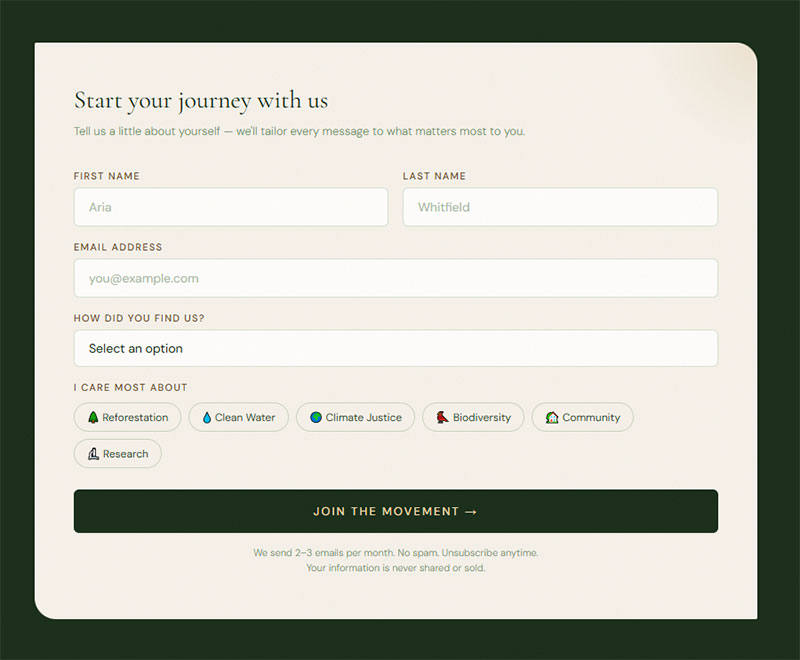
Impact guides, webinar registrations, volunteer toolkits, and short mission-tied quizzes convert best among nonprofit lead magnets. Each format fits a different point in the funnel. A guide suits someone still in the awareness stage. A webinar suits someone already interested enough to give up thirty minutes of their evening.
A lead magnet only works if the offer feels specific enough that a visitor senses they’re getting something real, not just handing over an email address for nothing in return.
Only 13% of nonprofits use gated content to grow their email list, according to the Nonprofit Tech for Good 2026 report. That’s a wide-open gap, since gated content is one of the few lead magnet formats that scales without added staff time once it’s built.
The United Negro College Fund pairs its paid search traffic with an email sign-up push, using its Ad Grant to reach more than 5,000 new people a month and turning a good number of them into subscribers rather than one-time readers.
A downloadable impact or annual report works well here. So does a webinar or info session registration, a volunteer starter toolkit, or a cause-related quiz or self-assessment.
A magnet that doesn’t match the visitor’s stage in the funnel gets downloaded once and ignored. That mismatch is probably the single most common reason a nonprofit’s lead magnet underperforms.
How Do Nonprofits Qualify and Score Nonprofit Leads?
Qualifying a lead means weighing donor capacity signals, engagement level, and volunteer interest before handing the contact off to a fundraiser. Someone who opens every email but never clicks scores completely differently than someone who showed up at an event and asked for a call.
Donor capacity shows up in giving history, job title, or wealth-screening data. Engagement gets measured through email opens, event attendance, and website visits. Volunteer interest comes from form responses about time availability and skills, when a nonprofit actually asks.
A marketing qualified lead has simply shown interest, maybe downloading a guide or opening three emails in a row. A donor qualified lead has cleared a capacity or intent check and is ready for a fundraiser’s direct outreach.
The fields on the original capture form decide how much of this scoring is even possible later on. Choosing the right form fields for capturing high-quality leads up front saves a fundraiser from chasing a contact with no usable data behind it.
Tracking the right lead generation KPIs keeps scoring grounded in data instead of gut feeling. Once a lead scores as ready, a major gift officer or fundraiser typically takes the relationship over directly.
How to Nurture Nonprofit Leads After Capture
Nonprofits nurture a lead through a short email sequence, paired with retargeting ads for the contacts who don’t open email at all. A typical run looks like three to five emails: a welcome message, a story from the field, then a direct ask.
Nonprofits raised $54 for every 1,000 fundraising emails sent in 2025, per M+R Benchmarks, which makes even a modest list worth nurturing consistently rather than letting it sit.
Starting from proven lead nurturing templates saves a small communications team from writing every sequence from scratch.
Retargeting ads pick up the contacts who never open a single email, showing them the same story or offer across social platforms instead.

Every message in the sequence needs one clear next step. Strong call to action examples tend to name the action directly, something like “read Maria’s story,” instead of a vague “learn more.”
The nurture sequence should keep circling back to the same lead magnet that brought the contact in. A guide about clean water access shouldn’t lead into a sequence about an unrelated program.
Which CRM Works Best for Nonprofit Lead Tracking?
Salesforce Nonprofit Cloud, Bloomerang, DonorPerfect, Neon CRM, and Virtuous CRM are the platforms nonprofits reach for most often to store and route leads, and each one is strongest at a different stage of the funnel.
| Platform | Best For | Starting Cost Tier | Key Integration |
|---|---|---|---|
| Salesforce Nonprofit Cloud | Large or fast-growing organizations | Higher, enterprise pricing | Extensive third-party app ecosystem |
| Bloomerang | Small to mid-sized teams wanting ease of use | Mid-range | Constant Contact, Mailchimp |
| DonorPerfect | Nonprofits wanting built-in email tools | Mid-range | Native Constant Contact integration |
| Neon CRM | Membership and event-driven nonprofits | Mid-range | Event registration and ticketing |
| Virtuous CRM | Teams wanting automated lead nurturing | Mid to higher | Built-in marketing automation |
94% of fundraisers already use a CRM, yet only 47% actually use the donor insights inside it to personalize outreach, per Bloomerang’s Mission Retainable Report.
The gap isn’t really the software itself. It’s how much of the data inside it actually gets used before a lead goes cold.
A nonprofit switching platforms should weigh data migration cost and staff training time before signing a new contract. Those hidden costs often outweigh whatever a shinier feature set promises upfront.
How Much Does Nonprofit Lead Generation Cost?
Nonprofit lead generation through digital advertising costs an average of $2.81 per lead, well below the cost of driving a donation directly. Cost varies sharply by channel and by cause area, so a single number rarely tells the whole story.
Average cost per lead across digital advertising sits at $2.81 (M+R Benchmarks, 2026). Through Meta platforms specifically, it climbs to $3.64 (M+R Benchmarks, 2026). Digital ad spend per dollar of online revenue averages $0.10 study-wide (M+R Benchmarks, 2026), but for Disaster and International Aid nonprofits it runs $0.23, more than double the study-wide average (M+R Benchmarks, 2026).
Asking for a donation directly through an ad costs far more than asking for an email address or a form submission first.
Neighborhood Cats, an animal welfare nonprofit, runs Facebook ads for specific animals needing urgent medical care and regularly raises thousands of dollars a month from that lower-friction ask, according to Bloomerang’s advertising research.
A nonprofit with a $1,000 monthly ad budget should expect roughly 350 to 360 leads at the digital-advertising average, before accounting for platform or audience differences.
That number drops fast the moment a campaign narrows in on something like major donor prospects instead of a broad email list.
What Compliance Rules Apply to Nonprofit Lead Capture?
Nonprofit lead capture in the United States is governed mainly by the CAN-SPAM Act for email outreach, and by GDPR for any contact based in the European Union.
Violations of CAN-SPAM carry a maximum civil penalty of $53,088 per non-compliant email, following the FTC’s January 2025 inflation adjustment.
The FTC’s largest CAN-SPAM case to date, a $2.95 million penalty against a security camera company in 2024, shows regulators do pursue email violations aggressively, even though nonprofits are rarely the direct target.
A compliant setup needs accurate sender information in every header, a working opt-out link honored within 10 business days, and a valid physical postal address in the email footer.
GDPR applies whenever a nonprofit contacts someone based in the European Union, regardless of where the nonprofit itself is registered. Consent under GDPR has to be an active opt-in. A pre-checked newsletter box on a donation form does not count.
A compliant lead capture form states clearly what the contact is signing up for, links to a privacy policy, and never bundles a newsletter opt-in inside a required field.
Nonprofits handling both US and EU contacts on the same form usually build to the GDPR standard throughout, since it’s the stricter of the two. The National Council of Nonprofits publishes further guidance for organizations building outreach programs across state and country lines.
How to Build a Nonprofit Lead Generation Strategy
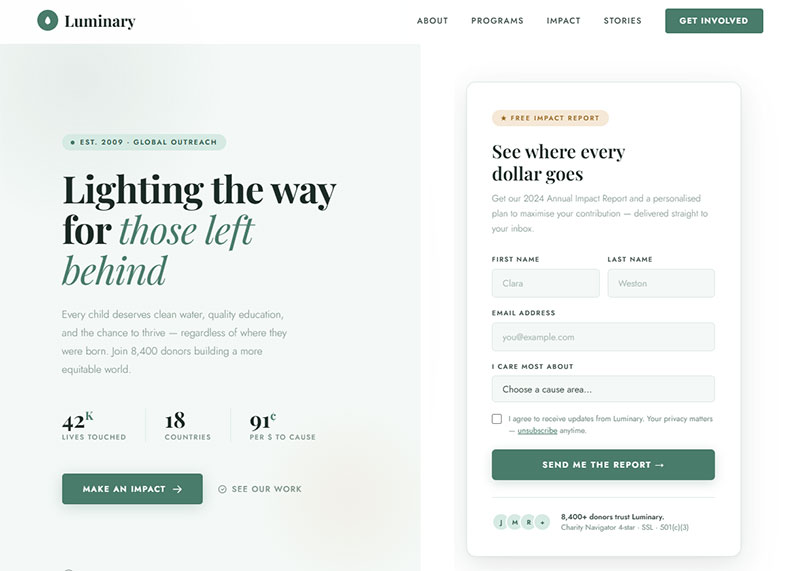
Building a nonprofit lead generation strategy comes down to sequencing five decisions in order, not running them all at once. Skipping a step early usually shows up as a broken handoff later, most often between the capture form and the CRM.
- Set the goal and target lead volume before choosing a channel, based on how many donors or volunteers the program actually needs this quarter.
- Build the lead magnet and landing page before running any paid traffic, so there’s somewhere for a click to land.
- Connect the capture form to the CRM before launch, not after the first leads start arriving.
- Set the nurture sequence live before the first lead arrives, so no one sits in an empty inbox for a week.
- Review cost per lead and adjust the channel mix after 30 to 60 days of live data.
Most of the failure points in this sequence are structural, not creative. A beautiful landing page connected to nothing still produces zero usable leads.
Thirty days is enough to judge form performance. Sixty is closer to enough to judge cost per lead against actual donor conversion.
The landing page in step two carries most of the conversion risk. Following proven landing page form best practices matters more here than sticking with whatever the website theme provides by default.
Ownership usually splits along familiar lines. Goal setting falls to the development director or executive director. The magnet and landing page land with communications or marketing staff. Whoever administers the database, often someone in an operations role, handles the CRM connection. The nurture sequence goes to communications staff, sometimes with a fundraiser reviewing tone before it goes out.
A one-person marketing team can still run this sequence. It just runs slower, and step five often gets skipped entirely without a calendar reminder.
When Lead Generation Does Not Work for Nonprofits
Lead generation fails for nonprofits that have no CRM to catch the leads, since a form submission with nowhere to go simply evaporates. It also fails for organizations with too little website traffic to reach a meaningful sample size, no matter how well the funnel is designed.
No CRM or tracking system means leads pile up in an inbox and never get followed up on. Low website traffic, a few hundred monthly visitors, won’t produce enough leads to justify the setup time. No nurture sequence behind the magnet means a lead downloads once and never hears from the nonprofit again. And a small, high-net-worth donor base usually does better with direct relationship fundraising than a broad funnel.
Even a well-built capture form loses visitors. Charity-sector forms convert at just 56.86% overall, according to Zuko’s 2025 industry benchmarking data.
That means close to half of everyone who lands on a well-designed nonprofit form still won’t finish it, before a single email is even sent.
Nonprofits that want to push past this baseline usually work through the same proven ways to increase form conversions: shorter field counts, clear value statements, and mobile-first layouts.
A nonprofit with fifteen major donors who give six figures a year doesn’t need a lead funnel. It needs a fundraiser making phone calls.
The same logic applies to compliance load. An all-volunteer nonprofit with no capacity to manage CAN-SPAM or GDPR consent correctly is often better off with a shorter, simpler outreach list than a large one it can’t legally maintain.
FAQ on Lead Generation For Nonprofits
Is Google Ad Grants worth setting up for nonprofit lead generation?
For most nonprofits with staff time to manage the account, yes. The $10,000 monthly search budget pushes cost per lead close to zero, as long as the nonprofit keeps click-through rate and compliance standards intact.
What is the difference between a donor lead and a marketing qualified lead?
A donor lead is anyone who has shared contact information without further screening, like downloading a guide. A marketing qualified lead has cleared an engagement threshold, such as opening three emails in a row, before a fundraiser invests outreach time.
How long before a nonprofit sees results from a new lead generation campaign?
Most nonprofits see their first leads within two to four weeks of launching a campaign. Meaningful cost-per-lead data usually takes 30 to 60 days, and donor conversion from those leads often takes several months longer than that.
Can a nonprofit with no marketing budget still generate leads?
Yes. Organic content, referral asks, and a Google Ad Grant application cost no cash, only staff time. A nonprofit can build an email list through blog posts, social shares, and word of mouth before ever running a paid campaign.
Does a nonprofit need a CRM separate from its donation processor?
Not always. Some donation processors, like Donorbox or Givebutter, include basic contact tracking built in. Nonprofits scaling past a few hundred leads a month usually outgrow that and need a dedicated CRM for scoring, segmentation, and nurture sequences.
What Should a Nonprofit Fix First in Lead Generation for Nonprofits?
The first fix, and the one that matters most, is connecting every capture form directly to a working CRM. A lead with no destination produces no donor, no volunteer, no advocacy outcome, no matter how well the surrounding campaign performs.
A few moves recover the most ground in that first month: connecting the capture form directly to the CRM, segmenting existing contacts by engagement level before the next send, and turning on a nurture sequence for contacts who’ve been sitting untouched.
Fixing the CRM link before launching new channels slows list growth for the first month. It’s worth the tradeoff, because it guarantees every later lead converts into a trackable follow-up instead of another dead entry in an inbox.
The next practical step is refining the fields and flow of how to design lead capture forms that convert once the pipeline itself is fixed.