




Most lead magnets don’t work. They get downloaded, skimmed for 30 seconds, and forgotten. Meanwhile, your email list fills up with people who will never buy anything. The problem isn’t…
Table of Contents
Empty chairs cost money. Every unfilled appointment slot represents lost revenue that your dental practice can’t recover.
Lead generation for dentists solves this problem by creating a predictable flow of new patient inquiries through digital and traditional marketing channels.
The American Dental Association reports that practices need 20-50 new patients monthly just to maintain growth. Without a system for dental patient acquisition, you’re relying on luck.
This guide covers the marketing methods that actually work: Google Ads, local SEO, social media advertising, and patient referral programs.
You’ll learn what dental leads cost, which channels deliver the best ROI, and how to convert website visitors into booked appointments.
What is Lead Generation for Dentists
Lead generation for dentists is the process of attracting potential patients to a dental practice through marketing strategies and converting their interest into contact information or appointments.
A dental lead is a person who has shown interest in dental services.
They filled out a contact form, called the practice, subscribed to an email newsletter, or scheduled a consultation.
The American Dental Association reports that most practices need 20-50 new patients monthly to maintain growth.
Without a steady flow of leads, practices stagnate.
How Dental Practices Attract New Patients
Optimize Key Digital Channels
Google Business Profile drives the most local visibility for dental practices.
Sixth City Marketing found 71% of people search online before scheduling a dental appointment. Amra and Elma reports 86% of people who search for a dentist go on to contact one.
Essential profile elements:
- Complete business information (hours, services, phone)
- High-quality photos of office and staff
- Regular posts about services and offers
- Quick response to patient questions
Build your practice website with conversion tools:
- Online booking widgets (only 26% of practices offer this per NexHealth)
- Click-to-call buttons for mobile users
- Contact forms on service pages
- Patient testimonials and before/after photos
Sixth City Marketing shows 44% of patients who find providers through mobile search schedule appointments.
Run Targeted Advertising Campaigns
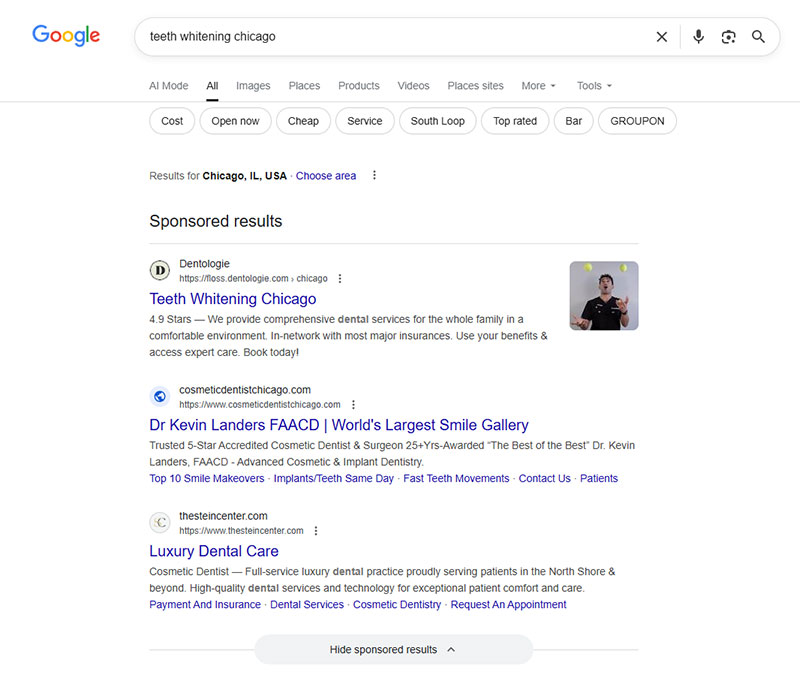
Google Ads captures high-intent searches from people actively seeking dental services.
Ruler Analytics found paid search drives 35% of total business traffic for dental offices.
Campaign structure:
- Target treatment-specific keywords (Invisalign, teeth whitening, emergency dental)
- Use location targeting for your service area
- Set mobile bid adjustments (52% of PPC clicks come from mobile per Sixth City Marketing)
- Create dedicated landing pages for each service
Facebook Ads Manager allows precise targeting:
- Location radius around your practice
- Age ranges for specific services
- Income levels for cosmetic dentistry
- Parents for pediatric dental campaigns
FollowApp research shows 41% of people say social media content impacts their treatment center choice.
Dominate Local Search Rankings
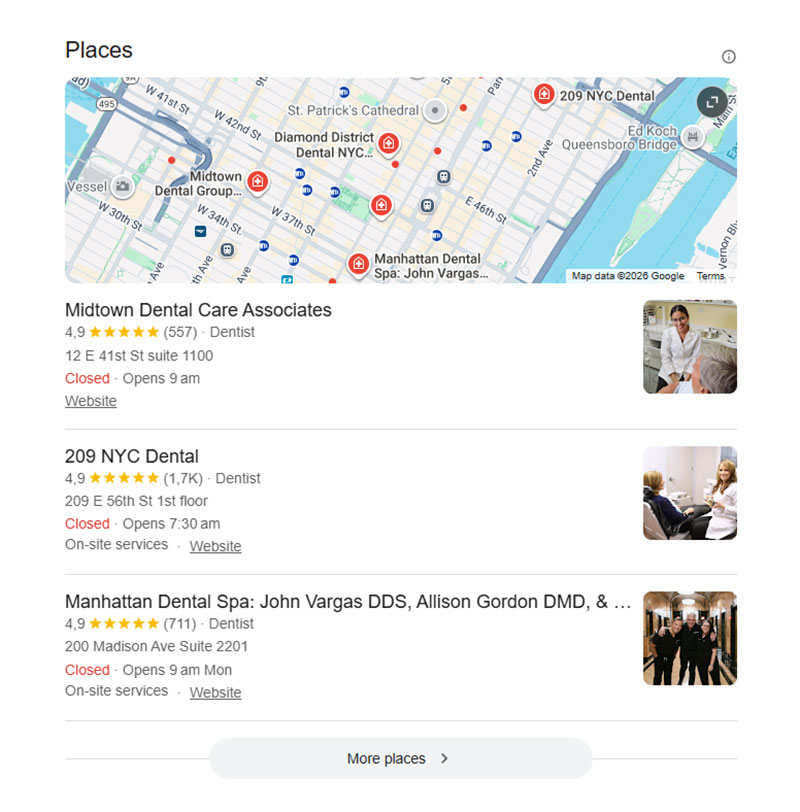
Local SEO determines whether patients find your practice or competitors down the street.
Google Maps ranking factors:
- Relevance (complete profile with accurate categories)
- Distance (proximity to searcher)
- Prominence (review quantity, ratings, citations)
Maintain consistent NAP across directories:
- Google Business Profile
- Yelp for Business
- Healthgrades
- Zocdoc
NexHealth data shows 93% of online experiences begin with a search engine.
Leverage Patient Reviews
Review-based decisions dominate the selection process.
Sagapixel found over 70% of consumers research dental treatments and read reviews when looking for a new dentist.
Adit reports 81% of patients rely on consumer feedback when choosing healthcare providers.
Review generation strategy:
- Send automated review requests after appointments
- Make it easy with direct links to review platforms
- Respond to all reviews (positive and negative)
- Display top reviews on your website
Sixth City Marketing shows 48% of patients spend over two weeks researching before booking.
Capture High-Intent Searches
Treatment-specific searches signal ready-to-book prospects.
Target these search patterns:
- “Dentist near me” (millions of monthly searches)
- “[Treatment] dentist” (Invisalign, veneers, implants)
- “Emergency tooth extraction”
- “Dental office open Saturday”
- “Affordable family dentist”
Amra and Elma notes 92% of search queries are long-tail phrases, meaning people type specific needs like “affordable family dentist near me” instead of just “dentist.”
Implement Online Booking
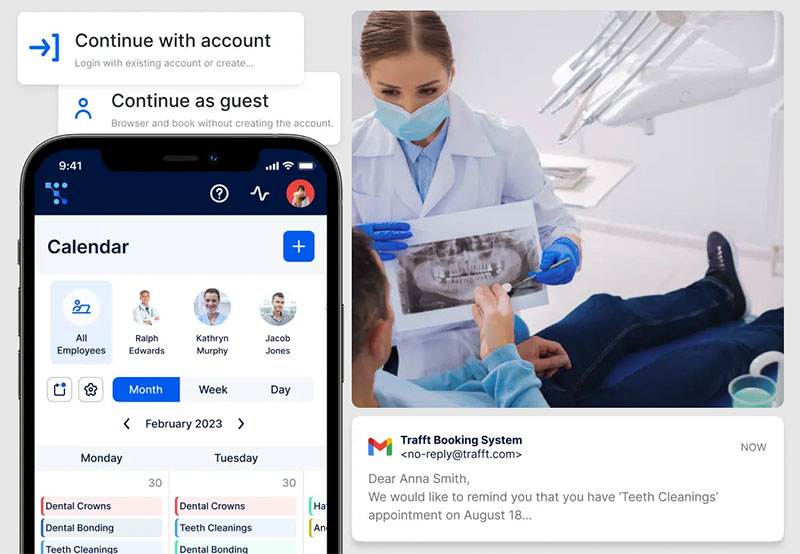
Patient convenience drives conversion and reduces no-shows. You can use WPAmelia, if your website is WordPress-based or Trafft to implement a flawless booking option.
FollowApp found 77% of patients want online booking, but only 26% of practices offer it.
Sixth City Marketing reports average landing page conversion rate for dental offices is 10%.
Booking system benefits:
- 24/7 appointment scheduling
- Reduces phone call volume
- Captures after-hours prospects
- Decreases no-show rates with automated reminders
Titan Web Agency warns 43% of new patients fail to return for a second appointment, making retention critical.
What Types of Dental Leads Exist
Compare Organic and Paid Lead Sources
Organic leads come from SEO, Google Business Profile, and content marketing.
Ruler Analytics found organic search converts at 3.5%, while Search Engine Journal reports 70% of users prefer organic results over paid ads. Dentistry research shows organic search drives 53% of all website traffic versus 15% from paid search.
Build takes 6 to 12 months but costs zero per click once ranked. Delmain data shows general dentists spend $65 to $135 per new patient lead through various channels.
Paid leads from Google Ads and Facebook deliver immediate results.
Digital Authority Partners reports average dental PPC costs exceed $6 per click, with Elevate DDS showing dental keywords range from $6.50 to $9.75 in 2025. Sixth City Marketing found PPC traffic generates 50% more conversions than organic search.
Key differences:
- Organic: Lower cost per lead, builds over time, higher trust factor
- Paid: Instant visibility, higher immediate costs, predictable volume control
Capture Emergency Dental Leads
Emergency leads search for urgent pain relief, broken teeth, or acute infections.
These patients need immediate response. InfluxMD research shows leads contacted within 5 minutes are 10 times more likely to convert than those waiting 30 minutes. Rep.ai found 82% of consumers expect responses within 10 minutes, and responding after 30 minutes is 21 times less effective.
Mobile dominates emergency searches (Sixth City Marketing reports 52% of PPC clicks come from mobile).
Essential systems:
- 24/7 answering service or after-hours call handling
- Prominent emergency contact numbers on homepage
- Mobile-optimized booking for after-hours scheduling
- Clear messaging about same-day availability
Rep.ai data shows 1-minute response time leads to 391% more conversions. First responders win 35% to 50% of sales according to Vendasta research.
Emergency leads convert fastest but require instant action. The practice that answers first wins the patient.
Convert Cosmetic Dentistry Leads
Cosmetic leads pursue elective procedures like teeth whitening, veneers, Invisalign, and smile makeovers.
PatientGain data shows cosmetic dentistry initial visits average $5,000 with lifetime value reaching $14,000 when patients stay 5 years. Delmain research indicates general dentists report patient LTV of $5,500 to $7,500, but specialized cosmetic practices see significantly higher values.
CareCredit reports cosmetic dentistry market grows at 7.1% annually.
Extended decision cycles require strategic nurturing:
- Portfolio of before and after photos
- Detailed case studies and testimonials
- Virtual consultation options
- Flexible payment plans and financing information
These patients research extensively. Dentistry IQ recommends converting 30% to 50% of internet leads through proper front desk training.
Cosmetic leads demand polished presentation skills during consultations. Treatment plan acceptance directly determines conversion success.
Build General Dentistry Patient Base
General dentistry leads seek routine checkups, cleanings, and family dental care.
Lower immediate revenue per visit but highest retention potential. SmileTactics found dental practices aim for 10% to 30% conversion rates, with top performers hitting 50%.
A survey of nearly 13,000 practices by Delmain shows gross production per patient averages $4,200. PatientGain calculates general dentistry LTV at $6,600 to $6,700 over 6 years, assuming patients visit twice yearly for checkups plus one treatment visit annually.
Family multiplier effect amplifies value. A family of four staying 10 years generates $26,400 to $26,800 in lifetime revenue, plus potential referrals.
Effective messaging strategies:
- New patient special offers
- Insurance acceptance and verification
- Same-day appointment availability
- Family-friendly scheduling blocks
NexHealth found 43% of new patients fail to return for a second appointment, making retention systems critical for maximizing general dentistry lead value.
Which Marketing Methods Generate Dental Patients
Deploy Local SEO to Capture Search Traffic
Target local keywords patients actually search.
Dominate Dental found 89% of patients research dental services online before booking, with RevUp Dental showing the top 3 Google Maps listings capture over 70% of all clicks.
Build ranking foundations:
- Optimize title tags with “Dentist in [city]” plus service
- Create dedicated pages for each treatment (implants, Invisalign, emergency care)
- Include local landmarks and neighborhood references in content
- Build backlinks from dental associations, community organizations, local media
Technical requirements matter. DentalScapes reports 53% of mobile users abandon sites loading slower than 3 seconds.
Complete Google Business Profile:
- Fill every field (services, hours, attributes)
- Upload high-quality office and team photos
- Post weekly updates about services and offers
- Enable online booking through the profile
Reviews drive rankings. DentalScapes research shows reviews contribute 15% to Google’s local ranking factors, with Techyscouts finding practices with complete profiles 70% more likely to attract location visits.
Netpeak reports 46% of Google searches have local intent. Dominate Dental data shows practices implementing comprehensive SEO strategies see 156% increase in consultation bookings within 12 months, with patient acquisition costs decreasing 43% within 18 months.
Run Targeted Google Ads Campaigns
Google Ads operates on pay-per-click bidding.
Elevate DDS reports dental keyword costs range $6.50 to $9.75 in 2025, with competitive terms like “emergency dentist” reaching $8 to $15 per click. Average dental lead costs sit between $50 and $85.
Campaign structure:
- Target high-intent keywords (specific treatments plus location)
- Create dedicated landing pages for each service
- Use location extensions to show address and distance
- Set mobile bid adjustments (52% of PPC clicks come from mobile per Sixth City Marketing)
Ad copy essentials:
- Clear call-to-action (Book Today, Call Now)
- Unique offers (New Patient Special, Same-Day Appointments)
- Trust signals (20 Years Experience, 500+ Five-Star Reviews)
NexHealth data shows paid search delivers 35% higher conversion rate than organic search visits. Sixth City Marketing reports PPC traffic generates 50% more conversions than organic.
Build Social Media Presence for Trust
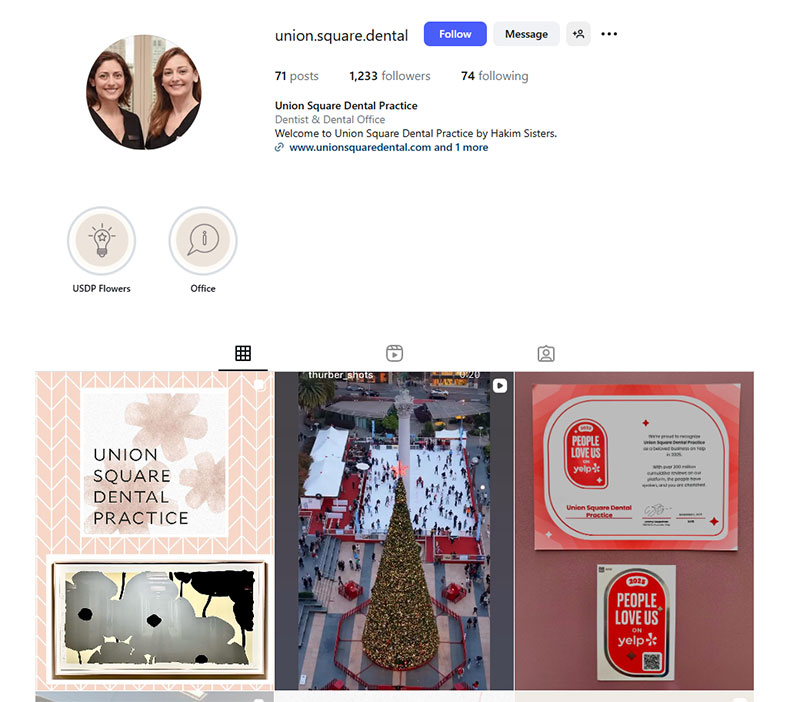
Facebook dominates with 3 billion monthly users.
Rosemont Media shows Facebook popularity peaks with ages 45 to 54. Sixth City Marketing found 97% of dentists use Facebook as their main platform, with 41% of people saying social media content impacts treatment center choice.
Platform strategy:
- Facebook: Targeted local ads, patient testimonials, educational content
- Instagram: Before/after photos, behind-scenes office culture, treatment videos
- TikTok: Short educational clips for younger demographics
Dominate Dental research shows 78% of patients check social media profiles before booking first appointment, with practices sharing behind-scenes content seeing 43% higher consultation booking rates.
Content mix guidelines:
- Educational posts (40% of content) on oral health tips
- Patient transformations with consent
- Team spotlights and office culture
- Promotional campaigns and special offers
Dominate Dental data shows practices with active social media see 67% more patient inquiries versus those using only traditional marketing.
Remarketing recaptures website visitors who didn’t convert initially. Run ads targeting people who viewed service pages but didn’t book.
Leverage Email Marketing for Retention
Appointment reminders slash no-shows.
Sesame Communications study of 1,604,184 appointments found automated reminders reduced no-shows 22.95%. Dialog Health reports SMS reminders achieve 1.90% no-show rate, with text messages having 90% immediate open rate.
NexHealth data shows 49% of practices use automated reminders, while 79.5% of dental patients prefer SMS and email reminders over phone calls.
Essential email campaigns:
- Appointment confirmations (sent immediately upon booking)
- Reminders (48 hours before plus same-day)
- Post-treatment follow-ups with care instructions
- Reactivation campaigns for patients 6+ months overdue
Sixth City Marketing reports email ROI hits $44 per $1 spent, with welcome emails achieving 82% open rate. Omnisend found one in three recipients take action after clicking automated emails versus just one in 18 for regular emails.
Patient reactivation targets lost revenue. Practices lose 15% to 20% of patient base annually according to EmailWarmup data.
Referral requests after positive visits generate word-of-mouth at zero acquisition cost. GetResponse 2024 data shows welcome emails see highest open rates at 83.6%.
Send educational newsletters monthly with oral health tips, treatment options, and practice updates to stay top-of-mind between visits.
What Makes a Dental Website Convert Visitors into Leads
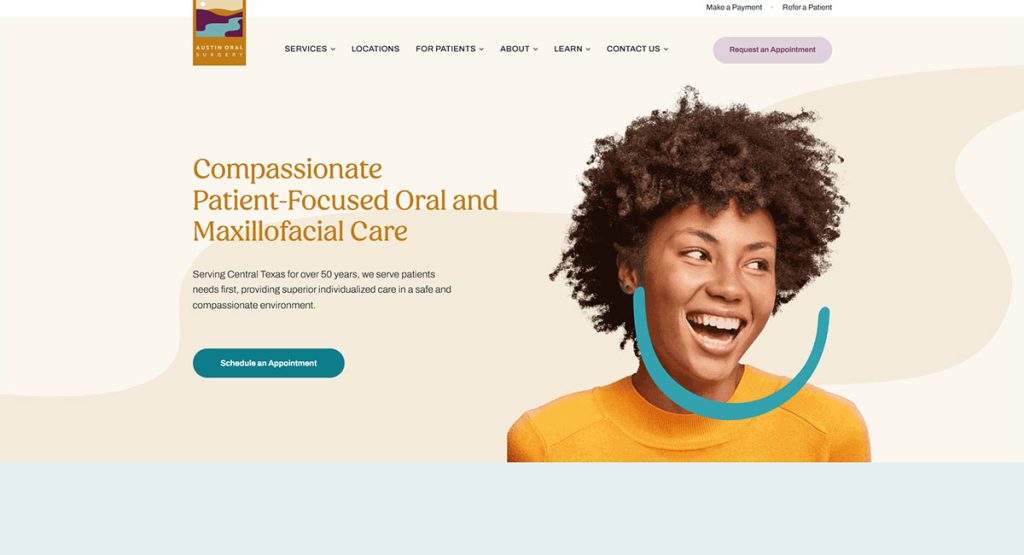
Build Essential Content Pages
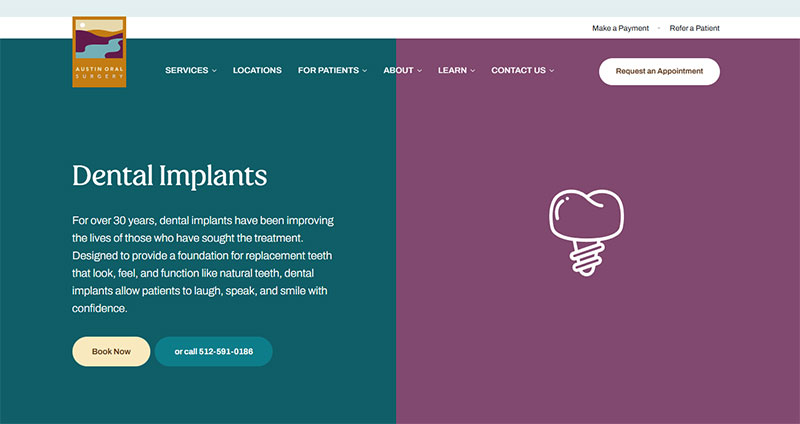
Image source: austinoralsurgery.com
Service pages capture treatment-specific searches.
Create dedicated pages for each procedure (implants, Invisalign, teeth whitening, emergency care) with detailed descriptions, benefits, process timelines, and costs.
Dentist profiles build trust before first visits:
- Professional headshots and team photos
- Credentials, education, and certifications
- Personal backgrounds and practice philosophy
- Years of experience and specialties
Display critical information prominently. Patients abandon sites when they can’t find basics.
Location and hours requirements:
- Address with embedded Google Maps
- Operating hours including emergency availability
- Parking and public transit directions
- Multi-location practices need individual pages
Insurance accepted listings reduce friction. List all accepted carriers, explain coverage verification process, offer flexible payment options.
Reviews drive decisions. NexHealth found 90% of dental patients consult reviews before booking, with 70% saying reviews equal credentials importance. Arini.AI reports 42% won’t visit practices with less than three stars.
Video testimonials boost retention. NexHealth shows video has 95% retention rate versus 12% for text.
Optimize Form Design for Completion
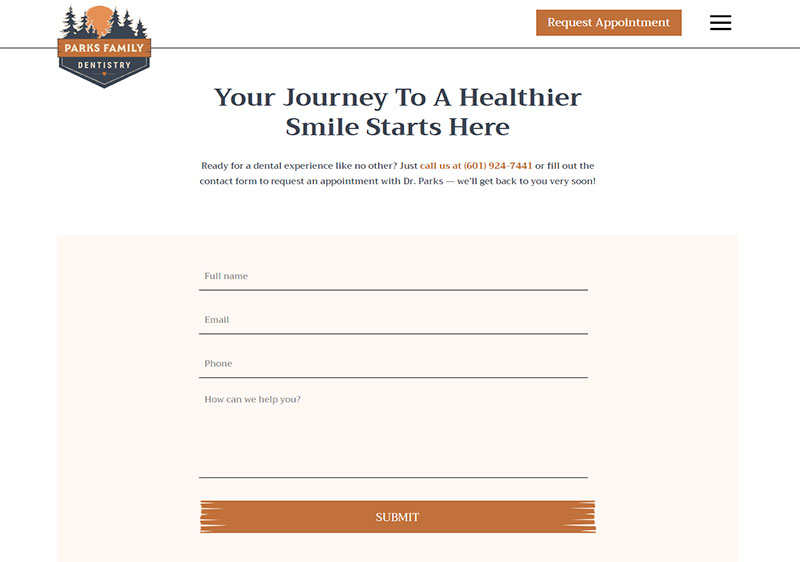
Reduce form fields for higher completion.
Capture essentials only:
- Name
- Phone number
- Email address
- Preferred appointment date/time
- Brief reason for visit (optional)
Mobile optimization drives conversions. New Patient Flow reports over 60% of potential patients research via smartphones, with Arini.AI showing over 60% search for providers on mobile devices.
Apply form design principles:
- Large tap-friendly buttons
- Auto-fill enabled for contact fields
- Single-column layout on mobile
- Progress indicators for multi-step forms
- Error messages that explain how to fix issues
Manage response expectations. Add clear messaging like “We’ll call within 2 business hours” or “Book instantly online for immediate confirmation.”
New Patient Flow found 1-second page load delay causes 7% conversion reduction, with 50% of consumers expecting sites to load under 3 seconds.
Deploy High-Converting CTAs
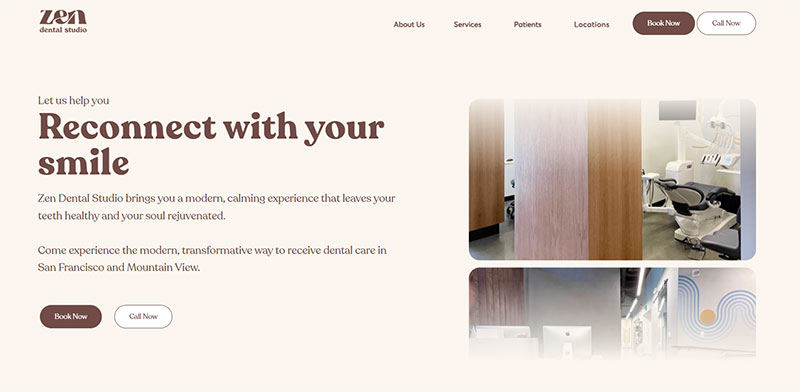
Click-to-call buttons capture mobile visitors instantly.
Position phone numbers prominently:
- Sticky header that follows scroll
- Large tap-friendly buttons
- Emergency line displayed separately
- Call tracking to measure effectiveness
Workforce Dental Staffing shows 68% of dental conversions come from phone calls.
Online booking removes friction. NexHealth reports only 26% of practices offer online booking, but 77% of patients want providers with this feature.
Booking system requirements:
- Sync with practice management software
- Display real-time availability
- Confirm appointments immediately via email/SMS
- Require minimal information upfront
Live chat answers questions in real-time.
PatientGain research shows chatbots available 24/7 help convert after-hours visitors. TrueLark data reveals 86% of website conversations initiated by new patients, with web chat offices booking significantly more than practices without chat.
Remedo indicates live chat-enabled healthcare websites experience greater engagement and conversion rates.
Teledentistry captures busy prospects. Netpeak reports teledentistry market expected to reach $1.38 billion by 2030 with 15.6% annual growth.
Offer virtual consultations for:
- Initial assessments before in-office visits
- Post-treatment follow-ups
- Second opinions
- Basic dental advice questions
TrueLark found 17% of leads book within first minute, 55% within 5 minutes, 64% within 10 minutes. After 10 minutes, booking rates drop dramatically.
Average missed call costs practices $200 to $500 in lifetime patient value according to Arini.AI.
Track Conversion Benchmarks
Average dental website conversion sits between 2% to 5%.
Arini.AI reports typical range, with NexHealth showing top performers reach 10%. Sixth City Marketing found average landing page conversion around 10%, while PatientGain states dental average 4.2%.
Blogging Wizard research shows direct traffic converts best at 3.3%, with cosmetic and dental industries hitting 5.3% for direct traffic and 4.1% for referral traffic.
Calculate your rate: (Conversions / Visitors) × 100
Remedo shows improving from 2% to 5% converts 1,000 monthly visitors into 50 inquiries instead of 20, creating 150% increase in leads from same traffic.
How Much Do Dental Leads Cost
Understand Cost-Driving Factors
Geographic competition creates dramatic pricing variations.
Urban practices face higher costs. Curve Dental shows urban dentists encounter greater overhead expenses from rent, utilities, and wages. Cosmetic Dentistry analysis reveals urban practices charge higher fees than rural counterparts due to metropolitan operational costs.
Competition intensity varies by market:
- Manhattan and major metro areas: 3x to 4x higher than rural
- Suburban markets: 40% to 60% premium over rural areas
- Rural practices: Lower lead costs but smaller patient pools
HRSA data shows rural areas have 4.7 dentists per 10,000 people versus 7.8 in urban areas, creating less marketing competition but reduced patient density.
Service type determines lead value.
Cosmetic dentistry leads cost more than general cleaning inquiries. Specialty procedures (oral surgery, orthodontics, implants) command higher acquisition costs but deliver greater patient lifetime value. PatientGain data shows cosmetic initial visits average $5,000 versus general dentistry at $200.
Marketing channel affects long-term economics:
- SEO: Higher upfront investment, lower cost per lead after 12 months
- PPC: Immediate results, ongoing per-click expenses
- Referral programs: Minimal cost but requires existing patient base
- Social media: Moderate costs with engagement-driven results
First Page Sage found organic leads deliver higher long-term ROI but require longer lead time before producing results, while paid channels give faster traffic.
Seasonality impacts demand peaks. January sees spikes from insurance resets and New Year’s health resolutions. Fourth quarter slows as patients exhaust benefits.
Practice reputation influences effective cost. Strong Google reviews lower cost per acquired patient by improving conversion rates. NexHealth found 90% of patients consult reviews before booking, with practices under 3 stars losing 42% of prospects.
Track Industry Cost Benchmarks
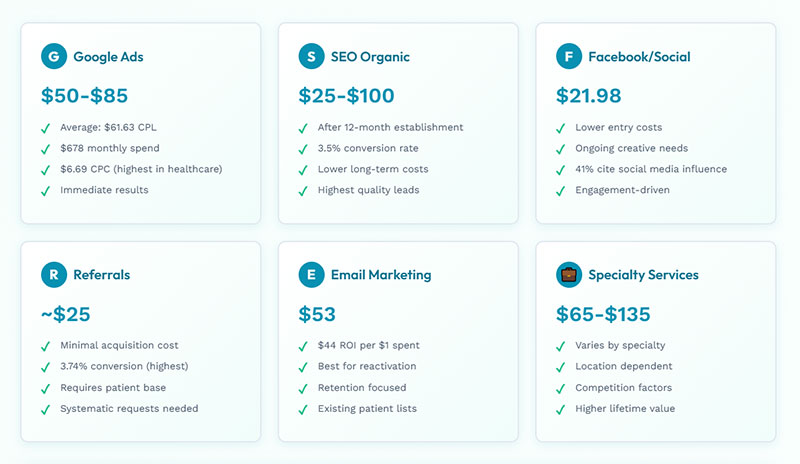
Cost per lead varies dramatically by channel.
Promodo shows healthcare average CPL at $53.53 across all specialties, with dentists and dental services commanding higher costs. InfluxMD reports healthcare lead costs range from $30 to $286 depending on specialty and platform.
Channel-specific benchmarks:
Google Ads performance:
- WordStream 2025: $70.11 average CPL across industries
- Promodo: Dentists average $6.69 CPC (highest in healthcare)
- Elevate DDS: Average dental leads $50 to $85
- AdLuge: Dental Google Ads average $61.63 CPL at $678 monthly spend
SEO organic leads:
- First Page Sage: Organic channels deliver lower long-term costs
- AdLuge: SEO generates $25 to $100 per lead after establishment
- Ruler Analytics: Organic converts at 3.5% for dental
- 12-month investment required before optimal performance
Facebook and social channels:
- Amra and Elma: Facebook leads average $21.98 across industries
- Lower entry costs but requires ongoing creative production
- FollowApp: 41% say social media impacts treatment center choice
Referral programs:
- Sopro: Referrals cost just under $25 per lead
- NexHealth: Referral conversion rate 3.74% (highest of all channels)
- Zero to minimal acquisition cost with established patient base
- Requires systematic request process
Email marketing:
- Amra and Elma: Email averages $53 CPL
- Sixth City Marketing: $44 ROI per $1 spent
- Best for reactivation and retention versus new acquisition
Specialty service premiums exist. Delmain data shows practices spend $65 to $135 per new patient lead depending on specialties, location, and competition factors.
Calculate acceptable cost per lead. JEMSU recommends using lifetime value formula: Average annual spending × Years retained = LTV. With $600 yearly spend and 5-year retention, LTV reaches $3,000. Target CPL at 10% of LTV or lower ($300 maximum).
Optimize Cost Per Patient Acquisition
Quality matters more than quantity.
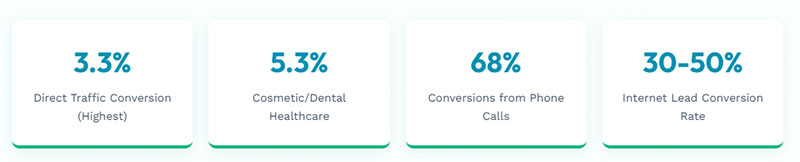
Flyweel notes low CPL becomes vanity metric if lead quality suffers. Focus on cost of acquiring qualified leads versus any leads. SmileTactics shows practices converting 30% to 50% of internet leads through proper qualification.
Track full funnel economics:
- Cost per lead (initial inquiry)
- Lead to consultation conversion rate
- Consultation to patient conversion rate
- Cost per acquired patient (total investment)
Blogging Wizard reports direct traffic converts highest at 3.3%, with cosmetic and dental hitting 5.3% for healthcare. Ruler Analytics found 68% of dental conversions come from phone calls.
Reduce waste through targeting. Promodo shows hospitals and clinics achieve $32.14 CPL with 12.33% conversion rates, while cosmetic surgery faces $100.48 CPL at only 3.92% conversion.
Improve conversion infrastructure:
- Fast response systems (InfluxMD: 5-minute response = 10x conversion)
- Online booking (NexHealth: 77% want it, only 26% offer)
- Mobile-optimized forms (New Patient Flow: 60%+ research on mobile)
- Call tracking to measure phone conversions
Causal Funnel recommends setting CPL goals based on customer lifetime value calculations, monitoring trends monthly, adjusting strategies quarterly.
How to Track Dental Lead Sources
Deploy Marketing Performance Tools
Call tracking software assigns unique numbers to each channel.
Titan Web Agency shows dental practices lose leads without tracking systems in place. WhatConverts and CallRail provide HIPAA-compliant solutions that connect phone calls, forms, and chats to specific campaigns.
Core call tracking features:
- Dynamic number insertion for website visitors
- Unique numbers for print ads, billboards, direct mail
- Call recording for quality assurance and training
- Keyword attribution showing search terms that trigger calls
- Integration with Google Ads and Analytics
Ruler Analytics found 68% of dental conversions occur via phone call, making call tracking essential for accurate attribution.
Google Analytics tracks digital behavior:
- Traffic source breakdown (organic, paid, referral, direct, social)
- User behavior flow through website
- Goal completions (form submissions, booking clicks)
- Conversion paths showing touchpoints before conversion
- Device and location data
Google Search Console reveals organic performance:
- Keywords driving impressions and clicks
- Average position for target terms
- Click-through rates by query
- Technical issues affecting rankings
- Mobile usability problems
Connect leads to revenue through CRM systems.
Grand View Research shows U.S. dental practice management software market reached $924 million in 2024, growing at 9.1% CAGR through 2030. Market.us reports global market expected to hit $6.9 billion by 2034.
Popular dental CRM platforms:
CareStack notes AI-driven analytics tools help identify revenue opportunities, enhance marketing campaigns, optimize staff performance.
Attribution models assign conversion credit.
Single-touch models:
- First-touch: Credits initial interaction
- Last-touch: Credits final touchpoint before conversion
Multi-touch models:
- Linear: Equal credit across all touchpoints
- Time decay: More credit to recent interactions
- Position-based: Emphasis on first and last touchpoints
Blogging Wizard shows direct traffic converts best at 3.3% for cosmetic and dental at 5.3%, making proper attribution critical for understanding true channel performance.
Monitor Lead Quality Indicators
Volume means nothing without quality metrics.
Track appointment show rates as primary indicator. ThriveCloud found only 10% of patients with scheduled appointments cancel or no-show when booked before leaving office.
Certify Health reports dental industry averages:
- 14.4% cancellation rate across 200,000 U.S. practices
- 6.2% no-show rate
- Combined 20.6% broken appointment rate costs billions annually
Improve show rates through:
- Automated SMS reminders (Dialog Health: 1.90% no-show with text)
- Confirmation calls 48 hours before
- Same-day reminder messages
- Easy rescheduling options
- Financial policy clarity
Treatment acceptance rate indicates lead quality and presentation skills.
Dental Economics reports treatment acceptance above 70% signals healthy performance. Adams Brown found practices with strong acceptance achieve 55% to 70% depending on tracking methodology, with $3,200 treatment proposed per patient exam.
ThriveCloud shows top performers approach 90% acceptance through:
- Clear treatment plan explanations
- Intraoral photos and 3D imaging
- Flexible payment options and financing
- Discussion of consequences for delayed treatment
- Same-visit scheduling when possible
Patient lifetime value determines acceptable acquisition costs.
Delmain data shows general practice LTV ranges $5,500 to $7,500, with cosmetic reaching $14,000 over 5 years. Survey of 13,000 practices found gross production per patient averages $4,200.
Calculate LTV formula:
- Average annual spending × Years retained = Total LTV
- Conservative: $600 yearly × 5 years = $3,000 LTV
- Target CPL at 10% of LTV maximum
Referral rate from new patients indicates satisfaction.
NexHealth reports referrals deliver 3.74% conversion rate (highest of all channels) at minimal acquisition cost. Practices with systematic referral request processes generate word-of-mouth leads continuously.
Additional quality metrics to track:
Active patient count:
- ThriveCloud benchmark: 1,500 active patients per solo dentist
- Active defined as seen within last 18 months
- Below 1,500 creates scheduling gaps
- Above 1,500 may compromise patient experience
Pre-appointment percentage:
- Dentistry IQ shows practices should maintain 30% to 40% minimum
- ThriveCloud reports typical practices hit 50%
- Top performers exceed 65%
- Tracks active patients with future appointments scheduled
Production per visit:
- Dentistry IQ identifies PPV as top metric to examine
- Reveals treatment volume and acceptance patterns
- Compare month-over-month for trends
- Shows whether patient volume or treatment acceptance drives revenue changes
Databox emphasizes tracking these metrics through dental KPI dashboards for comprehensive performance view, enabling data-driven decisions beyond basic revenue and patient volume.
What Mistakes Reduce Dental Lead Generation
Fix Critical Website Performance Issues
Slow load times destroy conversions instantly.
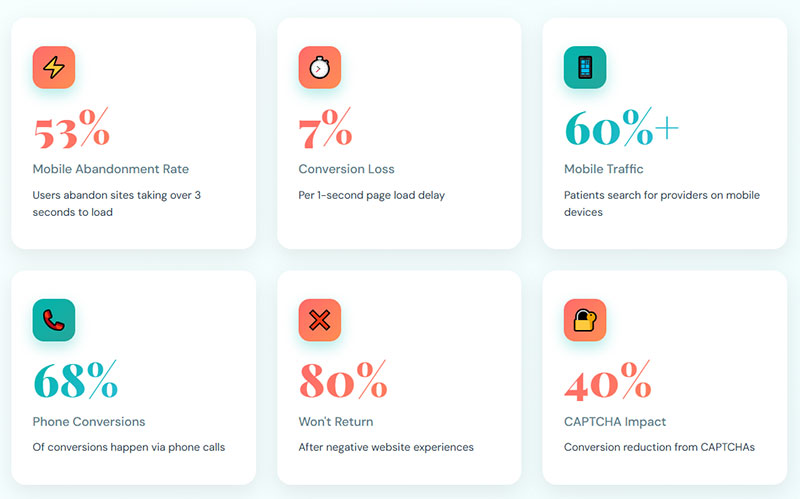
Hostinger reports 53% of mobile users abandon sites taking over 3 seconds to load, with Site Qwality confirming this abandonment rate holds across 2025 data. DentalScapes found 53% of mobile users abandon slow-loading sites.
First Stop Dental notes research shows most people leave if sites take longer than 3 seconds. New Patient Flow found 1-second page load delay results in 7% conversion reduction.
Speed optimization essentials:
- Compress images (use WebP or AVIF formats)
- Enable browser caching and Brotli compression
- Minimize CSS and JavaScript files
- Use content delivery network (CDN)
- Lazy-load below-the-fold images
- Remove unused plugins and scripts
WordPress sites average 2.5 seconds desktop load but 13.25 seconds mobile according to Hostinger, showing mobile optimization gap.
Missing contact information frustrates prospects:
- Display phone number in sticky header (follows scroll)
- Click-to-call buttons for mobile users (Ruler Analytics: 68% of conversions via phone)
- Office address with embedded map
- Emergency contact displayed separately
- Hours including after-hours availability
Poor mobile experience kills leads from 60%+ of traffic.
Arini.AI reports over 60% of patients search for providers on mobile devices. New Patient Flow confirms 60%+ conduct initial research via smartphones.
Mobile requirements:
- Responsive design that adapts to all screen sizes
- Large tap-friendly buttons (minimum 44×44 pixels)
- Readable text without zooming
- Forms optimized for mobile input
- Single-column layouts
- No horizontal scrolling
Weave found 80% of people with negative website experiences unlikely to return.
No clear calls to action leaves visitors uncertain.
Place CTAs strategically:
- Above fold on every page
- After service descriptions
- In sidebar that follows scroll
- End of content sections
- Exit-intent popups
Understanding form abandonment fixes conversion leaks. Reduce fields, enable autofill, remove CAPTCHAs (WPForms: 40% conversion reduction).
Eliminate PPC Budget Waste
Broad targeting shows ads to prospects 50+ miles away who’ll never visit.
GoAdFuel warns hyper-local targeting is essential for dental practices. Cardinal Digital Marketing notes broad keywords waste budget on wrong audiences.
Geographic targeting fixes:
- Radius targeting (5, 10, or 15-mile circles around practice)
- Specific ZIP code targeting
- Exclude areas too far to serve
- Adjust bids by location performance
- Schedule ads for business hours
Golden Proportions warns practices using broad match without negatives waste spend showing ads for irrelevant searches like “cheap dental implants abroad.”
Wrong keywords attract zero patients.
Now Media Group shows common mistakes include targeting job-seeker terms. DentalScapes lists critical errors: “dental school,” “dental assistant jobs,” “hygienist openings,” “free dental care,” “DIY whitening,” “cheap implants.”
Negative keyword categories to add:
- Job searches (assistant, hiring, careers, employment)
- Educational queries (school, classes, degree, study)
- Free services (free care, charity, volunteer)
- DIY solutions (home remedies, at-home kits)
- Competitor brand names
- Irrelevant procedures not offered
GoAdFuel recommends long-tail keywords attracting high-intent patients: “dental implant financing near me,” “Invisalign specialist for adults,” “emergency dentist open Saturday.”
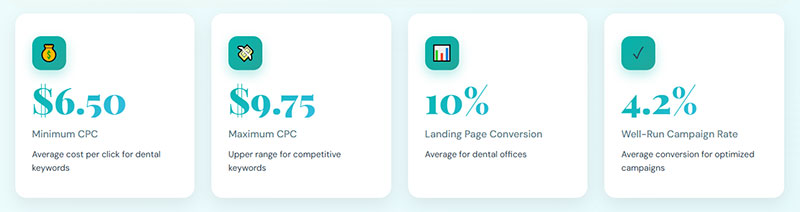
The Creative Composite notes broad keywords like “dental implants” or “emergency dentist” have higher CPC from competition. Elevate DDS reports dental keywords average $6.50 to $9.75 CPC in 2025.
Weak landing pages fail to convert expensive clicks.
DentalScapes warns sending all clicks to homepage instead of dedicated service pages wastes spend. GoAdFuel calls generic homepage traffic a costly mistake.
Landing page requirements:
- Service-specific content matching ad
- Prominent booking CTA above fold
- Social proof (reviews, testimonials)
- Clear pricing or financing info
- Trust signals (credentials, years experience)
- Mobile-optimized design
- Fast load time (under 3 seconds)
Workforce Dental Staffing shows average landing page conversion for dental offices around 10%.
No conversion tracking means flying blind.
DentalScapes emphasizes tracking cost per booked appointment, not just clicks. RevUp Dental warns practices without proper tracking burn through budgets without knowing what works.
Track these metrics:
- Conversion rate (clicks to calls/forms)
- Cost per conversion
- Booked appointment rate
- Cost per acquired patient
- Patient lifetime value by channel
- Return on ad spend (ROAS)
Media NV notes not measuring ROI means unknown campaign performance. Workforce Dental Staffing reports practices typically spend $5,000 monthly on PPC, making tracking essential.
Integrate call tracking with Google Ads:
- Assign unique numbers to campaigns
- Record calls for quality assurance
- Track keyword attribution
- Measure call duration and outcomes
- Connect calls to booked appointments
GoAdFuel shows well-run campaigns average 4.2% conversion rate, with CPC ranging $6.50 to $9.75, making optimization critical for profitability.
How to Improve Dental Patient Conversion Rates
Implement Speed-to-Lead Response Systems
Call web leads within 5 minutes for massive conversion advantage.
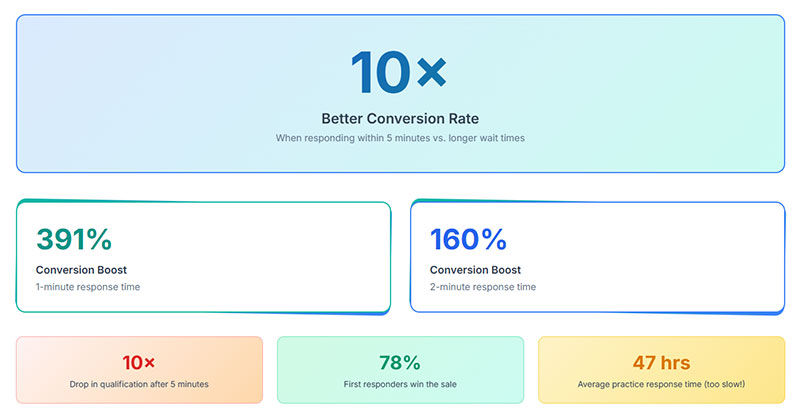
InfluxMD reports practices responding within 5 minutes convert leads 10 times more likely than those waiting longer. Rep.ai found 1-minute response improves conversions by 391%, while 2-minute response only delivers 160% improvement.
Amra and Elma shows response beyond 5 minutes drops qualification success by 10x. Vendasta confirms first responders win 35% to 50% of sales, with some sources reporting up to 78%.
DemandSage notes 9 times more leads convert with follow-ups within 5 minutes. InfluxMD warns average medical practice response time remains 47 hours despite data showing 5-minute advantage.
Speed-to-lead implementation:
- Auto-notifications to front desk when forms submitted
- CRM alerts sent to multiple staff members
- Click-to-call from lead management dashboard
- Automated SMS acknowledgment (“We received your request, calling within 5 minutes”)
- Backup protocols if primary contact unavailable
- After-hours answering service for 24/7 coverage
Train front desk for conversion success.
Patient Prism specializes in call handling coaching to convert more leads. InfluxMD notes up to 59% of qualified callers never book appointments despite reaching practices.
Phone protocol requirements:
- Greeting script that creates warm first impression
- Active listening to identify patient needs
- Same-day or next-day appointment offers
- Flexible scheduling accommodations
- Insurance verification during call
- Payment plan discussion if needed
- Appointment confirmation before hanging up
Track these call metrics:
- Answer rate (target: 95%+ during business hours)
- Average time to answer (under 30 seconds)
- Call-to-appointment conversion rate
- Appointment show rate from phone bookings
- Missed call follow-up time
Reduce no-shows through confirmation systems.
Dialog Health reports SMS reminders achieve 1.90% no-show rate with 90% immediate open rate. Sesame Communications found automated reminders reduce no-shows 22.95%.
Confirmation system layers:
- Automated appointment confirmation email immediately after booking
- 48-hour advance text reminder with confirm/cancel option
- Same-day morning reminder for afternoon appointments
- Two-way texting for easy rescheduling
- Waitlist system to fill cancellations
Certify Health data shows dental industry averages 14.4% cancellation rate, 6.2% no-show rate, with combined 20.6% broken appointment rate costing billions annually.
Automate follow-up sequences with practice management software.
Weave Communications and Solutionreach provide automated patient engagement tools. InfluxMD shows automated follow-up systems can increase conversion rates 20% to 400% depending on implementation.
Automated sequence timeline:
- Immediate: Confirmation email/text after form submission
- 5 minutes: Phone call from front desk
- 2 hours: Follow-up if first call unanswered
- 24 hours: Second attempt with voicemail and text
- 48 hours: Final email with easy booking link
- 7 days: Re-engagement for unconverted leads
Rep.ai emphasizes 82% of consumers expect responses within 10 minutes, making automation critical for meeting expectations.
Use Online Reputation Management
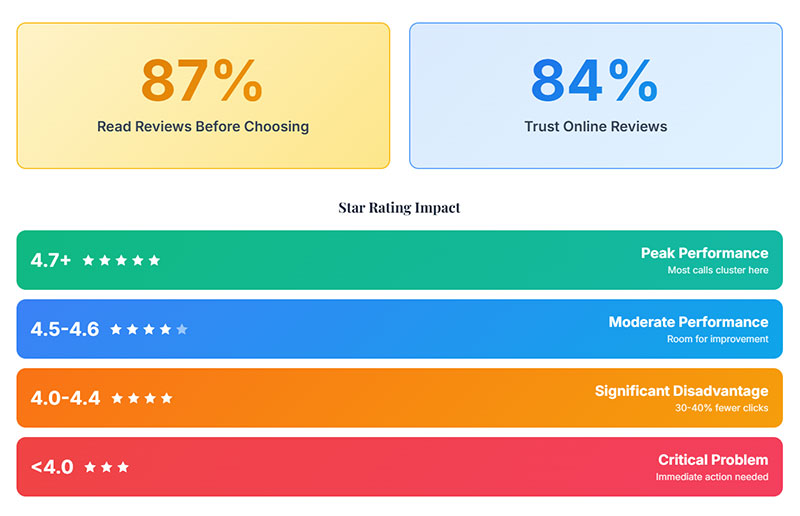
Reviews count and rating quality drive conversion decisions.
Oral Health Group data shows practices with 4.7+ star ratings receive dramatically more calls than those below this threshold. RevUp Dental found 4.4 to 4.5 ratings see call volume drop significantly even with decent review count.
Dominate Dental tracked 200+ UK practices over 18 months, finding those maintaining 4.5+ stars with 50+ reviews generated 156% more consultation requests than practices with basic profiles.
Patient NEWS reports 87% of patients read online reviews before choosing dentist, with 84% trusting online reviews as much as personal recommendations. Healthcare Call Center confirms 72% wait to read reviews before proceeding.
Review volume benchmarks:
- 10 to 50 reviews: Minimum credibility threshold
- 100+ reviews: Strong trust signal
- 300 to 500 reviews: Significant call volume increase (often doubling or tripling)
- 500+ reviews: Premium tier with 400 to 600+ monthly calls
Decisions in Dentistry notes new practice with 500 positive reviews consistently outranks decades-old practice with only 50 reviews in local search.
Rating thresholds that matter:
- 4.7+ stars: Competitive range where most calls cluster
- 4.5 to 4.6 stars: Moderate performance
- 4.0 to 4.4 stars: Significant disadvantage, expect 30% to 40% fewer clicks
- Below 4.0 stars: Critical reputation problem
Respond to all reviews professionally.
Circulation Dental emphasizes responding to every review, including those without text, demonstrates engagement and builds trust. Reviewly.ai notes responding to reviews signals commitment to patient satisfaction.
Response best practices:
- Reply within 24 to 48 hours maximum
- Thank positive reviewers by name
- Address specific points mentioned
- For negative reviews, acknowledge concern and offer offline resolution
- Keep responses professional, never defensive
- Include invitation to return or contact directly
- Mention specific team members when praised
Decisions in Dentistry warns Google algorithms favor businesses engaging with reviews, improving local search rankings.
Generate reviews systematically with automation tools.
PatientPop and RevenueWell build reputation through automated review requests. Patient NEWS recommends targeting 3+ new reviews weekly for optimal momentum.
Review generation process:
- Request immediately post-treatment while patient grateful (15 to 30 minute window)
- Send direct Google review link via text before patient leaves
- Email follow-up within 24 hours with same link
- Make process mobile-friendly (one-click access)
- Train all staff on asking naturally
- Track which team members generate most reviews
Healthcare Call Center notes Google connects service mentions like “teeth whitening,” “Invisalign,” “emergency dental care” from reviews to practice, improving rankings for those queries.
Ruler Analytics shows 92% of B2B buyers more likely to purchase after reading trusted review, with reviews being trusted source driving positive buying outcomes in dental sector.
Decisions in Dentistry calculates review generation ROI: 50 monthly reviews at $5 staff incentive costs $250 but brings 3 to 5 new patients monthly worth $7,500 to $12,500 in lifetime value, plus lasting benefits including 30% to 50% increase in organic calls.
What Offline Methods Still Generate Dental Leads
Build Patient Referral Programs
Referrals deliver highest conversion rates at lowest acquisition cost.
Ruler Analytics found referral traffic converts at 3.6% for dental practices, highest among all channels. Sopro reports referral leads cost only $25 with 3.74% conversion rate.
Sixth City Marketing shows 68% of patients choose dentists based on referrals when seeking new providers. NexHealth data confirms referrals outperform all other lead sources for quality and conversion.
Arini.AI notes average dental practice converts only 23% of new patient calls, but referrals close at significantly higher rates due to pre-established trust.
Program incentive structures that work:
- $25 to $50 gift cards to popular retailers (Amazon, Target, Starbucks)
- Account credits applied to future treatments
- Charitable donations in patient’s name (appeals to altruistic motivations)
- Family upgrade offers (whitening, premium cleanings)
- Tiered rewards (more referrals = bigger benefits)
Request timing that maximizes response:
- Immediately after successful treatment completion
- While patient still in chair expressing satisfaction
- Within 24 hours via text/email follow-up
- After major procedures with excellent outcomes
- During routine cleaning when rapport strong
Mail Shark data shows patient referrals generate average 1.4 additional referrals per patient, multiplying initial acquisition value. PatientGain calculates average new patient LTV at $6,700, with referrals adding $9,730 in additional production over time.
Make asking natural for staff:
- “We’re so glad you’re happy with your results. If you know anyone looking for a great dentist, we’d love to take care of them too.”
- Provide referral cards patients can hand to friends/family
- Text direct booking link for easy referral sharing
- Digital referral tracking in practice management system
Deploy Community Marketing Strategies
Local sponsorships build brand recognition in target neighborhoods.
Community involvement creates familiarity that converts to patient trust. Practices sponsoring youth sports teams, school events, health fairs gain top-of-mind awareness when families need dentists.
Effective sponsorship channels:
- Youth sports leagues (soccer, baseball, basketball)
- School fundraisers and events
- Little League teams with field signage
- Local charity runs/walks
- Community festivals and fairs
Health fair screening captures qualified leads:
- Free oral cancer screenings
- Blood pressure checks
- Dental health assessments
- Kids’ education activities
- Capture contact info via sign-up forms
- Offer special new patient discount for attendees
Taylor reports 80% of new movers search for local services including dentists, making community visibility during transitional periods critical.
School partnership programs create family connections:
- Classroom dental education presentations
- Free toothbrush/toothpaste distribution
- School nurse referral relationships
- Athletic team dental guard programs
- Science fair sponsorships
Business networking generates B2B referral relationships through Chamber of Commerce, BNI (Business Network International), Rotary clubs, professional associations.
Each networking contact becomes potential referral source referring employees, family members, professional network. One strong business relationship can yield 10 to 20 patient referrals annually.
Execute Direct Mail Campaigns
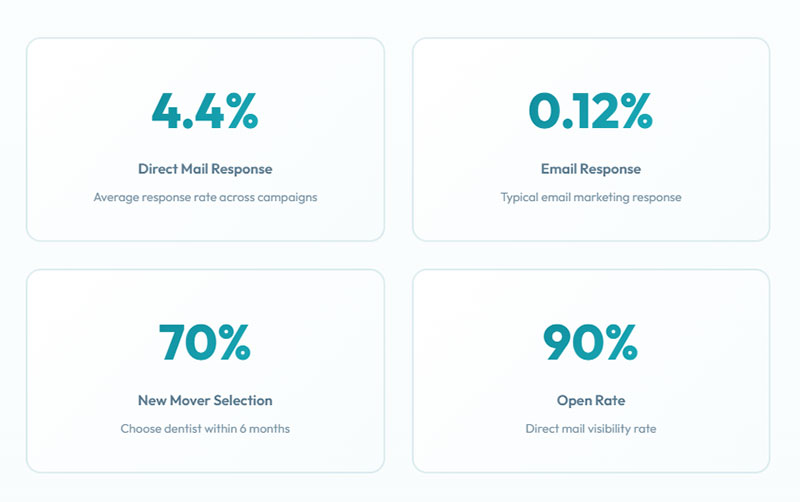
New mover lists deliver concentrated opportunities.
MVP Mailhouse reports 70% of new movers select new dentist within first six months of relocating. Taylor data shows 26 million Americans moved in 2024 (8% of population), spending $9,000 to $12,000 within first six months on services including dental care.
Dentaltown case study shows dental practice in Ashburn, VA spent $6,664 on new mover campaign, achieved 125% ROI earning roughly $15,000.
New mover campaign implementation:
- Use USPS or third-party verified mover data
- Target households within practice service area
- Send 3 postcards over 3-month window (repetition builds recall)
- Welcome messaging acknowledging recent move
- Special new patient offer prominently displayed
- Practice photos showing friendly team
Data & Marketing Association reports direct mail response rates average 4.4% compared to 0.12% for email. Selzy shows prospects respond at 5% rate, existing customers at 9%.
Radius targeting reaches entire neighborhoods:
- 5-mile radius around practice location
- Target ZIP codes with desired demographics
- Exclude areas too far to realistically serve
- Focus on family-dense neighborhoods
- Adjust based on competition density
AIM Dental Marketing notes direct mail response rates up to 9x higher than email marketing, with LTV of $6,000 to $10,000 per patient making investment worthwhile.
Offers that generate response:
- Free new patient exam (removes barrier)
- Discounted cleaning ($59 to $79 range)
- Invisalign consultation ($500+ value promoted)
- Teeth whitening add-on with first visit
- Emergency exam special
Mail Shark data shows general dental direct mail response rates range 0.25% to 1%+ over 1 to 3 month period. Conservative 0.25% response on 10,000-piece mailing yields 25 new patients at $6,950 LTV each, generating $173,750 production.
PrintTech emphasizes direct mail’s tangible nature ensures visibility during settling-in period when brand loyalties not yet established.
Patient NEWS reports direct mail achieves 90% open rate, with 70% of consumers saying direct mail more personal than online interactions. Study shows consumers engage with 3 out of 10 mail pieces by visiting website, inquiring, or making purchase.
Response rate benchmarks and demographics:
- New movers: 0.5% to 2% response
- Current patients: 5% to 9% response
- Families with children: Higher engagement
- Seniors: Prefer traditional mail, less digitally active
- Non-internet-active households: Only reachable via mail
Track campaign effectiveness:
- Unique phone numbers per campaign
- QR codes with campaign-specific landing pages
- Promo codes mentioned in mailer
- Ask “How did you hear about us?” at booking
- Calculate cost per acquired patient
How to Build a Dental Lead Generation Plan
Establish Marketing Budget Benchmarks
Industry standard varies by practice stage and growth goals.
ViziSites reports dental practices typically invest 4% to 7% of annual revenue on marketing, with most successful practices allocating 80% to digital channels and 20% to traditional methods. Ortho Marketing notes American Dental Association recommends 7% to 10% of gross revenue.
Budget allocation by practice stage:
- Established practices: 3% to 8% for steady growth (S8E8 shows 2-7% typical, 3-7% for positive results)
- Growing practices: 8% to 12% for aggressive expansion (Ortho Marketing)
- New practices: 10% to 20% first year to build patient base (ViziSites shows 15-20%, Smile Tactics 20-30%)
- Startup practices: Up to 25% of revenue goal to reach target within first year (S8E8)
Dr. Marketing reports practices should allocate 5% to 10% to stay competitive in local markets, while 2740 Consulting shows 60% of offices increased digital budgets during growth years.
Solo practitioner benchmarks:
- Average $24,000 annually (3% of revenue) for typical practice
- $1,000,000 annual collections = $1,700 to $5,800 monthly spend (S8E8)
- Conservative range 2% to 4% shows healthy growth (ViziSites)
- Below 2% risks stagnant or shrinking patient numbers
Workforce Dental Staffing notes dentists spend vast majority of resources on local SEO, which remains single biggest revenue driver beating social media ads.
Channel allocation recommendation:
- Website/SEO: 30% to 40% of marketing budget (largest allocation)
- Google Ads: 25% to 35% for immediate patient acquisition
- Social media advertising: 15% to 20% for brand building
- Reputation management/review generation: 10% to 15%
- Content creation: 10% to 20% (blogs, videos, social posts)
- Email/SMS/CRM systems: 5% to 10%
Dr. Marketing emphasizes paid advertising typically gets 25% to 40% of budget when seeking quick new-patient growth, with monthly spend of few hundred dollars creating meaningful returns if properly targeted.
FireGang warns underinvesting early costs more long-term, as practices need marketing to acquire patients before having patients. New offices should build marketing into startup budget from day one.
Set Realistic Timeline Expectations
Different channels deliver results at different speeds.
Google Ads produces fastest results with immediate visibility.
Elevate DDS reports dental Google Ads campaigns begin generating leads within 24 to 48 hours of launch, though building truly effective campaigns requires ongoing optimization.
Keywords Everywhere shows average CPC for dental services $6.82 in 2024, with average conversion rate 6.96%. JEMSU notes conversion rates 3% to 5% considered good, with well-optimized campaigns achieving 4.2% average.
Google Ads ROI benchmarks:
- New patient acquisition cost: $175 to $325 depending on specialty
- ROI for optimized campaigns: 300% to 500%
- ROAS target: 4:1 or higher ($4 revenue per $1 spend)
- Average CPC: $6.50 to $9.75 in competitive markets
SEO requires patience but delivers compounding returns.
Dental Marketing Guy reports improvements visible within few months, but significant results typically take 6 to 12 months. DesignOmate shows most practices see visibility improvements in 3 to 4 months, increase in calls/bookings around month 5, strong consistent results by month 6.
Workforce Dental Staffing reports local SEO conversion rate nearly 50% for healthcare industry (compare to 3% for social media), making patience worthwhile.
DesignOmate calculates SEO ROI: at $6,500 lifetime value per patient, just 5 monthly organic patients yield $390,000 annual revenue, far exceeding typical SEO investment of $1,500 to $5,000 monthly.
Brand building shows results over 6 to 12 months.
Nexus Dental Systems notes content marketing and social media require sustained effort to see compounding effects. Video content dominates engagement, with educational content building trust and positioning practice as authority.
2740 Consulting reports 71% of patients research potential dentists before booking, with 81% trusting feedback from past patients. Building review base and content library takes consistent monthly effort.
Similar to lead generation for healthcare broadly, dental marketing requires patience and consistent investment across multiple touchpoints.
Implement Multi-Channel Strategy
Practices succeeding with local business lead generation combine multiple channels rather than relying on single source.
2740 Consulting shows 50% of dentists question right platform, but truth is no single “right” platform exists. Best approach: spread budget across different channels where target users spend time.
Channel performance data:
- Local SEO: 50% conversion rate, highest ROI long-term
- Organic search: 3.5% conversion, 53% traffic share (35% according to 2740)
- PPC/Google Ads: 4.2% conversion, immediate results, 35% of traffic
- Referrals: 3.6% to 3.74% conversion, 37.4% of high-quality patients
- Direct traffic: 2.7% conversion
- Paid social: Lower immediate conversion but builds awareness
Dental Marketing Guy emphasizes Google dominates with 91.6% global search market, making optimization essential. Top ranking captures 28% of clicks, second position 15.8%, third 11%. Second page results get under 1% click chance.
Track marketing ROI monthly through key metrics:
- New patient source attribution
- Cost per acquisition by channel
- Conversion rate by traffic source
- Patient lifetime value by acquisition channel
- Return on ad spend (ROAS)
- Website conversion rate (NexHealth: 10% top performers, 3-5% average)
- Appointment booking rate from inquiries
Shift budget quarterly toward best-performing channels based on data, but maintain presence across multiple channels for consistent lead flow and brand reinforcement.
ViziSites warns dropping below 2% total marketing spend often results in stagnant or shrinking patient numbers. Consistent investment across 12+ months required to see compounding effects of integrated strategy.
FAQ on Lead Generation For Dentists
What is a dental lead?
A dental lead is a potential patient who has expressed interest in your services. They submitted a contact form, called your office, booked an online appointment, or subscribed to your email list. Each lead represents a possible new patient relationship.
How much does a dental lead cost?
Cost per lead varies by channel and location. Google Ads typically runs $25-75 per lead. Facebook advertising averages $15-40. SEO delivers leads at $5-15 after 12 months of investment. Metro areas cost 40-60% more than suburban markets.
What is the best marketing channel for dentists?
Google Business Profile combined with local SEO delivers the best long-term ROI. Google Ads provides immediate results for practices needing patients quickly. Most successful practices combine both organic and paid channels for consistent dental patient acquisition.
How many new patients should a dental practice get monthly?
The American Dental Association suggests 20-50 new patients monthly for healthy growth. The exact number depends on practice size, patient retention rate, and revenue goals. Solo practitioners need fewer than multi-dentist practices with higher overhead.
How long does dental SEO take to work?
Expect 4-6 months for initial rankings and 12+ months for significant organic traffic. Dental SEO services require patience but deliver the lowest cost per lead over time. Competitive markets take longer than underserved areas.
Do Google Ads work for dentists?
Yes. Google Ads for dentists captures high-intent searches from people actively seeking dental services. Pay-per-click campaigns generate leads within 24-48 hours of launch. Success depends on proper keyword targeting, ad copy, and landing page optimization.
What information should dental contact forms collect?
Keep forms short: name, phone, email, and preferred appointment time. Fewer fields increase completion rates. Following web form best practices and proper form validation reduces abandonment and captures quality leads.
How do patient reviews affect lead generation?
Reviews directly impact Google Maps ranking and patient trust. Practices below 4.0 stars see 30-40% fewer clicks. Aim for 50+ reviews on Google. Online reputation management through platforms like PatientPop systematically builds review volume.
What is the best way to track dental leads?
Use CallRail for phone tracking, Google Analytics for website traffic, and a dental CRM like Dentrix or Open Dental for patient management. Attribution models connect marketing spend to actual booked appointments and practice revenue growth.
Should dentists use social media for lead generation?
Facebook and Instagram work best for paid advertising targeting specific demographics. Organic social media builds brand awareness but rarely generates direct leads. Dental social media marketing shines for cosmetic procedures where before/after visuals drive interest.
Conclusion
Lead generation for dentists requires a multi-channel approach combining digital marketing with traditional patient referral programs.
No single tactic fills your appointment book alone.
Start with Google Business Profile optimization and a conversion-focused website. Add Google Ads for immediate patient flow while building long-term organic visibility through dental content marketing.
Track everything using CallRail and Google Analytics. Know your cost per lead by channel and double down on what works.
Response speed matters more than most practices realize. Call web leads within 5 minutes. Train your front desk staff on phone conversion techniques.
Build your online reputation systematically through review generation tools like RevenueWell or Lighthouse 360.
The practices winning at dental patient acquisition treat marketing as a system, not a series of random tactics. Start building yours today.