






Most lead magnets don’t work. They get downloaded, skimmed for 30 seconds, and forgotten. Meanwhile, your email list fills up with people who will never buy anything. The problem isn’t…
Table of Contents
Empty calendars kill interior design businesses faster than bad taste.
Lead generation for interior design is the difference between waiting for the phone to ring and having a pipeline of qualified prospects ready to book.
Most designers rely on word-of-mouth alone. That works until it doesn’t.
Platforms like Houzz Pro, Instagram, and Pinterest have changed how homeowners find designers. Your competitors are already there.
This guide covers the specific strategies that fill project calendars: portfolio optimization, referral programs, social media marketing, paid advertising, and partnership development.
You’ll learn how to attract the right clients, qualify them before wasting consultation time, and convert inquiries into signed contracts.
What Is Lead Generation for Interior Design
Lead generation for interior design is the process of attracting potential clients interested in design services, capturing their contact information, and converting them into paying customers.
Interior designers use marketing strategies like portfolio showcasing, referral programs, content creation, and digital advertising to build a consistent pipeline of qualified prospects.
The goal is simple: fill your calendar with projects from clients who actually match your style and budget requirements.
Unlike retail businesses where customers walk in, interior design firms must actively pursue client acquisition through multiple channels.
Platforms like Houzz Pro, Instagram, and Pinterest serve as primary discovery points where homeowners search for designers.
Your website, social media presence, and professional network all work together to generate inquiries.
The most successful design firms treat lead generation as a daily activity, not something they do when projects dry up.
How Does Lead Generation Work for Interior Design Businesses
The process follows a predictable path: awareness, interest capture, qualification, nurturing, and conversion.
Discovery Stage
Potential clients find you through Google searches, social media, referrals, or platforms like HomeAdvisor and Thumbtack.
The U.S. interior design market is substantial. According to Credence Research, it reached $37.66 billion in 2024 and is projected to hit $52.20 billion by 2032. This growth creates opportunity, but also means more competition for leads.
Platform costs vary significantly: HomeAdvisor charges $15-$100 per lead plus a $350 annual fee, according to Housecall Pro. Thumbtack uses a pay-per-response model where you only pay when potential clients contact you back.
Portfolio Evaluation
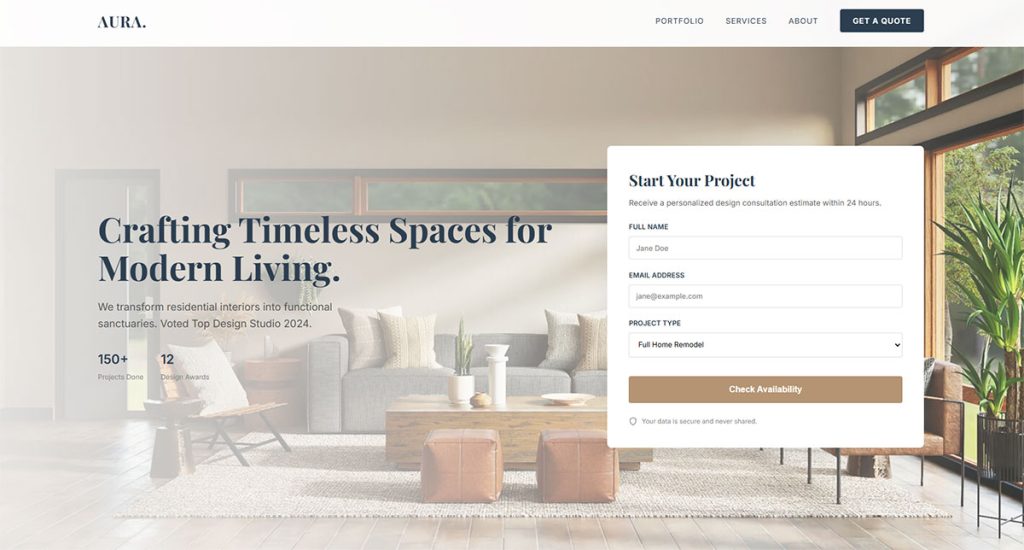
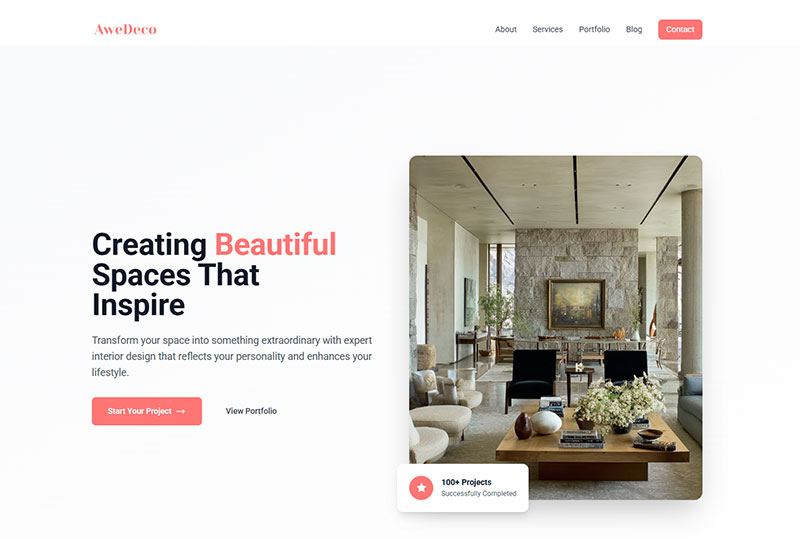
Visitors land on your portfolio website and decide if your aesthetic matches their vision.
Website performance matters here. According to Hostinger, sites taking over two seconds to load lose 60% of visitors. Your portfolio needs to load fast and showcase your best work immediately.
According to Higher Visibility, the global average website conversion rate is 3.68%. If you’re hitting 3-4%, you’re performing well.
Lead Capture
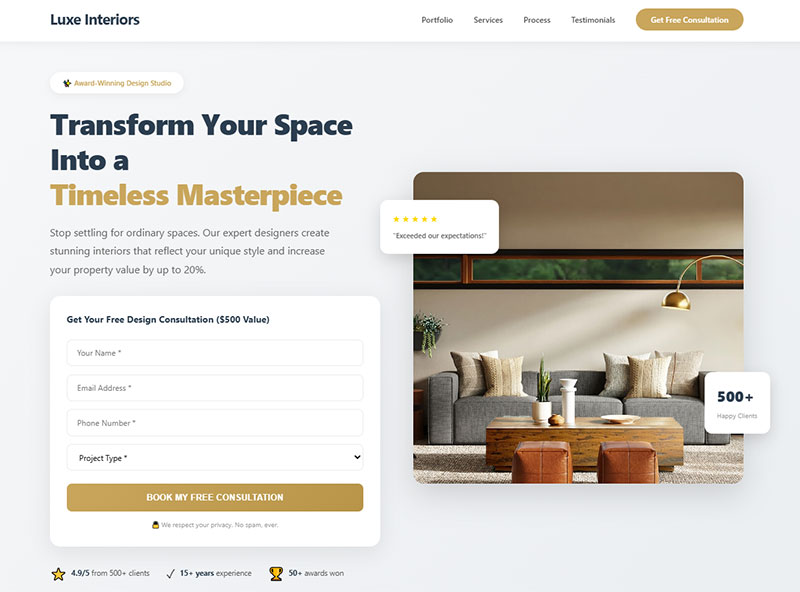
Interested visitors fill out a contact form or request a consultation.
According to Invesp, increasing your landing pages from 10 to 15 boosts leads by 55%. Create separate landing pages for kitchen remodels, bathroom design, whole-home projects, and commercial work.
The challenge? According to Wiser Notify, 61% of marketers struggle most with generating quality leads. Quantity without quality wastes time.
Qualification Process
Screen prospects based on budget, timeline, project scope, and design compatibility.
Budget ranges matter. According to Credence Research, projects in the $10,000-$50,000 range represented the largest market share in 2024. Know your ideal client’s budget range and filter accordingly.
Market breakdown by service type:
- Interior decoration: 38% of market
- Renovation and remodeling: 47.37% of revenue
- Premium and luxury projects: Growing at 11.79% annually
Use these benchmarks to position your services and pricing.
Nurturing Sequence
Qualified leads enter your email follow-up sequence or receive direct outreach.
Email delivers strong ROI. According to OptinMonster, every $1 spent on email marketing returns $36. Set up automated sequences for different project types.
Conversion to Client
A discovery call or initial consultation converts them into paying clients.
Set realistic expectations. According to First Page Sage, even top companies like Salesforce convert less than 5% of traffic into qualified leads. If you’re converting 2-3% of website visitors, you’re on track.
What Role Does a Portfolio Play in Attracting Design Clients
Your portfolio is the single most influential factor in converting visitors to leads.
Content That Converts
High-quality before-and-after photos create immediate emotional impact. According to Wegic’s analysis of top interior design portfolios, before-and-after case studies with visual contrast convincingly demonstrate design value.
Include these elements:
- Same-angle comparison shots
- Project context (challenges solved, materials selected)
- Timeline to completion
- Client testimonials
- Detailed project descriptions
Mix residential and commercial work. According to Mordor Intelligence, residential holds 55.36% market share while commercial grows faster at 10.76% annually. Show both to capture more opportunities.
Organization Strategy
Organize by room type or style so visitors quickly find relevant work.
According to Wegic, neat grid formats showcase design expertise while image carousels let users browse at their own pace. Every portfolio page needs a clear call-to-action leading to your consultation booking.
Portfolio format options:
- Grid layouts for showcasing volume
- Case study formats for demonstrating process
- Combination approach for different project types
Budget Transparency
Include project budgets when possible. This pre-qualifies visitors and attracts your ideal price point.
Projects under $10K attract price-shoppers. The $10K-$50K range holds the largest market share. Premium projects over $100K are growing at 11.79% annually, according to Mordor Intelligence.
Display budget ranges to filter leads before they contact you.
Technical Performance
According to Wegic’s portfolio analysis, service pages with dynamic “Contact Us” buttons increase conversion rates. Place CTAs strategically throughout your portfolio, not just at the end.
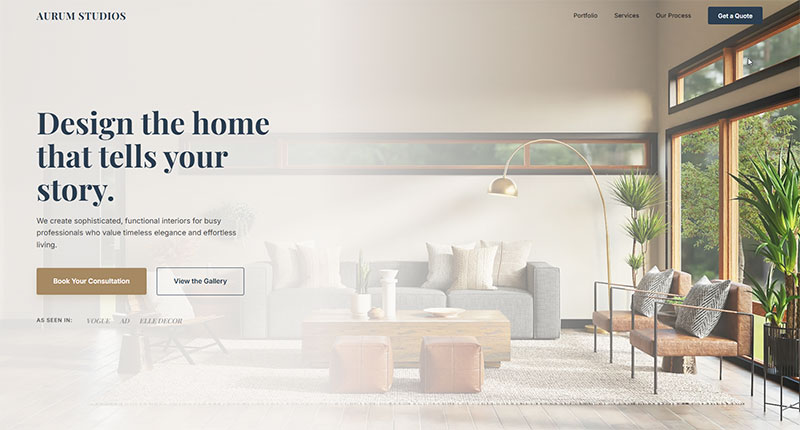
Use full-screen background images with ample white space for visual impact. Personal language like “My mission” and “I can help” creates emotional connection with prospects.
How Do Interior Designers Qualify Leads
Not every inquiry deserves a consultation. Qualification saves hours of wasted meetings.
Pre-Consultation Screening
Use intake forms to collect essential information before scheduling calls.
Required intake fields:
- Budget range
- Project timeline
- Property details (square footage, room count)
- Design style preferences
- Full-service design vs. consultation only
CRM software like Dubsado, HoneyBook, or 17hats automates this screening. According to Invesp, companies spend just $1 on conversion optimization for every $92 on customer acquisition. Flip this ratio by qualifying better upfront.
Budget Verification
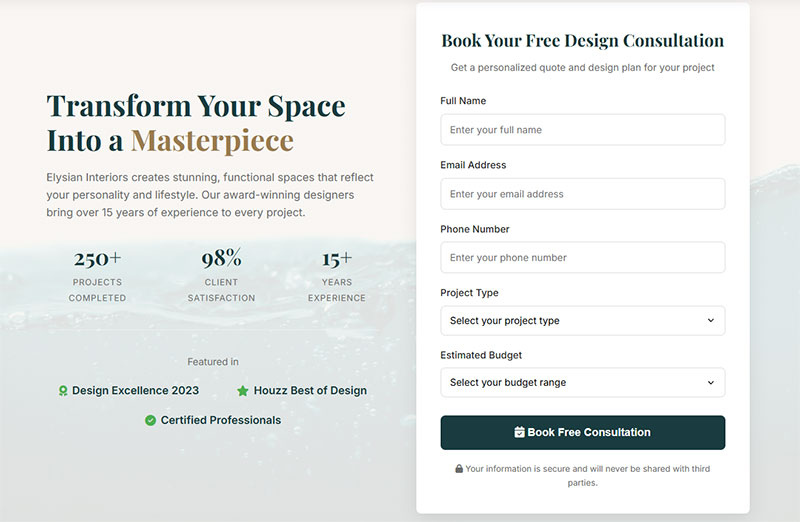
Structure your intake form with clear budget ranges: under $10K, $10K-25K, $25K-50K, $50K-100K, $100K+.
This immediately filters prospects who can’t afford your services. According to Contractor Talk, designers report spending $500-$1,000 monthly on HomeAdvisor with mixed conversion rates. Better qualification reduces wasted spend.
Project Scope Assessment
Ask specific questions about room count, square footage, and service level needed.
Service type breakdown:
- Space planning consultations attract budget-conscious clients
- E-design packages work for remote projects
- Full-service design commands premium rates
- Commercial projects require different expertise
According to Mordor Intelligence, corporate workplaces increasingly demand experiential designs requiring ongoing refurbishment. Commercial projects offer repeat business potential.
Timeline Screening
Clients with urgent timelines (under 30 days) often pay premium rates but demand immediate attention. Projects with 6+ month timelines may not materialize. Find your sweet spot.
According to 99 Landing Pages, listing on platforms like HomeAdvisor, Yelp, Houzz, and Thumbtack increases visibility for “interior designer near me” searches. But platform leads require stricter qualification since they’re often price-shopping.
What Are the Most Effective Lead Generation Channels for Interior Designers
Successful design firms diversify across multiple channels rather than relying on a single source.
The best mix depends on your target market, service offerings, and geographic location.
High-end design clientele often come through referrals and editorial features in publications like Architectural Digest or Elle Decor. Budget-conscious clients typically find you through Google searches and platforms like Angi.
How Does Search Engine Optimization Generate Interior Design Leads
SEO brings organic traffic from homeowners actively searching for designers in your area.
Local searches like “interior designer near me” carry high purchase intent. According to Krofile, 76% of people who search for local businesses visit within 24 hours, and 80% of local searches convert into customers.
Local SEO Impact
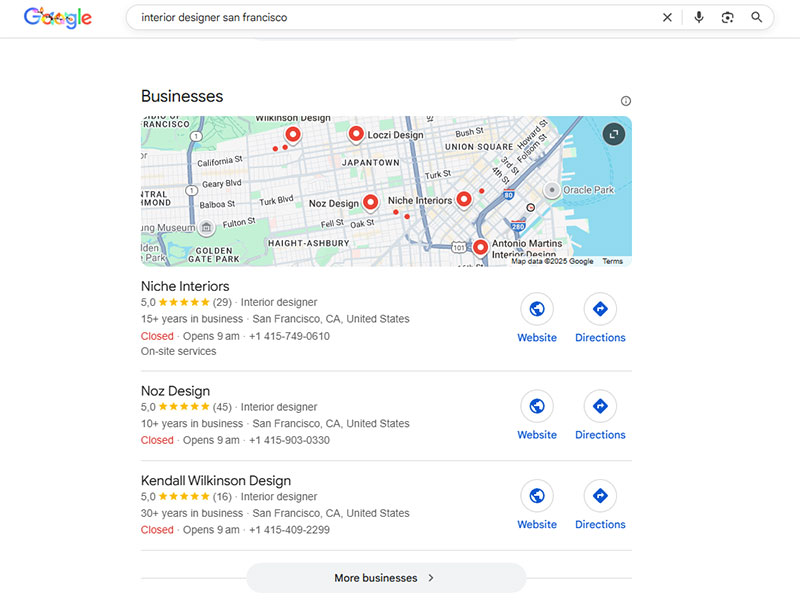
The numbers are compelling. According to Wiser Review, 98% of customers search online for nearby companies, up from 90% in 2019. According to SeoProfy, 88% of consumers who conduct a local search on their smartphone visit or call a store within a day.
Your Google Business Profile matters significantly. According to SeoProfy, verified profiles get around 200 clicks or interactions monthly. According to Local Dominator, Google Business Profile signals account for 32% of all map pack ranking factors.
Claim Your Google Business Profile
Upload high-quality photos showcasing completed projects. Add detailed service descriptions. Post regular updates about recent work.
According to Mailmodo, 99% of people use the internet to look up local business information. According to A Design Partnership, even luxury clients now search “Scottsdale interior designer” or “best architect in Pennsylvania.”
Star ratings influence clicks dramatically. According to Krofile, 91% of consumers use reviews to evaluate local businesses. Respond to every review, positive or negative.
Website Content Strategy
Blog posts targeting specific queries attract informational searchers. “How much does interior design cost” or “kitchen remodel timeline” capture people early in their research.
Service pages optimized for room types and design styles capture transactional searches. Create dedicated pages for kitchen design, bathroom remodels, bedroom makeovers, and whole-home projects.
According to A Design Partnership, educational blog posts like “How to Design a Transitional Kitchen” or “5 Mistakes High-End Clients Make When Renovating” prove authority to Google in 2025.
How Do Social Media Platforms Attract Interior Design Clients
Instagram and Pinterest dominate for visual discovery. LinkedIn works for commercial projects.
According to Hootsuite, 10% of Instagram’s user base searches for interior design. According to Cropink, interior design ranks third in searched categories at 10%, behind fashion (12%) and hair/makeup (11%).
Instagram Performance
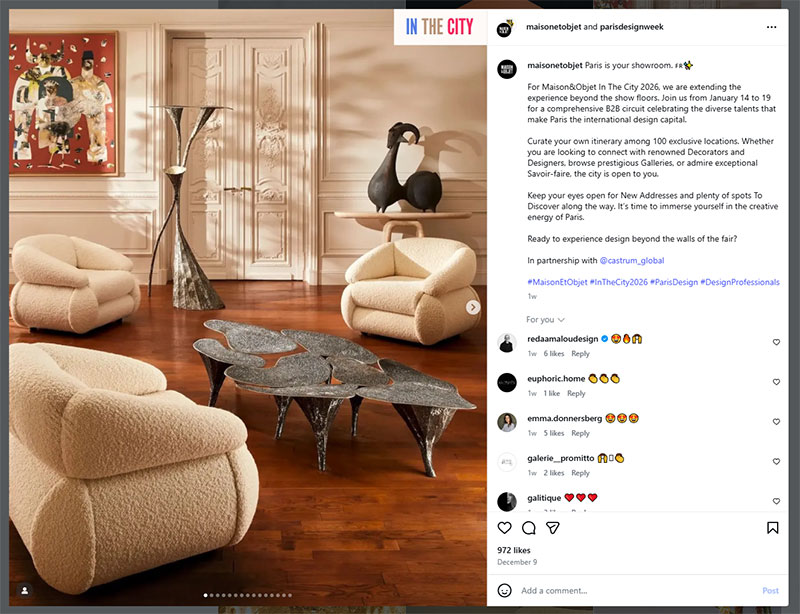
The platform delivers engagement. According to Hootsuite, the average engagement rate sits at 2.0%, with carousels performing best at 2.4%. According to Cropink, photo posts achieve 2.69% engagement for business profiles.
Shopping behavior matters here. According to Cropink, 54% of users buy a product after seeing it on Instagram. According to Hootsuite, 44% of users shop on Instagram weekly.
Post Reels format: Finished project photos, behind-the-scenes content, and design tips perform well. According to Hootsuite, videos generate 67% more engagement than static images.
Use location tags and relevant hashtags. According to Hootsuite, 36% of users use Instagram like Google for search. Engage with local real estate agents and contractors to expand reach.
Pinterest Strategy
Pinterest users come ready to plan and purchase. According to Twin Strata, 537 million monthly active users generate 5 billion searches per month. According to Twin Strata, 85% buy based on brand pins, and 46% discover new products weekly.
Create boards organized by style, room type, and color palette. According to The Social Shepherd, two out of three users consider Pinterest a go-to platform for searches.
Pin consistently. According to Twin Strata, pins last 3.76 months (far outpacing Twitter’s hours). According to The Social Shepherd, the optimal days for posting are Sunday, Monday, and Tuesday.
Pinterest user demographics favor your market: According to Twin Strata, women comprise 69.4% of users, with the 25-34 age group making up 27.3%. According to The Social Shepherd, nearly 80% of Millennial women use Pinterest for inspiration.
What Is the Value of Referral Programs for Interior Designers
Referrals convert at higher rates because trust transfers from the referring party.
A structured referral program turns satisfied clients and professional partners into consistent lead sources.
Client Referral Incentives
Offer design credits, gift cards, or percentage discounts on future services for successful referrals.
Timing matters: Ask for referrals at project completion when satisfaction peaks. According to Credence Research, projects in the $10,000-$50,000 range hold the largest market share. Calculate referral incentives as a percentage of project value.
Send a follow-up email 2-3 weeks after project completion with a simple referral request and shareable link.
Professional Partnerships
Build relationships with complementary professionals:
Real estate agents provide staging leads for home sales Contractors refer renovation projects Furniture stores offer showroom referrals Architects need interior design partners for residential projects
According to Color Whistle, the Interior Design Services Market is estimated at $137.93 billion in 2024, expected to reach $177.13 billion by 2029. This growth means more partnership opportunities.
Members of the American Society of Interior Designers (ASID) and International Interior Design Association (IIDA) access networking events and directories that facilitate these connections.
How Does Email Marketing Nurture Interior Design Leads
Email converts website visitors who aren’t ready to book immediately.
A lead magnet like a design guide or style quiz captures email addresses for ongoing nurturing.
Lead Magnet Ideas
Room planning checklists, budget worksheets, style guides, or “questions to ask your designer” PDFs work well.
Deliver via email automation through Mailchimp or HubSpot. According to OptinMonster, email marketing delivers $36 ROI for every $1 spent (referenced in hotel context, applies across service industries).
Email Sequence Structure
Day 1: Welcome email with lead magnet delivery Day 4: Portfolio highlights (3-4 best projects) Day 7: Client testimonials and case study Day 11: Educational content (design tips or trends) Day 14: Consultation offer with calendar booking link
Space emails 3-5 days apart. Don’t overwhelm subscribers.
Segment by project type: Send kitchen remodel content to kitchen design leads. Send whole-home transformation stories to high-budget prospects.
According to Invesp, companies spend just $1 on conversion optimization for every $92 on customer acquisition. Email nurturing flips this by maximizing value from leads you already have.
What Types of Content Generate Leads for Interior Design Firms
Content marketing positions you as an expert while attracting organic search traffic.
The right content answers questions your ideal clients ask during their research phase.
How Do Before-and-After Project Photos Convert Visitors to Leads
Transformation images create emotional response and demonstrate tangible value.
Visual content works. According to Sixth City Marketing, visual content is 43% more persuasive than text alone. According to Digital Silk, businesses that blog get 55% more website visitors than those that don’t.
Distribution Strategy
Post before-and-after photos on Instagram, Pinterest, your website portfolio, and in email campaigns.
According to Hootsuite, photo posts achieve 2.69% engagement on Instagram business profiles. According to Twin Strata, Pinterest users generate 5 billion searches monthly, with 85% buying based on brand pins.
Include brief descriptions of challenges, solutions, and client feedback with each transformation.
Portfolio Impact
According to Wegic’s analysis of interior design portfolios, before-and-after case studies with visual contrast convincingly demonstrate design impact. Same-angle comparison shots maximize emotional response.
According to Ahrefs, 85.19% of all blog traffic comes from organic search. Strong portfolio pages with optimized images capture this traffic.
What Blog Topics Attract Interior Design Clients
Write about room-specific guides, style comparisons, budget breakdowns, and local market trends.
Content marketing delivers results. According to HubSpot, 73% of B2B marketers say content marketing is the most effective strategy for boosting leads and sales. According to Color Whistle, 72% of marketers believe their content strategy has increased engagement and traffic.
High-Converting Topics
Room-specific guides: “How to choose a kitchen layout” or “bedroom design mistakes to avoid”
Style comparisons: “Modern vs. transitional design” or “minimalist vs. maximalist interiors”
Budget breakdowns: “Kitchen remodel costs by city” or “design on $10K vs. $50K”
Local market trends: “2025 Seattle design trends” or “popular finishes in Texas homes”
According to Semrush, the average #1 ranking page also ranks in the top 10 for nearly 1,000 other relevant keywords. Comprehensive guides capture multiple search queries.
Content Length and Format
According to Semrush, short content of 300-900 words attracts 21% less traffic and 75% fewer backlinks than 900-1,200 word articles.
According to Digital Silk, almost 50% of buyers read a company’s blog when evaluating purchase options. Educational content builds trust before prospects contact you.
Content creation approach: According to Semrush, 38% of marketers who don’t use AI spend 2-3 hours writing long-form articles. Those using AI spend less than one hour. Use AI for research and outlines, then add personal expertise.
Calls-to-Action
Include clear calls-to-action linking to your contact us page or consultation booking.
According to HubSpot, over 41% of marketers measure content marketing success through sales. According to Content Marketing Institute, only 29% of marketers with documented strategies rate them as extremely or very effective.
Make your CTAs specific: “Schedule a free 15-minute discovery call” converts better than generic “Contact us” buttons.
How Do Virtual Consultations Function as Lead Generation Tools
Virtual design services expand your market beyond geographic limitations.
According to Mordor Intelligence, the Virtual Interior Design Services Market reached $18.20 billion in 2024, expected to hit $30.96 billion by 2029 (11.21% annual growth).
Free Discovery Calls
Free 15-minute discovery calls lower the barrier to first contact.
According to BoCo Interior Designs, consultation rates range from $90-$450 per hour in most markets. Offering a free initial call removes price objections and builds rapport.
Use discovery calls to assess project fit, budget, and timeline before proposing paid services.
Paid Virtual Consultations
Paid virtual consultations ($150-500) qualify serious prospects and generate revenue even if they don’t book full projects.
According to Debora Interiors, mid-tier designers average $100-$200 per hour, while experienced professionals in major cities charge $300-$500. Virtual consultations typically fall in the lower range.
Pricing structure: Consultation fees often credit toward full project costs if clients proceed. This reduces perceived risk while filtering price-shoppers.
E-Design Packages
E-design packages serve clients outside your geographic area.
According to Debora Interiors, e-design typically costs $600 per room or $2 per square foot for full homes. According to Skyline Build & Design, basic consultations and design plans start at $500 per room.
What’s included: Shoppable deliverables, scaled layouts, 3D visuals, SKU-level shopping lists, implementation guides. According to Debora Interiors, this approach provides trade-look curation at retail prices with compressed design cycles.
Market opportunity: According to Mordor Intelligence, COVID-19 accelerated virtual design adoption, and demand hasn’t slowed. App-based matchmaking pairs designers with clients through style surveys and digital data gathering.
Revenue Potential
Virtual services create multiple revenue streams beyond traditional full-service design.
According to BoCo Interior Designs, the average interior designer cost per room ranges from $1,500-$3,000 (not including furniture), based on 12-15 hours of design work at $125/hour average rate.
Virtual consultations offer:
- Lower overhead than in-person meetings
- Ability to serve multiple markets simultaneously
- Recurring revenue from e-design clients who return for additional rooms
- Portfolio expansion outside your local area
According to Mordor Intelligence, the virtual design market is partially fragmented with numerous competitors, creating opportunities for differentiation through specialized services or unique design aesthetics.
What Are the Lead Generation Costs for Interior Designers

Cost per lead varies dramatically based on channel, market, and competition level.
Track every source to calculate true client acquisition cost and optimize spend accordingly.
How Much Does Pay-Per-Click Advertising Cost for Interior Design Services
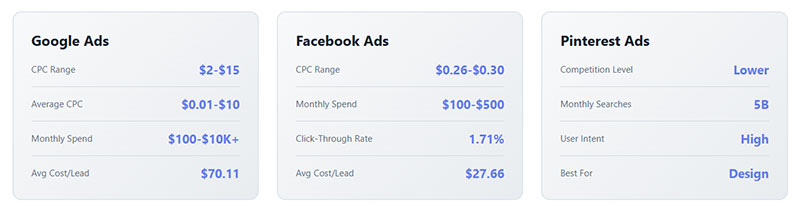
PPC costs have risen across platforms but remain effective when properly managed.
According to Design Rush, the overall average Google Ads CPC reached $4.66 in 2024, up from $4.22 the previous year. According to Focus Digital, 86% of industries saw higher CPCs in 2024, with an average 10% year-over-year increase.
Google Ads Reality Check
Interior design keywords typically range from $2-15 per click depending on location and competition.
According to WebFX, average CPCs in Google Ads vary from $0.01 to $10, with most businesses spending $100-$10,000+ monthly. According to American Eagle, 26% of businesses spend under $5,000 monthly, while 27% spend $5,001-$10,000.
Calculate your break-even: If your average project value is $5,000 and you close 20% of inquiries, each lead is worth $1,000. At $10 per click with 3-5% conversion to inquiry, you’ll pay $200-$333 per lead.
According to WebFX, 54% of businesses report satisfaction with their PPC ROI despite rising costs.
Social Media Ad Performance
Facebook and Instagram ads typically cost less per click but may require more touches to convert.
According to WordStream, Facebook advertising delivers the highest ROI out of all social ad platforms. According to WebFX, businesses pay $0.26-$0.30 per click on Facebook, with most spending $100-$500 monthly.
According to PPC Land, Facebook lead generation campaigns saw a 21% cost increase in 2025, with cost per lead reaching $27.66. However, this remains substantially lower than Google Ads, where the average cost per lead is $70.11.
Platform comparison: Facebook traffic campaigns achieve 1.71% click-through rates at $0.70 per click, according to PPC Land. This makes social ads effective for building awareness before conversion.
Pinterest Opportunity
Pinterest ads perform well for interior design with lower competition than Instagram.
Visual discovery platforms match interior design’s aesthetic nature. According to earlier research, Pinterest users generate 5 billion monthly searches with high commercial intent.
Test Pinterest first for lower CPCs on design-related keywords.
Retargeting Strategy
Retargeting campaigns convert 3-5x better than cold traffic. Budget accordingly.
According to WebFX survey data, satisfied advertisers typically allocate 15-35% of their total marketing budget to PPC. Allocate 70% to proven campaigns, 20% to expansion testing, and 10% to new platform experiments.
What Is the Cost Per Lead on Interior Design Platforms
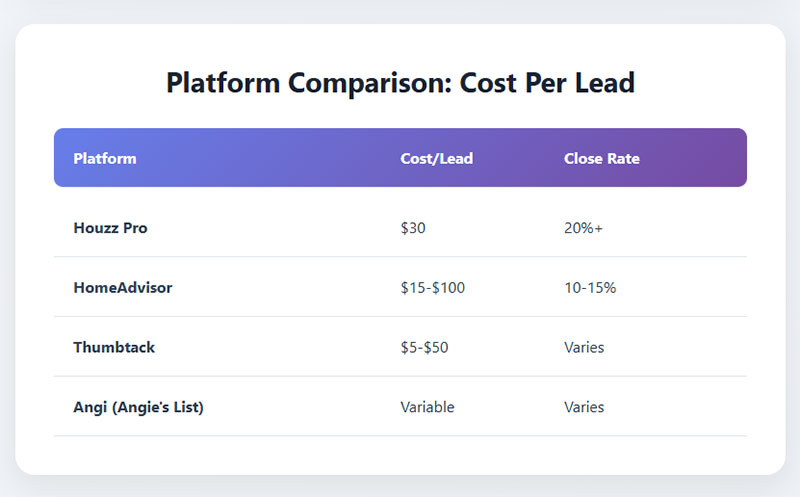
Platform fees vary from flat monthly rates to per-lead pricing models.
Calculate your close rate to determine actual cost per acquired client.
Houzz Pro Pricing
Flat monthly subscription ($65-999/month) includes lead generation, project management, and 3D tools.
No per-lead fees means ROI depends on your market saturation and how aggressively you pursue platform leads. In saturated markets, you’re competing with dozens of other designers for the same client inquiries.
Value assessment: If you pay $300/month and generate 10 leads monthly, your cost per lead is $30. If you close 20% at $5,000 average project, each client costs $150 to acquire (strong ROI).
HomeAdvisor Structure
According to Housecall Pro, HomeAdvisor charges $15-100 per lead depending on project size, plus a $350 annual membership fee.
According to Contractor Talk, designers report spending $500-$1,000 monthly with mixed conversion rates. Platform leads often contact multiple designers simultaneously, reducing close rates to 10-15%.
True cost calculation: $100/month average + $350/year annual fee = $1,550 yearly. At 120 leads/year and 15% close rate, you acquire 18 clients at $86 per client (before considering your time investment).
Thumbtack Model
Pay per quote sent, typically $5-50 per response.
According to Online Visibility Pros, you only pay when customers respond to your bid, which filters some tire-kickers. However, according to Contractor Talk, recent price increases and allowing up to 10 contractors per job have reduced effectiveness.
Budget management: Set weekly spending limits to control costs. Track which project types convert best and adjust your targeting preferences accordingly.
Angi (formerly Angie’s List)
Similar pricing structures with membership tiers.
According to Online Visibility Pros, Angi operates on a cost-per-lead model where you only pay for leads you respond to. Pricing varies based on job type and location.
Platform Decision Framework
Compare all costs: lead fees + membership + time spent bidding and following up.
Questions to answer:
- What’s your close rate on each platform?
- What’s your average project value from each source?
- How much time do you spend managing platform leads?
- Are leads exclusive or shared with competitors?
According to Design Rush, despite rising costs, 26% of businesses plan to increase PPC spending in the next six months, while only 13% plan to decrease. This suggests most find profitable strategies despite higher costs.
Cost Per Acquired Client Reality
Don’t confuse cost per lead with cost per client. According to Invesp, companies spend just $1 on conversion optimization for every $92 on customer acquisition.
Track these metrics:
- Platform cost per lead
- Lead-to-consultation conversion rate
- Consultation-to-project conversion rate
- True cost per acquired client
- Average project value by source
- Customer lifetime value (repeat clients/referrals)
According to Credence Research, projects in the $10,000-$50,000 range hold the largest market share. If your average is $25,000 and true acquisition cost is $500, that’s a 2% CAC-to-LTV ratio (excellent).
How Do Interior Designers Convert Leads into Paying Clients

Conversion rate matters more than lead volume.
A designer closing 40% of qualified leads outperforms one generating twice the inquiries at 15% close rate.
What Information Should Lead Capture Forms Request
Balance thoroughness with completion rate. Too many fields kill conversions.
Understanding form fields for capturing high-quality leads prevents wasted consultations.
According to Zuko, only 38% of users who interact with a contact form successfully submit their details. The view-to-completion rate drops to just 9%. According to Ecommerce Bonsai, the average completion rate of single-page forms is 4.53%, while multi-page forms achieve 13.85%.
Field Selection Strategy
According to Popupsmart, the ideal number of form fields is 3 to maximize conversion rates. According to MyTechMag, HubSpot found conversion rates increased to nearly 50% when they reduced form fields from 4 to 3. According to the same source, Neil Patel observed a 26% higher conversion rate after removing one form field.
Required fields only:
- Name and email
- Phone number
- Project type (kitchen, bathroom, whole-home, commercial)
- Budget range (dropdown selection)
- Timeline (when do you want to start?)
- Property address or zip code
According to Zuko, email and phone number fields have abandonment rates of 6.4% and 6.3% respectively. The name field has the shortest completion time at 3.5 seconds with minimal returns.
Optional qualifying questions:
- How did you hear about us?
- What’s your design style preference?
- Do you own or rent?
Use conditional logic to show relevant follow-up questions based on project type.
According to Getmonetizely, research by HubSpot found reducing form fields from 11 to 4 increased conversions by 120%. However, According to Venture Harbour, testing isn’t always straightforward. One case showed reducing fields resulted in a 14% drop because the removed fields were ones users wanted to interact with.
Form optimization tactics:
According to Edge Digital, each additional required field increases abandonment likelihood. Keep forms under 5 questions for higher completion rates. According to Ecommerce Bonsai, just a 1-second delay in site loading time can hurt conversions by up to 7%.
Mobile considerations: According to Popupsmart, optimizing forms for mobile is critical as mobile traffic is too high to ignore. Make forms mobile-responsive and remove unnecessary fields.
How Quickly Should Interior Designers Respond to New Leads
Speed wins. According to Kixie, leads contacted within 5 minutes are 21 times more likely to qualify compared to waiting 30 minutes. You’re 100 times more likely to even connect with that lead in the first 5 minutes versus waiting just half an hour.
Set up instant email notifications and mobile alerts for new form submissions.
Response time mathematics:
According to Velocify research cited by Lead Angel, responding within one minute increases conversion rates by 391%. Responding just one minute later (two-minute response time) cuts that improvement to 160%.
According to Rep.ai, leads reached within 5 minutes are more likely to lead to real conversations. However, letting 30 minutes elapse can sink your chances. According to the same source, calling after 30 minutes is 21 times less effective.
According to Voiso, responding within 5 minutes increases conversion rates by 100x compared to a 30-minute delay. According to Vendasta, you are 21 times more likely to turn a lead into an opportunity if you respond within 5 minutes compared to waiting just one hour.
Industry reality check:
According to Kixie, the average B2B lead response time is a staggering 42 hours. According to Email Analytics, the average B2B response time is also 42 hours. According to SuperAGI, InsideSales.com found the average response time for companies is around 42 hours, far beyond optimal.
According to Kixie, 55% of companies take five or more days to respond, and studies show as few as 27% of leads ever get contacted at all, meaning up to 73% are completely wasted.
Customer expectations:
According to Rep.ai, 82% of consumers expect responses within 10 minutes, especially for sales. According to SuperAGI, a Drift report found waiting just 5 minutes to respond increases the risk of losing a lead by 10 times. If response time extends to 10 minutes, the risk skyrockets to 100 times.
According to WifiTalents, 88% of consumers are willing to buy from the first responder. According to the same source, 73% of buyers want immediate contact after inquiry.
Decay timeline:
According to AMRA and Elma, if response time exceeds 5 minutes, qualification success drops 10x. Within 10 minutes versus 5 minutes decreases by approximately 400%.
According to Email Analytics, leads contacted within 5 minutes had a 21% close rate in tests of 1,000 leads. Those contacted after 30 minutes had just 1%.
First responder advantage: According to Rep.ai, first vendors to respond to leads win 35-50% of sales. According to Vendasta and Ricochet360 cited by Rep.ai, this number may exceed 78%.
Implementation steps:
Automation setup:
- CRM instant lead routing based on availability
- Auto-acknowledgment emails (buys you time while showing responsiveness)
- Mobile alerts for high-value leads
- Calendar integration for meeting scheduling
According to Email Analytics, auto-routing leads to available reps cuts response time by 73%.
Channel strategy:
According to Email Analytics, multi-channel approaches get 3x faster responses than email-only. Measured channel response times show live chat averages 45 seconds, phone averages 2 minutes, SMS averages 3 minutes, email averages 12 minutes.
According to Chili Piper, letting customers book a meeting immediately after form fill doubles your inbound conversion rate from 30% to 66.7% on average. Even still, only 8% of the top B2B SaaS companies have form scheduling on their website.
CRM tool recommendations:
HoneyBook, Dubsado, and 17hats automate instant responses and follow-up sequences.
All three integrate with WordPress contact form plugins for seamless lead capture.
According to Reanin Intelligence, hybrid delivery models that blend virtual design consults with on-site execution are widening access and compressing project cycles, improving client conversion and utilization rates. According to the same source, platforms offering 3D/AR visualization and AI concepting reduce rework and elevate close rates.
Tracking metrics:
According to Email Analytics, track response time by hour, day, and rep to find patterns. Key metrics include response time by lead source, time-of-day performance, rep-by-rep comparisons.
Set “5-minute response” goals for individuals and “100% under 30 minutes” for teams. According to the same source, public recognition plus small bonuses equals 43% improvement in response times.
What Partnerships Generate Interior Design Leads
Strategic partnerships create recurring referral streams without advertising costs.
Focus on professionals who serve your target clients at adjacent stages of their journey.
How Do Real Estate Agent Partnerships Work for Interior Designers
Agents need staging help and want to offer value to new homeowners. Position yourself as their go-to design resource for both scenarios.
According to Metropolist, 65% of sellers found their agent through a referral from a friend, neighbor, or relative. According to Cubi Casa, the typical real estate agent receives upward of 30% of their business from repeat clients or referrals. This positions designers as valuable referral partners who can strengthen agents’ client relationships.
Referral Structure
Offer agents 5-10% referral fees or reciprocal referrals to their clients. According to DesignFiles, a 10% commission, a nice dinner, or a thoughtful gift keeps referrals flowing. According to Behind the Design, when money is involved, protect yourself with a legally binding agreement.
Provide staging services at discounted rates to build the relationship. According to Agent Advice, agent-assisted homes sold for a median of $405,000, compared to FSBO homes at $310,000. Designers who help agents showcase properties contribute to this premium pricing.
New Homeowner Targeting
Immediate actions:
- Ask agents to include your information in closing gift packages
- Host joint workshops on “decorating your new home” to capture warm leads
- Create a plan for regular outreach at least six times a year
According to The Pearl Collective, relationship building takes two to three years to see the full benefit, but this marketing strategy is worth the investment. Start with what you can do to help them.
Partnership Cultivation Tactics
Monthly touchpoints:
- Send gifts for referrals (check if limited to gifts under $25)
- Take them to lunch or drinks (find out firm policies first)
- Stay in touch with cards and handwritten notes
- Highlight their firm on your blog or social media as a top realtor in your area
What Contractor Collaborations Generate Design Project Leads
Builders and renovation contractors encounter clients who need design help daily. A formal partnership benefits both parties through increased project value.
According to The Pearl Collective, referrals come from happy clients and referral partners like vendors, realtors, builders, contractors, and subcontractors. If projects last a year or more, it takes time to see a steady stream of client referrals.
Builder Relationships
Connect with members of the National Kitchen and Bath Association (NKBA) for kitchen and bathroom remodel inquiries. According to KBIS, NKBA has over 50,000 members and is the leading source of information for kitchen and bath industry professionals.
Market opportunity: According to NKBA, the kitchen and bath industry is worth $134 billion, segmented into an $85 billion remodel market for existing homes and a $48.6 billion market for new homes.
Offer to specify materials and finishes for their projects in exchange for referrals. According to The Pearl Collective, many builders don’t enjoy dealing with buyers’ indecisiveness. Some builders will build in your design fees because they understand the value. Share your process document showing how you keep their clients on task.
Design-Build Package Offerings
Create joint packages where contractor provides construction, you provide design. Clients prefer one-stop solutions, and this positioning wins more whole-home design projects.
According to Business and Interiors, partnerships with architects, builders, contractors, and suppliers who share your vision enhance project quality. These partnerships lead to new business opportunities through mutual referrals.
According to Behind the Design, contractors are often called into the process early and can identify when a designer is needed. They value having someone responsive to call when design is an issue.
Partnership Development Timeline
Year 1: Build relationships before asking for referrals
According to The Pearl Collective, wait to ask for referrals until you’ve referred business to them. Once that referral becomes a client, let them know what an ideal referral is for you.
Ongoing: Make relationship nurturing a daily activity
According to Medium, engaging with local contractors and professionals leads to collaborative projects and mutual referrals. These local connections foster trust, as recommendations carry significant weight in community-driven markets.
Patience required: According to The Pearl Collective, partnership building takes two to three years to see the full benefit. Don’t expect immediate results, but the investment is worth it.
Additional Partnership Opportunities
Vendor relationships: According to DesignFiles, referral swaps are straightforward. A tile installer refers clients to you, you refer clients to them. Other partnership types include online boutique stores and lifestyle bloggers in similar niches.
Tracking performance: Track personal details surrounding kids, pets, hobbies, gifts received, introductions made, and referrals received. This helps spark conversations, source great gifts, and reciprocate goodwill to keep referrals coming.
According to Medium, at year-end, review referral sources. Some send ideal clients (clone them), some send mismatched leads (redirect them politely), and some waste time (evaluate their value).
How Do Interior Designers Measure Lead Generation Success
Track metrics at every funnel stage to identify bottlenecks and optimize performance. What gets measured gets improved.
Start With Your Website Conversion Rate
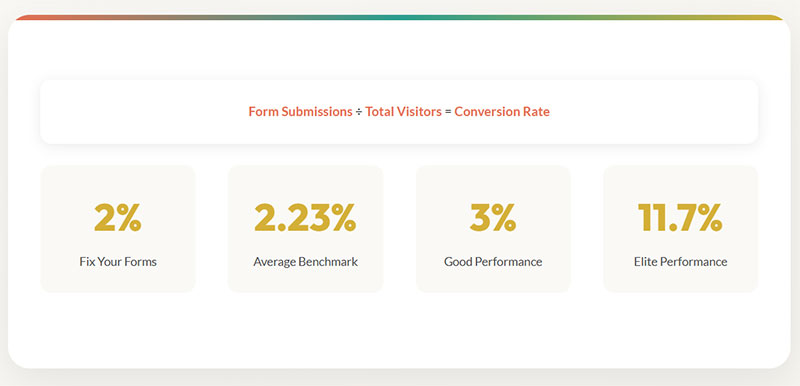
Calculate your visitor-to-lead rate using this simple formula: form submissions divided by total visitors.
Your benchmark target: According to Mindfeeder, the average B2B conversion rate is approximately 2.23%, while top 10% of performers achieve 11.7%. If you’re below 2%, fix your forms before spending more on traffic.
Here’s what the numbers mean for your business. According to Enhencer, typically only 2-3 out of 100 visitors become customers. If your conversion rate is around 3%, your strategy is working and has room for improvement.
Action step: Pull last month’s numbers. Take your total form submissions and divide by total website visitors. Compare against the 2.23% benchmark.
Track Traffic Sources That Actually Convert
Monitor where your visitors come from and which sources turn into paying clients.
Set up tracking for:
- Organic search (Google, Bing)
- Paid ads (Google Ads, Facebook)
- Referrals (real estate agents, contractors)
- Social media (Instagram, Pinterest, Facebook)
- Lead platforms (Houzz, HomeAdvisor, Thumbtack)
Why this matters: According to Cardinal Path, platform-specific reporting in Google, Facebook, and others often overvalue their own contributions and undervalue other channels. GA4 provides an unbiased view across all channels.
Action step: Tag every inquiry source in your CRM. Ask “how did you find us?” on every intake form.
Calculate Your True Cost Per Client
Total marketing spend divided by number of signed clients equals your real acquisition cost. This number tells you which channels are worth the investment.
Break it down by channel:
- Google Ads spend / clients from Google Ads = Google Ads cost per client
- Instagram ads spend / clients from Instagram = Instagram cost per client
- Houzz subscription / clients from Houzz = Houzz cost per client
According to Ruler Analytics, high-value purchases take longer to convert and require more guidance. A $25,000 whole-home design project will naturally have a higher cost per acquisition than a $3,000 room refresh.
Action step: Create a simple spreadsheet. Track monthly spend by channel in one column, clients acquired in another, then divide to get cost per client. Drop channels where the cost exceeds your profit margin.
Set Up Google Analytics Tracking (The Right Way)
Track three critical actions: form submissions, consultation bookings, and phone number clicks.
What changed in 2024: According to Search Engine Land, Google renamed “conversions” to “key events” in Analytics. The term “conversion” now only applies to Google Ads conversions.
Quick Setup Process
Step 1: Create your conversion actions
According to NestScale, select the action you want to track under Goal. Choose how to count conversions: “Every” for sales, “One” for leads. For interior design inquiries, use “One” since you only need to know if someone submitted a form once.
Step 2: Set up tracking tags
According to Growth Minded Marketing, create the conversion action in Google Ads first, then create a tracking tag in Tag Manager with a trigger that fires when the action happens.
Step 3: Choose your attribution model
According to Cardinal Path, GA4 offers Data-Driven Attribution, which uses machine learning to distribute credit across multiple touchpoints. This shows which channels actually contributed to a conversion, not just the last click.
According to Growth Minded Marketing, there’s no right or wrong attribution method. Pick the model that makes sense for your business and customer buying habits.
What to Track Weekly
Create a simple dashboard showing:
- Form submissions by traffic source
- Cost per lead by channel
- Consultation booking rate
- Phone call conversions
According to DiGGrowth, analyzing trends in user behavior and conversion pathways helps identify optimization opportunities and develop targeted marketing strategies.
Focus on these metrics: According to Metrics Watch, track conversion value, ROAS (Return on Ad Spend), and CPA (Cost Per Acquisition). Review weekly and adjust spending based on conversion rate benchmarks for your industry.
Avoid This Common Mistake
According to Growth Minded Marketing, dedicated Google Ads conversion tracking shows 10-20% more accurate data than relying only on imported analytics. Set up direct tracking for each platform you use.
According to UAWC Agency, typical tracking problems include tags not firing correctly, outdated settings, and only tracking purchases without custom goals. Test your setup before relying on the data.
FAQ on Lead Generation For Interior Design
What is the best platform for interior design leads?
Houzz Pro delivers the highest quality residential leads for most markets. Instagram and Pinterest work well for brand awareness and portfolio discovery. Google Business Profile captures local search traffic from homeowners actively looking for designers.
How much should interior designers spend on lead generation?
Allocate 5-15% of revenue to marketing. New firms need higher percentages (15-20%) to build visibility. Established designers with strong referral networks can operate at 5-8%. Track cost per acquired client to optimize spend.
What is the average cost per lead for interior designers?
Expect $30-150 per lead depending on channel and location. Referrals cost nearly nothing. Google Ads range $50-150 per inquiry. Platforms like HomeAdvisor and Thumbtack charge $15-100 per lead based on project size.
How do interior designers get their first clients?
Start with your personal network. Tell everyone you know. Offer portfolio-building projects at reduced rates. Partner with real estate agents for staging opportunities. Post consistently on Instagram and Pinterest to build visibility.
What should an interior design lead capture form include?
Request name, email, phone, project type, budget range, timeline, and property location. Use multi-step forms to improve completion rates. Keep it under 7 fields to avoid abandonment.
How quickly should I respond to new design inquiries?
Within 5 minutes if possible. Leads contacted within the first hour convert at significantly higher rates. Set up instant email notifications and automated responses through CRM tools like HoneyBook or Dubsado.
Do referral programs work for interior designers?
Referrals convert at 3-5x higher rates than cold leads. Offer past clients gift cards or design credits for successful referrals. Partner with contractors, real estate agents, and furniture stores for consistent professional referrals.
What content attracts interior design clients?
Before-and-after project photos perform best. Blog posts about room-specific design tips, budget breakdowns, and style guides attract search traffic. Video walkthroughs and Reels increase engagement on Instagram and Pinterest.
Should interior designers use paid advertising?
Yes, if you track ROI carefully. Google Ads capture high-intent searches. Facebook and Instagram ads build awareness with visual content. Start with $500-1,000 monthly budget and scale what works.
How do I qualify interior design leads before consultations?
Use detailed lead capture forms requesting budget and timeline. Review responses before scheduling calls. Offer paid discovery consultations ($150-300) to filter serious prospects from tire-kickers.
Conclusion
Lead generation for interior design requires consistent effort across multiple channels.
No single strategy fills your calendar alone. The best results come from combining SEO, social media marketing, referral programs, and strategic partnerships with contractors and real estate agents.
Start with what you can control: optimize your portfolio website, set up proper lead capture systems, and respond to inquiries fast.
Track your cost per acquisition through CRM tools like Dubsado or 17hats. Double down on channels that deliver qualified leads at reasonable costs.
Cut what doesn’t work.
Whether you’re targeting luxury interior market clients or budget-conscious homeowners, the fundamentals stay the same. Attract, qualify, nurture, convert.
Build these systems now. Your future project pipeline depends on the leads you generate today.