




Most lead magnets don’t work. They get downloaded, skimmed for 30 seconds, and forgotten. Meanwhile, your email list fills up with people who will never buy anything. The problem isn’t…
Table of Contents
Your model homes look stunning. Your craftsmanship speaks for itself. But none of that matters if qualified buyers never find you.
Lead generation for home builders has shifted almost entirely online. Roughly 97% of home buyers start their search on the internet, and builders without a digital presence lose deals to competitors before they even know prospects exist.
Referrals alone won’t sustain growth. Market conditions change, and word-of-mouth can’t scale on demand.
This guide covers proven methods to attract custom home buyers, capture their information, and convert interest into signed contracts. You’ll learn which channels deliver the best cost per lead, how to qualify prospects efficiently, and what tools successful residential construction companies use to keep their sales pipeline full year-round.
What Is Lead Generation for Home Builders
Lead generation for home builders is the process of attracting potential home buyers and converting their interest into sales appointments.
Custom home builders, production builders, and residential construction companies use digital marketing channels to fill their sales pipeline with qualified prospects.
The process combines website optimization, paid advertising, content marketing, and referral programs.
Unlike other industries, the home building sales cycle runs 6-12 months on average. This extended timeline means builders need systems that nurture leads over time, not just capture them once.
A strong lead generation funnel moves prospects from initial awareness through consideration to final purchase decision.
Home builder marketing works across both B2B channels (reaching contractors and developers) and B2C channels (reaching individual home buyers).
The goal isn’t just more leads. It’s better leads that actually convert to model home tours, consultations, and signed contracts.
Why Does Lead Generation Matter for Home Building Companies
Every home buyer starts their search online. The National Association of REALTORS reports that 100% now use the internet during their search, with 43% beginning by browsing properties online rather than contacting an agent.
If you’re not visible in search results or on social platforms, you don’t exist to most prospects.
Your Marketing Budget Needs to Work Harder
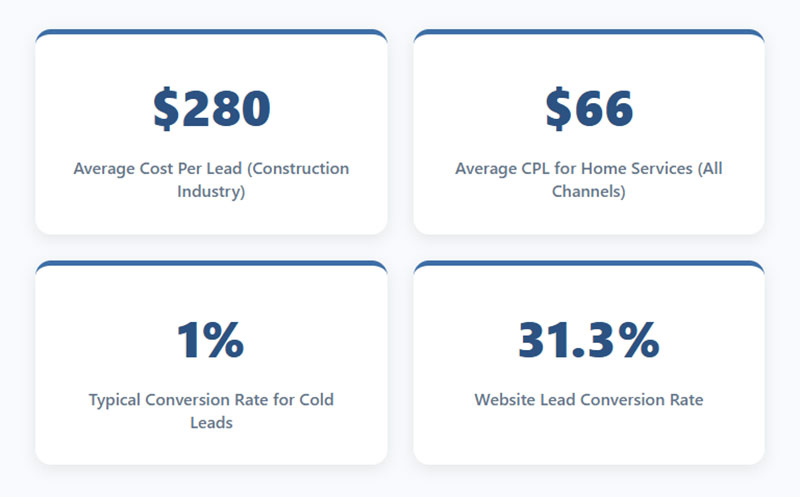
Construction companies spend an average of $280 per lead according to 2024 data, but smart builders control this cost through strategic channel selection. The range spans from $50 to $600+ per qualified prospect.
Here’s what this means for your business:
Production builders need high lead volume to fill spec home inventory. Custom builders need fewer leads but must focus on budget qualification and project fit.
Stop chasing unqualified prospects. Time spent pursuing buyers who can’t afford your services directly erodes profit margins. Track your cost per lead by channel and cut underperforming sources.
Marketing Investment Directly Impacts Your Bottom Line
Builders who allocate 3% of revenue to marketing achieve higher net profit margins than those who don’t, according to the 2025 SORCI Report.
The data is clear: builders using regular content marketing saw 26% gross markup compared to just 20% for those without consistent marketing efforts.
Set your marketing budget as a fixed percentage of revenue. Build it into your project costs like any other business expense.
Predictable Lead Flow Solves Multiple Problems
Strong pipeline management isn’t just about sales. Consistent leads let you:
- Plan construction schedules without gaps
- Maintain steady subcontractor relationships
- Forecast revenue accurately for better cash flow
- Negotiate better pricing with suppliers based on volume
Market downturns hit hardest when you rely solely on referrals. Companies with digital presence and active lead generation maintain stability during slow periods.
Most Builders Miss the Opportunity Window
Research shows 53.9% of builders struggling with lead generation produce no content. They’re invisible during the research phase when buyers spend months evaluating options.
Zillow data reveals that half of buyers search for less than three months, but 13% take seven months to a year. Without visibility during this window, you’ve lost before the conversation starts.
Build your content library now. Answer the questions prospects ask during research. When they’re ready to contact builders, your name should already be familiar.
Buyer Behavior Has Shifted Permanently
According to Clever Real Estate, 62% of 2025 home buyers prioritized finding an affordable home (up from 48% in 2024). This means buyers research longer, compare more options, and scrutinize value more carefully.
Your digital presence determines whether you make their shortlist. The sale happens before you ever speak to them.
What Are the Most Effective Lead Generation Methods for Home Builders
The best approach combines multiple channels working together.
Paid advertising delivers immediate visibility. SEO builds long-term organic traffic. Content marketing establishes expertise. Referral programs leverage satisfied clients.
Each channel serves different buyer journey stages.
How Does SEO Generate Leads for Custom Home Builders
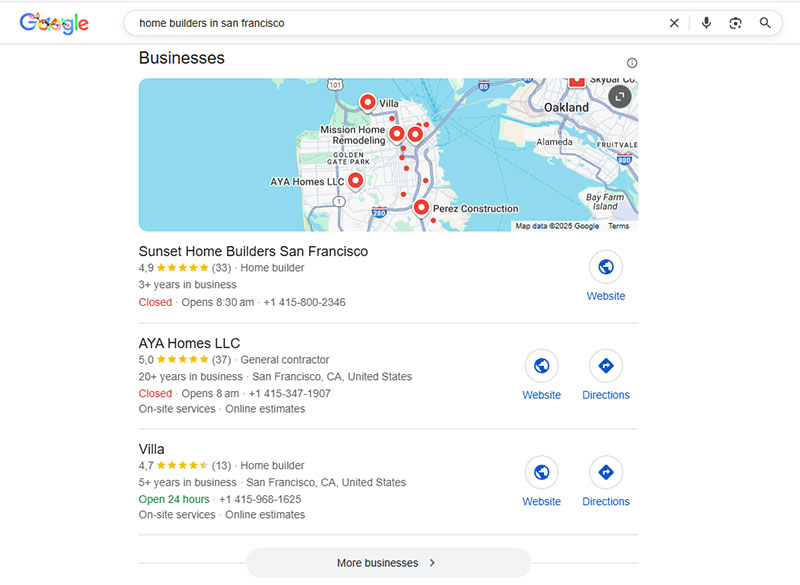
Focus on local search first. Target phrases like “custom homes near me” and “home builders in [city name].”
Research shows 46% of all Google searches have local intent. When buyers search locally on mobile, 80% convert into actual purchases or visits.
Your Google Business Profile needs:
- Accurate business information and hours
- High-quality photos of completed projects
- Consistent review management
Data from SOCi reveals every 10 new reviews increases your conversion rate by 2.8%. Responding to 25% of your reviews improves conversions by 4.1%.
Create these pages for your website:
- Individual community pages with location details
- Floor plan galleries with pricing
- Building process guides
- Cost calculators
Technical optimization matters. 62% of consumers won’t convert if your mobile site is slow or clunky. Fast load times and mobile-friendly design aren’t optional.
Local SEO converts at 80%, making it one of your highest-performing channels.
How Can Paid Advertising Bring Home Builder Leads
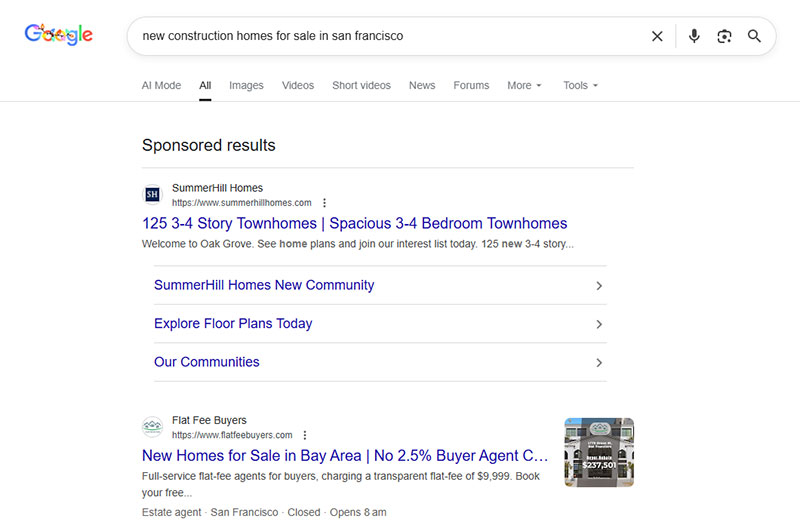
Google Ads captures high-intent buyers searching “build custom home” or “new construction homes for sale.”
Real Estate ads see a 9.20% click-through rate (well above the 6.42% average). Average cost per lead sits at $66.69.
Facebook and Instagram reach your demographic. 78% of people aged 30-49 regularly use Facebook. Average cost per lead runs $21.98 (dramatically cheaper than Google).
What to showcase:
- Model home tours and virtual walkthroughs
- Construction progress photos
- Community amenities and lifestyle shots
- Before and after transformations
Budget allocation:
- Reinvest 1% to 3% of revenue into advertising
- Split 60/40 between Google and Facebook
- Start with $2,000 to $3,000 monthly
- Adjust based on cost per lead data
Set up conversion tracking before spending anything. Test different ad copy and audiences ruthlessly. Review your landing page forms monthly.
What Role Does Content Marketing Play in Home Builder Lead Generation
Educational content answers buyer questions during research.
High-performing content types:
- Blog posts on building costs and timelines
- Video tours of completed homes
- Design guides and floor plan libraries
- Construction process walkthroughs
Video performs exceptionally well. 84% of people say video convinced them to buy a product or service. Video on landing pages boosts conversion rates by up to 80%.
Create a lead magnet. Offer a home building checklist or cost calculator in exchange for contact information.
Builders using intentional lead magnets see 11% visitor-to-lead conversion rates (compared to 0.5% with just a contact form).
The National Association of Realtors reports social media as the top tech tool for quality leads, beating CRM systems and MLS sites.
Your weekly content plan:
- One valuable piece per week (blog, video, or case study)
- Repurpose into 5-7 social media posts
- Share behind-the-scenes construction updates
- Highlight client testimonials and finished projects
How Do Referral Programs Generate Qualified Home Buyer Leads
Satisfied homeowners are your best salespeople. Word-of-mouth carries more trust than any advertisement.
Structure your referral program:
- Cash bonus ($500 to $1,000)
- Gift cards to local restaurants or retailers
- Upgrades on future purchases
- Donation to their favorite charity
Give clear guidance on ideal referrals. Describe your perfect client so referrers send qualified prospects, not tire kickers.
When to ask for referrals:
- At closing (emotional high point)
- After the one-year walkthrough
- When a client compliments your work
- During project completion celebrations
Thank referrers even if leads don’t convert. Send handwritten notes. Small gestures maintain warm relationships and encourage future referrals.
Track referral sources in your CRM. Some clients will send multiple referrals over years, making them incredibly valuable to your business.
How Do Home Builders Capture Leads on Their Website
Your website is often a buyer’s first impression of your company.
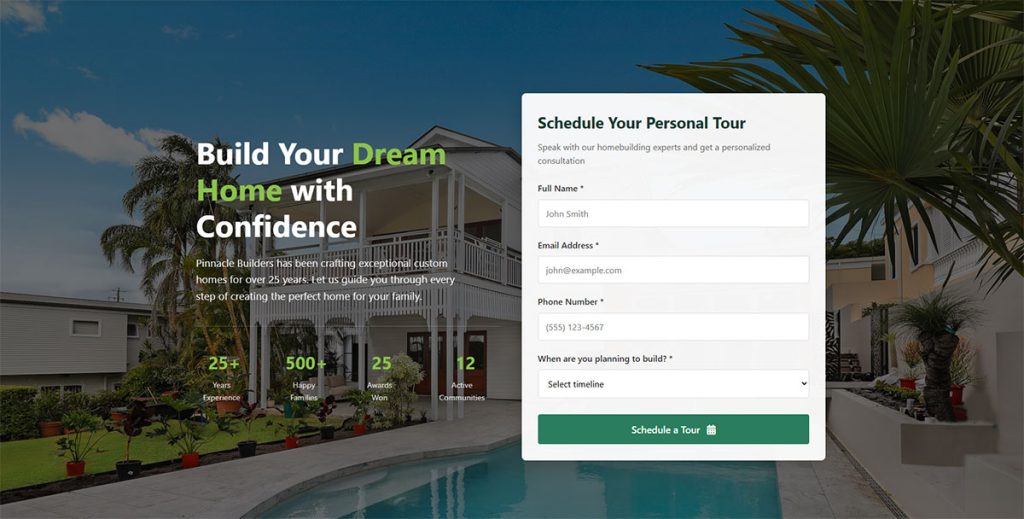
Strategic placement of lead capture form templates throughout your site creates multiple conversion opportunities. Every community page, floor plan detail, and pricing page needs a clear call-to-action.
Landing Page Structure
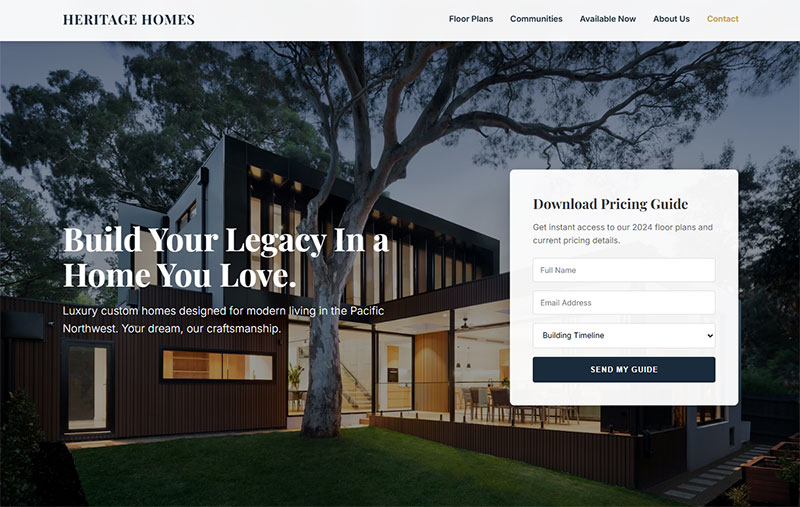
Dedicated landing pages for each community or home model outperform generic contact pages.
Research from Bokka Group shows builders with targeted landing pages see visitor-to-lead conversion rates above 10%. Compare that to the 0.5% typical conversion rate from a basic contact form.
What belongs above the fold:
- High-quality photos of the community or model
- Floor plan downloads with pricing
- Neighborhood details and nearby amenities
- Clear call-to-action button
The average landing page converts at 6.6% across industries. Top performers exceed 20% by following design best practices.
Mobile matters. 82.9% of landing page traffic comes from mobile devices. If your pages don’t work perfectly on smartphones, you’re losing most of your visitors.
Form Optimization
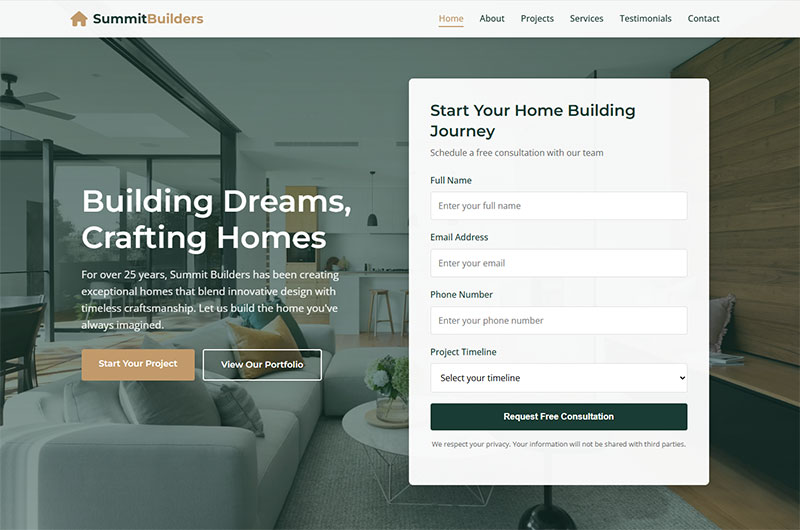
Balance information gathering with friction.
Ask for name, email, phone, and project timeline. Skip unnecessary fields that kill conversions. Research shows reducing form fields from 11 to four increased conversions by 120% for one company.
Form field best practices:
- Keep forms to 5 fields maximum
- Use dropdown menus for project timeline
- Mark optional fields clearly
- Place forms where attention naturally flows
Following form design principles captures more leads without annoying visitors.
Every second delay in page load time reduces conversions by 7%. Pages loading under 2 seconds see 30% higher conversion rates.
Value Proposition Placement
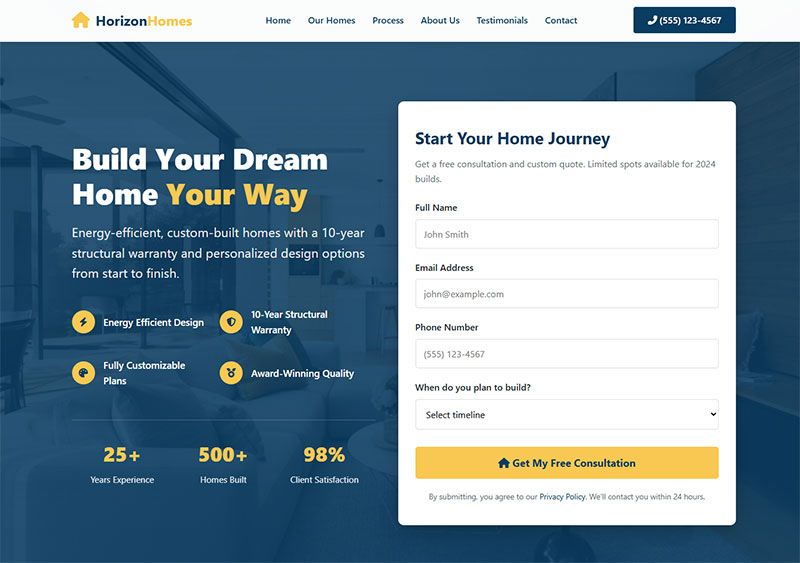
Your unique selling points should be visible within seconds of landing on any page.
What makes you different from other builders? Energy efficiency, warranty programs, customization options, or build quality?
Headlines matter. 80% of people read your headline but only 20% read the rest. Start with your most compelling information.
Write copy at a 5th to 7th grade reading level. Landing pages with this reading difficulty convert at 11.1% compared to 5.3% for college-level writing.
Call-to-Action Design
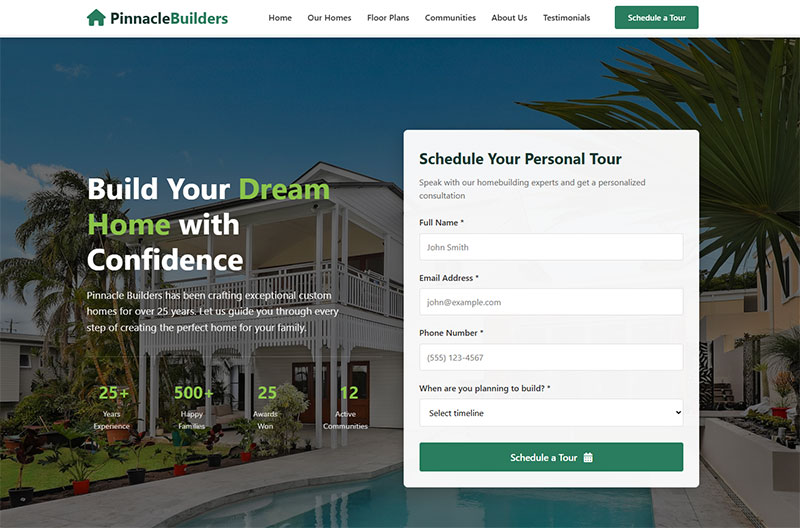
Use action-oriented button text.
“Schedule a Tour” converts better than “Submit” or “Contact Us.” Personalized CTAs have 202% better performance than generic ones.
Where to place CTAs:
- After photo galleries
- Below pricing sections
- In sticky headers
- At the end of floor plan descriptions
92% of signup buttons are less than 5 words. Keep yours short and action-focused.
Green and blue are the most popular CTA button colors (nearly 70% of all CTAs). These colors test well across industries.
Lead Magnet Delivery
Offer downloadable resources in exchange for contact details.
Floor plan PDFs, community brochures, and building guides work well. Research shows 55% of email submissions come from downloadable content like ebooks and guides.
High-performing lead magnets:
- Cost calculator or budget worksheet
- Floor plan comparison guide
- Community amenity overview
- Timeline and process checklist
Videos boost conversions by 86%. Adding video to landing pages increases engagement dramatically. 84% of people say video convinced them to buy a product or service.
Exploring different types of lead magnets helps you find what resonates with your specific buyer demographic.
Include social proof. Landing pages with testimonials or reviews convert 34% better than those without.
Testing and Optimization
Marketers who regularly A/B test landing pages see a 37% increase in conversions.
Only 17% of marketers actively test their pages. This means most builders miss massive optimization opportunities.
What to test first:
- Headline copy (biggest impact)
- CTA button text and color
- Form field count
- Photo selection and placement
Test 4 to 10 unique landing pages with different offers and messaging. Using the right targeting and testing can boost conversion rates by up to 300%.
Track everything. Measure which pages convert best, which traffic sources perform, and where visitors drop off. Without data, you’re guessing.
What Is the Lead Follow-Up Process for Home Builders
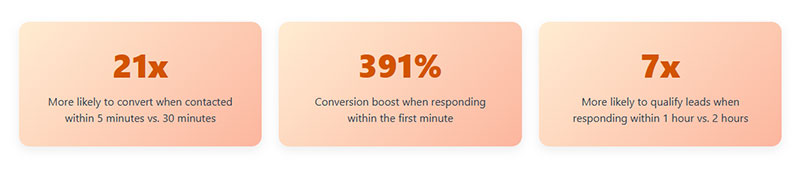
Speed matters more than most builders realize.
Research shows leads contacted within 5 minutes are 21 times more likely to convert than those contacted after 30 minutes. Responding within the first minute can boost conversions by 391%.
Most competitors give up after 1-2 follow-up attempts, creating opportunities for persistent builders.
Response Time Benchmarks
Aim for initial contact within minutes, not hours.
The average business takes 47 hours to respond to leads. Just 27% of leads get contacted at all. This creates a massive opportunity for builders who move fast.
The reality of response time:
- 82% of consumers expect responses within 10 minutes
- 78% of buyers go with the company that responds first
- After 5 minutes, odds of qualifying a lead drop by 80%
- After 1 hour, you’re 7 times less likely to have meaningful conversations
Automated email responses buy time while your sales team prepares personal follow-up. Set up instant confirmation emails that acknowledge receipt and set expectations for callback timing.
Use instant notifications. Alert your sales team immediately when new leads arrive so they can respond within minutes.
Multi-Channel Follow-Up Sequences
Combine email, phone calls, text messages, and retargeting ads.
Different prospects prefer different communication methods. Some won’t answer phone calls but respond immediately to texts.
Your multi-channel approach:
- Day 1: Phone call within 5 minutes, followed by email
- Day 2: Text message with specific community info
- Day 3: Phone call at different time of day
- Day 5: Email with floor plans and pricing
- Day 7: Phone call with limited-time incentive
Personalize outreach based on which community or home type each lead expressed interest in. Generic follow-ups get ignored.
Less than 25% of businesses respond to web leads via phone. Making actual phone calls sets you apart from competitors hiding behind automated emails.
Marketing Automation Implementation
Set up automated sequences that send relevant content based on lead behavior and timeline.
Drip campaigns keep your brand top-of-mind during the months-long consideration process without requiring manual effort from your sales team.
What to automate:
- Immediate confirmation email with next steps
- Educational content series (building process, financing, design)
- Community-specific updates and availability changes
- Price change notifications and incentive announcements
Tag leads based on their interests. Someone who downloaded floor plans for a 4-bedroom model gets different content than someone researching 2-bedroom townhomes.
Track email opens and link clicks. These behaviors signal renewed interest and should trigger immediate personal outreach.
Lead Nurturing Over Extended Sales Cycles
Home buying decisions take time. Regular touchpoints with educational content build trust while buyers work through their decision.
Content to share during nurture:
- Financing updates and rate changes
- New incentive announcements
- Construction progress photos from their community of interest
- Customer testimonials and completed home tours
- Timeline guides and process explanations
Send value, not spam. Each touchpoint should educate or inform, not just ask for the sale.
Research shows that businesses responding within an hour are 7 times more likely to qualify leads than those waiting one more hour. Stay persistent but respectful.
Personalization Based on Interest
Segment leads by community preference, budget range, and timeline.
Send targeted content that matches their specific situation. Generic mass emails perform poorly.
Key segmentation criteria:
- First-time buyer vs. move-up buyer vs. downsizer
- Budget range ($300k, $500k, $750k+)
- Timeline (3 months, 6 months, next year)
- Community preference (urban, suburban, specific location)
- Home type interest (single-family, townhome, custom)
A first-time buyer needs different information than a downsizing empty-nester or luxury custom home client.
First-time buyers want:
- Down payment assistance programs
- First-time buyer incentives
- Detailed financing explanations
- Move-in timeline information
Empty nesters need:
- Single-level floor plans
- Low-maintenance features
- Community amenities
- Downsizing guidance
Custom home buyers expect:
- Customization options and limits
- Builder portfolio and past projects
- Lot availability and selection process
- Detailed construction timelines
Track which content each lead engages with. If someone opens every email about energy-efficient features, make that the focus of your next phone conversation.
Set up behavior-based triggers. When a lead visits your pricing page three times in one week, that’s a buying signal requiring immediate personal outreach.
How Do Home Builders Qualify Leads
Not every inquiry deserves equal attention.
Qualification separates serious buyers from tire-kickers wasting your sales team’s time. A structured qualification process protects your profit margins and keeps focus on prospects most likely to sign contracts.
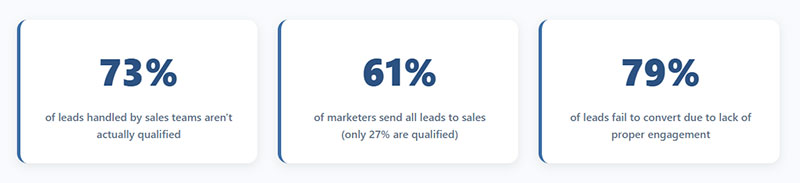
According to Leads at Scale research, 73% of leads sales teams handle aren’t actually qualified. This wastes time and tanks conversion rates. MarketJoy data shows that 61% of marketers send all leads to sales, even though only 27% are qualified.
Budget Qualification
Ask about budget range early in the conversation.
Custom homes start at $300K+ in most markets. You need to know if prospects can actually afford your builds before investing hours in design consultations.
How to ask without being pushy:
- “What budget range are you working with?”
- “Have you spoken with a lender about financing?”
- “What price point are you targeting for your new home?”
Sales-qualified leads convert to opportunities at 20-30%, compared to just 5-15% for unqualified marketing leads, according to Sales So research. Budget qualification is the fastest filter.
Don’t waste time presenting $500K custom homes to buyers with $300K budgets. Direct them to appropriate options or refer them to production builders in their range.
Timeline Assessment
Buyers ready within 6 months need different handling than those 2 years out.
Adjust follow-up frequency accordingly. Someone building next month gets daily contact. Someone planning for next year gets monthly check-ins.
According to Leads at Scale, 79% of leads fail to convert due to lack of proper engagement and nurturing. Timeline-based segmentation solves this by matching contact frequency to buyer readiness.
Timeline-based segmentation:
- 0-3 months: High-priority, daily follow-up
- 3-6 months: Medium priority, weekly contact
- 6-12 months: Monthly nurture sequence
- 12+ months: Quarterly touchpoints
The average MQL to SQL conversion rate sits at 13%, according to Sales So data. Top performers using behavioral scoring and timeline qualification achieve 40% (triple the average).
Track timeline changes. When a “next year” lead suddenly starts asking about current inventory, move them to high-priority immediately.
Lot Ownership or Land Requirements
Do they own land? Need help finding a lot?
This changes the scope of your involvement and project timeline significantly. Building on owned land moves faster than helping buyers find and purchase suitable lots.
Key questions to ask:
- Do you already own the land where you want to build?
- What’s the lot address and size?
- Has the land been surveyed or tested for buildability?
- Do you need help finding and purchasing a lot?
Buyers without land add 3-6 months to the project timeline. Factor this into your qualification and project scheduling.
If you don’t offer lot-finding services, have referral partners ready. Don’t let unqualified leads sit in your pipeline waiting for services you don’t provide.
Financing Pre-Approval Status
Pre-approved buyers are serious. Those who haven’t talked to a lender yet need nurturing before they’re sales-ready.
MarketJoy research shows that SQL to opportunity conversion rates average 25-40%. Pre-approved buyers fall at the high end of this range because they’ve cleared a major qualification hurdle.
Pre-approval status categories:
- Pre-approved with lender letter: Sales-ready now
- Pre-qualified (soft check): Needs full approval
- Haven’t contacted lender: 3-6 months away
- Cash buyers: Verify proof of funds
Responding within 1 hour makes leads 7 times more likely to qualify, according to Harvard Business Review research. But qualification itself determines whether that time investment pays off.
Send pre-approval resources immediately to unqualified leads. Partner with mortgage brokers who can fast-track your prospects through approval.
MarketJoy data shows the biggest drop-off happens at the MQL to SQL stage. Many marketing teams hand over leads that aren’t truly sales-ready. Fix this with better financing qualification.
Decision-Maker Identification
Both partners need to be involved in home buying decisions.
Presenting to one spouse wastes everyone’s time. The absent partner will have questions, concerns, and veto power you haven’t addressed.
How to handle this:
- “Who else will be involved in this decision?”
- “Can we schedule our next meeting when both of you are available?”
- “I want to make sure everyone who needs to be part of this conversation is included”
According to Leads at Scale research, companies with formal qualification processes see 27% faster profit growth compared to those without structured processes.
Don’t move forward with design meetings or detailed proposals until all decision-makers are present. You’ll just have to repeat everything later.
Geographic Targeting Criteria
Confirm they want to build in your service area.
Out-of-territory leads belong to referral partners, not your pipeline. Don’t waste time quoting projects you can’t take.
Service area qualification:
- Where do you want to build? (City, neighborhood, specific area)
- Is this location within our 50-mile service radius?
- Have you considered communities we’re currently building in?
If they’re outside your area, have referral relationships with builders who cover those territories. Generate goodwill and potential reciprocal referrals.
Track geographic patterns. If you’re getting consistent inquiries from one area outside your territory, consider expansion.
Create a Lead Scoring System
Assign points to each qualification criterion.
Ruler Analytics research shows the average conversion rate across industries is 2.9%. Home building and construction typically see higher rates (3-5%) when leads are properly qualified, because of the high-value, considered purchase nature.
Sample scoring system:
- Pre-approved financing: 25 points
- Timeline under 6 months: 20 points
- Owns buildable lot: 20 points
- Budget matches your range: 20 points
- All decision-makers engaged: 10 points
- In service area: 5 points
Leads scoring 70+ points get immediate sales attention. Leads scoring 40-69 enter nurture sequences. Below 40 gets quarterly check-ins or disqualification.
Top-performing sales teams using lead scoring see 38% higher sales win rates and 24% faster revenue growth, according to Leads at Scale data.
Update scores as circumstances change. A lead who gets pre-approved jumps 25 points instantly.
Qualification Saves Money and Time
According to First Page Sage data, the average lead-to-MQL conversion rate is 31% across all channels. But without proper qualification, you’re spending sales time on the 69% who aren’t ready.
Sales So research shows that top-performing sales development teams convert 59% of SQLs into opportunities. The difference? They qualify ruthlessly and focus only on serious buyers.
Chili Piper data reveals that most industries see lead conversion rates between 2-5%. Construction and home building can hit 5-10% when qualification filters out time-wasters and focuses effort on ready buyers.
What Lead Generation Tools Do Home Builders Use
The right tech stack automates repetitive tasks and keeps leads from falling through cracks.
According to Freshworks research, 73% of businesses adopted CRM tools in 2024. For home builders specifically, integration between tools matters as much as individual features.
CRM Systems
| CRM Platform | Core Specialization | Key Features for Builders | Pricing Model |
|---|---|---|---|
| Salesforce | Enterprise-grade general CRM with extensive customization capabilities | Advanced automation workflows, robust third-party integrations, custom home building pipeline configuration, comprehensive analytics dashboards, AI-powered lead scoring | Starts at $25/user/month (Essentials), scales to $300+/user/month for advanced features |
| HubSpot | Inbound marketing-focused CRM with user-friendly interface | Free tier available, email marketing automation, lead nurturing sequences, website visitor tracking, custom property fields for lot specifications, integrated content management | Free tier available, paid plans start at $20/user/month, Professional at $1,600/month (3 users minimum) |
| Buildertrend | Construction-specific project management with integrated CRM functionality | Daily logs, construction scheduling, budget tracking, change order management, client portal access, warranty management, subcontractor coordination, Gantt chart timelines | Starts at $199/month (Essential), $399/month (Advanced), $699/month (Complete) |
| CoConstruct | Custom home builder and remodeler project management platform | Bid management, selection tracking, client selections with visual galleries, financial reporting, QuickBooks integration, time and material tracking, custom estimating tools | Starts at $99/month (up to 1 project), scales with project volume, typically $299-$699/month for active builders |
| Procore | Enterprise construction management for commercial and residential builders | Document control, RFI management, submittal tracking, safety management tools, quality and safety inspections, field productivity tracking, unlimited storage | Custom pricing (typically $10,000+/year), quote-based on company size and project volume |
| Pipedrive | Visual sales pipeline CRM with deal-tracking focus | Pipeline visualization, activity reminders, email integration, customizable stages for home buying journey, mobile app functionality, sales forecasting, workflow automation | Starts at $14/user/month (Essential), $34/user/month (Advanced), $49/user/month (Professional) |
| Zoho CRM | Affordable all-in-one CRM with extensive feature set | Lead management, workflow automation, canvas design studio for custom layouts, AI assistant (Zia), multi-channel communication, inventory management, custom modules | Starts at $14/user/month (Standard), $23/user/month (Professional), $40/user/month (Enterprise) |
| BuildTools | Residential construction management designed for small to mid-size builders | Job costing, purchase orders, specifications management, warranty tracking, homeowner portals, scheduling with calendar views, document storage and organization | Starts at $99/month (up to 3 projects), $299/month (up to 15 projects), custom pricing for larger operations |
| Lasso CRM | Real estate and home builder lead management specialist | Lot inventory management, online registration forms, automated lead distribution, traffic and lead source tracking, prospect nurturing campaigns, model home management, sales performance analytics | Custom pricing based on community size and number of users (typically $500-$2,000/month per community) |
| JobNimbus | Contractor-focused CRM and project management for exterior contractors and builders | Contact management, task automation, job tracking, mobile-first design for field teams, photo documentation, integration with estimating tools, storm tracking for restoration work | Starts at $25/user/month (Suite), $45/user/month (Plus), $65/user/month (Pro) with minimum 3-user requirement |
Buildertrend, CoConstruct, and Salesforce handle construction-specific workflows. Track leads from first contact through closing and beyond.
LinkPoint360 data shows 91% of all companies with more than 10 employees use some type of CRM system. For home builders managing complex, multi-month sales cycles, this isn’t optional.
Key benefits backed by data:
- 94% of businesses saw increased sales productivity after CRM adoption (Freshworks)
- 34% report CRM shortened their sales cycle by 8-14 days
- 43% save 5-10 hours of employee workload per week
- 91% experienced decreased customer acquisition costs
Freshworks research reveals that CRM saves time by automating repetitive tasks (50% of users), centralizing customer data (46%), and streamlining communication (41%).
Construction-specific CRMs like Buildertrend integrate job costing, scheduling, and client communication. Generic platforms like Salesforce require customization but offer more integration options.
Salt Creative research shows 87% of businesses use cloud-based CRM solutions, making data accessible from job sites and model homes.
Marketing Automation Platforms
HubSpot, ActiveCampaign, and Mailchimp automate email sequences, lead scoring, and behavioral triggers.
Cazoomi data shows 76% of companies use marketing automation as part of their strategy. Companies using marketing automation experience an average increase in qualified leads by up to 451%.
What automation delivers:
- 77% of marketers use automation for personalized content creation (HubSpot)
- 58% of businesses include automation in email marketing strategy
- Organizations see $5.44 return for every dollar spent on marketing automation (Nucleus Research)
- 91% of decision-makers report increasing automation requests from business teams
Cropink research found that 98% of B2B marketers consider marketing automation crucial for success. For home builders with long sales cycles, automation keeps prospects engaged without manual effort.
The global marketing automation market reached $6.65 billion in 2024 and is growing at 15.3% annually, according to Mordor Intelligence.
Set up drip campaigns that send floor plans, financing guides, and construction timelines based on where prospects are in their journey. Automate follow-ups when leads visit your pricing page or download community brochures.
Call Tracking Software
CallRail and similar tools attribute phone leads to specific marketing campaigns. Know which ads actually drive calls.
Despite the digital focus, phone calls remain critical for home builders. Call tracking software assigns unique phone numbers to each marketing channel (Google Ads, Facebook, billboard, direct mail).
Why call tracking matters:
- Identify which marketing channels generate qualified phone leads
- Record calls for training and quality assurance
- Track conversion rates from call to appointment
- Calculate ROI for offline advertising
Home builders spend thousands on billboard advertising and home show booths. Without call tracking, you’re guessing which offline channels work.
Integration with your CRM automatically logs calls and creates contact records, eliminating manual data entry.
Landing Page Builders
Unbounce, Leadpages, or WordPress lead generation plugins create conversion-optimized pages without developer help.
Research from Unbounce analyzing 41,000 landing pages shows the average conversion rate is 6.6% across industries. Top performers exceed 20% through testing and optimization.
Landing page performance factors:
- Pages loading under 2 seconds see 30% higher conversion rates (Firework)
- Personalized CTAs boost conversions by 202%
- Adding video increases conversions by 86%
- A/B testing improves conversion rates by 37% (Firework)
Dedicated landing pages for each community or home model outperform sending traffic to your homepage. Create separate pages for Google Ads, Facebook campaigns, and email promotions.
Test headlines, images, form fields, and CTA button text. According to Website Builder Expert research, 8 out of 10 people read your headline but only 2 out of 10 read the rest.
Analytics and Reporting
Google Analytics 4 tracks website behavior. Connect it to your CRM for full-funnel attribution reporting.
Salt Creative data shows 65% of businesses start using CRM within 5 years of opening. But only 18% of B2B marketers integrate their CRM with analytics platforms, missing critical insights.
What to track:
- Which marketing channels drive the most leads
- Cost per lead by source
- Lead-to-appointment conversion rates
- Appointment-to-sale conversion rates
- Revenue attribution by marketing campaign
Businesses using CRM automation see an average increase in lead conversion rates by up to 30%, according to Cazoomi research.
Companies that effectively use CRM systems increase sales by up to 29%. But this only happens when you track the right metrics and make data-driven decisions.
Integration Is Everything
According to Folk research, 50% of CRM projects fail due to lack of cross-functional coordination. Don’t buy tools in isolation.
Critical integrations:
- CRM to email marketing platform
- Call tracking to CRM
- Landing page builder to CRM
- Analytics platform to CRM
- Accounting software to CRM
Salt Creative research shows businesses using mobile CRM are 150% more likely to exceed sales goals. Your sales team needs mobile access to update leads from model homes and job sites.
Cazoomi data reveals 30% report improved conversion rates when CRM connects to email automation. Without integration, leads fall through cracks between systems.
Invest in tools that talk to each other. Manual data entry between platforms wastes time and creates errors.
How Much Does Lead Generation Cost for Home Builders
Marketing budgets typically run 2-5% of projected revenue for established builders, according to NAHB and SBA standards. New market entries may spend more.
EPCON Franchising research shows sound marketing budgets should be around 5% of gross projected revenue to maintain current awareness and visibility. Spend 10% to actively grow and gain market share.
Anderson Marketing Solutions data reveals the home building industry typically allocates 1-2% of total sales volume to marketing. However, Builder Funnel research suggests construction companies under $5 million in revenue should spend 7-8% on marketing per Small Business Administration recommendations.
Average Cost Per Lead by Channel
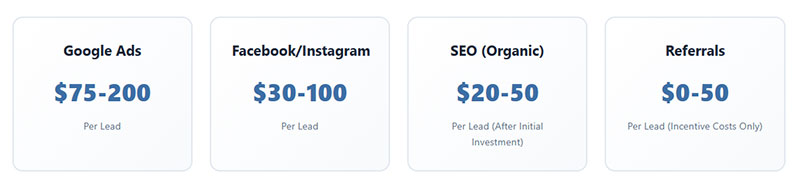
Association of Professional Builders data shows construction companies spend an average of $280 per lead. But costs vary dramatically by channel and market.
Cost per lead breakdown:
- Google Ads: $75-200 per lead
- Facebook/Instagram: $30-100 per lead
- SEO (organic): $20-50 per lead after initial investment
- Referrals: $0-50 per lead (incentive costs only)
LocaliQ research shows the average cost per lead for home services across all channels is $66.02 based on search and advertising efforts. Real estate specifically sees Google Ads CPL averaging $66.69 according to WordStream data.
Home Builder Marketing research indicates builders allocating 3% of revenue to marketing achieve higher profit margins. For a $750,000 build, that translates to $22,500 in marketing expenses. With a typical 1% conversion rate for cold leads, you need 100 leads to land one contract. This means you can afford up to $225 per qualified lead.
Budget Allocation Strategy
Split spend between brand awareness (30-40%) and direct response campaigns (60-70%) targeting ready buyers.
Home Builder Marketing data shows successful builders typically allocate: 40% to digital marketing (website, SEO, ads), 30% to traditional marketing (signage, print materials), and 30% to relationship building (events, referral programs).
Digital channel priorities:
- Paid search advertising (Google Ads)
- Social media ads (Facebook, Instagram)
- SEO and content marketing
- Email marketing automation
- Retargeting campaigns
Builder Funnel research suggests 1-2% of gross revenue should go toward advertising efforts alone, separate from broader marketing infrastructure investments.
ROI Calculation That Matters
If your average home sale is $450K with 15% margin, you can afford significant acquisition costs. A $500 lead that converts is extremely profitable.
Do the math:
- $450,000 sale price
- 15% margin = $67,500 profit
- Marketing budget at 3% = $13,500
- 100 leads needed at 1% conversion
- Maximum cost per lead = $135
Association of Professional Builders research shows builders using the design-and-build model can start covering advertising costs when clients pay for preliminary design, rather than waiting until full build contract.
Houzz data reveals builders who’ve been in business 1-5 years should spend 12-20% of gross revenue on marketing. After 5 years, reduce to 6-12% as brand recognition builds.
Organic vs Paid Comparison
Paid advertising delivers immediate results but stops when budget stops. SEO takes 6-12 months to build but compounds over time.
Paid advertising benefits:
- Immediate lead flow
- Precise targeting
- Measurable ROI
- Scalable results
Organic SEO benefits:
- Lower cost per lead long-term
- Builds authority and trust
- Continues working without ongoing spend
- Higher conversion rates (visitors trust organic results more)
First Page Sage data shows organic channels consistently yield superior long-term ROI compared to paid options. Website leads convert at 31.3%, customer and employee referrals hit 24.7%, according to Sales So research.
Smart builders invest in both for short-term wins and long-term sustainability.
New vs. Established Builder Budgets
Entrepreneur Magazine found the majority of small businesses spend 4% of gross revenue annually on marketing. Deloitte research shows marketing makes up an average of 10.4% of overall budgets.
Budget guidelines by business stage:
- New builders (years 1-5): 12-20% of gross revenue (Houzz Pro)
- Established builders (5+ years): 6-12% of gross revenue
- Aggressive growth phase: 7-10% of revenue
- Market maintenance: 3-5% of revenue
EPCON data shows about 1-2% of gross revenue goes to advertising alone, with remaining budget covering website, content, brand materials, and marketing infrastructure.
Bokka Group research indicates builders should allocate between 5-15% of revenue to marketing, with the exact amount depending on company size, target market, and growth objectives.
Cash Flow Considerations
Builder Funnel warns many builders get tripped up by cash flow issues. Even when marketing works, long sales cycles mean months before seeing returns.
Association of Professional Builders data shows typical conversion rate for cold leads is 1%. You’ll convert 1 out of every 100 leads into a contract.
Timeline expectations:
- Lead generation: Immediate to 30 days
- Lead nurturing: 3-6 months average
- Design/planning phase: 2-4 months
- Contract signing: Month 6-10
- Construction begins: Month 10-12
Have cash reserves to fund lead generation for 6-12 months before contracts start closing. Otherwise you’ll run out of money before marketing pays off.
Marketing Budget Calculation Tool
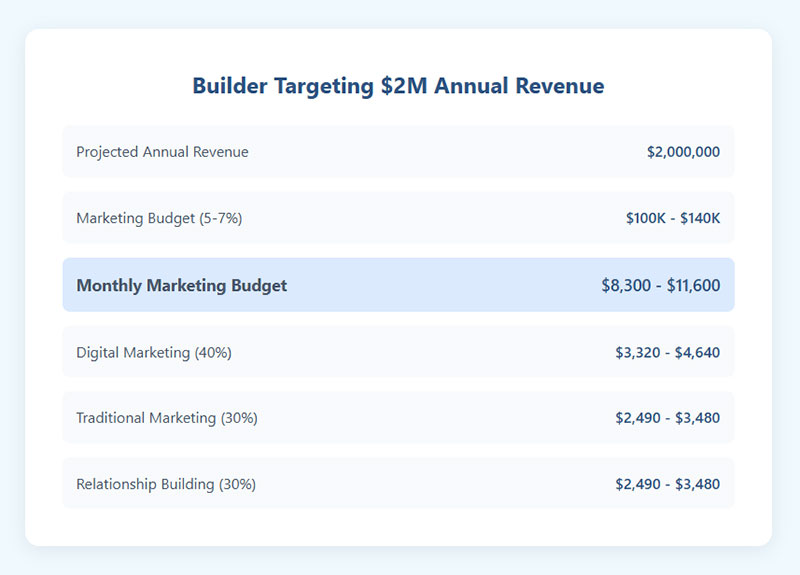
Home Builder Marketing research recommends this formula:
- Start with projected annual revenue (not current)
- Multiply by 5-7% for marketing budget
- Allocate 40% to digital, 30% to traditional, 30% to relationships
- Track cost per lead by channel monthly
- Adjust spend toward highest-performing channels
For a builder targeting $2 million in revenue, budget $100,000-$140,000 for marketing. This breaks down to roughly $8,300-$11,600 per month.
Builder Funnel data shows this translates to approximately $200-$300 monthly for proposal software, $150-$250 for CRM, plus ad spend divided across channels based on performance.
What Common Mistakes Reduce Home Builder Lead Quality
Avoiding these errors saves money and improves conversion rates across your entire funnel.
Over-Reliance on Referrals Alone
Referrals are great but unpredictable. You can’t scale a business on word-of-mouth when market conditions shift.
Builder Funnel research shows most builders rely heavily on referrals to start, but this approach isn’t sustainable for long-term growth. When referrals slow down, lead flow crashes.
Why referral-only strategies fail:
- No control over lead volume
- Can’t scale during growth phases
- Vulnerable to market downturns
- Inconsistent monthly pipeline
SORCI Report data reveals 53.9% of builders struggling with lead generation produce no content. They’re sitting idle waiting for referrals instead of proactively generating leads.
Referrals should supplement your marketing, not replace it. Association of Professional Builders research shows builders who continued investing in marketing during the COVID boom are still booked 12-18 months in advance.
Generate your own demand through digital marketing. Then referrals become bonus leads rather than your only source.
Generic Website Content
Pages that could belong to any builder anywhere don’t rank locally or convert visitors. Specificity wins.
According to Bokka Group data, the 0.5% average visitor-to-lead conversion rate applies to builders with passive sites using generic content and basic contact forms. Builders using specific, targeted landing pages see conversion rates above 10%.
Generic content problems:
- Doesn’t rank for local searches
- Fails to differentiate from competitors
- Provides no compelling reason to choose you
- Doesn’t address specific buyer concerns
Google prioritizes local, specific content. Click Through Marketing research shows 93% of customers won’t go past the first page of Google. Generic content won’t get you there.
Create community-specific pages. Write about local schools, neighborhoods, and building restrictions. Show completed homes in areas where prospects want to build.
Home Builder Marketing data indicates pages with location-specific content and community details convert visitors at much higher rates than generic “about us” pages.
Slow Follow-Up Response
Waiting 24 hours to respond kills deals. Buyers contact multiple builders. First responder often wins.
Harvard Business Review research shows responding within 1 hour makes leads 7 times more likely to qualify. But the data gets more dramatic. According to Kixie research, responding within the first minute boosts lead conversions by 391%.
Speed-to-lead statistics:
- Leads contacted within 5 minutes are 21x more likely to convert (Lead Angel)
- 78% of buyers go with the company that responds first (Amplemarket)
- 82% of consumers expect responses within 10 minutes (Podium)
- Average business takes 47 hours to respond (Rep.ai)
Waiting more than 5 minutes to follow up lowers your chances of qualification by 21 times, according to Chili Piper data. After 30 minutes, you’re essentially out of the race.
Set up instant notification systems. Use automated email responses to buy time while your sales team prepares personal outreach. Have mobile alerts that go directly to sales reps’ phones.
Amplemarket research shows 71% of B2B leads never get a response at all. Simply responding fast puts you ahead of most competitors.
Insufficient Lead Qualification
Treating every lead equally burns sales resources on prospects who’ll never buy.
Leads at Scale data shows 73% of leads sales teams handle aren’t actually qualified. This wastes massive amounts of time and money chasing tire-kickers.
Qualification impact on performance:
- Sales-qualified leads convert at 20-30% vs. 5-15% for unqualified leads (Sales So)
- Top performers using scoring convert 59% of SQLs to opportunities
- Companies with formal qualification see 27% faster profit growth (Leads at Scale)
- 61% of marketers send all leads to sales despite only 27% being qualified (MarketJoy)
First Page Sage research shows the average lead-to-MQL conversion rate is 31%. Without proper qualification, you’re wasting 69% of your sales team’s time on people who aren’t ready or able to buy.
Create a lead scoring system. Assign points for budget, timeline, financing status, and decision-maker involvement. Only send high-scoring leads to sales for immediate follow-up.
MarketJoy data reveals the biggest drop-off happens at the MQL to SQL stage when marketing hands over leads that aren’t truly sales-ready.
Neglecting Nurture Sequences
Leads requiring 5+ touches often become highest-value buyers. Don’t abandon them after two attempts.
Leads at Scale research shows 79% of leads fail to convert due to lack of proper engagement and nurturing. Most builders give up too early.
Nurture sequence statistics:
- Home buying decisions take months, not days
- Zillow data shows 13% of buyers shop for 7-12 months
- Multiple touchpoints build trust over time
- Automated sequences maintain engagement without manual effort
Cazoomi data reveals 76% of companies use marketing automation for nurturing. Those using automation see $5.44 return for every dollar spent (Nucleus Research).
Set up automated drip campaigns. Send educational content, floor plans, financing updates, and construction progress photos based on lead behavior and timeline.
HubSpot research shows 77% of marketers use automation tools to create personalized content. This keeps your brand top-of-mind during the long consideration process.
Don’t mistake silence for disinterest. Many buyers research for months before reaching out again. Stay in their inbox with valuable content.
Poor Mobile Experience
Over 60% of home searches happen on phones. If your site isn’t mobile-optimized, you’re losing leads daily.
Backlinko research analyzing landing page data found that mobile visitors account for 82.9% of traffic share compared to only 17.1% from desktop.
Mobile experience impact:
- 53% of mobile users abandon pages taking over 3 seconds to load (Firework)
- 62% of consumers are less likely to convert with negative mobile experience (Click Through Marketing)
- 86% of top landing pages are mobile-friendly (Website Builder Expert)
- Mobile-friendly design is non-negotiable for local search rankings
Virtual Staging research shows by 2024, effectively 100% of home buyers use the internet during their search, with mobile devices as primary research tools.
National Association of REALTORS data reveals 88% of home buyers purchased through an agent or broker, but they found that agent after mobile research. Your mobile site creates the first impression.
Following mobile forms best practices keeps smartphone users engaged through conversion. Test your site on actual phones, not just desktop browsers.
Unbounce data shows pages with simple, mobile-optimized forms convert significantly better than desktop-only designs forced onto small screens.
Inconsistent Brand Messaging
Saying different things across channels confuses prospects and kills trust.
Your website says “luxury custom homes.” Your Facebook ads say “affordable builder.” Your sales team emphasizes speed. This mixed messaging makes buyers uncertain about who you actually are.
Consistency requirements:
- Same value propositions across all channels
- Unified visual branding (colors, logos, fonts)
- Consistent tone in all content
- Aligned pricing and positioning messaging
Sales So research shows teams with formal processes and consistent messaging see 38% higher sales win rates and 24% faster revenue growth.
Create brand guidelines. Document your positioning, key messages, and visual standards. Train everyone on your team to communicate the same value propositions.
Ignoring Analytics and Data
Flying blind wastes budget on channels that don’t work while underfunding winners.
Sales So data shows marketers who regularly calculate ROI are 1.6 times more likely to secure budget increases. You can’t improve what you don’t measure.
Critical metrics to track:
- Cost per lead by channel
- Lead-to-appointment conversion rate
- Appointment-to-sale conversion rate
- Average time from lead to contract
- Revenue attribution by marketing source
Set up proper tracking before spending money. Connect Google Analytics to your CRM. Tag all marketing campaigns with UTM parameters. Review performance monthly and shift budget toward highest-performing channels.
Ruler Analytics research shows the average conversion rate across industries is 2.9%, but this varies dramatically by channel and execution quality. Without tracking, you won’t know your actual numbers.
How Can Home Builders Measure Lead Generation Performance
What gets measured gets improved. Track these metrics monthly at minimum.
Key Metrics That Matter
Cost per lead (CPL) by channel
Association of Professional Builders data shows construction companies spend an average of $280 per lead, but this varies dramatically by channel. WordStream research reveals Google Ads CPL averages $66.69 across industries, while Facebook ads run substantially cheaper at $21.98.
Track CPL separately for each marketing channel. LocaliQ data shows the average for home services is $66.02, but top performers optimize continuously to drive this down.
Lead-to-appointment ratio
Bokka Group research reveals average home builder conversion rates through the sales funnel: 5 appointments from 25 leads. That’s a 20% lead-to-appointment rate for typical production builders.
Builders with dedicated online sales consultants see much higher conversion rates because they follow up faster and more consistently.
Appointment-to-contract rate
Industry data shows typical conversion from appointments to signed contracts. Bokka Group data indicates this rate varies significantly based on lead quality and sales training.
According to home builder benchmarks, builders with structured online sales programs see well over half their total sales coming from online leads and appointments.
Average deal value
Track not just conversion rates but revenue per closed deal. Higher-value projects justify higher lead costs.
Home Builder Marketing research shows for a $450,000 sale with 15% margin ($67,500 profit), you can afford significant marketing investment and still maintain profitability.
Customer acquisition cost (CAC)
First Page Sage data reveals the average CAC varies by industry. Real estate benchmarks show organic CAC of $660 versus paid CAC of $1,185.
Calculate total marketing spend divided by number of customers acquired. Freshworks research shows 91% of businesses report decreased CAC after CRM implementation, with nearly half seeing reductions between 11-20%.
Attribution Tracking Systems
Multi-touch attribution shows which channels contribute to closed deals. First-click and last-click models tell incomplete stories.
Why attribution matters:
- Buyers research for months across multiple channels
- Credit for the sale shouldn’t go only to the last touchpoint
- Understanding the full journey optimizes budget allocation
- Multi-channel campaigns work together to close deals
Ruler Analytics research shows 34% of qualified leads get lost between departments due to poor tracking and attribution gaps. Without proper attribution, you can’t identify which channels actually drive revenue.
Sales So data reveals that only 18% of B2B marketers integrate their CRM with analytics platforms. This gap means most builders don’t understand their true cost per acquisition or which marketing channels generate revenue.
Set up UTM parameters on all marketing links. Track every touchpoint from first website visit through contract signing. Connect your analytics platform to your CRM for complete funnel visibility.
Sales Pipeline Analysis
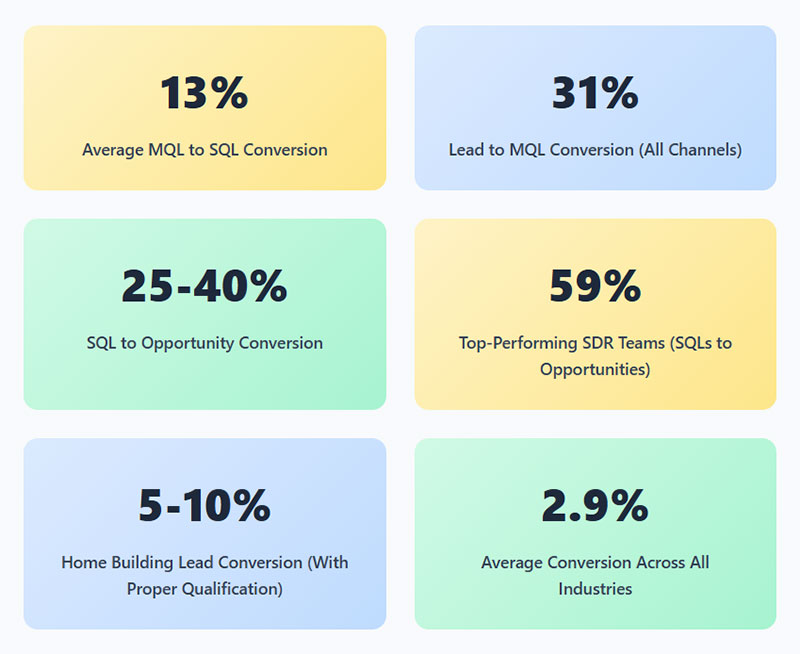
Monitor how leads move through stages. Identify bottlenecks where prospects stall or drop off.
MarketJoy research shows average B2B conversion benchmarks:
- Lead to MQL: 31% (First Page Sage)
- MQL to SQL: 13% average, 40% for top performers (Sales So)
- SQL to Opportunity: 25-40%
- Opportunity to Closed-Won: varies by industry
Pipeline stage analysis reveals:
- Where leads get stuck in the funnel
- Which stages need process improvements
- How long leads typically spend at each stage
- Conversion rate differences between lead sources
Leads at Scale data shows the biggest drop-off happens at the MQL to SQL stage. Many marketing teams hand over leads that aren’t truly sales-ready.
Review pipeline velocity monthly. If leads are stalling at design phase, you need better qualification upfront. If appointments aren’t converting, sales training may be needed.
Lead Source Comparison
Compare quality across channels. High-volume sources mean nothing if those leads never convert to sales.
Quality metrics by source:
- Conversion rate to appointment
- Conversion rate to contract
- Average deal size
- Time to close
- Customer lifetime value
First Page Sage research shows website leads convert at 31.3%, customer and employee referrals hit 24.7%, and webinars reach 17.8% MQL to SQL conversion.
Sales So data reveals SQLs convert to opportunities at 20-30%, compared to just 5-15% for unqualified marketing leads. This 4-6x difference shows why lead quality matters more than volume.
Don’t just track total lead count. A channel generating 100 low-quality leads that never convert is worse than one producing 20 qualified leads that close at 30%.
Benchmark Your Performance
Industry conversion rate benchmarks help you gauge performance against competitors.
Home builder website conversion benchmarks:
- Bokka Group data: 0.5% for passive sites with basic contact forms
- Bokka Group data: 10%+ for targeted landing pages with specific campaigns
- Unbounce research: 6.6% average landing page conversion across industries
- Top performers: 20%+ landing page conversions
Ruler Analytics shows the average conversion rate across all industries is 2.9%. Home builders with proper qualification, fast follow-up, and optimization typically perform at the high end of this range or above.
Backlinko research found landing page copy written at 5th-7th grade reading level converts at 11.1%, compared to 5.3% for college-level writing.
Sales funnel benchmarks from Bokka Group:
- 500,000 impressions → 5,000 visitors (1% CTR)
- 5,000 visitors → 25 leads (0.5% conversion)
- 25 leads → 5 appointments (20% conversion)
- 5 appointments → 1 sale (20% conversion)
Top-performing builders beat these averages significantly through optimization, speed-to-lead, and qualification.
What to Track in Your Dashboard
Freshworks research shows 94% of businesses saw increased sales productivity after CRM adoption. But only if you track the right metrics.
Monthly dashboard metrics:
- Total leads by source
- Cost per lead by channel
- Lead-to-appointment conversion by source
- Appointment-to-contract conversion
- Average sales cycle length
- Total marketing spend vs. revenue generated
- ROI by marketing channel
Salt Creative data reveals 34% of businesses report CRM shortened their sales cycle by 8-14 days. Track cycle length to identify improvement opportunities.
Cazoomi research shows businesses using CRM automation see an average increase in lead conversion rates by up to 30%. But you can’t optimize what you don’t measure.
Review Frequency and Adjustments
Review metrics quarterly to spot trends and adjust strategy before small problems become expensive ones.
Review schedule:
- Weekly: Lead volume and response times
- Monthly: Cost per lead, conversion rates, pipeline health
- Quarterly: Full funnel analysis, budget reallocation
- Annually: Strategic planning and benchmark comparison
Sales So research shows marketers who regularly calculate ROI are 1.6 times more likely to secure budget increases. Present data to leadership quarterly showing marketing’s contribution to revenue.
Leads at Scale data reveals companies with formal processes see 27% faster profit growth. Make metric reviews a structured part of your operations, not an occasional check-in.
Test continuously. Firework research found marketers who regularly A/B test landing pages see a 37% increase in conversions. Track which changes improve performance and scale winners.
Connect Marketing to Revenue
Salt Creative research shows companies that effectively use CRM systems increase sales by up to 29%. The key word is “effectively,” which means tracking complete attribution from first touch to closed deal.
Calculate marketing ROI with this formula: (Revenue from marketing – Marketing cost) / Marketing cost × 100
Nucleus Research data shows organizations see $5.44 return for every dollar spent on marketing automation. But only when properly tracked and optimized.
Stop guessing which channels work. Start measuring everything, and let data drive your budget decisions.
FAQ on Lead Generation For Home Builders
What is the best way to generate leads for a home building company?
Combine SEO, paid advertising, and referral programs. Google Ads captures buyers actively searching. Local SEO builds organic visibility over time. Satisfied homeowners referring friends deliver the highest-quality prospects with minimal acquisition cost.
How much should home builders spend on marketing?
Most residential construction companies allocate 2-5% of projected revenue to marketing. New market entries or aggressive growth phases may require higher investment. Track cost per lead by channel to optimize budget allocation.
What is a good cost per lead for home builders?
Expect $50-200 per lead depending on channel and location. Google Ads runs higher ($75-200), while organic SEO delivers leads at $20-50 after initial investment. Referrals cost the least but can’t scale predictably.
How long does it take to see results from home builder marketing?
Paid advertising generates leads immediately. SEO takes 6-12 months to build momentum. Content marketing compounds over time. Plan for a mixed approach delivering both quick wins and sustainable long-term growth.
What information should home builders collect on lead forms?
Request name, email, phone, project timeline, and budget range. Avoid excessive fields that increase abandonment. Using proper form fields for capturing high-quality leads balances qualification needs with conversion optimization.
How quickly should builders respond to new leads?
Within 5 minutes if possible. Leads contacted within minutes convert at 21x higher rates than those contacted after 30 minutes. Automated email responses buy time while your sales team prepares personal follow-up.
What CRM do home builders use for lead management?
Buildertrend and CoConstruct are popular construction-specific options. Salesforce and HubSpot work for larger operations. Choose a system that integrates with your website forms and marketing automation tools.
How do builders qualify leads effectively?
Ask about budget, timeline, lot ownership, and financing status early. Identify decision-makers before investing sales time. Score leads based on engagement and readiness to separate serious buyers from casual browsers.
Should home builders use social media for lead generation?
Yes. Facebook and Instagram work well for visual content like model home tours and construction progress. Target local audiences by location and demographics. Retargeting ads keep your brand visible during long buying cycles.
What conversion rate should home builder websites achieve?
Builder websites typically convert 2-5% of visitors to leads. Dedicated landing pages should hit 10-20%. Track performance monthly and test different headlines, images, and form placements to increase form conversions steadily.
Conclusion
Successful lead generation for home builders requires a multi-channel approach. No single tactic fills your buyer pipeline consistently.
Combine Google Ads for immediate visibility with local SEO that compounds over time. Use your CRM to track every prospect from first click to signed contract.
Qualification matters as much as volume. Focus your sales team on buyers with realistic budgets, clear timelines, and financing pre-approval.
Response speed separates builders who close deals from those who lose them. Minutes count, not hours.
Track your cost per lead, conversion rates, and lead-to-appointment ratios monthly. Data reveals what’s working and what’s wasting budget.
The home building market rewards builders who treat marketing as a system, not an afterthought. Build that system now, and your sales pipeline stays full regardless of market conditions.